7 Podcasts Looking for Guests: Verified Ways to Pitch

Edison Research's 2025 Infinite Dial study found that 73% of Americans aged 12 and older, an estimated 210 million people, had consumed a podcast in audio or video form. That's an enormous supply of shows, and an equally large supply of hosts who say they're open to guests.
The gap sits between the claim and the feed. We read 383 public RSS feeds pulled from a 408-show directory, and 246 of them, 60%, had published in the last six months and printed a contact route a stranger could use. The other four in ten were dormant, closed to outside guests, or unreachable.
So every platform below is judged on three things most roundups skip: whether its shows are still publishing, whether a usable pitch route exists, and whether the feed shows evidence of booking outside guests. Here are seven places to find podcasts looking for guests, with the verification work built in rather than bolted on.
Table of Contents
- 1. Let's Make A Podcast
- 2. PodMatch
- 3. MatchMaker.fm
- 4. PodcastGuests.com
- 5. RadioGuestList.com
- 6. Guestio
- 7. PitchPodcasts
- Where to find podcasts looking for guests at a glance
- Turn This List Into Booked Interviews With Your Next Three Moves
1. Let's Make A Podcast
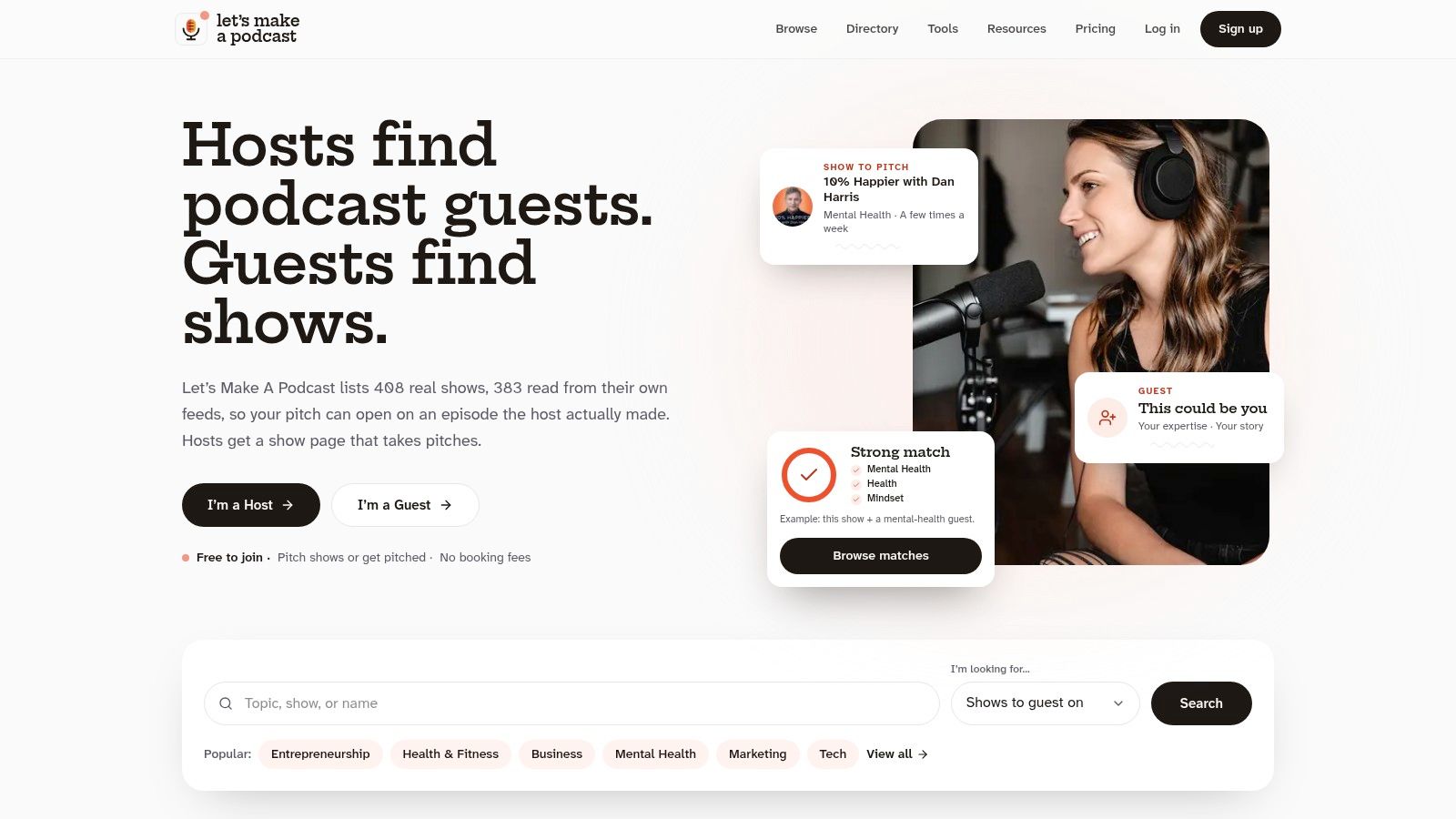
Let's Make A Podcast is a free-to-join marketplace where hosts publish the guest topics they want, guests publish a one-sheet, and the two sides message and schedule directly. No booking fees, no intermediary taking a cut. Guests browse a directory of 408 shows pulled from Apple Podcasts public directory data, filter by niche, draft pitches that reference a recent episode when the feed lists one, and track replies in one thread. Podcasting experience isn't required to join as a guest, and matching ranks shared topics for fit rather than counting keyword overlap.
Feed checks separate leads from guesses
Every directory promises a list. This one tries to answer whether the list is alive. The platform reads each show's public feed to confirm recent publishing, capture the pitch route the show itself prints, and flag whether the feed shows evidence of booking outside guests. Each listing carries a guest-fit snapshot built from what the feed says, and pitches go from the guest's own inbox to the route the show publishes.
That is the difference between a lead worth a focused pitch and a name on a page.
The openness research is published with downloadable data. Its pattern runs against prestige instincts: long-running shows and independently owned ones score more open to cold pitches than younger catalogues and network-run operations. The quiet veteran show is often the softer target.
The trade-offs:
- Partial coverage. Feed checks don't yet cover every listing, so a handful of shows carry no verification.
- It connects, it doesn't pitch. A sent pitch is not a booking, and no platform guarantees a reply.
- Free core, optional Pro. Most tools work without an account and nothing is saved unless you publish a one-sheet; a paid Pro tier exists for heavier use.
Pitch generator, pitch grader, one-sheet builder, and a show readiness check are free at Let's Make A Podcast.
2. PodMatch
PodMatch is a two-sided matcher. Hosts describe the guests they want, guests describe their expertise, and the system proposes pairings, then hands both sides scheduling and workflow tools. PodMatch says hosts need an active interview show listed on Apple Podcasts to qualify.
A paid matcher earns its keep through fit, not volume. The pitches that book are the ones where the guest's topics line up with what the host said they wanted, and a matching system exists to filter for exactly that. Where any matcher falls short of a live directory is the three checks that decide whether a lead is real: it can propose a pairing, but it won't tell you whether the show still publishes, whether it posts a usable pitch route, or whether its feed shows outside guests getting booked.
What gets a reply on PodMatch: a complete profile with a tagline, an intro video, and specific topics, plus a short message naming the host's recent episode. The profile does the selling; the message only opens the door.
Big-show chasing runs opposite to results in this category. A quiet niche show with a loyal audience is usually the easier booking, because its inbox is thinner and its guest-fit bar is clearer.
Where it costs you:
- Subscription-based. This isn't a free, open directory, so budget a couple of months before judging results.
- Host eligibility. PodMatch says hosts need an active interview podcast on Apple Podcasts to join.
- A match isn't a booking. Introductions still need follow-through.
Plan details sit at PodMatch.
3. MatchMaker.fm
MatchMaker.fm works like a networking site with a booking layer underneath. You can hold a show profile and a guest profile at once, search by niche, receive weekly suggested matches, shortlist people, and message from a single inbox with scheduling integrations and mobile apps.
That dual profile matters more than it sounds. Hosts who also guest build reciprocal relationships, and reciprocity fills a calendar once the first few appearances land.
What a profile can't tell you is whether the show still publishes or books outside guests. Weekly podcast listening has grown substantially since 2015, and habitual listening sustains narrow shows with small, concentrated audiences. That tier is where a well-matched guest still stands out, but you confirm it from the feed rather than the profile. Run the same three checks as anywhere else: recent episodes, a published contact route, and guests in the archive who arrived by pitch rather than by reputation.
Read the fee line before you say yes. Some hosts on any marketplace charge for appearances. That's a different transaction from a booking, and it's worth deciding in advance whether a paid slot serves your goal.
The honest drawbacks:
- Paid after the trial. The advertised free window is a trial, not a tier.
- Matches are suggestions. Nobody on the platform can promise a recording date.
- Fewer hosts than the biggest networks, though the search beats a public directory.
Start at MatchMaker.fm.
4. PodcastGuests.com
PodcastGuests.com runs on requests rather than profiles. A host submits a guest request, the service pushes it out, and interested guests pitch themselves through the supplied form. Guests can subscribe to a free newsletter of opportunities delivered by email, and hosts can browse a paid expert directory to find guests directly.
A live request answers two of the three checks that decide whether a show is worth pitching. The host has just confirmed they book outside guests, and they've published a usable route in. The third check is on you: a request doesn't prove the show still publishes, so open the feed and look at the latest episode date before you write a word.
A common failure mode is niche drift. A newsletter mixing business, health, and author requests hands you plenty of shows and few that fit, and fit decides outcomes. In a 2026 survey of 271 podcasters, 87.8% named topic relevance as an important guest-selection criterion while only 14.4% named audience size (CreateSocial's analysis of podcast guest selection). Follower counts barely register on the host's side of the table.
How to use it well:
- Filter hard. Skim each email for two or three requests in your exact subject area and ignore the rest.
- Respond fast. Request-driven lists reward the guest who answers within a day; a host with an open request is comparing pitches, not waiting for yours.
- Skip the paid listing until the free stream proves useful. You can test the newsletter before buying visibility.
Constraints: nothing here is managed for you. You screen the lead, write the pitch, and handle the follow-up, and a request is not an acceptance. If your topic is narrow, expect a low hit rate per email.
For a broader map of where request lists sit next to directories, see this podcast guest directory guide. Current options are at PodcastGuests.com.
5. RadioGuestList.com
RadioGuestList.com is the oldest format on this list: a public page of requests plus an email digest. Its listings name specific programs and describe the guests each one wants, spanning business, books, health, and entertainment, and it covers radio and other broadcast formats alongside podcasts.
That breadth is both the selling point and the trap. If your topic travels well on talk radio, this is one of the few places where podcast and broadcast requests sit side by side. If you're chasing a niche podcast audience, most of the list will be irrelevant.
What you get:
- Public request pages you can read before subscribing, so you can judge relevance without an account.
- Free email updates on new guest requests, which is enough to test the channel.
- Host-side tools where a show can submit a request and sign up for guest-expert leads.
Judge the request, not the show's logo. A one-line request tells you the topic and the format. It rarely tells you the audience size or the host's interview style, so check the program before you invest an hour in a tailored pitch.
Limits: this is an opportunity list, not a booking or scheduling platform. You respond to requests yourself, acceptance isn't guaranteed, and some leads are for radio or television rather than podcasts. Treat it as a sourcing channel, not a pipeline. Details at RadioGuestList.com.
6. Guestio
Guestio is the paid-route marketplace on this list: guest and host profiles, messaging, booking tracking, and press kits sit in one system, and the same workflow covers unpaid and paid appearances.
Paid appearances are a real slice of the market. In a 2022 survey of podcasters, 81% said their shows featured guests sometimes or often, and among shows that take guests, 61% prioritized organic guests while 39% accepted guests who paid to appear (the 2022 State of Podcasting survey). The same survey found 59% of hosts booked guests themselves and 48% said someone on their team handled booking, so your pitch may land with a producer rather than the host.
Where it bites:
- Free accounts carry monthly limits on pitches or bookings, so confirm the current ceiling before you build a pipeline around it.
- Paid guaranteed-response fees can prompt an answer while the booking remains undecided, so read the refund terms before you pay.
- Appearance fees should be confirmed in writing before you block the date.
Qualify like a skeptic even inside a marketplace. Check the feed for recent episodes, look for a contact route the show itself publishes, and count named guests across the last five episodes before you spend money or send a pitch.
Press kits are the quiet advantage. A host who can grab your bio, headshot, and links in one click is easier to schedule and easier to promote.
If you're weighing a marketplace against a booker, this comparison of podcast booking services covers costs and when each route pays off. Start at Guestio.
7. PitchPodcasts
Category pages are the whole idea at PitchPodcasts. It's a browsable directory where topic pages list podcasts looking for guests, each with a summary of preferred topics or expertise and a contact route, and both guest profiles and show listings are advertised as free.
You can start from business, education, arts, science, or sports and read each show's stated guest criteria before you write anything. That's a better starting point than a keyword search, because the host has already told you what they want.
Open the last five episodes before you pitch. Count how many feature a named guest. If it's zero, you're pitching a format change, not an episode, and that's a much harder ask.
Don't assume a whole category books guests. In a sample of 30,049 English-language episodes published in 2026, about 41% featured at least one guest, but the rate ran from 62.6% in Science and 59.8% in Business down to 10.3% in Fiction (CastFox's podcast guest statistics). Category browsing tells you where to look. The feed tells you whether the host books outsiders.
Watch for:
- Stale listings. Detail and freshness vary, so verify activity yourself.
- No verification layer. Reported directory counts don't prove a show is active or accepting pitches.
- Manual qualification. You contact and qualify every lead, which suits researchers and frustrates everyone else.
The pitch is where most of these leads die. This walkthrough of how to write a pitch email covers the short structure that gets replies. Browse at PitchPodcasts.
Where to find podcasts looking for guests at a glance
Every platform below gets you to a show eventually. What separates them is how much of the qualification work they do for you: confirming a show still publishes, surfacing a usable pitch route, and showing evidence the host books outside guests.
| Platform | Best for | How you connect | Free option | Watch out for |
|---|---|---|---|---|
| Let's Make A Podcast | Finding active shows and managing outreach | Browse matches, pitch, message, and schedule directly | Free to use, with no booking fees; paid tiers are planned | Feed checks cover most, not all, listings; replies aren't guaranteed |
| PodMatch | Structured matching for interview podcasts | Create a profile, review suggested matches, and manage scheduling | Subscription-based; no free open directory | Hosts need an active interview podcast on Apple Podcasts; matches aren't bookings |
| MatchMaker.fm | Hosts and guests who want in-platform networking | Create profiles, search, receive matches, and message | Advertised trial; paid membership afterward | Check profile fit and any appearance fees; matches aren't bookings |
| PodcastGuests.com | Guests seeking opportunities by email | Receive opportunity emails and pitch through supplied forms | Free opportunity newsletter | Opportunities may not fit your niche; screening and pitching are self-managed |
| RadioGuestList.com | Guests pursuing podcast and radio appearances | Subscribe to email requests and respond directly | Free basic email updates | Some leads are for radio or other broadcasts; no booking guarantee |
| Guestio | Managing guest profiles, press kits, and booking communication | Browse, message, and track bookings through the marketplace | Free tier with limited monthly pitches or bookings | Some appearances cost money; paid response fees don't guarantee bookings |
| PitchPodcasts | Researching niche-fit shows and pitching directly | Browse categories, review criteria, and use a show's contact route | Free guest profiles and podcast listings advertised | Verify show activity and listing freshness; outreach is self-managed |
Read the "Watch out for" column as your workload. Rows that mention self-managed outreach or unverified listings mean you confirm the last episode date, the guest pattern, and the contact route yourself before drafting. Rows where the platform handles matching still leave you responsible for the pitch itself, since a match only puts you in front of the host.
Turn This List Into Booked Interviews With Your Next Three Moves
Move one: shortlist three to five shows, not thirty. Use the guest-fit details each platform publishes and match them against two or three topics you can carry for forty minutes with stories and specifics. If a show's stated topics don't overlap yours in plain language, cross it off now and save the writing time.
Move two: verify the show is still publishing. Open the feed, check the last episode date, then read the last five to ten episode titles for a guest pattern. A show that hasn't published in six months is an archive, not an opportunity, and a show with no named guests in its recent run is a format change request. Confirm a real contact route exists before you draft anything.
Move three: send an episode-aware pitch through the route the show publishes. Name the specific episode your idea extends, propose one conversation, and explain who in the audience it helps. If the show asks for a form, use the form rather than hunting for a personal address.
That's the workflow our tools are built around. The free Find podcasts tool needs no account and searches every show in the directory by niche, flagging which are still publishing, which publish a contact route, and which show evidence of booking outside guests. The pitch generator drafts a show-specific pitch and the pitch grader scores your draft against that show before you send it, from your own inbox, so replies land where you expect. The free one-sheet gives a host everything needed to say yes in one link: bio, headshot, topics, past episodes.
Expect this to take longer than the roundups promise. Most shows fail the basic activity test before you write a word, so a short, verified list beats mass outreach every time. Ten careful pitches will outbook a hundred generic ones, and the hosts who say yes remember that you did the reading.
Let's Make A Podcast puts the whole sequence in one place: a directory where listings carry a guest-fit snapshot drawn from the show's own feed, a free finder that shows which shows are still publishing and which publish a pitch route, and free pitch drafting, grading, and one-sheet tools. Hosts list their shows free during early access and name the guest topics they want, so the match runs in both directions. Run your niche through the finder and see how many shows pass the activity test at Let's Make A Podcast.