10 Best Podcast Guest Directory Picks for 2026
In the 2026 directory analysis from Let's Make A Podcast, among 383 readable public feeds, 246 (60%) had published in the last six months and printed a contact route a stranger can use, and only 84 (21%) showed both recent activity and evidence of booking guests. That gap is why most pitches die before a host reads them. A dormant feed, a solo show, or a host with no route a stranger can use will not reply, however sharp the pitch is.
The only lens that matters when you pick a podcast guest directory in 2026 is practical. Does it tell you whether a show is active, guest-friendly, and reachable? A large searchable catalog without those three signals is a research list. It leaves the hardest verification work on you.
The ten options below are judged on exactly that. Some prove bookability and help you pitch, track, and follow up. Others are strong for discovery but stop short of openness or contact signals. I treat those as research tools, not booking pipelines. Read the usage notes with each pick. The same directory can waste a week or fill a calendar depending on how you filter it.
Table of Contents
- 1. Let's Make A Podcast
- 2. FindMeAPodcast
- 3. PodMatch
- 4. MatchMaker.fm
- 5. PodcastGuests.com
- 6. RadioGuestList
- 7. Podzay
- 8. Podseeker
- 9. Podchaser
- 10. Listen Notes
- Podcast Guest Directory Comparison
- Choosing Your Directory and Building a Pipeline That Books
1. Let's Make A Podcast
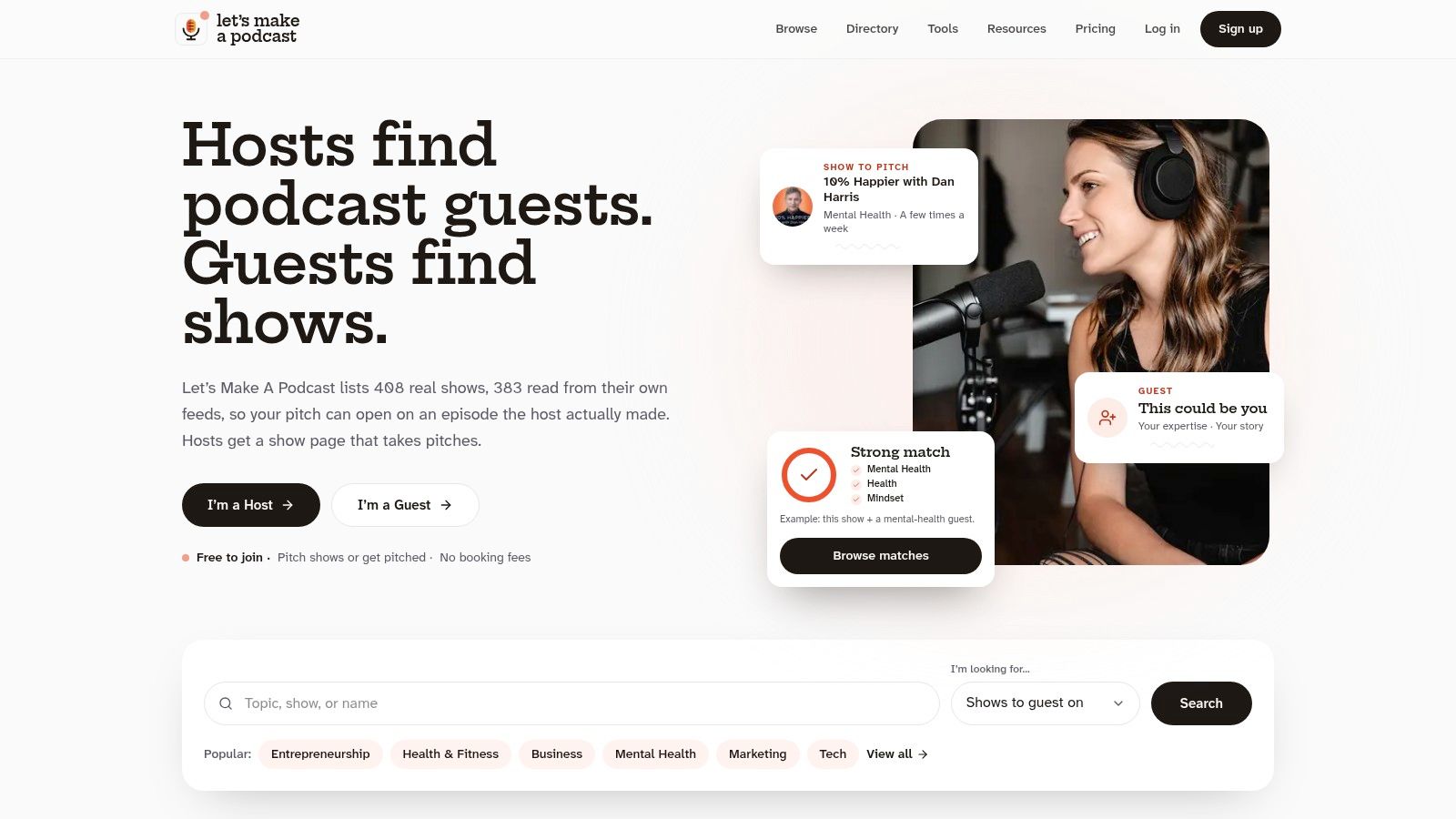
Let's Make A Podcast is the pick I'd start with because it was built around the bookability problem, not around listing volume. It holds 408 real podcast listings, with 383 checked against their public feeds, so guests can focus on shows that are still publishing and that publish a pitch route. Topic filters and matching based on declared interests and profile language help you separate exact-fit targets from vague category matches.
The workflow doesn't stop at discovery. Guests can build a shareable one-sheet, draft episode-aware pitches, track outreach, and manage follow-ups. Hosts can publish a page inviting pitches, browse guest profiles, and handle messaging and scheduling in one place.
What Works Best Here
- Feed-checked listings: Activity and contact signals are surfaced before you pitch, which cuts dead-end outreach.
- Free tools without an account: Pitch generators, interview prep, and guest-finding tools work standalone, and nothing you enter is saved unless you publish a one-sheet.
- Direct connection: There are no booking fees or intermediaries, and its research and downloadable dataset are published under CC BY 4.0.
The limits are real. The directory is smaller than the giant indexes below, the Free plan states a 25-show pitch or invite pipeline, and paid-plan pricing isn't clear from the information available. Guests still send pitches from their own inbox and depend on hosts to reply. Even so, for a first pipeline where every target needs to be plausible, this is the strongest starting point.
2. FindMeAPodcast
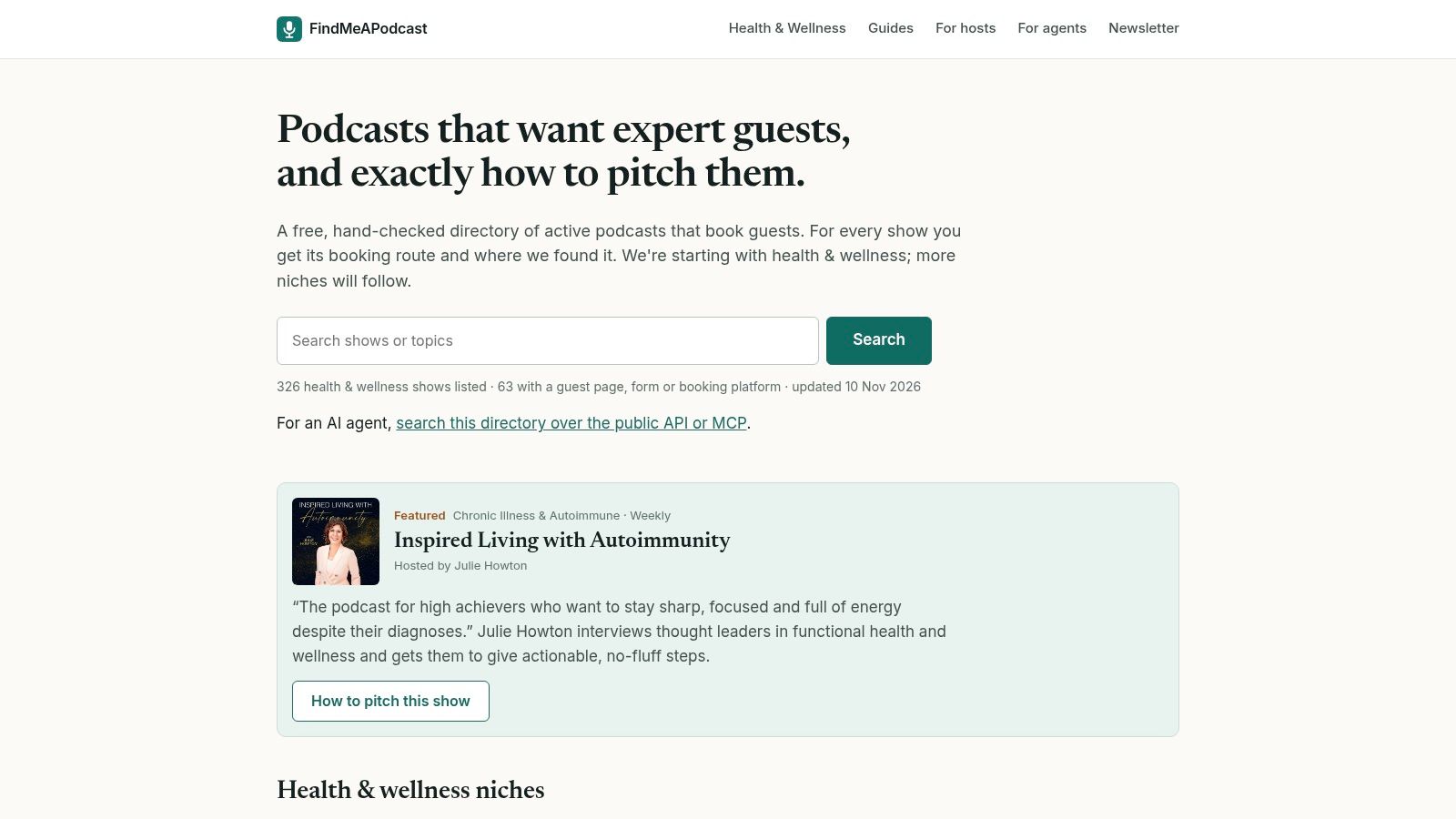
If you're in health and wellness, FindMeAPodcast does the verification work most directories skip. It's a free, hand-checked directory for guests seeking active podcasts that book experts, organized by sub-niche so a sleep specialist doesn't waste time on general wellness shows. You can browse without an account and go straight to the practical details.
Each entry shows the detail I check first before writing a pitch.
- Pitch route and its source: You see how to contact the show and where that route came from.
- Last checked date: You know how fresh the listing is instead of guessing.
- Possible guest fee flags: Shows that may charge guests are flagged, so you don't discover a pay-to-play ask after three emails.
Because listings are checked for recent activity and guest format, this passes the active, guest-friendly, reachable test better than far larger catalogs. The trade-off is scope. Coverage is currently concentrated in health and wellness, so it's a specialist tool, not a general pipeline. There's also no in-platform messaging or scheduling, so you'll pitch and coordinate from your own inbox and calendar. For a health expert who wants qualified targets fast, that's a fair trade.
3. PodMatch
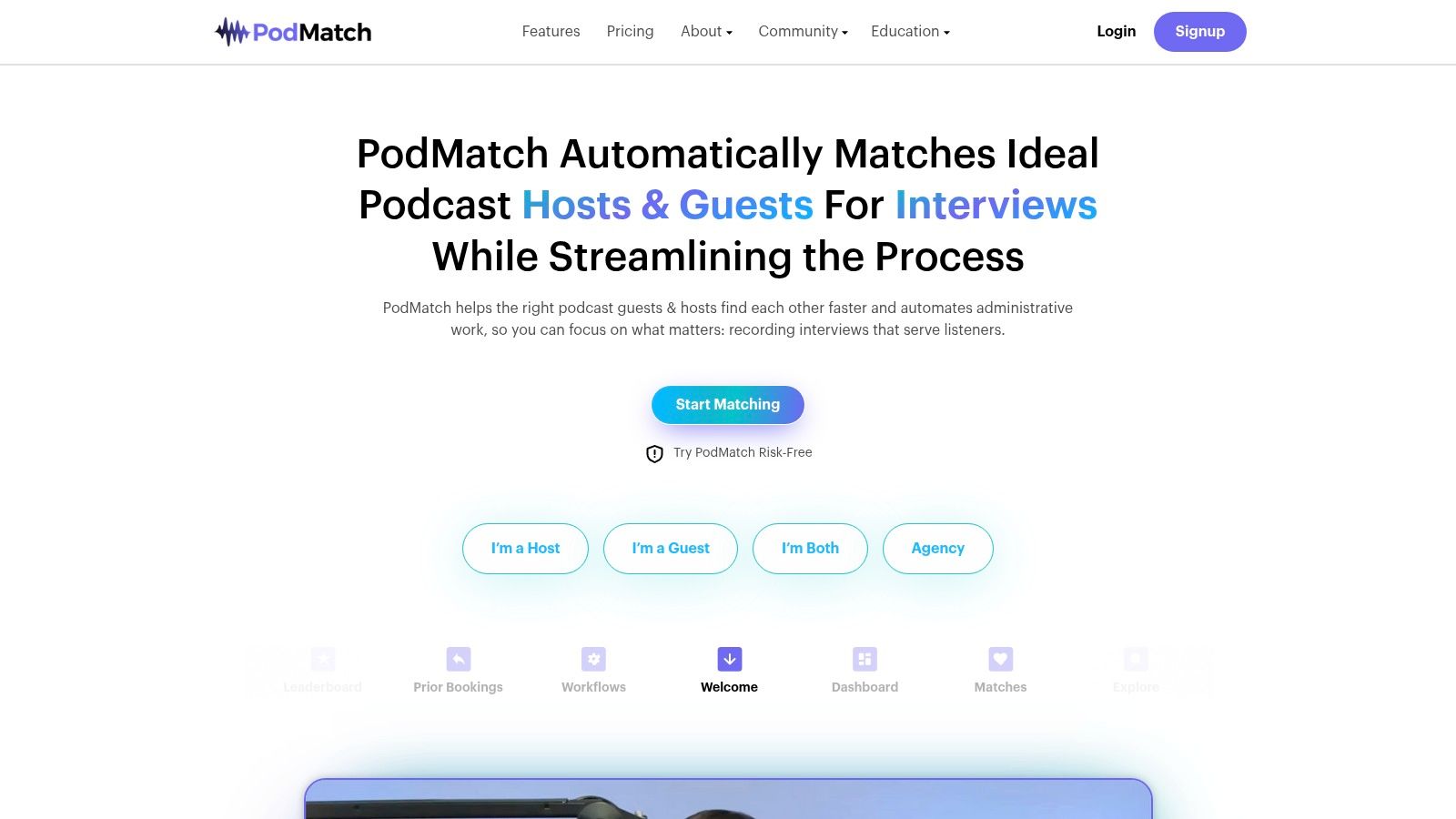
PodMatch is a matching platform for hosts and guests who book on a repeating schedule. Profiles, match recommendations, and interview coordination sit in one place, so it fits an ongoing workflow better than a one-off book tour push.
Guests and hosts publish public profiles, including video pitches, then search by keyword or work from recommendations. Scheduling and production tools take the thread from first contact to the recording date. That removes the usual split between inbox and calendar.
Bookability here is behavioral, not feed-based. A host with a maintained profile and recent platform activity is showing they are open. A stale profile is the same dead end as a dormant feed.
Read those signals before you invest in a match. Recent activity tells you the show is still working. A profile that stays current is the guest-friendly signal. Reach depends on a reply inside the product, not on a contact route printed in a public feed. If profiles go quiet, treat the catalog as research, not a booking pipeline.
Paid access is the main filter, so check PodMatch's pricing page before committing. PodMatch also says hosts can receive compensation for eligible completed bookings, which gives active hosts a reason to answer. A match still is not audience fit. Read recent episodes before you accept.
If paid matching starts to look like staffed outreach, compare the trade-offs in this guide to podcast booking services and when they're worth paying for.
4. MatchMaker.fm
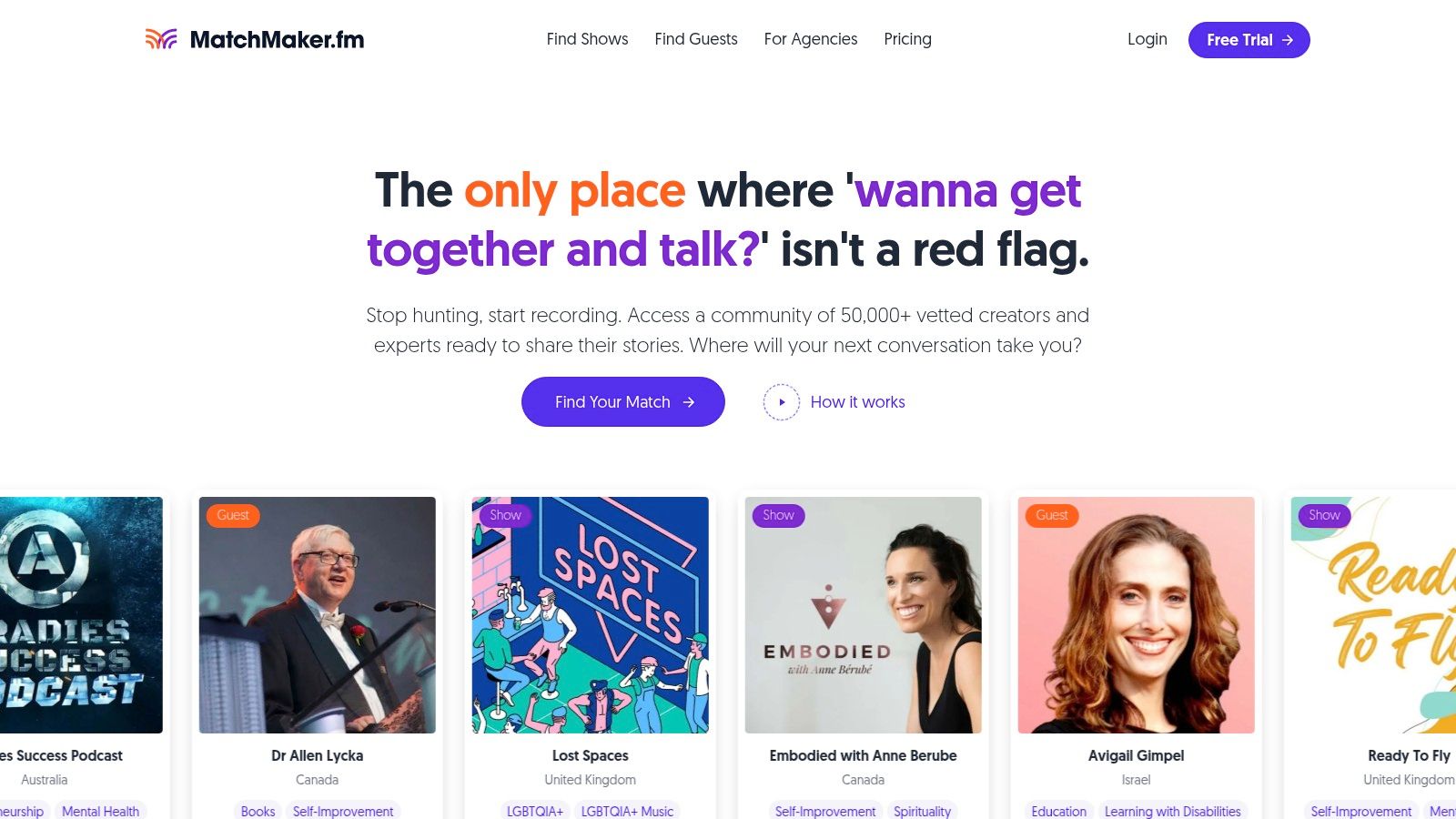
MatchMaker.fm gives you more control than pure algorithmic matching. Hosts and guests create profiles, search across more than 100 niches, shortlist prospects, and message each other in a unified inbox. Guest profiles can carry a video introduction, and show profiles can state exactly which guests they want.
That last detail matters for bookability. A show profile that names desired guest types is an explicit openness signal, which is stronger than inferring openness from episode history alone. Search gives you control beyond recommendations, so PR professionals can work a niche systematically instead of waiting for matches to appear.
Where It Fits in a Workflow
Scheduling integrations and shortlists make it practical for repeat outreach, and the agency plan supporting up to 10 client profiles suits publicists managing several experts at once. The advertised 30-day trial without a credit card is a reasonable way to test response rates in your niche.
Know the limits before you commit time. The trial is capped at five conversation starts, which is enough to test tone but not to build a pipeline. The platform also doesn't index every podcast, so a perfect-fit show that isn't a member won't appear. Treat it as a responsive member network, not a census of your niche.
5. PodcastGuests.com
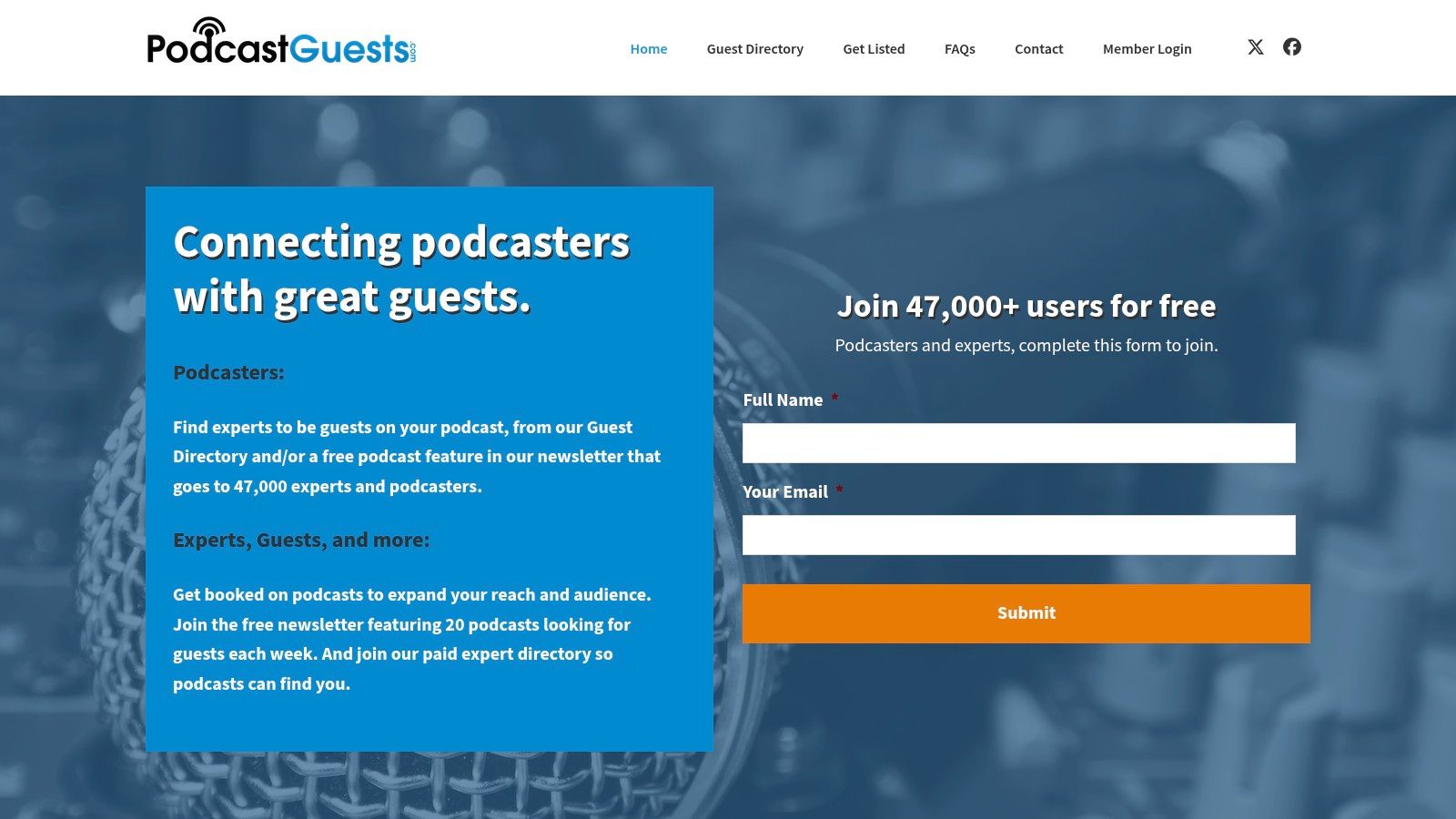
PodcastGuests.com works from both directions, which is its main strength. Hosts can submit shows for possible inclusion in its newsletter, and guests can subscribe to free opportunity emails and apply directly to relevant shows. According to its FAQ, guest-opportunity emails go out twice weekly.
Paid guest profiles act as online one-sheets that podcasters can browse by topic. A good profile carries your bio, topics, sample questions, links, and past appearances, which lets a host judge fit in under a minute. If your profile does that work well, some bookings will come to you instead of requiring cold outreach.
- Free options for both sides: Hosts and guests can start without paying.
- Searchable guest-expert directory: Hosts find guests by topic instead of waiting for pitches.
- Newsletter discovery: Show opportunities arrive by email, which suits guests without a research routine.
You still do the pitching yourself, and newsletter visibility and directory placement vary by membership level. Free members compete with paid profiles for attention, so your pitch quality carries more weight here. Before you apply to a batch of shows, tighten your approach with this walkthrough on how to write a pitch email a host will answer.
6. RadioGuestList

RadioGuestList flips the usual model. Instead of you hunting for shows and guessing whether they want guests, it publishes interview requests from hosts who are actively seeking guests. Requests often describe the guest profile, topic criteria, and format a host wants, which is about as clear an openness signal as you'll get.
Listings cover podcasts alongside radio, video, and other talk shows. Basic guest-request email lists are free, so opportunities land in your inbox without a platform routine. If you're open to multiple interview formats, that breadth is a genuine advantage over podcast-only directories.
The same breadth is the weakness if podcasts are your only goal. Opportunities aren't exclusively podcasts, and listing quality and fit vary, so review each show and its terms before you respond. Email delivery can also be affected by spam filters, which means you should whitelist the alerts or you'll miss time-sensitive requests.
I treat this as a reactive channel, not a targeting tool. You can't decide which shows appear next week, and activity checks are still on you once a request catches your eye. Pair it with a searchable target list, such as the options in this roundup of free podcast directory tools for finding shows, and it becomes useful supplemental deal flow.
7. Podzay
Podzay is the newcomer on this list, and you should judge it that way. It's a profile-based matching service where hosts and guests publish topics and availability, receive recommendations, message each other, and book through a calendar-oriented workflow. The company says it verifies profiles and uses topic and audience information to suggest connections.
The feature set covers the full path in one place.
- Shareable profile pages: You can send hosts a single link instead of assembling materials per pitch.
- Discovery and recommendations: Topic and audience inputs drive suggested matches for both hosts and guests.
- Messaging and booking tools: Coordination stays inside the service instead of scattering across threads.
Podzay advertises full access without a credit card for founding members, which lowers the cost of testing it. The honest caveat is network depth. As an early-stage platform, activity will vary sharply by niche, and its scale claims are company-provided rather than independently verified. Founding-member availability and terms may also change.
My recommendation is to claim a profile if your niche shows any activity, then measure replies for a month. If conversations start, it's cheap reach. If they don't, you've lost an afternoon, not a subscription fee.
8. Podseeker
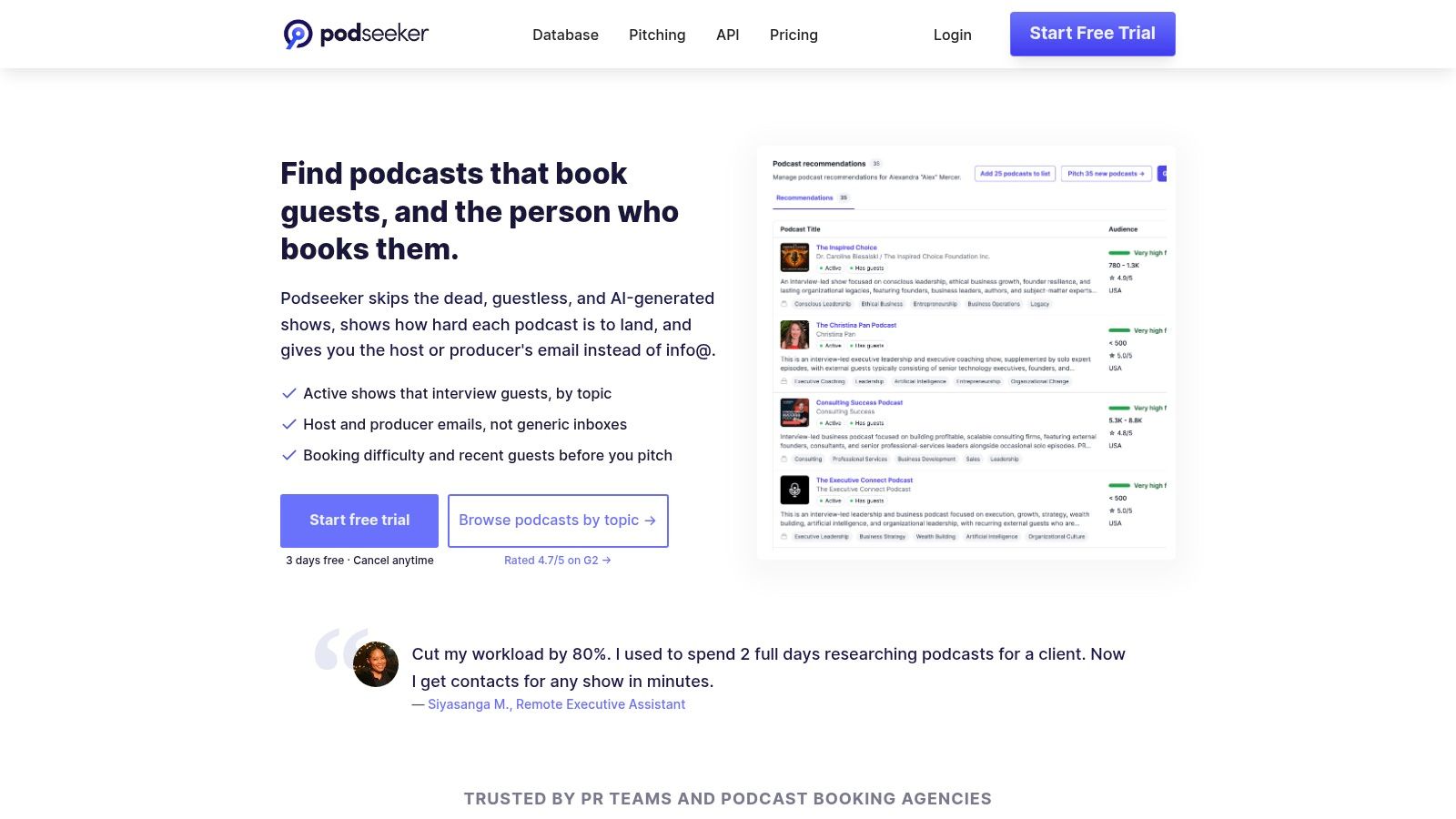
Podseeker is built for people who pitch beyond member networks, especially publicists and PR teams. It searches by topic and recommends podcasts from a guest or client profile, then shows recent episodes, guest history, booking difficulty, and host or producer contacts where available. You build lists, draft pitches, and send through your own connected email account.
Booking difficulty and recent-guest data are the features I'd pay for. They let you spend your best angles on reachable shows instead of famous ones that almost never book cold pitches. That priority matters at scale, since Edison Research reporting on podcast consumption puts total weekly time spent with podcasts among U.S. people aged 13 and older at 773 million hours, which means host inboxes are competitive and wasted pitches are expensive.
This is a paid research and outreach product, not an open podcast guest directory. Contact data isn't available for every show, and sending a pitch guarantees neither a reply nor a booking. It passes the reachable test more often than broad indexes do, but you still verify recency yourself. For a solo expert pitching occasionally, it's likely more tool than you need. For a team running client campaigns, the prioritization data earns its place.
9. Podchaser
Podchaser is excellent at answering one question: which shows interview outside guests, and who has been on them? Its database covers podcasts and episodes across categories, with creator and guest credits, community-curated lists, and ratings. Podchaser Pro adds contacts, audience insights, and advanced search for business users.
Guest credits are a smart way to work backward from comparable experts. Find three peers in your niche, pull every show they've appeared on, and you've got a qualified target list of programs that demonstrably book people like you. That pattern goes back to how directories first created value, when, as the Wikipedia history of podcasting records, Apple added a podcast directory to iTunes 4.9 in June 2005, initially listing approximately 3,000 shows and reported 1 million podcast subscriptions within two days. Searchable organization has always been the product.
Finding a show on Podchaser doesn't establish that it's active or accepting pitches right now. It establishes history. You still need a feed check and a contact route before it's a real target.
Pro pricing also isn't clearly displayed in the product information available, so budget conversations take extra steps. My verdict is clear. This is a research and qualification tool, not a booking marketplace. Use it to build and vet lists, then pitch through routes you verify elsewhere.
10. Listen Notes
Listen Notes is the broadest discovery tool here, and broad is both the point and the problem. Its search engine spans podcasts and episodes, so you can research whether a show covers your exact subject and find guest appearances by topic. Premium search adds expanded results, advanced filters, podcast email details, and access to classifieds, which can include shows seeking guests.
That scale reflects the market itself. A 2025 roundup of podcast statistics from ElectroIQ placed podcasts worldwide at roughly 4.42 million to 4.52 million, with another estimate of more than 177.5 million published episodes. In an index that large, a search result tells you a feed exists. It doesn't verify that the show is active, books guests, or wants your pitch.
- Strongest use: Episode-level topic research before you shortlist a show.
- Most direct opportunities: Classifieds, where shows state they're seeking guests.
- Biggest gap: No booking, messaging, or scheduling workflow, and advanced features require a paid plan.
Format checks are on you too. The Podcast Consumer 2025 report from Edison Research reports video podcast consumption at 37% monthly and 26% weekly among the U.S. population aged 12 and older, so confirm whether a target records video before you pitch. Listen Notes is a fine top-of-funnel research tool. It isn't a pipeline.
Podcast Guest Directory Comparison
| Item | Best for | Openness/contact signals | Free option | Booking workflow |
|---|---|---|---|---|
| Let's Make A Podcast | Finding active shows and managing guest outreach | Feed-checked listings, pitch invitations, and openness research | Free core features and tools; optional paid plans mentioned | Pitch tracking, follow-ups, messaging, and scheduling; hosts and guests connect directly |
| FindMeAPodcast | Finding health and wellness shows seeking expert guests | Pitch route and source, last-checked date, and possible guest-fee flags | Free to browse without an account | Pitch shows directly; no in-platform messaging or scheduling |
| PodMatch | Ongoing host-guest matching and interview coordination | Public profiles, match recommendations, and video pitches | No free account; paid plan required | Matching, scheduling, and production-management tools |
| MatchMaker.fm | Searching and matching across podcast niches | Host and guest profiles, show criteria, and in-platform messaging | 30-day trial without a credit card; limited conversation starts | Shortlists, unified inbox, and scheduling integrations |
| PodcastGuests.com | Finding guest opportunities and guest experts | Show-opportunity emails and searchable guest profiles | Free opportunity emails and host options; paid profiles available | Guests apply and pitch shows directly; hosts can browse profiles |
| RadioGuestList | Finding interview requests across multiple formats | Specific guest requests and stated topic criteria | Basic guest-request email lists are free | Receive opportunities by email and respond to hosts |
| Podzay | Trying an emerging host-guest matching community | Verified-profile claims, topic and audience matching, and shareable profiles | Founding members are offered access without a credit card | Recommendations, messaging, and calendar-oriented booking |
| Podseeker | Researching and pitching shows, especially for PR teams | Host or producer contacts where available; booking-difficulty and guest-history data | Paid research and outreach product | Draft and send pitches through your own email account; manage follow-ups |
| Podchaser | Broad podcast research and guest-appearance discovery | Creator and guest credits; Pro adds contacts and audience insights | Basic database browsing is available | Research tool; no direct booking workflow |
| Listen Notes | Searching podcasts and episodes for research | Premium contact details and classifieds may surface guest opportunities | Basic search available; advanced features require a paid plan | Research and classifieds; no full messaging or booking workflow |
Choosing Your Directory and Building a Pipeline That Books
Don't pick one tool and hope. The working setup combines a research layer with a booking layer. Use Podchaser, Listen Notes, and Podseeker to discover shows and qualify them on topic, guest history, and booking difficulty. Then move the survivors into openness-aware directories like Let's Make A Podcast and FindMeAPodcast, or into matching platforms, where activity and contact signals turn a list into conversations.
Our free Find podcasts tool searches all 408 directory shows by niche so you can pick targets without learning a new platform first. That's a sensible first step because the pattern we found when we read those feeds is unforgiving. Only 60% of the 383 checked feeds were recently active with a published contact route, so every unverified list you import carries dead weight into your outreach.
Verify Every Show Before You Pitch
Fit decides who replies. The State of Podcast Pitching 2026 analysis from Podseeker examined 6,546 pitches and reported a 5.6% booking rate for very-high-fit pitches versus 1.2% for very-low-fit pitches, while shows above 100,000 listeners booked none of 171 observed pitches. Treat giant shows as low-probability bonuses and build your core pipeline on niche programs where your topic match is exact.
Run this check on every target, whatever directory surfaced it.
- Active: The feed shows recent episodes on a recognizable cadence, not a single return episode after a long silence.
- Guest-friendly: Recent episodes feature outside guests like you, not only co-hosts, sponsors, or the host's own team.
- Reachable: The show publishes a specific pitch route, a booking form, a named producer, or a guest page, not just a generic website contact form.
- Format-ready: You know whether it records audio or video, remotely or in studio, so you can meet its production needs.
Pitch, Follow Up, and Track
Write episode-aware pitches. Name a recent episode, explain the specific angle you'd add for that audience, and offer two or three concrete talking points. Attach or link a one-sheet instead of a full media kit, because hosts decide in minutes. Our free guest one-sheet can be created in minutes and shared as a single link, which keeps that step fast for every batch.
Follow up once after about a week with one new detail, a fresh angle, a relevant credential, or a shorter version of the original ask. A second follow-up is reasonable for exact-fit shows. After that, move on and revisit next season. Silence usually means wrong timing, wrong fit, or a show that was never bookable in the first place.
Start free before you pay anything. Test a no-account search tool, pitch a small batch of verified shows, and measure replies, not sends. Once you know your response rate and your best-fit niches, paid matching or research platforms can compress the work. Paying earlier just scales an untested pitch, and no podcast guest directory can fix that for you.
Ready to pitch shows that are publishing and open to guests? Let's Make A Podcast lets you search 408 feed-checked shows by niche, build a free shareable one-sheet, and track pitches and follow-ups without booking fees or middlemen. Start with the free Find podcasts tool today, build your first verified target list, and send pitches that have a real chance of getting a reply.