10 Podcast Booking Services Compared
More podcast placements don't automatically produce better results. A booking service can fill a calendar with interviews that reach the wrong listeners, accept guests irregularly, or offer little value beyond a scheduled recording. The useful question isn't how many shows a provider can name. It's whether the provider can identify active programs, match the guest or host to the right topic, and manage the work at the level your campaign requires.
Most buyers are choosing between three practical paths. A managed agency owns research, pitching, follow-up, preparation, and scheduling. A self-serve marketplace gives hosts and guests discovery, matching, messaging, and calendar tools, while leaving much of the judgment and outreach to the user. A direct workflow tool combines searchable opportunities with structured profiles, context-aware pitches, and coordination without inserting an intermediary.
This comparison focuses on show fit, outreach ownership, coordination support, pricing visibility, scale, and workflow control. It also considers whether a service supports a broader goal, such as executive positioning, B2B pipeline development, content repurposing, or a consistent guest pipeline for a growing show.
Pricing isn't consistently published across the category. Where a provider discloses scope or pricing, it's identified plainly. Where it doesn't, treat the missing information as a buying question rather than an implied benefit.
Table of Contents
- 1. Let's Make A Podcast
- 2. Interview Connections
- 3. Interview Valet
- 4. Lemonpie
- 5. Kitcaster
- 6. Command Your Brand
- 7. Fame Connect
- 8. PodMatch
- 9. MatchMaker.fm
- 10. PodcastGuests.com
- Top 10 Podcast Booking Services Comparison
- Choose by Control, Capacity, and Campaign Goal
1. Let's Make A Podcast
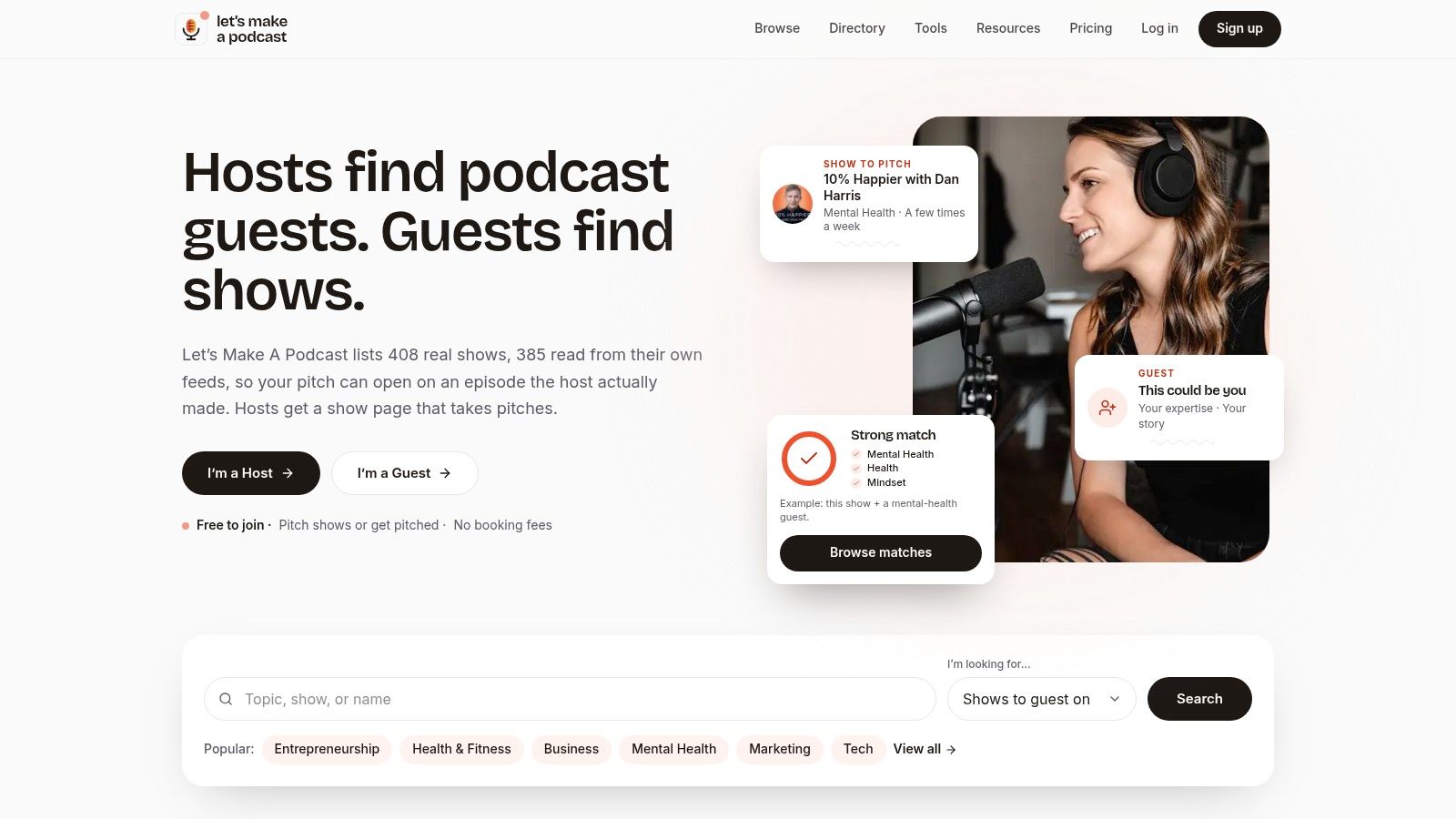
Let's Make A Podcast occupies a different position from a conventional booking agency. It's a direct marketplace and toolkit for hosts and prospective guests, so the people using it retain the relationship, the pitch, and the final decision. That makes it especially relevant for independent hosts, producers, subject-matter experts, authors, creators, and PR professionals who want structured discovery without handing outreach to a third party.
The directory lists 408 shows, with 385 feeds read from RSS sources to help identify programs that are publishing consistently. Those figures are stated on the product materials, and the platform also surfaces each show's preferred pitch route where available. That distinction matters because recent benchmark coverage places the median podcast-pitch acceptance rate at 5%, while the median response rate is 17.5%. Podchaser's podcast pitching benchmarks help explain why finding an active, reachable, relevant show can matter more than sending a larger number of generic messages.
A direct workflow from fit to recording
Guests can build one shareable one-sheet containing their bio, topics, image, and past appearances. The platform can draft pitches that reference a recent episode when the feed provides one, then support follow-up suggestions and pipeline tracking. Hosts get show pages that explain the guests and topics they want, and can browse one-sheets, invite people, message them, and schedule within one thread with calendar invites included.
The model is transparent about its limits. Free guest and host workflows support pipelines of up to 25 shows or people, while planned paid options include Guest Pro and an AI Booking Concierge. The provided product pages don't publish pricing for those planned tiers, so buyers should verify availability, limits, and whether managed replies and scheduling are included before relying on them.
Practical rule: Use active-feed signals and topic fit to reduce wasted outreach, but still review the show, audience, recent episodes, and pitch route yourself.
The platform also provides free, no-account tools such as a pitch generator, pitch grader, one-sheet builder, host readiness checks, invitation generators, and interview-question tools. Nothing is saved unless a user publishes a one-sheet, which gives cautious users a low-friction way to test the workflow. There are no booking fees or intermediaries, and the platform publishes openness research with a downloadable CC BY 4.0 dataset. Its strongest fit is therefore control, privacy, and workflow consolidation, not white-glove campaign execution.
2. Interview Connections
Interview Connections is a managed podcast guest-booking agency for founders, coaches, authors, consultants, and experts who want more than a list of possible shows. Its offer combines targeted research, campaign management, interview audits, and coaching, which places it firmly on the agency side of the comparison rather than in the self-serve marketplace category.
The central trade-off is straightforward. You give up some direct control over research and outreach in exchange for a team that can shape the campaign around business goals and help the guest improve interview performance. That can be useful when the problem isn't finding shows, but turning each appearance into a stronger conversation, clearer positioning, or a more useful next step.
Where the managed model earns its keep
The service supports targeted show research and placement, interview preparation, and ongoing campaign coordination. A white-label option also gives PR agencies a way to incorporate booking support into client work without presenting the operation as a separate provider. Month-to-month memberships are available through an application process, but pricing isn't published on the supplied service information.
That lack of public pricing doesn't make the model unsuitable, but it changes the evaluation. A prospective client should ask what the agency counts as a placement, how much control the client retains over target shows, what follow-up looks like, and whether coaching is included in the quoted scope.
Interview Connections is likely to be excessive for someone who enjoys researching shows and writing pitches independently. It makes more sense when executive time is scarce, the campaign needs strategic input, or the buyer wants an experienced operator to manage the process rather than assemble another database and spreadsheet.
3. Interview Valet
Interview Valet takes a message-first, outcome-oriented agency approach. The service is designed for experts and companies that want podcast appearances connected to a broader commercial or positioning goal, not a record of completed interviews.
Its workflow combines strategy, message clarity, host-ready materials, show qualification, outreach, and scheduling. The emphasis on audience fit is important because hosts don't evaluate a guest only on how polished the pitch sounds. A 2026 survey of 271 podcasters found that topic relevance influenced booking decisions for 87.8% of hosts, while guest expertise influenced 62.0%. Buzzsprout's survey coverage gives a useful reason to examine how an agency defines relevance before comparing outreach volume.
Stronger positioning, less public price information
Interview Valet's coaching can help a guest refine the narrative, episode idea, and call to action before outreach begins. Its end-to-end execution also reduces the coordination burden between guest, host, producer, and calendar. That makes the service a better fit for a leader who needs preparation and campaign direction, rather than a tool user who wants to approve every message and send each follow-up personally.
The main buying friction is pricing visibility. The supplied information says pricing isn't public and consultation is required. It also indicates that the service may prioritize more selective shows, which can mean longer lead times than a broad marketplace.
A booking should be judged by relevance and readiness, not by the existence of a calendar invitation.
Interview Valet is strongest when the campaign has a defined audience, a clear business message, and enough patience for selective targeting. It may be less suitable for a new creator testing many topics or for a buyer who wants a low-cost, fully self-directed workflow. For a broader comparison of service models, see this guide to podcast booking agencies.
4. Lemonpie
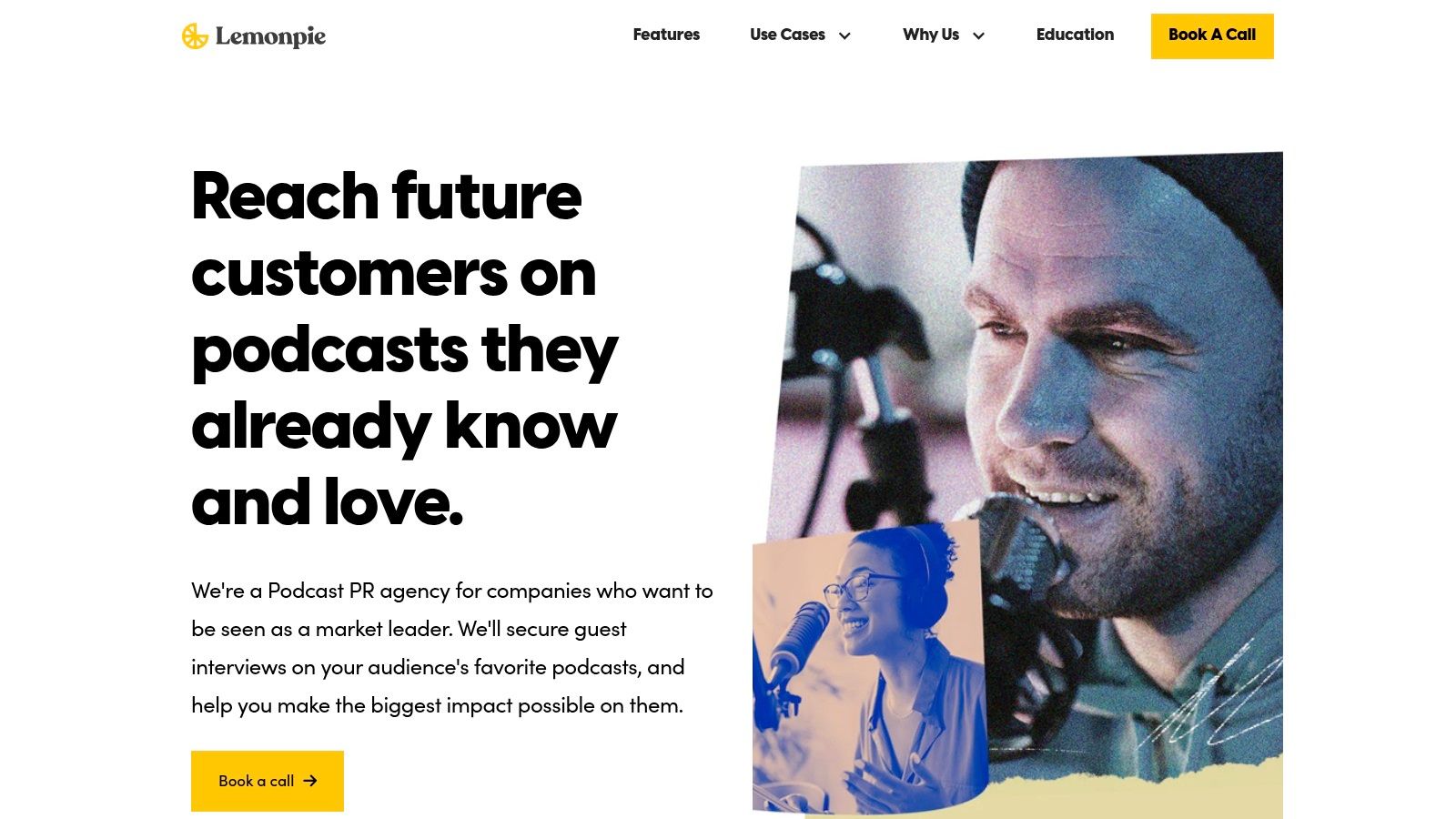
Lemonpie is built around managed podcast-tour programs for B2B brands, founders, executives, and teams. Unlike providers designed primarily for one individual, its model can support several speakers under one retainer. That makes it relevant to companies that want a coordinated campaign rather than an isolated founder-guesting effort.
The service handles research, outreach, preparation, and scheduling from start to finish. Its published resources and case-study material also position podcast touring as a structured communications program, where multiple appearances support a broader narrative instead of producing disconnected conversations.
A team model with visible scope
Lemonpie's strongest differentiator is its fit for multi-member campaigns. A company can assign several leaders to the program while keeping the research, messaging, and coordination process centralized. That matters when a campaign needs different subject experts for different topics, but still needs a consistent standard for audience fit and approvals.
The supplied plan notes identify transparent starting pricing and published scope, although they don't provide a specific amount that can be cited here. Buyers should still confirm the current entry point, minimum engagement, speaker limits, expected outreach volume, and how the service handles substitutions when a selected executive becomes unavailable.
This is a premium choice relative to a direct marketplace or a no-cost discovery workflow. It probably won't suit a solo guest who wants to test a single angle on a small budget. It can suit a B2B marketing or communications team that values campaign ownership, internal coordination, and a process that can accommodate more than one voice.
Lemonpie's value isn't merely the number of pitches sent. Its operational advantage comes from making podcast guesting behave more like a coordinated media program. That can reduce internal handoffs, but the buyer should confirm whether reporting, repurposing, and post-publication distribution are included or require separate work.
5. Kitcaster
Kitcaster is a boutique, high-touch booking agency aimed at founders and CEOs who want custom targeting without managing the mechanics themselves. Its positioning emphasizes relevancy, customer experience, and outcomes aligned with a defined ideal customer profile.
The service's boutique structure is an advantage when a senior executive needs a narrow set of carefully chosen opportunities. A high-touch account manager can spend more time understanding the guest's background, business, and preferred topics than a generic marketplace workflow typically allows. That said, boutique capacity can also create longer lead times when demand is high.
The executive-time trade-off
Kitcaster suits buyers who want to delegate show research, pitching, follow-up, and scheduling while retaining a campaign shaped around their objectives. Its category and program pages address common client types, including SaaS, which can help a buyer assess whether the agency understands the intended market.
The supplied information doesn't publish pricing, so a quote is required. That makes scope questions particularly important. Ask whether every show requires client approval, whether the agency distinguishes between a host acceptance and a scheduled recording, and whether preparation or content reuse is included.
Kitcaster isn't the obvious choice for a creator who wants to browse opportunities independently or experiment with a wide range of topics. It is more appropriate when the cost of executive time is high and the campaign needs a concierge-style experience. Buyers should also test whether the agency's targeting standards match their own definition of a qualified show, rather than assuming that a well-known program automatically serves the right audience.
6. Command Your Brand
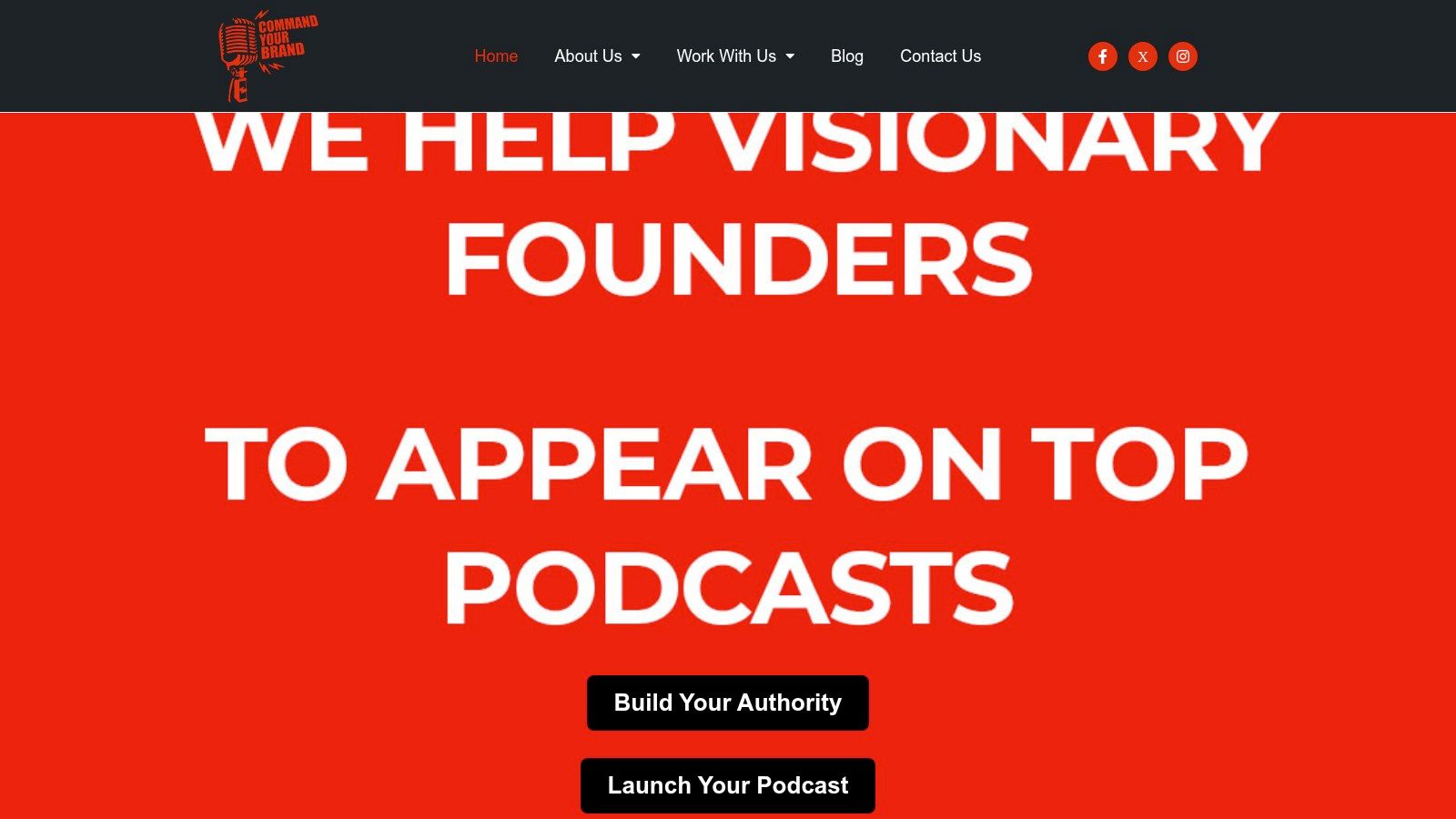
Command Your Brand combines message architecture, managed podcast bookings, and authority-building campaigns. Its service is aimed at founders and CEOs who want earned placements and may also need support producing a founder-led show.
The distinction between earned and pay-to-appear exposure deserves attention. A buyer should know whether the provider is pursuing editorial invitations, paid opportunities, or a mix of both, and whether the campaign reports those categories separately. The supplied plan notes position Command Your Brand around earned media and describe a case-study-led approach, but they don't provide a public price in the verified information.
A positioning-led campaign
The service can manage the campaign from message development through targeting, pitching, and coordination. Optional podcast production makes it more flexible for a company that wants to guest on other shows while also developing its own program. That combination could support a larger authority strategy, but it may be more than a guest who only needs a few relevant conversations.
The model is best suited to a founder with a clear ideal customer profile, a high-value offer, and a message that can be adapted across several shows. It's less compelling for a buyer whose main need is just a searchable list of active podcasts. In that case, a marketplace keeps more control in the buyer's hands and makes it easier to reject low-fit opportunities before outreach.
Ask how Command Your Brand defines authority outcomes, what approval rights exist, what reporting is supplied, and whether optional production is separate from booking. Those answers will reveal whether you're buying a focused booking campaign or a broader communications engagement.
7. Fame Connect
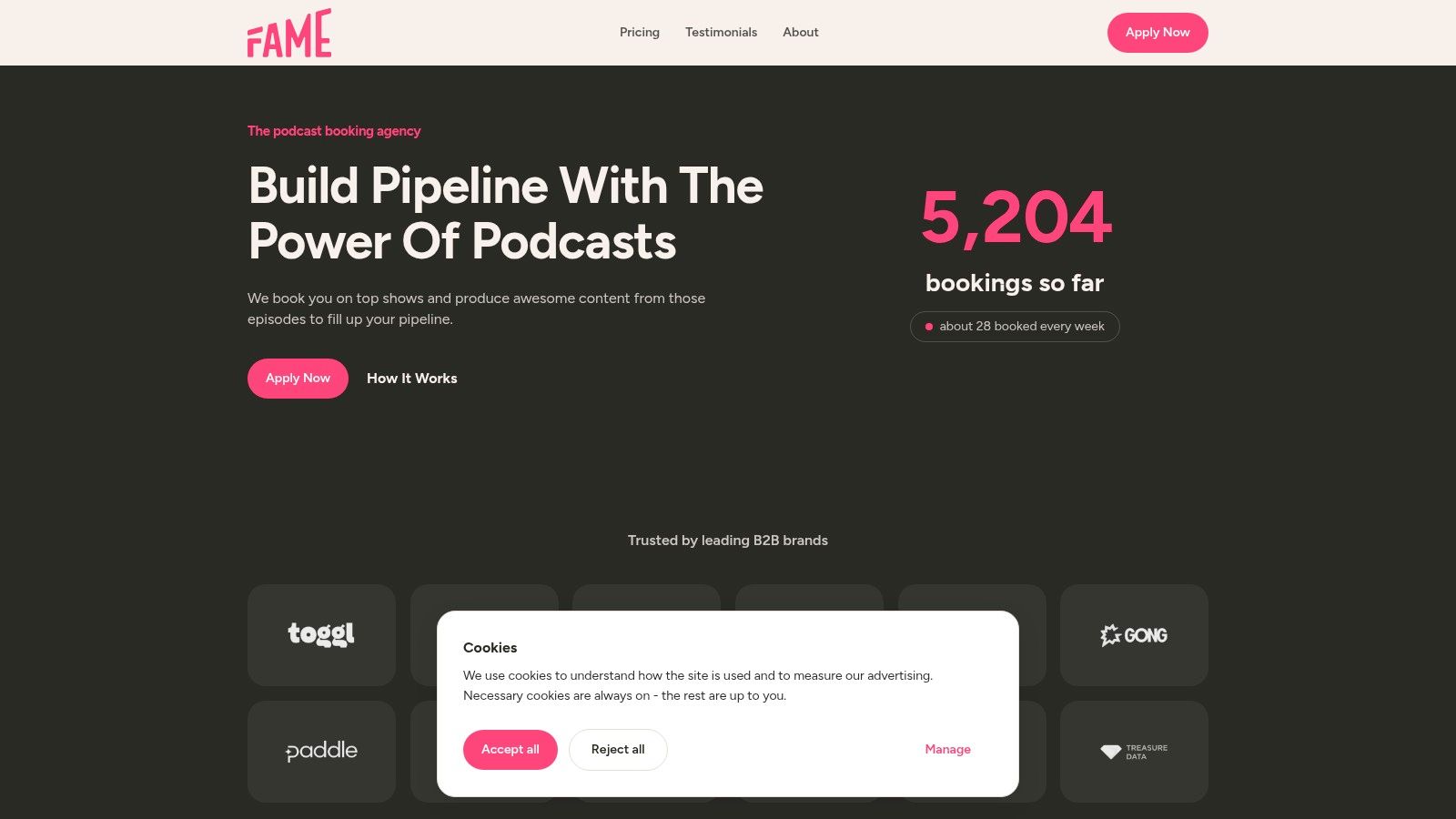
Fame Connect, formerly Speak On Podcasts, is a B2B booking and content-repurposing service. Its operational layer, Fame OS, tracks shows, approvals, placements, and publication status, while the broader offer turns each appearance into short-form video content.
That makes it different from an agency whose work ends when an interview is scheduled. Fame Connect treats guesting as part of a content flywheel. A B2B team can use the booking workflow to reach relevant shows, then use the recorded conversation as raw material for additional distribution.
Booking plus post-interview output
The service supports scoring and approval workflows for B2B podcasts, with operational tracking through its internal system. The plan notes don't publish current pricing, and access is described as application or quote based. A buyer should therefore request the exact number of placements, the definition of an approved booking, and the quantity and format of repurposed assets.
The B2B focus is a meaningful fit filter. It may work well for founders, sales leaders, and marketing teams that want appearances connected to pipeline development and content production. It may not suit entertainment, lifestyle, or consumer-focused guests whose best opportunities sit outside B2B programming.
Repurposing also creates a scope risk. “Short-form video” can mean different things depending on editing, captions, hooks, revisions, aspect ratios, and delivery rights. Confirm whether the team supplies only clips or also written assets, publishing support, and brand review. Fame Connect is therefore best judged on the whole operating system, not just the number of podcast introductions.
8. PodMatch
PodMatch is a self-serve matching platform rather than a managed agency. It connects hosts and guests through algorithmic matching, searchable profiles, filters, messaging, and scheduling. Hosts can also use estimated download information as one input when evaluating potential opportunities.
Its appeal is speed and control. A DIY guest can create a profile, review matches, decide which conversations deserve a pitch, and manage the relationship without waiting for an account manager. The platform offers low monthly pricing tiers, but the supplied information doesn't state a specific current amount, so buyers should verify plan limits and feature access before subscribing.
A marketplace rewards active operators
PodMatch can generate a continuing pipeline of opportunities, but it doesn't remove the need for judgment. The guest still has to write a relevant message, assess the show, follow up, prepare for the conversation, and decide whether the audience fits the campaign. In competitive categories, higher-tier plans and paid placement options may affect visibility, which makes the total workflow cost more than the membership alone.
That trade-off is acceptable for a guest with time, a clear profile, and a willingness to manage outreach. It's less suitable for an executive who wants someone else to qualify shows, develop the narrative, and coordinate the campaign.
Control has a cost: a marketplace lowers the software barrier, but the user still owns the research and relationship.
PodMatch is a sensible choice for ongoing experimentation, especially when budget matters more than white-glove service. Compare its matching experience with other podcast matchmaking services, and ask whether the platform gives you enough context to judge episode quality, recent activity, audience fit, and any pay-to-appear request.
9. MatchMaker.fm
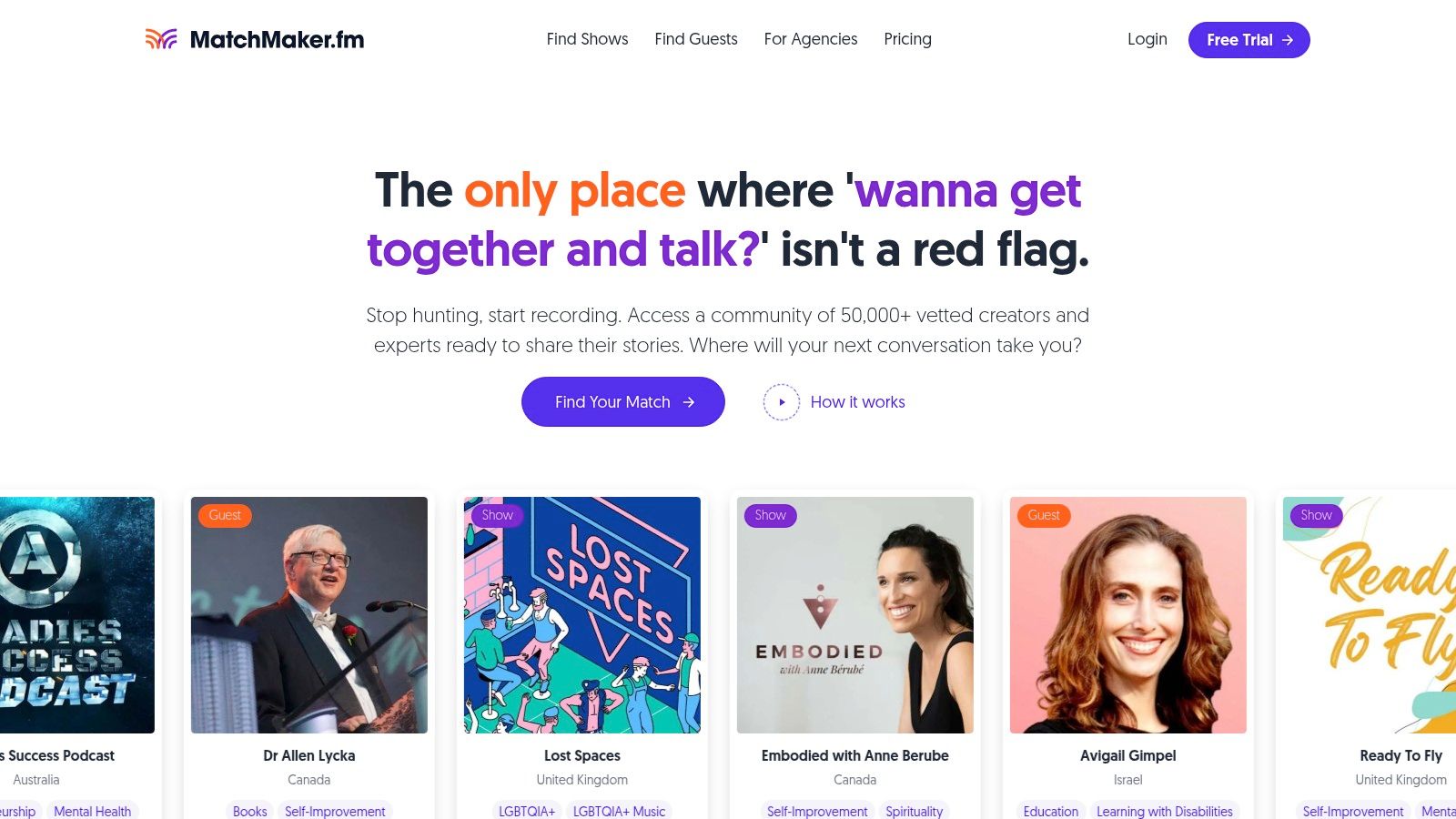
MatchMaker.fm is a broad discovery marketplace connecting hosts and guests through search, matching, and in-platform messaging. It also offers an agency plan for teams managing multiple guest profiles, which gives it more relevance to PR firms than a platform designed only for individual users.
The marketplace model provides breadth, but breadth can introduce noise. Users may encounter opportunities that look accessible without being strategically useful, including pay-to-appear offers. Those opportunities aren't automatically inappropriate, but they need to be identified, evaluated, and separated from editorial invitations before they enter a campaign report.
Broad discovery, variable vetting
MatchMaker.fm can work for an individual or agency that wants a large pool of shows and is prepared to perform its own qualification. Pro membership and conversation limits apply after the available grace period, while current pricing isn't clearly published in the supplied information. An agency buyer should request the current plan structure, number of team seats, profile limits, and messaging allowance.
The agency plan is the important differentiator. It can support multiple client profiles and a team workflow, allowing a PR professional to centralize discovery while maintaining separate guest identities. That doesn't turn the service into a managed agency, however. The team still owns pitch quality, follow-up discipline, client approvals, and audience assessment.
MatchMaker.fm is a good fit when discovery scale and agency administration matter more than verified activity signals or hands-off execution. Before committing, test a small set of opportunities and record why each one is relevant. That exercise will show whether the marketplace's breadth produces useful matches or expands the number of tabs your team has to review.
10. PodcastGuests.com
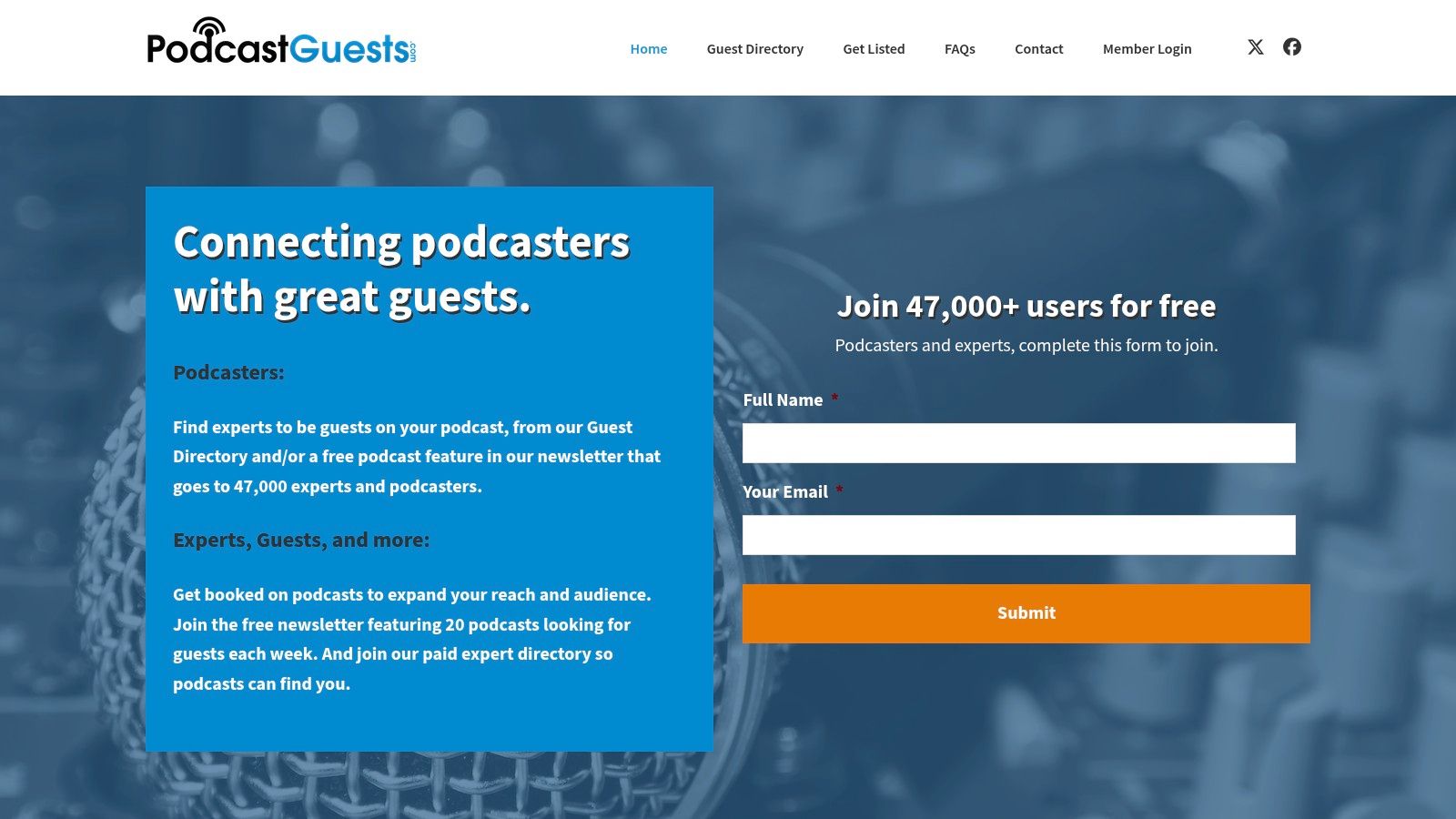
PodcastGuests.com uses an email-first directory and matchmaking model. It sends a twice-weekly newsletter featuring shows that are actively seeking guests and also maintains a searchable expert directory. That approach reduces the need to discover every opportunity through a platform dashboard.
The service is accessible to DIY guests because no-cost options are available. It can also help hosts find experts and provides an agency guidance page for teams managing several clients. The lower barrier is useful, but it doesn't replace audience qualification. A show actively seeking guests can still be a poor match for the guest's topic, language, expertise, or commercial objective.
Fast access, uneven opportunity quality
The newsletter workflow is its main strength. A guest can review current opportunities, select relevant ones, and respond while the request is still timely. Optional premium listings can improve visibility, but the supplied information doesn't specify current pricing, so buyers should confirm what premium placement includes and whether it changes access or only profile exposure.
PodcastGuests.com is a practical starting point for authors, experts, creators, and PR professionals who want a low-commitment source of opportunities. It demands more vetting than a curated active-feed directory because users must assess the show, audience, recent publishing behavior, and any commercial conditions themselves.
A strong process still needs a one-sheet, a specific episode idea, a follow-up schedule, and a record of every pitch. For a more detailed self-serve workflow, consult this guide on how to get booked as a podcast guest.
Top 10 Podcast Booking Services Comparison
| Product | Core features | UX / Quality (★) | Value & Price (💰) | Target Audience (👥) | Unique Selling Points (✨) |
|---|---|---|---|---|---|
| 🏆 Let's Make A Podcast | Directory (408 listed; 385 actively read), one-sheet builder, context-aware pitch drafts, messaging + calendar + pipeline | ★★★★☆ Verified feeds; privacy-by-default; data-driven matching | 💰 Free core tools; Guest Pro & AI Concierge planned | 👥 Independent hosts, guests, authors, PR pros | ✨ Verified active feeds, privacy-first tools, open dataset, no booking fees |
| Interview Connections | White-glove booking, show research, interview audits & coaching, month-to-month memberships | ★★★★ Deep experience (10+ yrs); strategic coaching | 💰 Quote / managed service | 👥 Founders, coaches, experts, agencies | ✨ Hands-on coaching + full campaign management |
| Interview Valet | Strategy, messaging support, end-to-end booking, show qualification | ★★★★ Outcome-focused; hands-on messaging help | 💰 Quote / agency retainer | 👥 Experts & companies aiming for measurable outcomes | ✨ Message-first framework; host-ready materials |
| Lemonpie | Managed podcast tours, research, outreach, multi-speaker team support | ★★★★ Enterprise process; campaign case studies | 💰 Published starting price (premium) | 👥 B2B brands, teams, enterprise leaders | ✨ Transparent pricing; multi-speaker team bookings |
| Kitcaster | High-touch account management, targeted show targeting, tailored concierge | ★★★★ Boutique experience; emphasis on fit | 💰 Quote / concierge service | 👥 Executives, founders, time-constrained leaders | ✨ Concierge-level account management and targeting |
| Command Your Brand | Podcast authority campaigns, messaging + managed bookings, optional production | ★★★★ Strong positioning around earned media | 💰 Quote / campaign-based | 👥 Founders, CEOs seeking authority & earned media | ✨ Campaigns centered on message + earned placements |
| Fame Connect | B2B booking + show scoring, Fame OS tracking, short-form video repurposing | ★★★★ Operational transparency; pipeline-focused | 💰 Quote / application | 👥 B2B teams seeking pipeline & content flywheel | ✨ Repurposes appearances into short-form video; operations layer |
| PodMatch | Algorithmic matching, profile SEO pages, search filters, messaging & scheduling | ★★★☆☆ Fast matches; DIY outreach quality varies | 💰 Clear low monthly tiers; premium placement options | 👥 DIY guests wanting steady matches | ✨ Algorithmic matching + straightforward pricing |
| MatchMaker.fm | Large discovery marketplace, matching/search, in-platform messaging, agency plan | ★★★☆☆ Broad show discovery; membership required | 💰 Membership required after trial; agency plan | 👥 Agencies & individuals seeking wide discovery | ✨ Established marketplace with agency workflows |
| PodcastGuests.com | Email-first directory, twice-weekly listings of shows seeking guests, searchable expert directory | ★★★☆☆ Low-barrier; opportunity quality varies | 💰 Free options + premium visibility | 👥 DIY guests who prefer email-driven leads | ✨ Twice-weekly curated email of actively seeking shows |
Choose by Control, Capacity, and Campaign Goal
There isn't one universal winner among podcast booking services because the services solve different operational problems. A managed agency sells labor, judgment, positioning, and coordination. A self-serve marketplace sells access to discovery and communication tools. A direct workflow platform such as Let's Make A Podcast focuses on reducing research and coordination friction while leaving the host and guest in direct control.
Choose a managed agency when your campaign needs strategy, outreach ownership, coaching, or support for several speakers. Interview Connections and Interview Valet are relevant when message development and interview performance matter as much as placement. Lemonpie is better aligned with a coordinated B2B team campaign. Kitcaster suits executives who want boutique handling, while Command Your Brand adds a broader authority and positioning layer. Fame Connect is the clearest fit when podcast booking and content repurposing belong in the same operating program.
Choose a self-serve marketplace when budget, flexibility, and control matter more than delegated execution. PodMatch offers algorithmic matching and built-in communication for active DIY users. MatchMaker.fm provides broad discovery and an agency workflow for multiple profiles. PodcastGuests.com offers an email-led route to opportunities that are actively seeking guests. Each requires the user to vet relevance, write the pitch, follow up, and manage the relationship.
Choose Let's Make A Podcast when you want direct, privacy-friendly discovery with a more consolidated workflow. Its active-feed signals, stated pitch routes, one-sheets, context-aware draft pitches, follow-up support, messaging, and scheduling address the gap between finding a show and getting the conversation recorded. The model doesn't charge booking fees or place an intermediary between the host and guest, which preserves relationship ownership.
Before buying, confirm the details that marketing pages often leave unclear:
- Current pricing and commitment: Ask for the live price, minimum term, pause rules, cancellation terms, and any setup or extra fees.
- Qualified-show definition: Find out whether fit means topic relevance, audience profile, publishing activity, estimated reach, host acceptance, or something else.
- Outreach volume: Clarify the number of researched targets, pitches, follow-ups, and active campaigns included in each period.
- Approval rights: Confirm whether you approve every show, pitch, guest, and paid opportunity before outreach begins.
- Delivery milestone: Ask whether a booking means host interest, a scheduled recording, a completed interview, or a published episode.
- Reporting and ownership: Establish who owns the target list, message history, contact relationship, reporting data, and published assets.
- Repurposing scope: If clips or written assets are included, define formats, revision rounds, publishing rights, and delivery timing.
- Pay-to-appear handling: Require disclosure of paid placements and ask whether they count toward delivery or are excluded from campaign results.
The evidence around outreach supports a focused test rather than an immediate commitment to volume. A 2026 benchmark reported that 42% of cold-outreach replies came from follow-ups, according to Million Podcasts' follow-up analysis. That makes follow-up ownership a meaningful differentiator between a directory and a managed service. A provider that sends an initial pitch but doesn't explain timing, context, and persistence may leave the most important part of the workflow to you.
Run the test around one defined topic, one audience, one credible episode idea, and one clear call to action. Track show fit, pitch context, replies, follow-ups, accepted invitations, scheduled recordings, and published episodes. Then decide whether you need more research capacity, more human support, better coordination, or just a cleaner system for doing the work yourself.
Let's Make A Podcast combines an active-show directory, one-sheet profiles, context-aware pitching, follow-up tools, messaging, and scheduling without booking fees or intermediaries. If you want to compare podcast booking services through the lens of fit and workflow control, visit Let's Make A Podcast and test the direct booking toolkit.