For hosts
Questions to Ask a Podcast Guest
The interview is the show. Great questions pull out stories no one has heard, keep the conversation moving, and give listeners a reason to stay. Here's a full question bank you can steal, plus how to use it without sounding like you're reading off a list.
12 min read
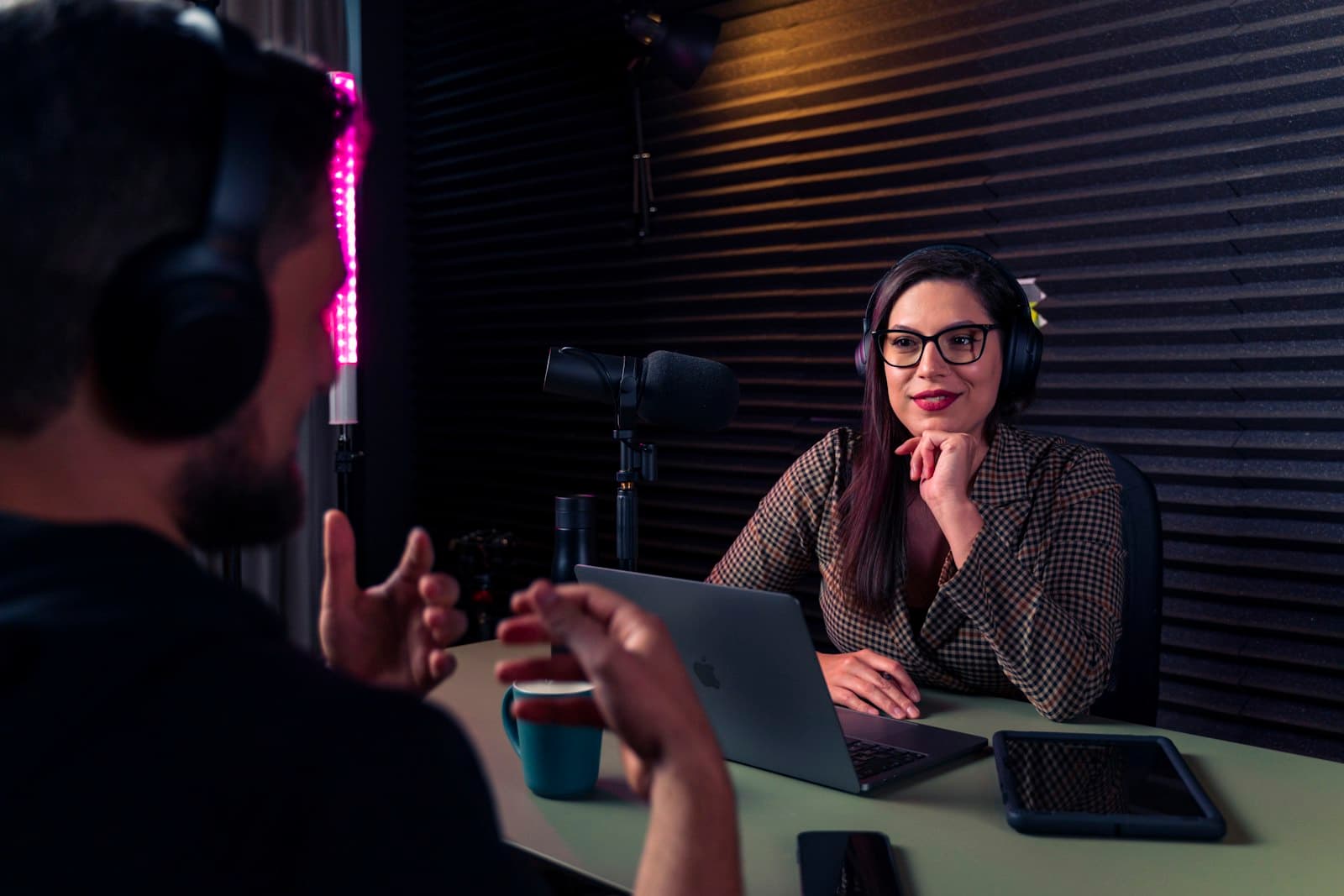
The difference between a forgettable interview and one people share almost always comes down to the questions. Good ones make an expert light up and tell the story they've never quite told before; weak ones get you a résumé read back at you. And the guest can only be as interesting as the questions let them be.
This is a working question bank you can copy straight into your prep doc, organized by where each question belongs in the conversation. Below it: how to structure the arc of an interview, which questions to cut, and how to run the whole thing so it feels like a conversation instead of a form.
What makes a great podcast interview question
Before the list, the pattern behind it. The best questions share a few traits, and once you can feel them you can improvise your own on the fly:
- Open, not closed: a question that can be answered "yes" or "no" hands the work back to you. Start with "how," "why," "what," or "tell me about."
- Specific over generic: "What was the moment you almost quit?" beats "What's your journey been like?" Specifics pull out stories; generalities pull out clichés.
- One idea at a time: stacking three questions into one lets the guest answer the easy part and skip the interesting part. Ask one thing, then follow up.
- Rooted in something real: reference an actual episode, a post they wrote, a number from their world. It signals you did the work and it gets a better answer.
- A little bit brave: the question the audience is thinking but you're slightly nervous to ask is usually the best one. Ask it with genuine curiosity, not a gotcha.
Hold those five in mind and most of your prep is just applying them to this specific guest.
Structure the conversation as an arc
A great interview has a shape. You warm the guest up, go deep in the middle, pull out something practical, then land on a memorable close. Prep questions for each stage rather than a flat list of 30: it keeps the energy building instead of wandering.
- Open (first 2–3 minutes): an easy, human question that gets the guest talking and comfortable. Not their whole life story yet.
- Origin (next few): how they got here, but aimed at a turning point, not a timeline.
- Depth (the core): the real substance: their expertise, their strongest opinions, the stories only they can tell.
- Practical (near the end), something the listener can actually use or act on, so the episode earns its runtime.
- Close (last few minutes): a reflective or forward-looking question, then where people can find them.
You won't get through everything, and you shouldn't try. Pick two or three must-hit questions per stage and let the conversation fill the rest.
Two things sit outside that arc. Before it, a short pre-interview stage: the questions you ask with the recorder OFF, which is where you find out what your guest would rather not be asked and what they'd be disappointed to miss. After it, 4 swap-in sets for particular kinds of guest. Those are not a stage and should never be run as a block: pull two or three of them into the depth stage and leave the rest.
The question bank: 100 questions to steal
Copy this into your prep doc and cut it down for each guest. 75 of them follow the arc above, in order, so you can cut upward from the bottom when you're short on time and still have a conversation. The last 25 are swap-ins for a particular kind of guest, and most episodes use one set or none.
These are deliberately broad so they work across almost any interview show: swap in specifics from your guest's actual work wherever you can.
PRE-INTERVIEW (ask these before you press record)
- Is there anything you'd rather I didn't ask about?
- What's the one thing you'd be disappointed if we didn't get to?
- How would you like me to introduce you?
- Has anything changed since we booked this that I should know about?
- Is there a name, title, or number you want me to get exactly right?
- What's a question you get asked on every show that you're tired of answering?

OPENING / WARM-UP
- For anyone who's never come across your work, what do you actually do all day?
- What's something you're weirdly obsessed with right now?
- How do you explain what you do to someone at a party?
- What's a common assumption people make about you or your field that's just wrong?
- What's the last thing you changed your mind about?
- What were you doing right before we started recording?
- What's the best thing that's happened to you this month?
- If I'd caught you on a normal Tuesday, what would you have been doing?

ORIGIN STORY (aim for a turning point, not a timeline)
- What was the moment you knew this was what you wanted to do?
- Was there a point where you almost quit? What kept you going?
- What did you believe early on that you've completely changed your mind about?
- Who or what gave you your first real break?
- What were you doing the year before any of this started?
- What's the version of your story people usually get wrong?
- What did the people around you think you were doing at the time?
- What's the first thing you ever got paid for in this line of work?

DEPTH / EXPERTISE
- What do most people get wrong about [their field]?
- What's a hard-won lesson that cost you the most to learn?
- If you had to teach someone your job in one afternoon, what would you focus on?
- What's an unpopular opinion you hold about your industry?
- What's changed the most in your world in the last few years, and what's about to?
- What's a decision you made that looked crazy at the time but paid off?
- What question do you wish clients or customers asked you before they hired you?
- What's the difference between someone who's good at this and someone who's great?
- What part of your job would surprise someone who only sees the output?
- What's the most expensive misunderstanding in your field?

STORIES & SPECIFICS (this is where episodes get shared)
- Tell me about the hardest day you've had doing this.
- What's the best mistake you ever made?
- Walk me through a project that didn't go the way you planned.
- What's a story you rarely get to tell because no one asks the right question?
- Who's someone nobody's heard of who changed how you work?
- What's the smallest thing that made the biggest difference?
- Walk me through the day everything changed.
- What's something you did that you'd never recommend to anyone else?
- Tell me about a time you were completely out of your depth.

CONTRARIAN / OPINION
- What advice in your field do you think is actively bad?
- What's something everyone's excited about that you're skeptical of?
- If you could change one thing about how your industry works, what would it be?
- What's a rule in your world that everybody follows and nobody can justify?
- What are you wrong about more often than you'd like to admit?
- What's the most overrated thing in your field right now?
- Who's doing this well that nobody talks about?
- What would you defend that you know most of my listeners disagree with?

PRACTICAL / ACTIONABLE
- If someone wanted to get started today, what's the very first step?
- What's a small change that made an outsized difference for you?
- What tools, habits, or resources would you not want to work without?
- What would you tell your younger self starting out?
- What's the cheapest way to find out whether someone's cut out for this?
- What should someone stop doing?
- What does the first year actually look like, honestly?
- How would you spend a hundred dollars and a weekend on this?
- What's the signal that someone should quit and do something else?

FOLLOW-UPS (for when an answer stops short)
- What did that feel like at the time?
- Can you give me a specific example?
- What would have happened if you'd done the opposite?
- You said that quite carefully. What's the uncarefully version?
- Why does that matter?
- Say more about that.
- Who else was in the room when that happened?
- How did you know that was the right call?
- What's the part of that you usually leave out?

CLOSING
- What are you most excited about right now?
- What's a question you wish more people asked you?
- What should someone go do or read right after this episode?
- Where can people find you and your work?
- Is there anything you were hoping I'd ask that I didn't?
- Who should I have on this show next?
- What's one thing you'd want a listener to do differently tomorrow?
- If we do this again in a year, what do you hope we're talking about?

SWAP-IN: YOUR GUEST HAS NEVER DONE THIS BEFORE
- Before we get into it, what made you say yes to this?
- What do you find yourself explaining over and over to people?
- If you were giving a talk on this, what's the slide you'd spend the longest on?
- What do you wish somebody had told you before you started?
- Who's the person you'd most want to hear this?
- What's a question you'd ask me about my listeners?
- What's the part of this you could talk about for an hour?

SWAP-IN: FOUNDERS AND OPERATORS
- What did you believe about customers that turned out to be wrong?
- What's the decision you'd take back?
- What were you doing in the months before it worked?
- What's the number you watch that nobody else in your company does?
- What did you have to stop doing to grow?
- What's the least glamorous thing that actually moved the business?

SWAP-IN: AUTHORS, RESEARCHERS AND ACADEMICS
- What did you find that you weren't looking for?
- What's in the work that you'd argue about with a colleague?
- What does the evidence NOT say that people keep claiming it does?
- What would change your mind?
- What's the finding that didn't make it in?
- If a listener reads one chapter, which one and why?

SWAP-IN: COACHES, CLINICIANS AND PRACTITIONERS
- What's the pattern you see in almost everyone who comes to you?
- What do people try first that almost never works?
- What's the thing clients are most relieved to hear?
- How do you tell the difference between someone who's ready and someone who isn't?
- What's changed in your practice in the last five years?
- What do you wish more people understood before they got to you?
Notice how few of these need editing to fit your show: the specifics live in the follow-ups, which you can't script anyway. That's the point: the bank gets the guest into a story, and your listening does the rest.
Questions that quietly kill an episode
Some questions feel safe and produce nothing. Cut these, or at least don't lead with them:
- "So tell us about yourself": too open; the guest doesn't know which of a hundred things you want, so they ramble. Ask something specific instead.
- "What's your journey been like?": invites a chronological résumé. Ask about a single turning point.
- Anything you can answer from their homepage: if the answer is on their about page, you're wasting airtime. Read it beforehand and ask the next question.
- Compound questions: "What's your process, and how did you build your team, and what's next?" The guest answers one part and the rest evaporates.
- Leading questions that answer themselves: "Don't you think consistency is the key to success?" leaves nothing to say but "yes."
- Yes/no questions: unless you immediately follow with "why" or "tell me more."
A good test: if you already know roughly how the guest will answer, it's probably not worth asking on air.
How to use the list without sounding like you're reading it
The biggest mistake hosts make is treating their prep as a script and marching through it. The magic is almost always in the follow-up: the thing you ask because of what the guest just said, not what you wrote down last night.
- Keep the list off to the side, not in front of your face: glance, don't read.
- Follow the energy: when a guest leans into something, stay there and go deeper instead of jumping to the next bullet.
- Ask the obvious follow-up: "What do you mean by that?", "How did that feel?", "What happened next?" pull out the best moments.
- Leave silence: a two-second pause after an answer often produces the realest thing the guest says all episode.
- Circle back: "Earlier you mentioned X, I want to come back to that" makes the conversation feel intentional and shows you were listening.
Your question list is a safety net, not a setlist. If you never look at it because the conversation is flowing, that's a great interview.
Should you send questions to the guest beforehand?
Usually, send a few, not all of them. Sharing three or four themes or headline questions helps a nervous or busy guest show up with stories ready, which makes for a better episode. Sending a full script tends to flatten the conversation, because the guest pre-writes answers and reads them back.
A good middle ground: send the topics you want to cover and one or two specific questions you're most excited about, and tell the guest the rest will be a natural conversation. It sets expectations, calms nerves, and still leaves room for the spontaneous moments that make an episode worth listening to.
This is also part of being the kind of host guests recommend to other guests. A clear, considerate invite and a well-run interview is how you build a reputation that keeps your pipeline full.
Frequently asked questions
What are good questions to ask a podcast guest?+
The best questions are open-ended, specific, and ask for a story rather than a summary: for example "What was the moment you almost quit?" instead of "What's your journey been like?" Build a set across the arc of the conversation: an easy warm-up, an origin question aimed at a turning point, a few deep expertise and opinion questions, one practical takeaway, and a memorable closer. Reference the guest's actual work wherever you can, and always leave room to follow up on what they say.
How many questions should I prepare for a podcast interview?+
Prepare more than you'll use, but plan to hit only a handful. A good rule is two or three must-ask questions per stage of the conversation (opening, origin, depth, practical, and close), which gives you roughly 10 to 15 anchor questions for a 45–60 minute episode. The rest of the conversation should come from follow-ups, so don't over-script. If you get through all your prepared questions, you probably weren't listening enough.
Should I send interview questions to my guest in advance?+
Send a few, not all of them. Sharing the topics and one or two headline questions helps a busy or nervous guest arrive with stories ready, which makes a better episode. Sending a full script tends to flatten the conversation because the guest pre-writes and reads their answers. Send the themes and your most exciting question, and tell them the rest will be a natural conversation.
What questions should I avoid asking a podcast guest?+
Avoid vague openers like "tell us about yourself," chronological "what's your journey" questions, anything you could answer from their website, compound questions that stack three asks into one, leading questions that answer themselves, and pure yes/no questions unless you immediately follow up with "why." A quick test: if you already know roughly how the guest will answer, it's probably not worth airtime.
What questions should I ask a guest speaker who has never been on a podcast?+
Lower the stakes before you raise the depth. A first-time guest, or an invited speaker who isn't a podcaster, tends to answer in tidy summaries, and summaries are what make an episode forgettable. Start with why they said yes and what they find themselves explaining over and over, which gets them talking about their work rather than performing an introduction. Ask what slide they'd spend longest on if this were a talk, because that is the part they already know cold. Then run the normal arc. Tell them beforehand that you'll cut anything that goes wrong: the permission to restart is usually what unlocks the good answers.
Should I ask different questions depending on who the guest is?+
Some, not most. The arc works for almost any interview, so the stages carry the episode and you swap two or three questions into the depth stage for the guest in front of you. The bank marks these as swap-in sets: 4 of them, for founders and operators, authors and researchers, coaches and practitioners, and anyone doing their first interview. A practitioner set is the one to read carefully before you use it, because a coach or clinician cannot tell you about a named client and pushing for a case study puts them in an impossible position on tape. Ask for the pattern instead.
How do I keep a podcast interview from feeling like an interrogation?+
Treat your question list as a safety net, not a setlist. Keep it off to the side, follow the guest's energy instead of marching through bullets, and lean on natural follow-ups like "what do you mean by that?" and "what happened next?" Leave a beat of silence after answers, and circle back to things the guest mentioned earlier. When you're genuinely listening, the conversation carries itself and the prepared questions become invisible.
More on the interview itself

Find guests worth interviewing
Great questions need a great guest. Post what your show is about and let relevant experts find and pitch you: free while we're in early access.