How to Write a Pitch Email for Podcast Guests

You've got a guest ready, a list of shows that look right, and a draft that grows longer every time you reopen it. You add a credential, then another topic, then a link to a talk, because you're afraid the host won't see why this person matters. Then you send three versions of that email, hear nothing, and you can't tell whether the writing failed, the show wasn't booking, or the message landed on a busy day.
That's the normal starting point for podcast outreach, and it's fixable. You don't need a more persuasive biography. You need three decisions in the right order: whether the show is booking at all, what five short lines you'll send, and when you'll follow up once and stop. Learning how to write a pitch email starts with that order, because a polished draft sent to a closed show still earns silence.
Table of Contents
- Why Most Podcast Pitches Get Few Replies
- Confirm the Show Is Booking Guests
- The Five-Line Pitch and How to Draft It
- Follow Up Once and Then Stop
- Send the Next Pitch From Your Inbox
Why Most Podcast Pitches Get Few Replies
A podcast pitch that gets a reply is a five-line email of 60 to 100 words. It has a subject of one to five words, one sentence proving relevance to a recent episode, one sentence on the guest's distinctive angle, one sentence on the takeaway for listeners, and one easy ask. That's the whole shape. If you leave with only that structure, you'll already write shorter and clearer pitches.
Cold replies are modest even when you do this well. Woodpecker's analysis placed average cold-email reply rates at 5.1% in 2024, and a later benchmark cited an average of 3.43% across a 2026 platform dataset, figures reported in Lemlist's roundup of personalized cold email evidence. Read those numbers as a warning against overreacting. Silence on three or four sends doesn't prove your pitch failed. It proves you don't have a large enough, well-targeted pipeline to judge yet.
The Running Example You'll Keep Rebuilding
Say you're pitching a climate-finance founder who underwrites small clean-energy projects. You find an investing show that ran a March episode on green bonds. That episode gives you your relevance line, the founder's term-sheet work gives you the angle, and listeners get a practical way to question a climate fund. Every decision that follows uses this same guest, so you can see how the pieces connect instead of learning separate tricks.
You'll make three calls in order. First, is that show booking guests right now, and through which route? Second, can you say the fit in five lines without a résumé? Third, if there's no reply, will you send one useful follow-up and then stop? Most pitches get few replies because senders reverse that order. They write first, target second, and follow up until the host is annoyed.
Confirm the Show Is Booking Guests
Sometimes the best pitch is no pitch. A clean, relevant email still wastes the relationship if the show is dormant, has switched to solo episodes, books only through a producer, or says plainly that it isn't taking guests. Wording can't fix a closed door. Run the check below before you write a single line.
Use this visual as your first filter before you open a draft.
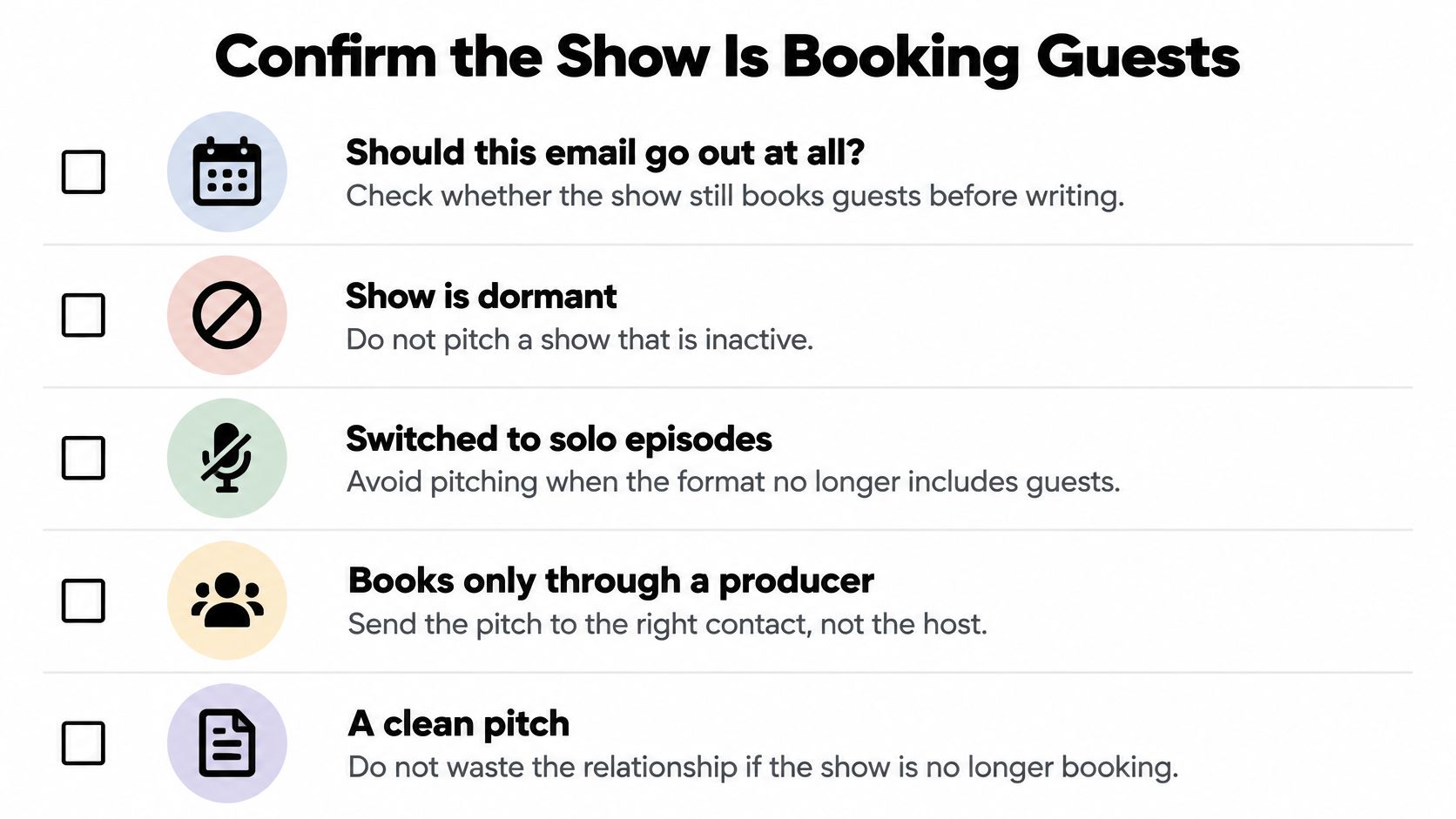
The Five Checks in Order
Work through these in sequence, and stop at the first failure.
- Confirm recent publishing. Open the feed and look at the newest episodes, not the trailer or a highlighted old interview. If the feed stalled last year, you're pitching an archive. Don't send.
- Find the route the host named. Look for a producer address, a guest application form, or a stated pitch inbox in the show notes, website, or host page. A public contact email you found somewhere else isn't an invitation.
- Check that outside guests are still part of the format. Recent episode titles and descriptions should show interviews with people beyond the host and regular co-hosts. If the last stretch is solo commentary, assume the format changed.
- Match the guest to a declared topic. The show should name the subjects it wants, or its recent episodes should cover your guest's exact area. A neighboring niche isn't a match. Climate finance doesn't automatically fit every money show.
- Decide, don't negotiate with yourself. If any check fails, don't send and hope. Move on, wait, or use the route the show offers.
That last check is where many senders stall, because they've already imagined the episode. Set the feeling aside. You'll get a clearer sense of what active booking looks like from hearing a host describe their own process.
What to Do When a Check Fails
You have three honest substitutes for sending anyway. You can wait for an episode that creates a real opening, you can use the formal form or producer route the show publishes, or you can pick a different active show. Each one protects the relationship better than a hopeful email to the wrong inbox.
Say your climate-finance founder looks perfect for a personal-finance show you admire. You open the feed and find it stopped booking guests in 2025 and now runs short solo explainers. The tempting move is to pitch anyway and argue for an exception. The better move is to choose the still-weekly investing show that ran the March green bonds episode and names a producer address for guest ideas. Same guest, same angle, but now there's a live route and a recent episode to reference.
Judgment to keep: A better target beats another adjective. No rewrite rescues a show that isn't booking.
Directory checks make this test faster. Each show in our directory is checked for whether it is still publishing and whether its host says how to pitch, so you can sort shows before you spend time drafting. If you're unsure how to tell interview shows from solo formats, read our guide to checking whether a podcast interviews guests and apply the same feed test yourself.
Sort every show into one of three outcomes. Send now to the published route. Send through the formal form or producer if that's the stated path. Drop the show and pick another if it's dormant, solo, or closed. This is the first decision because it determines whether you use the template at all.
The Five-Line Pitch and How to Draft It
By the time you open a blank draft, the hard decision is behind you. The show is publishing, it books guests, and you know which inbox it wants pitches in. The email now has one job, which is to prove that this guest belongs on this show. Five lines, in a fixed order, because the host decides in seconds whether you listened, whether the guest adds something new, and whether replying is easy. Treat the email as a fit-validation document where credentials stay subordinate to relevance.
- Subject. One to five words that name the idea, such as "Guest idea: climate finance." Keep it well under the longest subjects, which perform worst.
- Relevance. One sentence proving you heard this show, built on a recent episode or a recurring theme.
- Expertise. One sentence stating the guest's distinctive expertise or news angle. One angle only.
- Listener value. One sentence on the concrete takeaway. Name what listeners can do, ask, or decide afterward.
- Call to action. One low-friction ask, such as two recording windows or an offer to send a one-sheet. No attachment unless the host requested one.
Aim for 60 to 100 words in the body. Length is a measurable variable, and the data puts real pressure on it. In a Propel analysis of nearly 400,000 media pitches, messages of 50 to 79 words achieved a 4.16% response rate, while pitches exceeding 150 words produced only 0.16%, according to Wadds' summary of the Propel pitching analysis. Subject lines longer than 16 words performed worst in that same analysis.
There is no magic count. Every extra sentence still has to earn its place, and most credential sentences don't.
What Each Line Has to Do
| Line | Role | Length | Example |
|---|---|---|---|
| Subject | Name the idea, not the sender | About 1 to 5 words; avoid over 16 | Guest idea: climate finance |
| Relevance | Prove you heard this show | One sentence | Your March episode on green bonds stopped at policy, not founder math |
| Expertise | One distinctive angle | One sentence | I underwrite climate projects and can walk through a real term sheet |
| Listener value | Concrete takeaway | One sentence | Listeners get three questions to ask before a climate fund |
| Call to action | One easy next step | One sentence; one-sheet or two windows; no attachment | Open to 25 minutes in April, or I can send a one-sheet |
Read the table as a set of jobs to perform. The subject names the conversation, so the host can file it mentally before opening. The relevance line does the listening proof that generic praise can't do. "Love your show" could go to anyone. "Your March episode on green bonds stopped at policy, not founder math" could only go to this host, and it sets up why your guest continues a thread the audience already started.
The expertise line then has one job, which is to make the guest sound specific rather than generally qualified. "Founder and thought leader in sustainable finance" tells the host nothing about what will happen in the conversation. "I underwrite climate projects and can walk through a real term sheet" promises material. Hosts book conversations, and a title alone doesn't make one, so give them the scene, the document, the decision, or the mistake the guest can walk through on air.
Listener value is where you translate expertise into a reason to press record. Quantify the takeaway where you can. Three questions, one checklist, a two-part test, a before-and-after decision. Vague value such as "your listeners will love this" asks the host to trust you. A named takeaway lets the host picture the episode description and judge fit for their audience.
Personalization Means Two Real Attributes
Readers often trip on this point. Personalization means your email contains details that couldn't survive being sent to another show unchanged. A first name and a compliment clear no such bar. For a podcast pitch, the two attributes that matter are the specific episode or theme and the concrete connection between that content and your guest. Change those two things and the substance of the email changes.
The reply data points the same way. A 2019 analysis by Backlinko and Pitchbox examined approximately 12 million outreach emails and reported that personalized email bodies received 32.7% more replies than generic messages, a finding covered in EmailChaser's collection of cold email statistics. These are observational, vendor-side datasets, so they can't prove personalization alone causes replies. They do show a consistent relationship between customized content and response, which is enough to justify ten minutes of listening over ten minutes of adjective polishing.
The drafting tools follow that logic. A pitch draft opens on an episode of that show listed in its feed, whenever the feed lists one, so your first line starts from the host's own recent work rather than your guest's bio. A free account opens a pre-addressed draft in your mail app, and the platform never sends it. The email goes out from your own inbox, to the route the show itself publishes. Before you send, you can grade the draft against that show, and the grader returns a score with a fix for each weak line.
The Drafting Routine Step by Step
Follow this routine in order and you'll avoid the common failure modes, which are generic praise, a long life story, several possible topics, links that require the host to do research, and an ambiguous request such as "let me know your thoughts."
- Pick one episode and one specific claim from it. Listen or read the show notes closely enough to name where the conversation stopped, what it assumed, or what it left untested. That stopping point is your opening.
- Choose one subject family. Go episode-specific, such as "Following your green bonds episode," or outcome-specific, such as "Guest idea: climate finance." Pick one. You'll test the other family later on different shows.
- Write the body in table order. Relevance, expertise, listener value, ask. Don't start with your guest's name and company history, because you'll never cut it back down.
- Link a one-sheet instead of stacking proof. One link where the host can verify topics, a short bio, a photo, and past episodes beats three links and an attachment. The pitch sells the conversation. The one-sheet handles verification.
- Ask a question the host can answer in one line. "Would either of two April windows work for 25 minutes" is answerable. "Let me know your thoughts" makes the host compose your next step for you.
- Cut the second topic and the origin story. If you listed three possible angles, keep the one tied to the episode you cited. Extra options don't look generous. They look undecided, and they force the host to do your editorial work.
If you want to see this structure applied to other guest types before you draft your own, work through our podcast pitch examples and notice how each one keeps a single angle tied to a single episode.
A Complete Sample You Can Mirror
Subject: Guest idea: climate finance
Hi Maya, your March episode on green bonds explained the policy case well, but it stopped before the founder math behind a real project. I underwrite small climate projects, and I can walk through an actual term sheet, including where the returns get fragile. Your listeners would leave with three questions to ask before putting money in any climate fund. Would you be open to 25 minutes in April? I can send a one-sheet first if that's easier.
Count what that sample does. The body runs about 80 words. There's one episode reference, one angle, one named takeaway, and one ask with a softer alternative built in. There's no attachment, no awards list, and no claim that the guest is a leading voice in anything. If the host says no, the email gave them nothing to trip on, so the answer reflects fit, and fit answers are what the pre-send check exists to surface early.
Read your own draft against the sample line by line. If your relevance sentence could be sent to five other shows, rewrite it with a specific episode detail. If your expertise sentence is a job title plus years of experience, replace it with the material the guest will bring. If your value sentence promises inspiration, swap it for something listeners can use on Monday. If your closing asks for thoughts, replace it with two windows or a one-sheet offer.
Finally, run a real test. Split comparable shows between the two subject families, episode-specific and outcome-specific, while holding the body structure constant. Track delivered emails, replies, positive replies, and booked interviews separately, because a reply alone isn't a booking. Judge the test only after a sufficiently large, comparable sample. Rewriting your whole template because four hosts stayed silent teaches you nothing except how to churn.
Follow Up Once and Then Stop
Follow-up advice usually arrives as a universal cadence, and that's the wrong shape for an unsolicited podcast pitch. You're a stranger asking for airtime, not a vendor chasing a signed contract. The evidence itself disagrees enough that you should use judgment instead of a fixed sequence.
One 2025 analysis cited a first follow-up increasing replies by about 49%, with only a further 3% from the second and declining effectiveness by the third, while another benchmark claimed that four to seven follow-ups captured more than 55% of total responses, both discussed in Autobound's guide to follow-up emails. Those figures aren't directly comparable. They may use different populations, different definitions of response, and commercial cold outreach rather than podcast guest pitches. So don't import a seven-touch sales cadence into a host's inbox and call it data-driven. The conservative reading is the useful one. A first follow-up can recover attention. After that, returns shrink fast and recipient burden grows.
The Decision Table
| Attempt | When to send | What to add | When to stop |
|---|---|---|---|
| First follow-up | 4 to 7 days if fit and the route are solid | One new relevance point or a short correction, plus an opt-out | Do not resend the original unchanged |
| Second follow-up | Only with a launch, news hook, or deadline | A shorter value add than the first note | Stop if there is still no reply |
| Third or later | Usually do not send | Nothing new is likely to change the outcome | Silence is a no, not consent |
Send the first follow-up only when two conditions hold. The fit is strong, meaning the show passed every pre-send check and your angle connects to a specific episode. And the recipient has a clear submission route, so you're reminding someone who invited pitches, not interrupting someone who didn't. If either condition is shaky, your original email was the whole attempt. Let it stand.
A second follow-up needs a reason that has nothing to do with your anxiety. A book launch date, a news hook that will expire, or a recording deadline you mentioned can justify one shorter note. "Just checking in again" can't. If there's still no reply after that, stop. You've been heard or you haven't, and either way more messages won't create an opening that doesn't exist.
What Each Note Should Contain
Never forward your original email with a line on top asking whether they saw it. Each follow-up must carry something the first message didn't. That can be new relevance, such as a newer episode that sharpens your angle. It can be a concise correction, such as a fixed date or a clearer takeaway. It should always include an easy opt-out, because giving the host a graceful no makes a yes more likely and keeps the relationship intact for a future guest.
Subject lines matter here too, and replying in the original thread usually beats inventing a new one. If you do start fresh, keep it short and honest rather than disguising the follow-up as a new idea, and compare your options against tested follow-up email subject lines before you send.
Hi Maya, following up once on the climate finance idea. Your episode last week on fund fees sharpened it, since my term-sheet walkthrough shows exactly where fees eat project returns. Still happy to do 25 minutes in April, and no problem at all if the timing or topic isn't right.
That note runs about 50 words, opens with one new relevance point, and ends with a clean opt-out. It doesn't paste the original pitch below, guilt the host, or pretend to be a final attempt you'll repeat next week.
One process note. When a pitch goes quiet, the platform emails the guest a follow-up draft ready to send. That draft is a convenience, not an exemption. Read it against the same stop rule, add your one new relevance point, and delete anything that sounds like a resend. Silence after your defined attempts means move to the next show. Never treat it as consent to keep asking.
Send the Next Pitch From Your Inbox
Close the loop with one show, not a batch. Pick a show that passed the pre-send check, write the five lines, and send before you start researching the next target. Momentum matters more than a perfect spreadsheet.
- Write to 60 to 100 words using the template. One episode reference, one angle, one takeaway, one ask. If you're over, cut credentials before you cut relevance.
- Read the draft once against the checklist. One episode reference present. One ask only. No attachment. No second topic hiding in a final sentence.
- Grade the weakest line and fix only that. The Pitch grader takes a pasted pitch and returns a score with a fix for each weak line. Apply the same test by hand if you prefer. Replace a vague ask with two April windows. Add the episode title you forgot. Name the takeaway you only implied.
- Paste your one-sheet link. Guests can build a one-sheet with their topics, bio, photo and past episodes, at a link they can paste into any pitch. The host verifies fit in one click, without downloading a file from a stranger.
- Send from your own email address to the published route. Not to a personal contact you found elsewhere, and not through a form the show didn't ask you to use.
- Log the send date and mark the follow-up window. If the fit and route were solid, one follow-up falls four to seven days later. After that, the entry is done, whatever the outcome.
The free tools help users find podcasts to pitch, draft a cold pitch, grade it, and build a guest one-sheet, so you can run this whole sequence without stitching together separate documents. Use them in the order above. Find and check the show first, draft second, grade third, send fourth.
If the show isn't booking guests this month, the correct move is a different show, not a longer email. That's the decision this whole method protects. A short pitch to a live, well-matched show will beat a brilliant pitch to a closed one every time, and it respects the host enough that you can come back with a better-fitting guest later.
Find a show that's booking, draft your five lines against a real episode, and grade the weakest one before you send, all in one place at Let's Make A Podcast. You'll pitch from your own inbox to the route each host publishes, with a one-sheet link ready to paste and a single follow-up when a pitch goes quiet. Start with one well-matched show today and send the short version.