Podcast Schedule: How to Plan Releases You Can Keep

Roughly 38% of active podcasts publish every 8 to 14 days, and that fortnightly band shows the highest survival rate of any cadence in the analysis cited below. Not weekly. Not daily. Two weeks per episode is a sensible starting point.
That is a starting point, not a guarantee. The survival figures show an association, not proof that publishing every two weeks keeps a podcast alive. Your schedule has to fit the work between episodes: guest booking, recording, editing and approvals.
Plan backward from the release date, then check whether the time available covers each step. A weekly schedule can fail if a guest needs more time to book or approve an episode. Set the cadence only after you know how many hours and days those dependencies require.
Table of Contents
- Pick a Release Cadence You Can Actually Keep
- How to Build the Schedule Backward from Release Day
- Separate Recording, Release and Promotion Dates
- Book Guests Within Your Lead Times
- Set Up an Editorial Calendar and Scheduling Tools
- Diagnose Slipping Releases and Confirm Your Cadence
Pick a Release Cadence You Can Actually Keep
Before you choose, look at what active shows do. The Podder episode pacing benchmarks show 34% of active podcasts released every 3 to 7 days and 38% published every 8 to 14 days. Together those two bands are 72% of active shows. Only 7% published every 0 to 2 days, 20% every 15 to 29 days, and 2% less often than monthly.
Daily publishing isn't the norm. It's a rounding error with a content team behind it.
The caution on that dataset matters: it measures gaps between published episodes on one hosting platform, not whether a show advertises a fixed weekday. Platform users aren't every podcast globally. Read it as observed behaviour among active shows, not as an ideal.
The survival numbers have the same limit, and a bigger one. One cited analysis of shows with at least four episodes found the highest survival rate for approximately biweekly publishing at 44%, against 39% weekly, 40% monthly and 28% daily, per Inside Audio Marketing's breakdown of the staying-power data. Those are associations. Nobody randomised shows into daily publishing. It may equally be true that daily output requires a team, and shows with teams survive for reasons unrelated to frequency.
Here's how the options stack up.
| Release gap | Share of active shows | Survival rate (shows with 4+ episodes) | What it demands |
|---|---|---|---|
| Every 0-2 days | 7% | 28% (daily) | Very high output; rarely sustainable for an interview show |
| Every 3-7 days | 34% | 39% (weekly) | A guest or recording slot nearly every week |
| Every 8-14 days | 38% | 44% (biweekly) | About 14 days for booking, editing and promotion |
| Every 15-29 days | 20% | 40% (monthly) | Time for deeper edits; weaker habit for listeners |
| Less than monthly | 2% | No separate figure published | Rarely chosen by active shows |
The last row is the honest one. The analysis didn't report a survival rate for shows publishing less than monthly, and I'm not going to invent one.
So the decision rule. Count the actual hours for one episode: outreach emails, prep doc, recording, edit passes, show notes, approvals, promotion. Multiply by four to get a monthly figure. Then pick the fastest cadence that still leaves room for a listen-through before each release. If the hours say you can produce 2.2 episodes a month, you publish two.
For an interview show with no full-time editor, biweekly is the sensible default, and not because the survival data says so. Because it gives roughly 14 days per episode: enough for a guest to confirm, reschedule once, approve the cut, and still leave three days of slack.
The test I'd use: if your on-time release rate falls below target for two cycles in a row, slow the cadence. Never speed the edit to protect the promise.
How to Build the Schedule Backward from Release Day
A release date only works if every step before it has room to finish. Set the publication deadline first, then work backward through editing, recording, guest preparation and booking. That makes the actual constraints visible: how long a guest takes to confirm and how many editing hours you can fit between episodes.
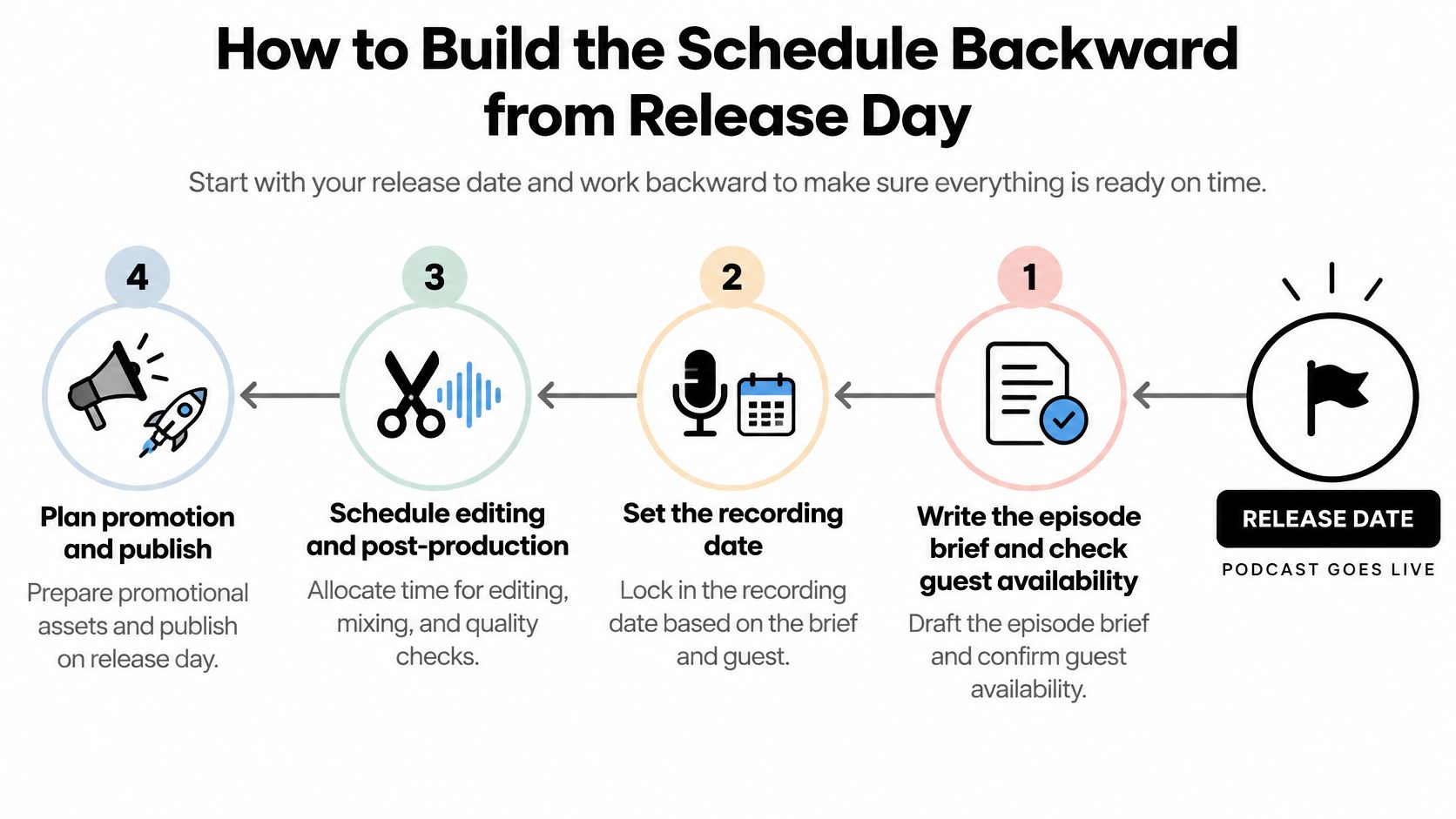
1. Set the release deadline and work backward. Put the publication date on the calendar, then reserve time for the final quality check and publishing tasks. The time left before those deadlines is what you can allocate to the recording and edit.
2. Write the episode brief and check guest fit. Define the topic, angle and contribution you need from the guest. A short brief can expose a mismatch before you spend time booking and recording. Name the risk plainly: a guest may be well known but have little overlap with the episode's subject.
3. Contact the guest early and allow for delays. Guest confirmation is a real dependency, not a box to tick on recording day. Leave room for slow replies, scheduling conflicts and a backup date. If the guest has not confirmed, the recording slot is not secure.
4. Prepare questions and check the setup before recording. Complete research, draft questions and test microphones, internet and backup recording. A brief technical check can prevent a lost session or a recording that needs to be repeated.
5. Record, then verify the files. Check that the main recording and any local backups are usable before ending the day. That gives you time to address a missing or corrupted file while the guest is still available.
6. Reserve editing time and a full quality-control listen. Editing hours depend on the episode and the amount of cleanup it needs, so use your own recent episodes to estimate the work. Schedule the listen-through after the edit, not in the same block. If editing repeatedly consumes the time reserved for the next release, the cadence is too tight for your available hours.
7. Leave a final block for publishing tasks. Complete show notes, metadata, chapters, links and distribution before the release deadline. Keep these tasks on the calendar; otherwise, they get pushed aside when editing runs late.
The schedule should include slack for the parts you do not control, especially guest replies and revisions. Add the steps and owners to a podcast production checklist, then check whether the work fits the hours available before release. A biweekly show, for example, needs enough time each cycle for booking, recording, editing, review and publishing, not just a recording slot.
Practical rule: Keep a recorded episode in reserve if you can. A delay then uses up your buffer instead of immediately becoming a missed release.
For a biweekly Tuesday show, the calendar might put recording on Monday of week one, editing later that week, and the final listen and publishing tasks before Tuesday's release in week two. Assign each deadline to a person, and leave time between the edit and publication for corrections.
Separate Recording, Release and Promotion Dates
One date on the calendar hides four, and each has a different owner. Collapse them and you'll be negotiating with a guest about promotion on release morning.
The recording date is owned by guest availability and your studio time. It's day zero of the cycle.
The publication date belongs to your slot. In this workflow it lands 7 to 14 days after recording, which is what the edit window buys you.
The promotion window is yours. Socials, newsletter, the guest's own audience. It opens two or three days before release, because assets have to exist before anyone can share them.
The guest embargo date is the day the guest may post their clip, and it gets agreed in writing before the publication date is confirmed. Not after. If the guest believes it's theirs to post when they like, your release day gets pre-empted by the guest's own audience.
The audience data explains why this coordination matters more than hour-level timing. In a Fall 2025 survey, 23% of weekly podcast consumers said they listen immediately after release, and 78% consumed new episodes within one day, per Cumulus Media and Signal Hill's podcast download insights. Most listeners arrive within 24 hours rather than at one exact moment. So the gain comes from a dependable window and coordinated guest promotion, not from chasing a specific hour.
Now the slip. A recording moves from Monday to Thursday. The edit due date absorbs three days or it doesn't. If it doesn't, the embargo shifts three days, the promotion window shifts three days, and the publication date has to move too. If the edit window can take the hit, the release date holds and everything else moves as planned.
A publication date moves only when the embargo date moves with it. Treat them as one object.
One habit kills the time-zone confusion: state every date in both the host's time zone and the guest's local time, in the invite itself, not in a follow-up. A guest in Berlin reading "2pm" needs the offset spelled out, and so do you.
Book Guests Within Your Lead Times
Guest booking is the bottleneck in most interview shows, and it's the one producers plan around least. Confirmations slip. One reschedule cascades into two. A no-show empties a week you'd already announced.
Start with the working rule: allow 3 to 10 days from first contact to a confirmed recording for a guest who is already interested, extending it for busy guests or cold outreach. That figure comes from a production-planning benchmark that treats booking as a stage with its own duration rather than an errand.
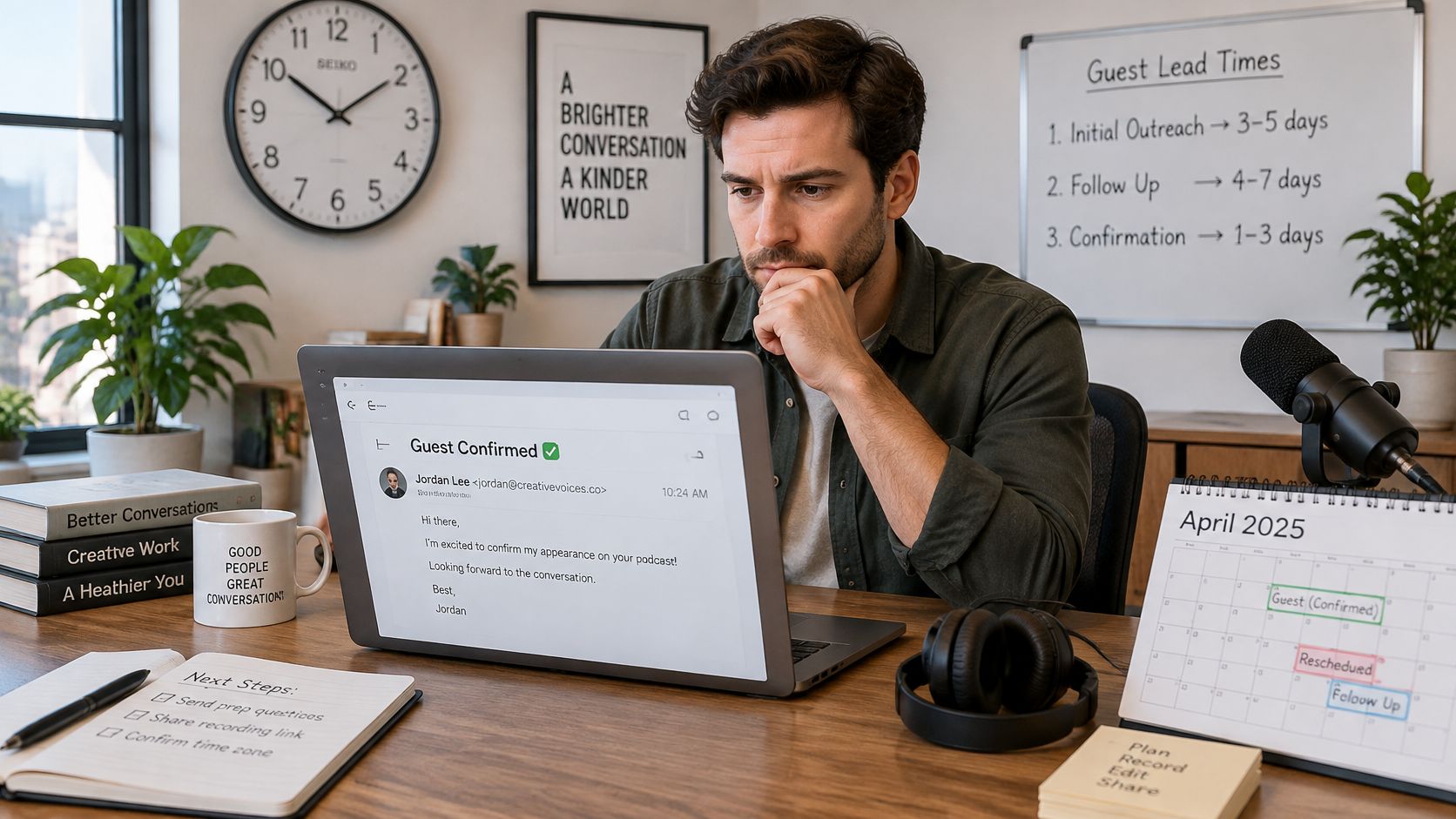
Then build the reserve. Two recorded episodes in hand, recording slots opened about three weeks ahead. That's the structure that lets a cancellation get swapped instead of absorbed.
A backup guest for every slot, with a date agreed before the first invite goes out. Not a name on a list. A date.
The habits that protect a booking:
- One clear invite. Recording time in the guest's time zone, a link to reschedule, a short prep note. Not four emails over a week.
- Confirm 48 hours out. A single line: still good for Thursday? It catches the ones who forgot without making them feel chased.
- Log every slip. Guest, first contact date, confirmation date. After ten bookings you'll know your real lead time instead of guessing at it.
If more than one booking in four slips, extend the lead time in the schedule. Do not push the publication date.
Then batch. Book two or three guests into one recording block on the same day, sized to your two-episode reserve, so one studio setup fills several release slots. Setup, checks and teardown happen once. Edit all episodes from that block together for the same reason: open the session once, work through them in order, and each episode still meets its own edit due date. If you're still building the outreach list, a guide to finding podcast guests covers where the qualified ones originate.
Set Up an Editorial Calendar and Scheduling Tools
A calendar only works when each episode has one row, every date on it, and a named owner. Split across a doc, a notes app and your inbox, it's not a calendar, it's a rumour.
| Field | What to enter | What it protects |
|---|---|---|
| Episode and topic | Number, working title and guest fit | Keeps the brief clear before outreach starts |
| Guest and backup guest | Names and confirmation status | Stops one cancellation from emptying a slot |
| Recording date and time zone | Date, start time and both time zones | Prevents missed sessions across regions |
| Edit and approval dates | Due date for editing and sign-off | Stops late approvals delaying the release |
| Publication date | Scheduled release day and time | Holds the public cadence |
| Promotion window and embargo | Start date for promotion and guest clearance date | Keeps guest and audience promotion aligned |
| Status | Booked, recorded, edited, scheduled or published | Shows slips at a glance |
The backup guest field is the one that pays for itself. It converts "our guest cancelled" into "we're recording the alternate on Thursday". The approval date is the second: a guest who signs off on Friday afternoon rather than Monday morning is the difference between publishing and not.
Tool roles, kept separate on purpose. A shared calendar holds dates and owners. A booking link handles guest availability without a five-email exchange. Your hosting platform's scheduled publishing holds the release date in advance so release day isn't a task at all. A task list carries the editing and show-note steps, because those don't live naturally in a calendar. If you're choosing between scheduling options, this comparison of interview scheduling tools is the place to start.
One worked row for a biweekly Tuesday show: record Monday, edit by Thursday of the following week, approve Friday, publish the Tuesday after that, promote from the Sunday before. Every date is derived from the release date, which is why a single moved recording doesn't break the chain.
The habit that makes it work: check the calendar every Friday and mark slipped items before the next cycle starts. Ten minutes. It's the difference between noticing a slip on Friday and discovering it on release morning.
Diagnose Slipping Releases and Confirm Your Cadence
Most missed releases aren't surprises. They have an early sign weeks before the date, and the signs cluster.
| Slip | Early sign | Fix |
|---|---|---|
| Guests confirm late | Invites going out less than a week before the recording slot | Raise the booking lead time and hold a backup guest |
| Editing runs long | Edit hours exceed the 2 to 5 day budget for several episodes | Track edit hours for three cycles before changing cadence |
| Releases go out unchecked | Errors reach listeners after publication | Add a fixed listen-through day before the publication date |
The editing row deserves a warning. The instinct when you're running late is to cut the edit, and that's the wrong lever. Editing hours are the most reliable signal you have about whether your cadence is real. Track them for three cycles before you touch frequency, because one long edit is a bad week and three long edits are a capacity problem.
The same applies to any cadence change. Before you move from weekly to biweekly or back, record four things across at least three release cycles: labor hours per episode, on-time release rate, episode completion, and listener response. Then the decision rests on evidence. Change cadence after one bad week and you'll chase your own noise for a year.
On cadence data generally: the survival figures and the publishing-gap shares describe what active shows do. Neither proves that changing your frequency will change your outcome.
If dates keep slipping, apply the two-cycle test: two consecutive cycles below target on-time rate, and you slow down. Rushing the edit to protect a cadence is how quality problems get published permanently.
One action for this week. Pick a cadence from the first table. Write the release dates for your next three episodes. Count backward through the seven-step workflow and put every date on one page. Then mark two backup recording slots on the calendar. That's the entire setup, and it takes under an hour.
Then run the Friday review: check the status column against those dates and flag any slip before the next cycle starts. A podcast schedule isn't a promise you make once. It's a document you correct every week, which is exactly why it survives.
If you're planning releases around guest interviews, Let's Make A Podcast gives you the directory and the scheduling pieces in one place: show listings built from public RSS feeds that flag which podcasts are still publishing and which print a contact route, plus pitch drafting, a show readiness check and a guest finder among the free tools. You can search real podcasts by topic with no account, then keep invites, messaging and calendar coordination in a single thread so the recording date you agreed is the one on your calendar. Start with the free search and see which shows in your niche are booking guests this quarter.