How to Find Podcast Guests: Verify, Pitch and Book Them
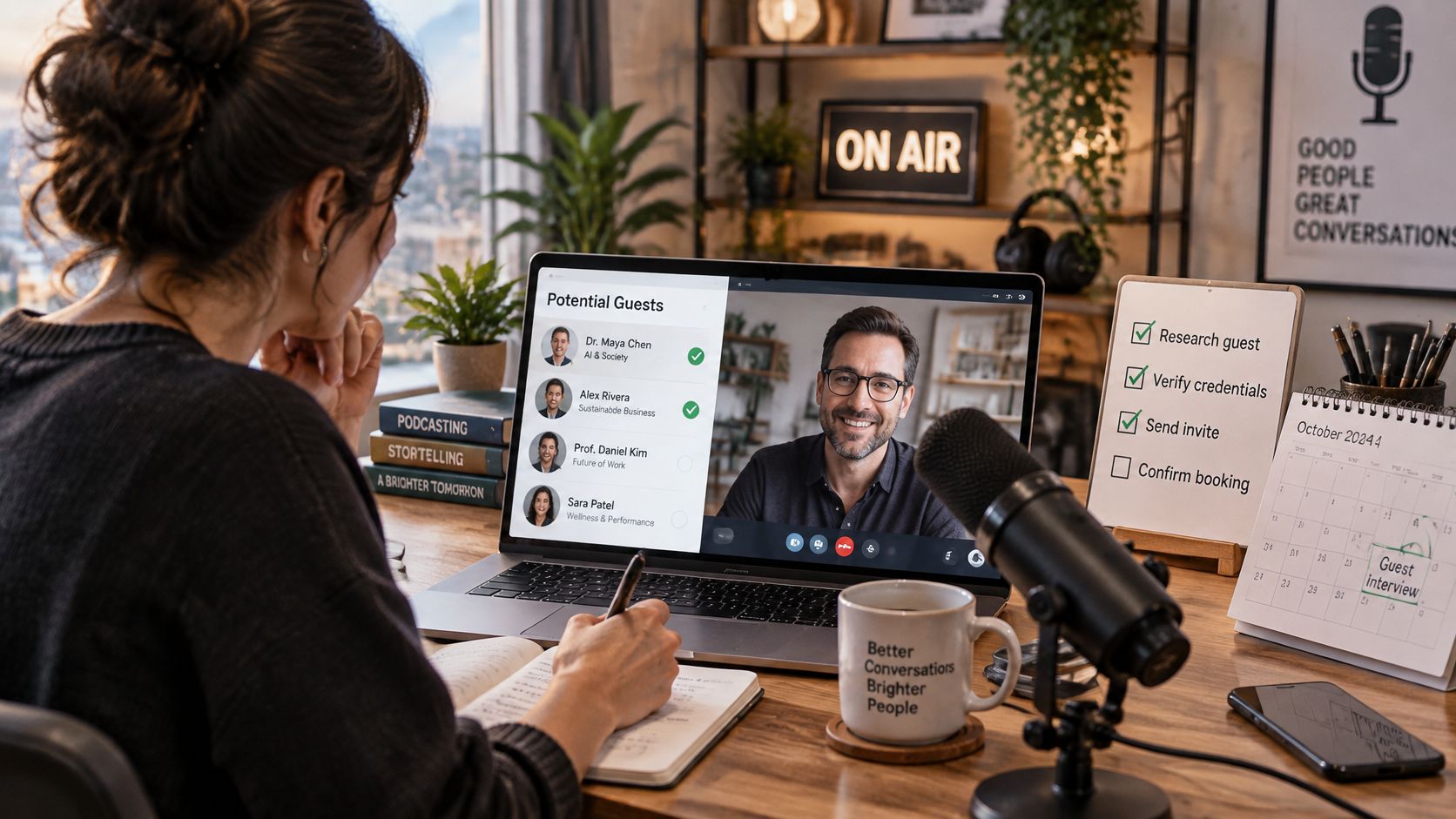
Most advice on how to find podcast guests starts in the wrong place. Search a directory, skim LinkedIn, write a warmer email, then blast it at fifty shows. A better sentence cannot rescue a show that stopped publishing, never interviews outsiders, or hides its contact route. I would not personalize a single line until those three facts are confirmed. Audience size is a later filter. Availability comes first.
Table of Contents
- Check Whether a Show Books Outside Guests
- Build a Shortlist of Guests Who Fit Your Episodes
- Write a Pitch and Follow Up Without Noise
- Build a Guest One-Sheet Hosts Can Use
- Schedule and Onboard Guests Without Email Ping-Pong
- Fix Common Problems in Guest Booking
- Build Your First Five-Guest Shortlist This Week
Check Whether a Show Books Outside Guests
Verification, not pitch writing, is where most outreach dies. Hosts still fill seats from people they already know. In a Buzzsprout survey on getting booked, 69.7% of respondents said their last three guests came from their own network, while only 28.0% cited cold-email pitches and 22.5% cited podcast guest platforms. A cold list is worth personalizing only after you filter it.
Work the checks in order. A fail on recent publishing ends the record. A fail on two of the other four checks sends the show to a reserve list, not this week's send.
| Check | Where to look | Pass signal | Red flag |
|---|---|---|---|
| Recent publishing | Latest episode date in the feed or Apple Podcasts | Episode within the last six months | No episode in six months |
| Reachable contact route | Show notes, About page, or stated submission page | Working email or form the show publishes | Only social DMs, or no route |
| Accepts outside guests | Titles and guest names of the last 10 episodes | At least two outside guests recently | Only co-hosts or solo episodes |
| Format fit | First three episodes and the show description | Interview format that suits the expertise | Panel or solo-only format |
| Booking lead time | Guest page, show notes, or one short question to the host | Stated booking window | No window and no reply to a short question |
Where each signal actually lives
Recent publishing is the date on the newest episode in the RSS feed or the Apple Podcasts listing. Six months of silence means the inbox is not a booking desk.
Contact route sits on the About page, in show notes, or on a page the show itself names. A host page that lists the guest topics they want is a stronger signal than a generic "contact us" footer. Social DMs are not a route you can track.
Outside guests show up in episode titles and named guests across the last ten episodes. Two recent outsiders is a pass. A run of solo or co-host episodes is a closed door.
Format is visible in the first three episodes plus the show description. If the show is a panel or a monologue, your expert interview will not fit, no matter how relevant the topic sounds.
Lead time is either printed on a guest page or answered by one short question. No window and no reply means you cannot plan a recording date.
Practical rule: Drop any show with no episode in six months. Park anything that fails two other checks. Personalize only what is left.
Build a Shortlist of Guests Who Fit Your Episodes
A guest list is useless until the episode is fixed. Write the brief before you open a search box, then score people against that sentence, not against follower counts.
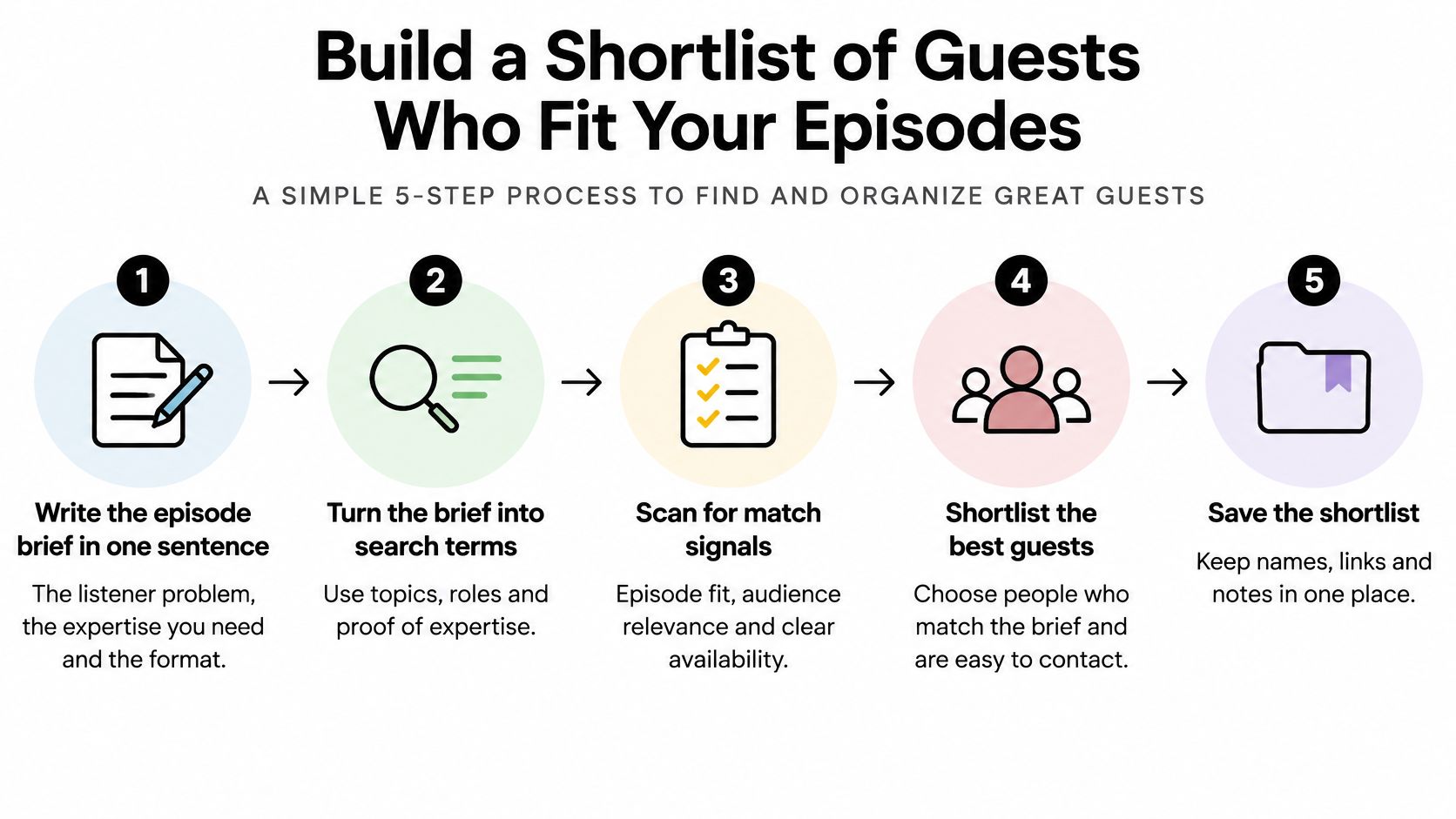
- Write the brief in one sentence. Name the listener problem, the expertise you need, and the format: a 30-minute interview, a solo expert, or a panel. A cybersecurity show might need "a practitioner who has run an incident response for a mid-size firm, in a 40-minute interview." That sentence stops you from collecting famous names who cannot answer it.
- Pull candidates from five places. Take guests who already appeared on adjacent shows, speakers from a recent conference in the niche, authors of a current book or journal article, officers of a professional association, and referrals from guests you have already recorded. A conference speaker with a published case study is usually easier to brief than a celebrity with a vague "thought leadership" bio.
- Score three things, and only three. You want one verifiable expertise signal (a book, a published study, or a named role), one angle your audience would ask about, and one reason this conversation belongs on this show. If any of the three is missing, the name stays off the active list. For a fuller pass on proof and red flags, use a guest vetting checklist before you spend time on outreach.
- Cut reach without depth. A large following is not expertise. Favour people peers cite, quote, or invite back. A lab lead with two cited papers will usually give a tighter episode than an influencer recycling the same three talking points.
- Balance the pool on purpose. A USC Annenberg study of hosts and guests found that 72.8% of guests across episodes of the top 100 podcasts in 2024 were men and 27.2% were women. Check the gender and background mix of your own sheet, then add women and underrepresented practitioners who already meet the three scores. Do not treat that as a quota bolted on after the "real" list is done.
- Log the row, then keep reserves. Columns that matter: source, expertise proof, contact route, last relevant episode or publication, pitch date, follow-up date, and outcome. Keep three reserve names for every booking slot. Cancellations are normal. A reserve list means you do not restart research on a Thursday night.
A candidate without one proof point, one audience angle, and one show-specific reason is not a candidate yet.
Write a Pitch and Follow Up Without Noise
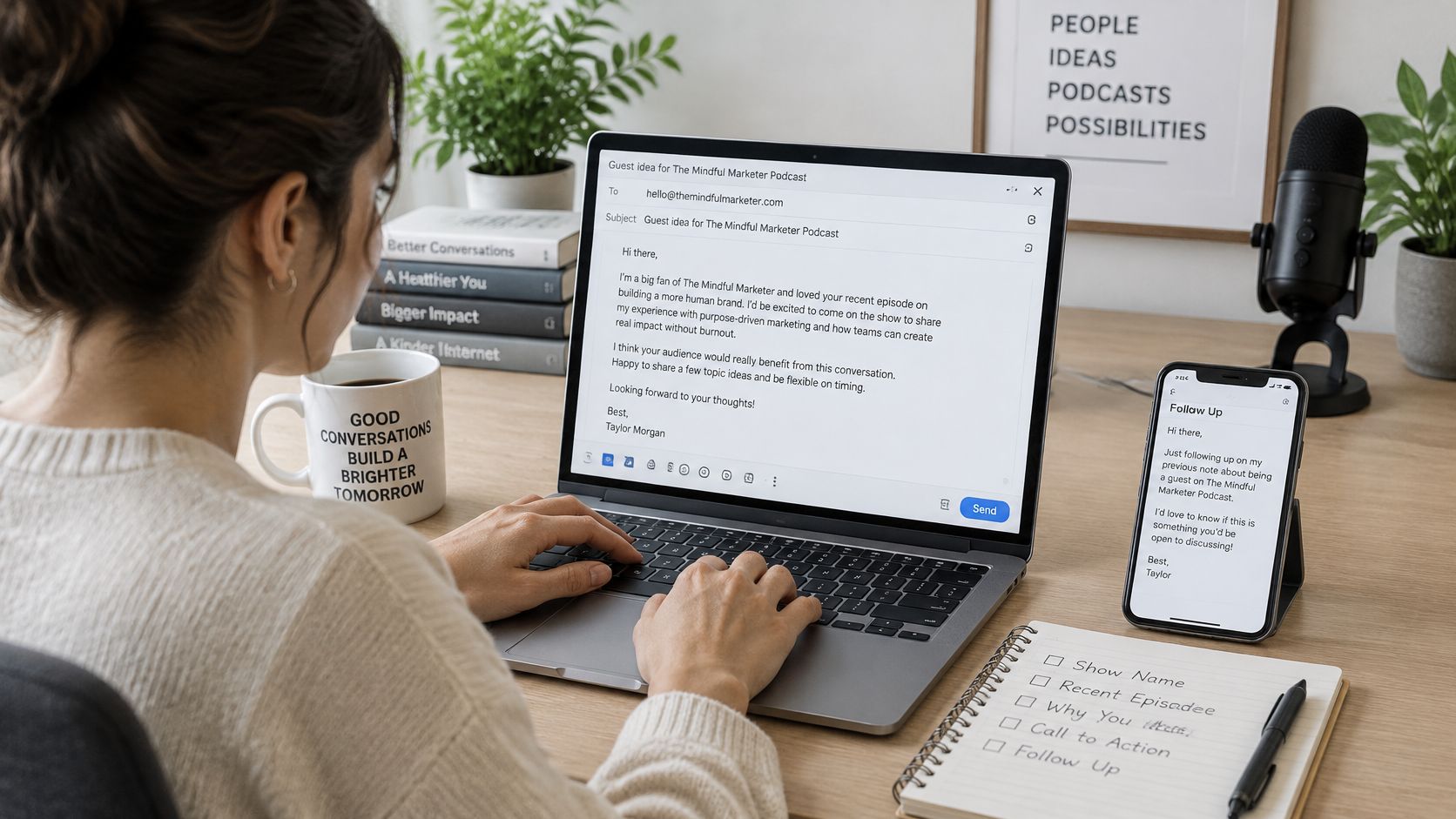
A pitch that could be sent to any show should not be sent to any show. Keep it under 150 words, send it from your own inbox, and send it only to the route the show itself publishes.
A 5,187-email study in Journal of Businesses reported an average response rate of 15% and tied shorter messages, plus personalization using the recipient's identity, company, and location, to higher response rates. The same benchmark set found that 58% of replies arrive after the first email. First-touch silence is incomplete data, not a verdict.
Five parts, in this order
- Subject line: Name the show, not your job title.
- Episode line: One sentence on a recent episode or a recurring theme. "I would love to be on your show" tells the host nothing. "Your episode on warehouse injuries never asked how small teams staff the night shift" does.
- Evidence line: One sentence on a book, a study, a role, or a result the guest can defend.
- Two angles: Write them as questions the host could ask, matched to topics the show already covers.
- One ask: A low-friction next step, such as a 30-minute call on a named topic.
Before you send, spell-check the episode title, the host's name, and the show name. Cut any bio longer than three sentences, any claim you cannot source, unrelated media links, and attachments. A longer walk-through of tone and structure sits in this podcast guest outreach email guide.
Seeing the shape of a tight note helps more than another template. This short walkthrough shows how a specific episode reference replaces a generic compliment.
Follow up twice, then stop
| Touch | Timing | What it adds | Stop if |
|---|---|---|---|
| Initial pitch | Day 0 | Episode reference, guest evidence, two angles, and one call to action | Never skip the personalization |
| First follow-up | Day 5 to 7 | One new point of relevance, such as a recent episode or data point | The host declines or replies |
| Second follow-up | Day 12 to 14 | A short close that offers an easy way to say no | The host declines, replies, or stays silent |
Track pitches sent, replies, positive replies, booked calls, and completed recordings. Booking rate matters more than reply rate. A high reply rate can still mean weak episode fit. Each month, compare reply and booking rates by segment and by opening line, then reuse only the opening line that booked.
Build a Guest One-Sheet Hosts Can Use
A host should be able to introduce the guest without writing back. One page, scannable in under a minute, delivered as a PDF and as a shareable link.
- Header. Full name, pronunciation written phonetically, and a role line with one proof point: a book, a published study, or a named position.
- Photo and links. A headshot at web resolution, a website, and one social handle. Skip a gallery.
- Bio. Three sentences at most, third person. If it needs a fourth sentence, the first three are doing too little.
- Topics as listener questions. Three to five subjects, each framed the way a listener would ask. "How do small clinics staff overnight triage?" beats "healthcare operations."
- Proof of range. Two or three past episodes or talks, with links, chosen so they do not repeat the same story.
- Logistics. Preferred format, length, and time zone, written out, not abbreviated into a guess.
- Producer contact. One route a producer can use if the recording link breaks.
Strip any claim you cannot source. After each recording, swap in the new episode and drop the oldest link so the sheet does not advertise a talk from four years ago as if it were current.
Say the guest is a supply-chain director. The header carries the company role and a line on a published disruption case. The questions cover buffer stock, supplier audits, and what failed in the last port closure. The host can pick one question and start, without a second email asking "so what do you talk about?"
Schedule and Onboard Guests Without Email Ping-Pong
A yes that sits in an inbox for a week often becomes a no. Move from agreement to a dated slot with as few messages as possible.
- Offer two links, not a calendar negotiation. One books a 15-minute qualification call. The other books the longer recording slot. Separate links stop a "when are you free?" thread that dies after three replies.
- Send a short pre-interview form. Ask for the topic, who the audience is, how to pronounce the guest's name, a website, and a headshot. Five fields, not a questionnaire.
- Attach the one-sheet as a link or PDF. Topics, bio, photo, and past episodes let the host write a true introduction instead of reading a LinkedIn headline on air.
- Confirm 24 hours out. Restate the recording link and write the time zone in words ("3:00 p.m. US Eastern"), not a bare clock time.
- Send the outline 3 to 5 days before. A question list or topic outline is enough. Ask the guest to test headphones and the connection the day before, not five minutes prior.
- Set the recording standard in the same note. Quiet room, headphones instead of speakers, and a local backup audio file if the platform drops.
What the confirmation email must contain
Date, time zone, length, recording link, prep materials, and who to contact if anything changes. Leave one of those out and you will get a "just checking" reply you could have prevented. A sample layout is in this podcast guest confirmation email note.
The trade-off is real. Two links and a form feel stricter than "reply with times that work." They also remove the ping-pong that loses guests who said yes and then got busy. I would rather lose a guest who will not pick a link than spend a week chasing one who will not commit.
Fix Common Problems in Guest Booking
Match the symptom to one cause before you rewrite anything. Changing the subject line, the guest, and the follow-up in the same week tells you nothing.
| Symptom | Likely cause | Fix |
|---|---|---|
| Almost no replies to any pitch | Show is dormant or has no working route | Re-run the verification checklist and drop shows with no episode in six months |
| Replies but no bookings | Vague ask or weak episode fit | Offer two specific angles and a 30-minute call on a named topic |
| Polite but vague replies | Pitch is too generic | Name a specific recent episode in the first sentence |
| Guests say yes, then go silent | Scheduling friction | Send the two-link scheduling option and the prep pack within 24 hours |
| Hosts keep declining candidates | Shortlist too broad or celebrity-heavy | Re-score candidates on the three checks and cut profiles without depth |
| Follow-ups get no reply | Repeated messages add nothing new | Add one new point, or stop after two follow-ups |
How to read the row
Silence across the whole batch is almost never a writing problem. A producer sends thirty notes, hears nothing, then finds that many targets have not published in six months. Cutting those shows raises the reply rate on what remains, without a new template.
Polite fog ("sounds interesting, maybe later") means the first sentence did not prove you listened. Name one recent episode and one question that episode left open.
Yes, then nothing is a calendar problem. The two links and the prep pack should leave within 24 hours of the yes. Waiting until "things calm down" is how a booked guest becomes a ghost.
Repeated host rejections mean the shortlist was wide or famous. Re-score on expertise proof, audience angle, and show fit. Drop the profiles that only have reach.
Change one variable at a time. Wait through a full follow-up cycle before you judge the batch. A new subject line sent on day 2 of an old sequence muddies both tests.
Build Your First Five-Guest Shortlist This Week
A week with dates beats another afternoon of browsing.
- Day 1: Write the one-sentence brief and lock the format.
- Day 2: Build 20 names from adjacent shows, conference lists, recent books or articles, associations, and past-guest referrals.
- Day 3: Run the five checks. Keep the five to eight that pass.
- Day 4: Send five personalized pitches from your own inbox, each short, each tied to a real episode.
- Day 7: First follow-up, one new point only.
- Day 14: Last follow-up or a clean close, then log every outcome.
Do not add a sixth pitch "while you are in there." Five finished threads teach you more than twenty half-written ones.
If you want the filtering done against a fixed directory instead of a fresh search each morning, our shortlist tool narrows 408 shows to those still publishing, reachable, and showing evidence they book outside guests, at no cost and without buying a list. A pitch generator and a show readiness check can draft and pressure-test the note before it leaves your inbox. Hosts who want a show listed, or want to claim a listing already there, can email the show and its feed to hello@letsmakeapodcast.com.
Let's Make A Podcast is a two-sided marketplace for hosts who need qualified guests and for guests who need shows that are booking. The directory, one-sheets, and pitching tools are built around the same checks this guide uses: recent publishing, a real contact route, and evidence the show interviews outsiders. Start with the free tools, or browse active shows, at Let's Make A Podcast.