Podcast Contact List: 10 Sources for Finding Guest Spots
Only 54.5% of 490 shows had featured a guest in at least one of their last ten episodes, according to an analysis discussed by Kite. That's the weakness in a typical podcast contact list: finding a show isn't the same as finding an interview opportunity.
A directory entry can tell you that a podcast exists. It may not tell you whether the host still publishes, interviews outside experts, or accepts unsolicited pitches. Even a working email address doesn't answer those questions. A producer's guest application form can be more useful than a host's personal inbox if that's where the team reviews proposals.
The useful question: What evidence suggests this show might book you, and what route does the host want you to use?
The sources below fall into different categories: downloadable lists, research databases, opportunity newsletters, and host-guest marketplaces. They're not interchangeable. Some help you uncover obscure niche shows; others help you reach hosts who've explicitly requested guests.
Judge each by guest activity, contact usability, and topic fit, not catalog size alone. Paid access can save research time, but it doesn't buy editorial interest. Where pricing or access terms aren't established, treat them as a purchasing question rather than assuming that search, contact details, and exports come together.
Table of Contents
- 1. Let's Make A Podcast
- 2. Podcastquery
- 3. Podseeker
- 4. Rephonic
- 5. MillionPodcasts
- 6. Podchaser Pro
- 7. Muck Rack
- 8. Feedspot Podcast Database
- 9. PodcastGuests.com
- 10. PodMatch
- How the 10 podcast contact sources compare on price, free access, and guest-booking signals
- Turning Your Podcast Contact List Into Booked Interviews
1. Let's Make A Podcast
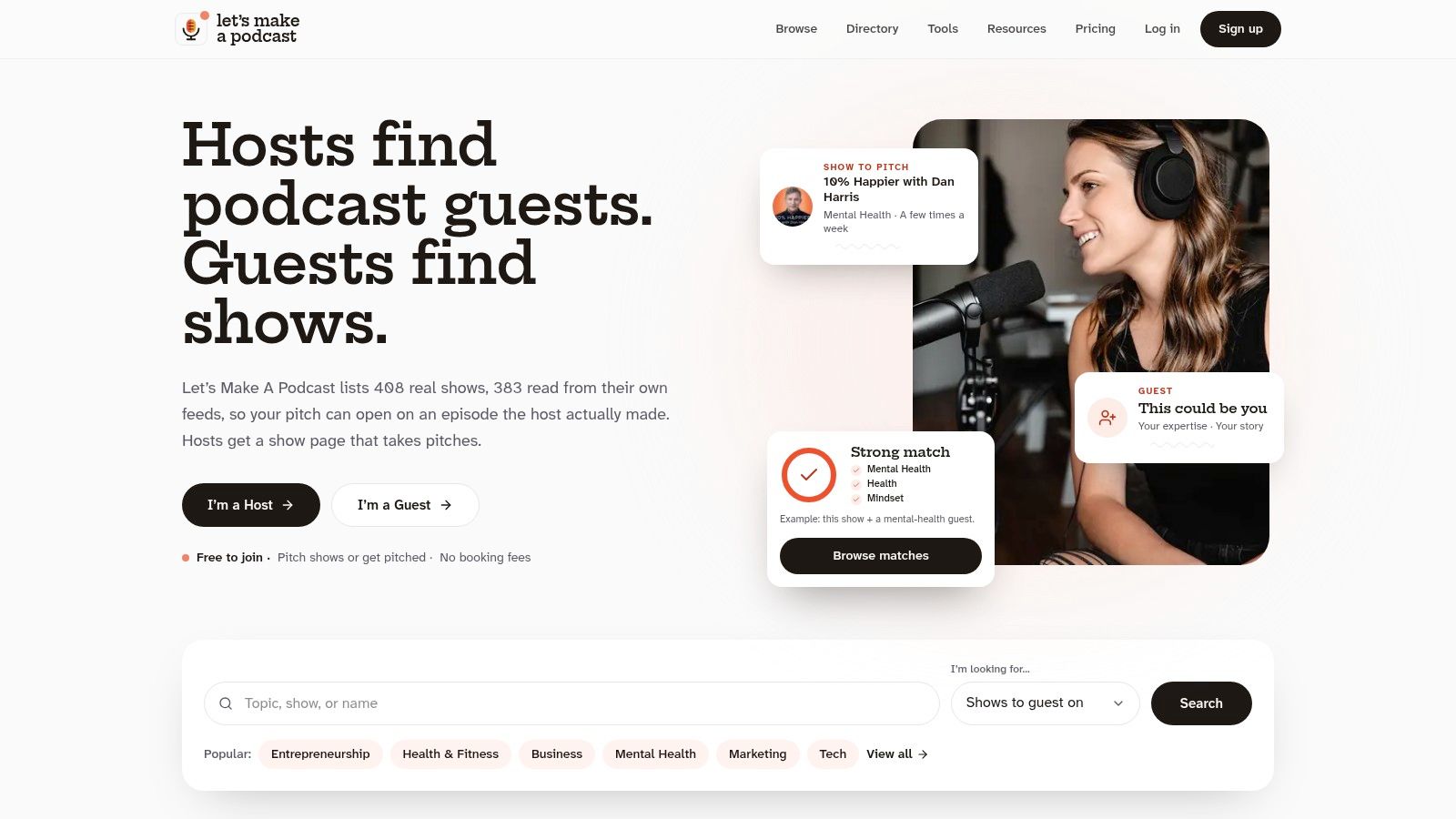
Best for guests who want to qualify a manageable shortlist before pitching. Our approach starts with the distinction between a listed show and a reachable, active prospect.
We read 383 public podcast feeds from our 408-show directory. Of the directory's shows, 246 had published in the last six months and printed a contact route a stranger could use. Those are useful qualification signals, not promises that the hosts are accepting every relevant proposal.
Our free, no-account search and shortlist tools help you identify publishing activity, available contact routes, and evidence of outside guests. Guests can create a shareable one-sheet, draft pitches tied to recent episodes, and manage outreach; hosts can publish profiles and coordinate conversations through messaging and scheduling. Joining and core connections are free, with no booking fees, while optional paid features require checking their current terms.
What the feed check does and doesn't establish
We don't print a podcast's contact address on its public listing page. A contact-route signal therefore shouldn't be mistaken for a downloadable email record. Listings include episodes read from the public feed and a guest-fit snapshot, so you can inspect the underlying context before deciding to pitch.
- Strength: Publishing checks and guest evidence make the directory more useful than an undifferentiated collection of show names.
- Limit: A focused directory won't replace broad discovery for every specialist subject or international market.
- Best practice: Read the show's stated submission instructions and inspect recent interviews before treating it as an open opportunity.
Hosts can also claim, correct, or remove their listings. That matters because feed-derived evidence needs human correction when a format, producer, or submission policy changes.
2. Podcastquery
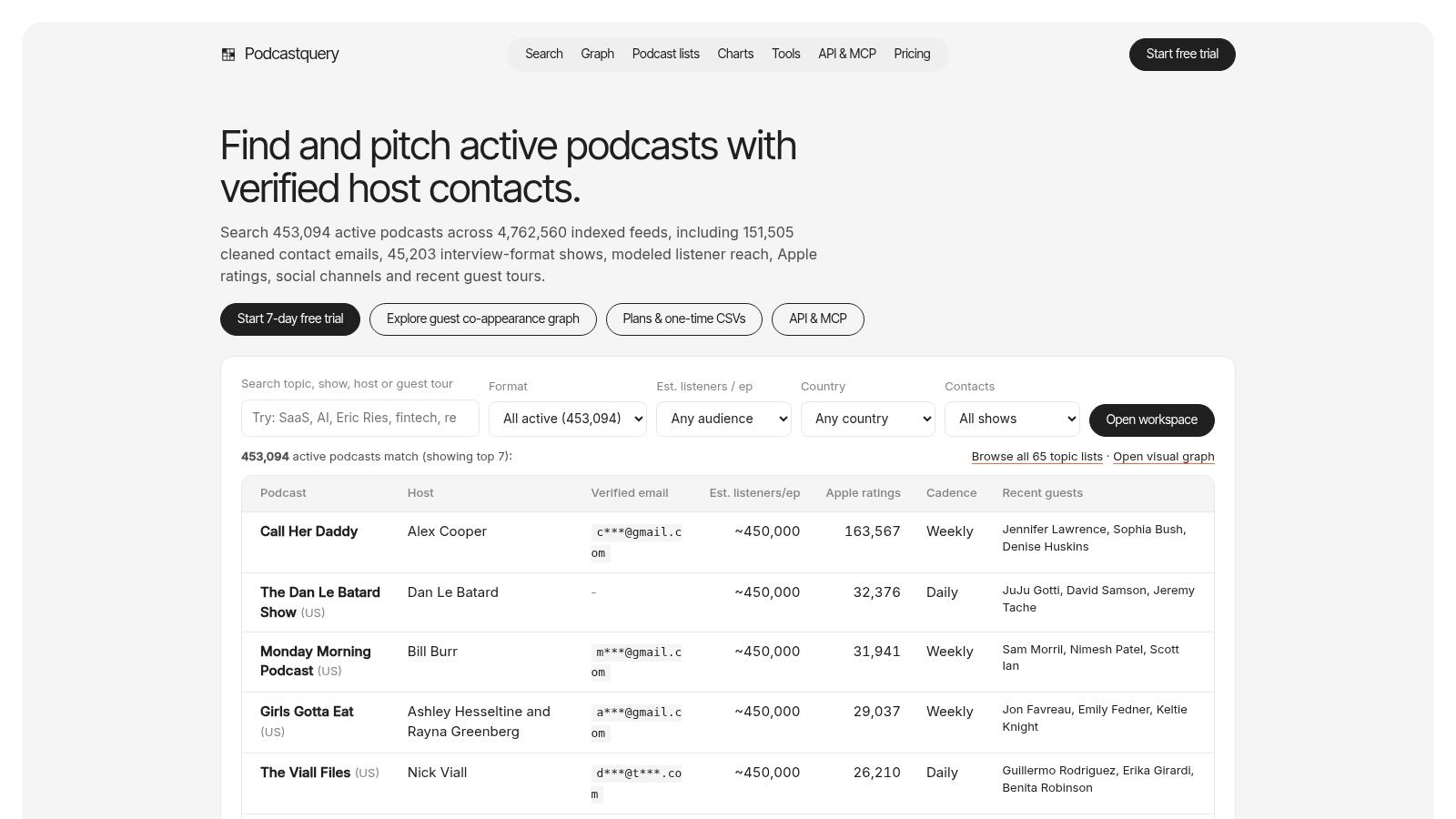
If you want a spreadsheet rather than another campaign platform, Podcastquery is a practical candidate. It offers topic- and category-based downloadable contact lists alongside a separate searchable workspace.
Its interview-focused records combine recent guest information with checked host or show emails. That's a stronger starting point than a category label alone: you can inspect whether the show's actual conversations resemble the interview you're proposing.
The trade-off is ownership of the next step. Once you download a CSV, you're responsible for updating publishing activity, recording replies, and removing contacts who decline further outreach.
Inspect the sample before buying
Use sample rows to test the fields you'll need, not just the appearance of the spreadsheet.
- Guest evidence: Does the record identify recent interviewees and give you enough context to verify their relevance?
- Contact quality: Is the address associated with the show, host, or producer, and is there a more specific guest-submission route?
- Working context: Can you filter by country and publishing frequency without rebuilding the list yourself?
Pricing model: One-time CSV purchases suit occasional campaigns; the workspace is a separate subscription. Confirm current checkout prices and what each purchase includes.
I'd choose this format for a tightly scoped campaign managed in an existing CRM. I wouldn't buy a broad category export and pitch every row unchanged. Recent interviews establish a format, not an invitation.
3. Podseeker
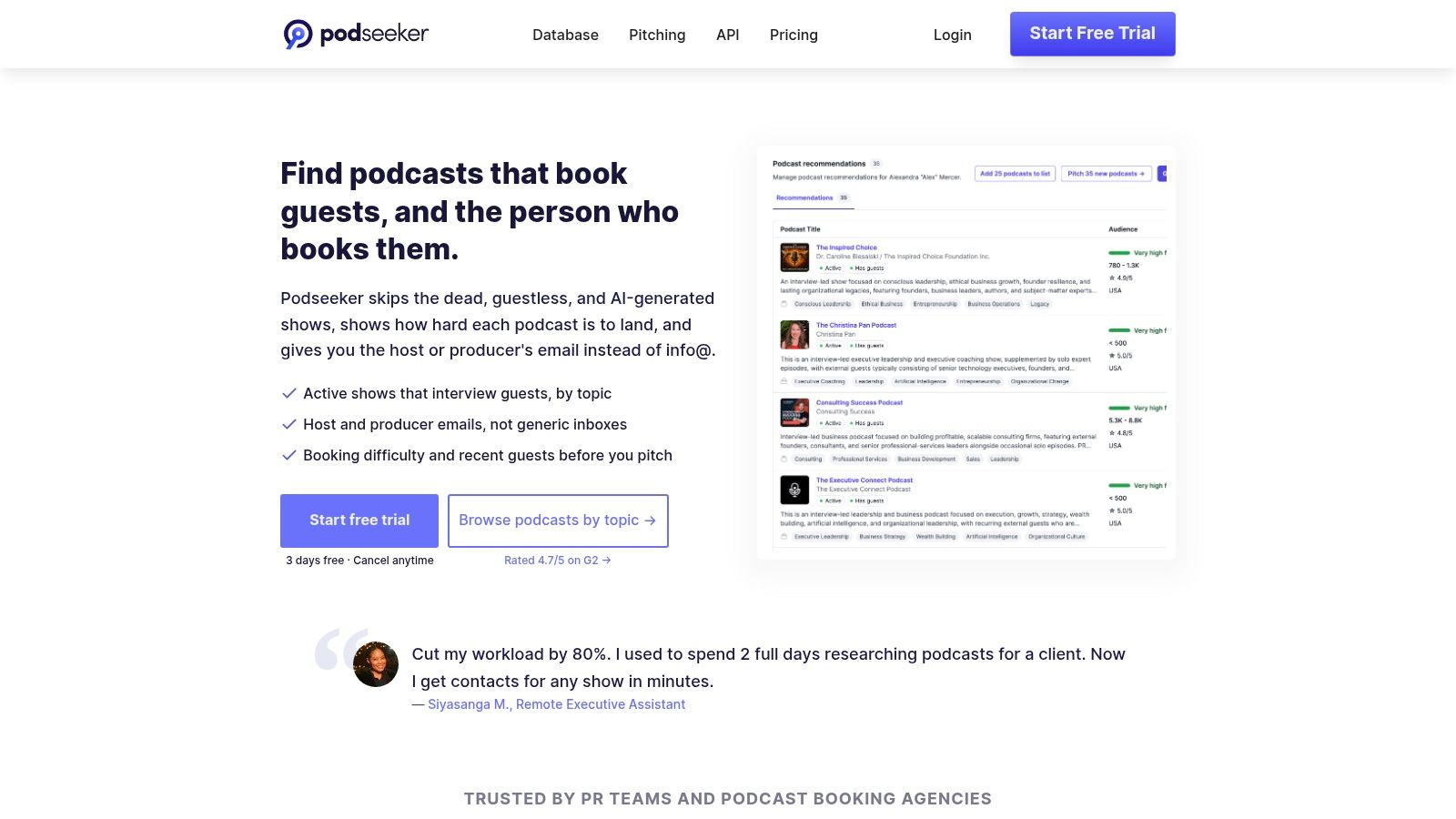
Podseeker makes more sense when research and outreach need to stay together. Podseeker combines show discovery, contact research, campaign lists, pitch drafting, follow-ups, and reply tracking.
For a PR team representing different experts, the useful feature isn't just access to contacts. It's the ability to preserve why a show qualified for a particular spokesperson, then keep the resulting conversation attached to that prospect.
Its booking-difficulty information and recent-guest context can help prioritize research. Neither should override what the host currently says about submissions, and contact enrichment won't necessarily produce a usable direct contact for every show.
A generated pitch is a draft. Check the episode reference, proposed angle, and recipient before you approve it.
Where the extra workflow earns its keep
Choose this kind of platform when you need campaign organization, exports, collaboration, and a clear record of replies. If you're still testing your subject or building an initial shortlist, a free podcast directory may be enough to establish whether suitable shows exist.
Pricing and limits: Podseeker uses a paid outreach subscription and offers a short trial that requires a payment card. Confirm current billing and cancellation terms before starting.
The strongest use case is a recurring pitching operation. For an occasional guest, the campaign tools may add more setup than the assignment needs.
4. Rephonic
A show can accept guests and still be wrong for your message. Rephonic is useful when you need audience and editorial context alongside contact information.
Its database brings together contacts, episodes, guests, sponsors, reviews, and audience information. That combination helps you distinguish a superficially relevant title from a program whose listeners and interview format suit your expertise.
Say you advise independent retailers. A business podcast aimed at venture-backed software founders may share broad category labels with your work, yet offer little room for the practical conversation you want to have.
Research depth versus booking intent
Rephonic's contact concierge offers a fallback when an existing record is missing or inadequate. Researching a contact page or better recipient can resolve a routing problem, but it can't establish editorial interest where none is stated.
- What works: Combining contactability with guest history, sponsorship context, and audience-fit research.
- What needs caution: Audience figures are estimates, not verified download reports supplied by the show.
- What remains your job: Checking whether the host accepts outside guests and whether your proposed subject adds something new.
Pricing model: Paid subscription plans and a trial are available. Check the current plan's research, contact-request, and outreach allowances rather than assuming every feature is included.
I'd favor Rephonic when the cost of pitching the wrong audience matters more than the cost of finding another email address. It may be excessive for a brief, narrowly defined shortlist.
5. MillionPodcasts
MillionPodcasts is worth considering if you want searchable contacts and exports but already have a spreadsheet or CRM for outreach. Its database includes host or producer details, filters, and CSV or Excel export options.
The operational advantage is portability. You can move qualified records into your existing process rather than asking everyone on your team to adopt a separate campaign workspace.
That portability also creates a maintenance obligation. An exported contact doesn't update itself when a producer leaves, a show pauses, or a host changes the preferred submission route.
Budget for usable records, not search results
Contact access and export allowances vary by plan. Before subscribing, work out whether your campaign needs broad browsing, a small set of verified contacts, or repeat exports across different client accounts.
- Useful safeguard: Missing or stale contacts can be flagged for researcher follow-up.
- Important limit: Broad database coverage doesn't establish that a show is looking for interview guests.
- Buying consideration: Compare the billing commitment and included allowances, not just the advertised monthly equivalent.
Pricing model: The service lists subscription tiers with annual-billing options and advertises a trial without a credit card. Confirm the current allowances attached to the plan you're considering.
I'd use it as a discovery and contact-research source, then add separate fields for guest evidence, pitch instructions, and last verification. Without those fields, an affordable export can become an expensive research backlog.
6. Podchaser Pro
Sometimes the problem isn't finding an address. It's finding the right person.
Podchaser Pro supports podcast and industry-contact research, including hosts, producers, and advertising representatives. It also includes public contact-form links, custom lists, and exports.
That role information matters for network-run shows. A host may be the public face of a program while a producer handles guest selection and preparation. An advertising representative, meanwhile, may have no responsibility for editorial bookings.
Keep editorial and commercial routes separate
A sponsored-placement inquiry and an unpaid guest pitch are different requests. Don't send an editorial proposal to an advertising contact merely because it's the only address you've found.
A public guest form can be the better route when it asks for the information the production team needs. Use its fields properly instead of treating the absence of a direct email as a research failure.
- Strength: Person-level context can help you route a proposal beyond the general show inbox.
- Limit: A contact record doesn't establish openness to unsolicited guest pitches.
- Access question: Contact and export functions require Pro access; confirm current pricing and export terms.
Podchaser Pro is most useful when your shortlist includes professionally produced shows with multiple people involved. For those prospects, knowing who handles bookings can be more valuable than adding more titles to the list.
7. Muck Rack
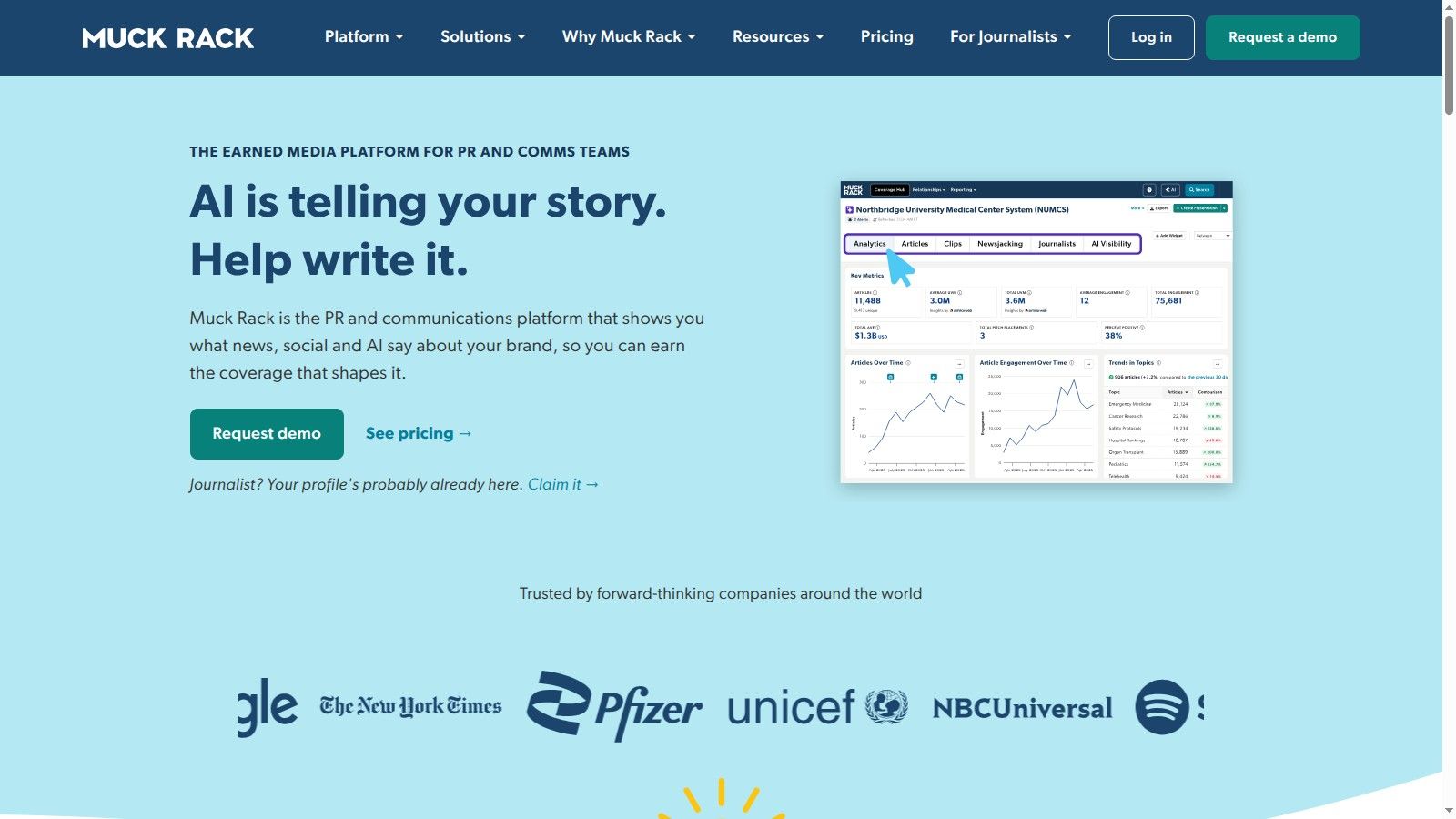
For communications teams already managing journalist outreach, Muck Rack offers a way to include podcasts in the same media-relations workflow. It works best as an organizing layer for a broader media list, not as a dedicated guest-booking exchange focused on whether a show books outside guests right now.
Podcast profiles include contact and show information, hosts, producers, networks, genres, countries, listenership estimates, charts, and reviews. Teams can add suitable shows to media lists instead of keeping podcast prospects in an unrelated document. The trade-off is practical: you gain outlet and network context, but a polished profile still does not prove that a producer is scheduling expert guests.
That organizational consistency matters most when one team is pitching podcasts, trade press, and broadcast media at the same time. A communications lead can compare a podcast appearance with other media opportunities while keeping ownership and network details attached to each prospect. For a guest building a small, show-specific target list, that structure may be more than the job requires.
Don't confuse a media profile with an open call
A researched profile tells you about an outlet. It does not tell you that the producer wants your spokesperson, is currently scheduling interviews, or accepts cold submissions.
Routing rule: Start with the show's editorial instructions. Use the database to identify the right recipient, not to bypass a stated submission process.
Pricing and data limits: Confirm current pricing and podcast access directly with Muck Rack; listenership figures are estimates. Check list-management capabilities within the proposed package before building a workflow around them.
Muck Rack is most useful when a team already needs broad media-relations software. For an occasional guest-booking problem, compare narrower tools first, especially those that show recent episodes, contact routes, and evidence of outside guests.
8. Feedspot Podcast Database
A specialist subject can require more discovery than a guest marketplace provides. Feedspot Podcast Database offers broad podcast search, contact information where available, and list-building and export tools.
Its filters include location, category, date, guests, and sponsors. Those fields can help uncover programs that don't describe themselves with your preferred keyword but still discuss the right problems.
For example, an expert in restaurant staffing might find relevant conversations under hospitality operations, small-business management, or local entrepreneurship. Category expansion is useful, provided you then inspect actual episodes.
Turn broad discovery into a qualified list
Treat search results as candidates, not approved recipients. Save the show website and recent episode evidence alongside any host or producer contact you export.
- Discovery strength: Broad filters can help surface niche and regional programs.
- Verification gap: The product information doesn't establish a uniform verification standard for every contact.
- Commercial question: Confirm pricing, contact access, export limits, and whether the fields you need are included.
Guest and sponsor filters offer context, but neither proves that a host welcomes an unsolicited expert. A show might interview only customers, invite guests through an existing network, or reserve episodes for a particular community.
Feedspot fits a research-heavy workflow where someone will qualify the results manually. It's less suitable if you expect the purchased list itself to answer whether each show is bookable now.
9. PodcastGuests.com
An explicit request for guests is a stronger starting signal than an old interview archive. PodcastGuests.com focuses on opportunities through newsletters featuring shows looking for guests and pitch forms connected to specific programs.
That changes the first research task. Instead of establishing whether a host wants submissions at all, you can concentrate on whether you meet the request and can offer a worthwhile conversation.
The opportunity newsletters are free, while optional paid directory and featured-expert offerings provide other forms of visibility. Check their current terms separately; receiving opportunities and being discoverable to hosts aren't the same service.
Answer the request in front of you
Read the eligibility details before submitting. A relevant subject isn't enough if the host needs a particular location, professional background, language, or recording arrangement.
- Strong signal: The show has stated a need for guests.
- Usable route: A show-specific pitch form reduces the need to guess which inbox handles proposals.
- Remaining friction: Opportunities won't always match your expertise or practical availability.
A podcast guest directory can complement opportunity emails by making your expertise available for hosts to discover.
This remains a do-it-yourself service, not an agency managing your booking. You still need to write the proposal, respond to questions, and agree on the interview details. I'd prioritize a closely matched request over a prestigious but poorly matched cold prospect.
10. PodMatch
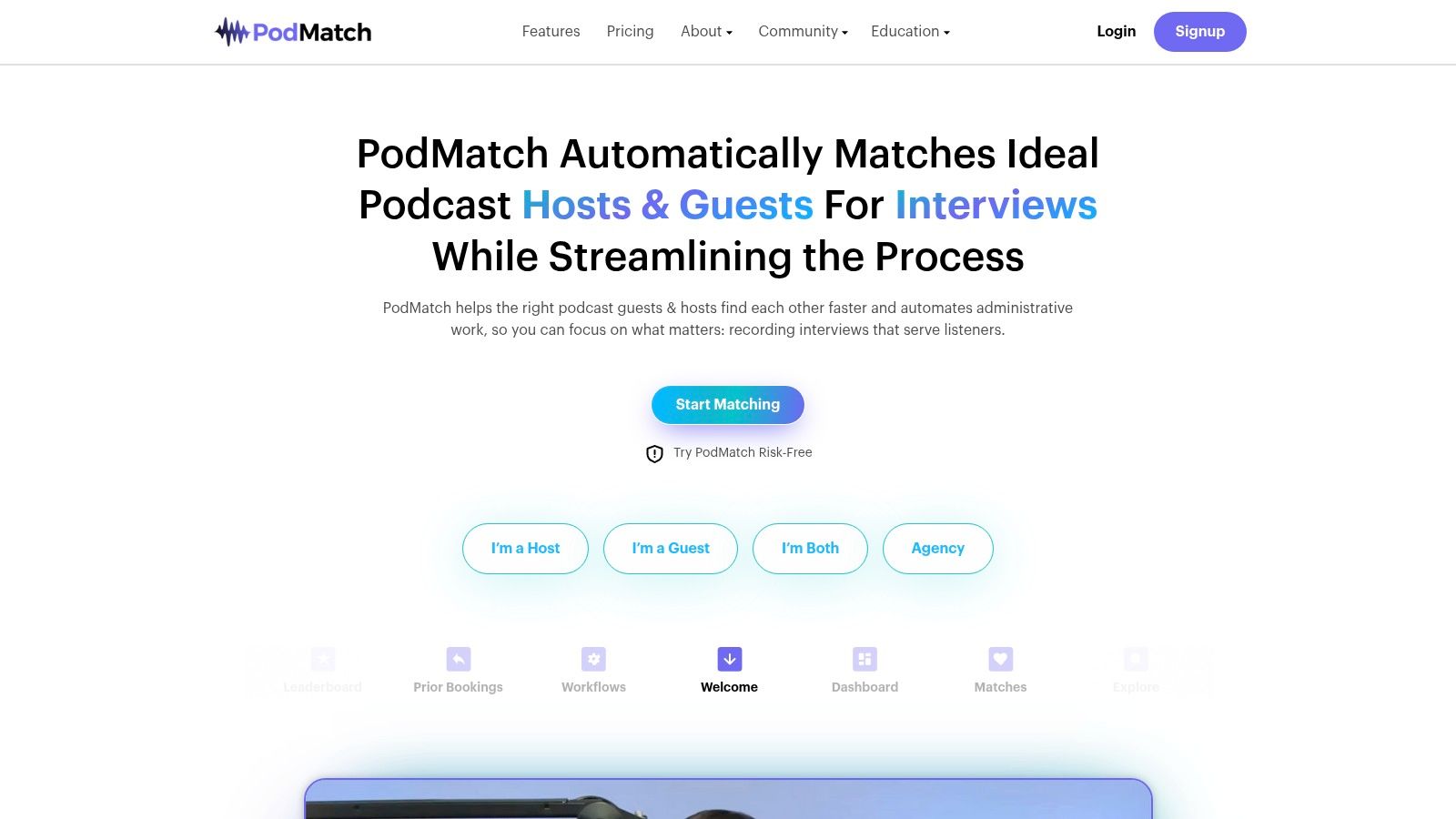
PodMatch replaces the hunt for an external email address with profiles, matching, messaging, and interview scheduling. It's a two-sided membership platform, not a general downloadable podcast contact database.
That distinction is useful for guests who would rather approach participating hosts through an established workflow. Hosts and guests provide topics and profile information, giving both sides more context than a bare contact row.
Participation is a positive signal of interest in matching, but it doesn't guarantee current availability or suitability. Read the show's requirements and recent episodes before sending a request.
Membership access versus market coverage
The limitation is the participating pool. A highly relevant show outside the platform still requires another discovery and outreach route.
Paid tiers differ in search, placement, and profile features. Confirm the current role-specific membership and billing terms, and distinguish features that improve your research from those that increase your visibility.
- Best fit: Guests and hosts who want matching and conversation management in the same place.
- Main trade-off: Convenience within the platform rather than broad access to external shows.
- Expectation check: A membership supports the process; it doesn't substitute for a clear interview proposition.
If you're weighing membership against delegated outreach, compare the responsibilities covered by different podcast booking services. Matching software and a managed booking service solve different problems, especially around research, writing, and reply handling.
How the 10 podcast contact sources compare on price, free access, and guest-booking signals
Price only matters after you know what the source can tell you. The column that decides real value is the last one: does the tool show that a show books outside guests right now, and does it give you a usable route to reach the host.
| Item | Best for | Published pricing | Free entry point | Shows booking guests? |
|---|---|---|---|---|
| Let's Make A Podcast (recommended) | Guests who need shows confirmed as publishing, reachable, and open to outside guests | Free tools and directory; planned Pro tiers not yet priced; no booking fees | Free search and guest tools, no account needed | Yes; feed data flags shows that still publish, print a contact route, and book outside guests |
| Podcastquery | Downloadable contact lists for interview podcasts | Topic lists about $29, $49; all-lists CSV $99; team archive $299; workspace subscription separate | Free samples | Guest history shown; current booking status unconfirmed |
| Podseeker | PR teams managing podcast outreach campaigns | $99 per month | Three-day trial; payment card required | Booking-difficulty context; live openings unconfirmed |
| Rephonic | Research combining contacts and audience information | $99, $299 per month | Seven-day trial | Guest data available; current booking status unconfirmed |
| MillionPodcasts | Budget contact research and exports | $11, $59 per month with annual billing | Free trial without a credit card | No guest-availability signal |
| Podchaser Pro | Finding podcast industry contacts and roles | No public price list; professional plan | No free plan | No guest-availability signal |
| Muck Rack | PR teams researching podcasts within a broader media database | Quote-based pricing | No free plan; sales-led access | No guest-availability signal |
| Feedspot Podcast Database | Broad podcast discovery and contact-list building | Subscription; export access tied to plan tier | Contact data sits behind paid plans | No guest-availability signal |
| PodcastGuests.com | Finding podcasts that have stated they want guests | Free newsletter; optional paid extras | Free guest-opportunity newsletter | Yes; posts opportunities from shows seeking guests |
| PodMatch | Matching podcast hosts with prospective guests | $6 per month for hosts; $32 per month for guests; professional tiers at $64 per month | No free plan | Yes; built to connect hosts and guests |
Read the signal column before the price column. A large database answers who exists. A signal-based source answers who is worth pitching this month. For a guest building a shortlist, the second question is the one that saves time: a cheap export of shows that stopped booking guests produces more dead pitches than a smaller list of shows verified as active, reachable, and open to interviews.
Turning Your Podcast Contact List Into Booked Interviews
A podcast contact list only helps when you qualify the show before writing. Keep separate fields for publishing activity, recent outside guests, topic fit, and the preferred pitch route. Combining those into a vague quality label makes it harder to see why a prospect belongs on your list.
Cold email is a legitimate route, but it isn't the whole booking process: a survey of 271 podcasters reported that cold email pitches accounted for 28.0% of how hosts found guests, according to Buzzsprout's guest-booking guide. Track referrals, previous appearances, inbound requests, and marketplace conversations separately so you can judge which routes produce relevant discussions.
Qualify the opportunity, then write the pitch
Start with the latest episodes. Confirm that the show still publishes, identify genuine outside interviews, and note whether guests resemble your proposed role. A recurring co-host or sponsor appearance isn't necessarily evidence of an open guest format.
Next, inspect the submission route. Follow an explicit guest application process rather than substituting a generic address from a database. If the host states that pitches are closed, suppress the prospect instead of trying another contact.
- Record the evidence: Save the episode title, episode URL, and the reason your subject fits.
- Check practical access: Confirm language, time-zone compatibility, remote recording options, and any stated guest requirements.
- Make the offer specific: Propose a conversation the audience can use, not a biography the host has to turn into an episode.
- Preserve the outcome: Track replies, declines, bookings, and opt-outs so nobody repeats an unwanted approach.
Say you teach inventory planning to independent shop owners. Your pitch should identify the listener's problem, explain the decision you can help them make, and connect that proposal to the show's existing coverage. Mentioning an episode title without that connection is decoration, not personalization.
A smaller list with clear evidence is easier to pitch responsibly than a large export whose rows all need investigation.
Your one-sheet should support the proposal with a concise bio, relevant topics, and credible examples of your expertise. You don't need podcasting experience to begin, but you do need a clear reason for the host to spend an episode with you.
Measure progress through qualified conversations and suitable bookings, not messages sent. When replies reveal a mismatch, update the record and your targeting. Better information should change the next pitch.
Build a focused shortlist, create a free guest one-sheet, and keep your outreach connected to the shows you've qualified. Visit Let's Make A Podcast to find active podcasts with guest-booking signals and use the pitching tools to turn your expertise into a specific interview proposal.