Pipeline Explained: How Podcast Guest Booking Works

There's a spreadsheet open in another tab with 40 show names on it, eight pitches you've sent and heard nothing back on, two interviews confirmed for next month, and a growing suspicion that the guest side of your podcast runs you rather than the other way round. The research list keeps getting longer. The recordings don't keep up.
That gap usually isn't a shortage of shows or a weak subject line. It's a flow problem. Guest booking behaves like a pipeline: work enters at one end, moves through a fixed sequence of stages, and leaves as a recorded interview. Each stage has a capacity, and the whole thing moves at the speed of the slowest one.
What follows is the pipeline explained through the parts you touch: finding shows worth a pitch, the pitch and follow-up rhythm, scheduling, recording, and the work after. The number that matters isn't how many guests you've booked. It's where the waiting happens.
Table of Contents
- The Six Stages of a Guest-Booking Pipeline
- Finding Shows That Are Worth a Pitch
- How to Pitch and Follow Up Step by Step
- Scheduling and Preparing the Interview
- What Happens During and After the Recording
- One Booking Traced From First Pitch to Episode
- Where Pipelines Break and How Many Pitches You Can Sustain
- Set Up Your Pipeline Before the Next Booking
The Six Stages of a Guest-Booking Pipeline
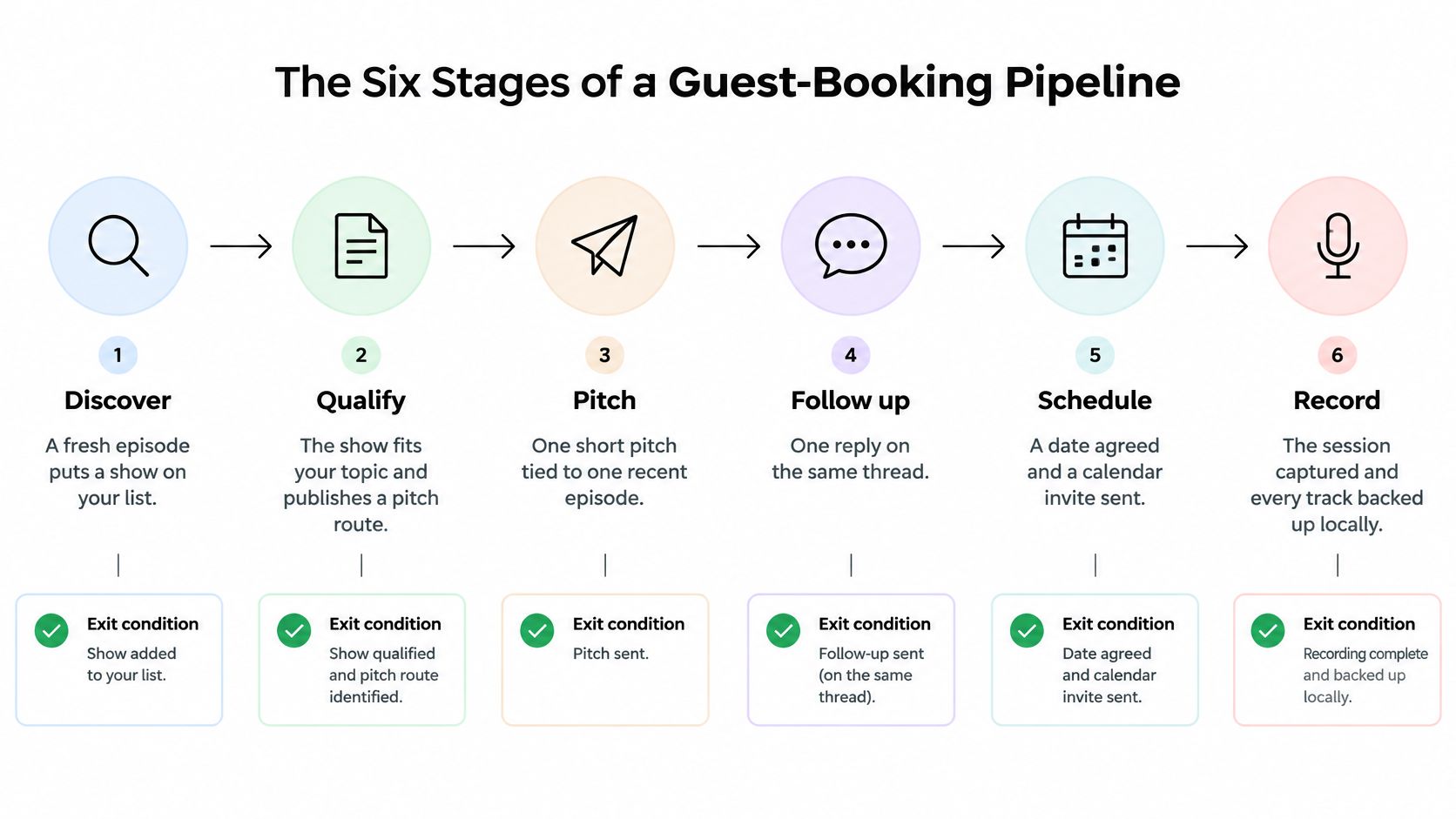
A guest booking moves through six stages, and each stage ends with a condition you can see. Give every show a stage and your list stops being a pile of names; it becomes a queue you can measure.
| Stage | What Enters | Exit Condition |
|---|---|---|
| 1. Discover | Search terms, topic filters, niche lists | A show with a recent episode and a published pitch route |
| 2. Qualify | Shortlisted shows | A confirmed topic match and a named contact route |
| 3. Pitch | Qualified show and guest one-sheet | A pitch sent from the guest's own inbox to the show's route |
| 4. Follow up | Pitch with no reply | A reply, or a close after the final follow-up |
| 5. Schedule | Interested host | A confirmed slot and a calendar invite |
| 6. Record | Confirmed slot and prep notes | Recorded audio, backed up, with consent logged |
Pipeline explained in one line: a chain of sections, each with a limit, with output set by the narrowest section rather than by what enters at the top. The engineering version is more formal: in a physical pipe, performance is governed by pressure drop and flow rate, losses climb with length and wall resistance, and a wider section lowers velocity and friction, as the AspenTech white paper on pipeline hydraulics sets out.
A guest pipeline has no pressure gauges, but the constraint behaves the same way. Each stage accepts only so many shows before work queues: research hours limit discovery, inboxes limit pitching, host calendars limit scheduling, and prep hours limit recording.
That is why the useful measures are waiting time and conversion, not booked guests. For each stage, count how many shows enter, how many exit, and how long a typical item sits there. A stack of qualified shows with nothing sent means drafting is the constraint. Interested replies that never become calendar invites mean scheduling is the narrow section.
Physical pipes made this obvious early: when a downstream section could not carry the flow, adding more supply at the inlet only raised pressure behind it. Guest booking answers to the same logic, because more leads cannot help when follow-up is already full.
Two mistakes keep people stuck. Treating booking as one task hides which stage is failing, so effort gets spread evenly across six steps that don't need equal effort. Tracking only confirmed guests means you learn about a dead pitch when it's already three weeks old.
Practical rule: Once a week, mark the age and exit rate of each stage. The stage with the oldest queue and weakest exit rate is your bottleneck; add capacity there before touching discovery.
Finding Shows That Are Worth a Pitch
A show deserves a pitch when four things are true at once: it's publishing now, it books people from outside its own team, it publishes a route for pitches, and it covers your topic. Sort every name into three piles: pitch now, watch, skip.
| Signal | Strong Sign | Weak Sign |
|---|---|---|
| Last episode | Published within the last 30 days | No episode in six months or more |
| Pitch route | Email or form listed in the show notes | No route, only social messages |
| Guest format | Regular outside experts | Host and own team only |
| Topic overlap | Recent titles match your angle | Only loosely related themes |
| Audience fit | Listeners match your target reader | Audience far outside your expertise |
A show with three recent episodes on your exact theme and a contact address in its notes beats a much larger show that hasn't published since last spring. Downloads you can't verify are a weaker signal than a feed that's clearly alive, because a dormant show can't book you no matter how big it once was.
The five-minute check that saves a week
Read the last five episode titles, the show description and the contact page. Then ask one question: were the recent guests outside experts, or the host's mates and co-workers? A directory or feed reader confirms publishing status quickly, but five minutes of reading catches the shows that stopped, changed format, or moved guest requests to a form you'd never find otherwise.
Match on the words the show uses about itself. If the host describes the programme as being about "bootstrapped software businesses," pitch that, not "entrepreneurship." The description is the vocabulary the host has already committed to.
Time budget: Research a shortlist of 10 to 20 shows properly instead of skimming 200 names. Depth beats volume at this stage, and the pitch gets easier when you actually know the show.
Learn a repeatable search method before you build the list, because the quality of your discovery step caps everything downstream. This guide to searching for podcasts covers the filters and phrasing that surface active shows rather than popular ones.
How to Pitch and Follow Up Step by Step
A strong pitch is short, tied to one recent episode, and sent to the route the show publishes. Seven steps, in order:
- Read the last two episodes and note one specific point. Write down a claim, a guest's answer, or an angle the host raised and didn't resolve. This is the raw material for everything that follows.
- Open with that point and explain in two or three sentences why your guest adds to it. The usual slip is opening with your own credentials, which gives the host a reason to stop reading.
- Link a one-sheet instead of pasting a biography, and offer two topics. Two gives the host a choice without a menu. The slip here is a 400-word bio the host has to mine for an angle.
- Propose a 30 to 45 minute window in your time zone. A concrete length tells the host this is a normal interview, not a three-hour commitment.
- Send it from your own inbox to the show's published route. Replies then land in a thread you control, and the host sees a real person rather than a broadcast address.
- Follow up on day 5 to 7 with one new thing. A data point, a short clip, a link to something the host would find useful. "Just checking in" adds nothing and reads as pressure.
- Send a final note on day 14, then close the thread politely. Say you'll keep listening and leave the door open, and mean it.

Why the close matters more than the follow-up
The two-week close protects two things. The show's inbox stays clean, which matters because most hosts field pitches alongside production work. Your reputation stays intact too: the producer who sends three follow-ups in one week gets remembered for the wrong reason, while the one who follows up twice and stops gets a fair read next time.
A draft built from a recent episode beats any template, because the specificity is the argument. Templates set the structure and the length; the sentence about last week's episode has to be written fresh, or the whole pitch reads as bulk mail. If you want a starting structure, this pitch follow-up email template gives you the shape to fill in.
Scheduling and Preparing the Interview
A yes only becomes a recording when the slot, the format, and the prep are locked within a few days. Three moves do most of the work.
Offer three specific slots across two time zones instead of open availability. Open availability pushes the decision back to you and adds a round trip, while three fixed options let the host pick in one reply.
Send the calendar invite immediately, with the recording link and a backup phone number. The invite is the booking. Until it exists, the agreement is only conversational, and conversational agreements slip.
Send a prep note 48 hours before recording. Include the topic outline, a pronunciation guide for names and technical terms, three to five planned questions, and a short tech check.
The four-item checklist
- Time zone confirmed with both people, written out in the invite, not assumed from a city name.
- Audio tested on the guest's side, using the microphone they'll speak into.
- Expected length agreed, so the guest knows whether to plan for 35 minutes or 75.
- Clip and promotion expectations settled, including whether you'll share social posts and who writes them.
Three edge cases that eat bookings
A guest in another country booked for the wrong day usually means someone converted a time zone without a date anchor. Put the weekday and the date in the invite subject line and the problem disappears. A guest with a weak connection needs a phone backup line written into the invite before the session, not discovered at the first dropout. A host who reschedules twice is telling you something: pause and check whether the topic still fits the show, rather than offering a fourth date.
Keep one thread for messages, invites and prep notes so details don't scatter across three inboxes. The mechanics of locking a session are covered in this podcast guest confirmation email walkthrough, and the principle is the same one I'd apply to any booking: one place, one record, one version of the truth.
What Happens During and After the Recording
Recording is the easy part. The value comes from the 48 hours after it, when the conversation either becomes a findable asset or a file that sits in a folder.

During the session
Keep a local backup of each speaker's track as well as the main recording, and check levels in the first minute while there's still time to fix a gain problem. Log consent out loud on the recording: permission to record, permission to publish, and permission to use clips. I'd rather have an awkward ten seconds at the top than an argument after publication.
The 48 hours after
Send thanks within 24 hours with the expected publish date. Then produce a transcript with speaker labels and corrected names and technical terms, add chapter markers, and cut a short clip that keeps enough context to make sense on its own.
Transcripts aren't housekeeping. Apple introduced transcript search that lets listeners find a word or phrase and jump to that moment, among the transcript changes tracked by Accessible, so an episode with no searchable text loses a route to discovery. Transcripts also serve the listeners who can't or won't play the audio at all.
Confirm permission before you publish AI-generated summaries or derived clips of a guest's words. A summary that misstates someone's position is a relationship problem, and it's avoidable with one question by email.
There's a commercial reason to care about all of this. U.S. podcast advertising revenue reached $2.862 billion in 2025, a 17.6% increase from 2024, according to IAB and PwC figures reported by RBR. Sponsors and listeners both drift toward episodes that can be found, cited and quoted.
Save three things for the next booking: the guest's preferred format, which version of the pitch worked, and the number of days from first pitch to recording.
One Booking Traced From First Pitch to Episode
Say a producer has a shortlist of twelve shows and wants one recording a month. Here's how a single booking runs across five weeks.
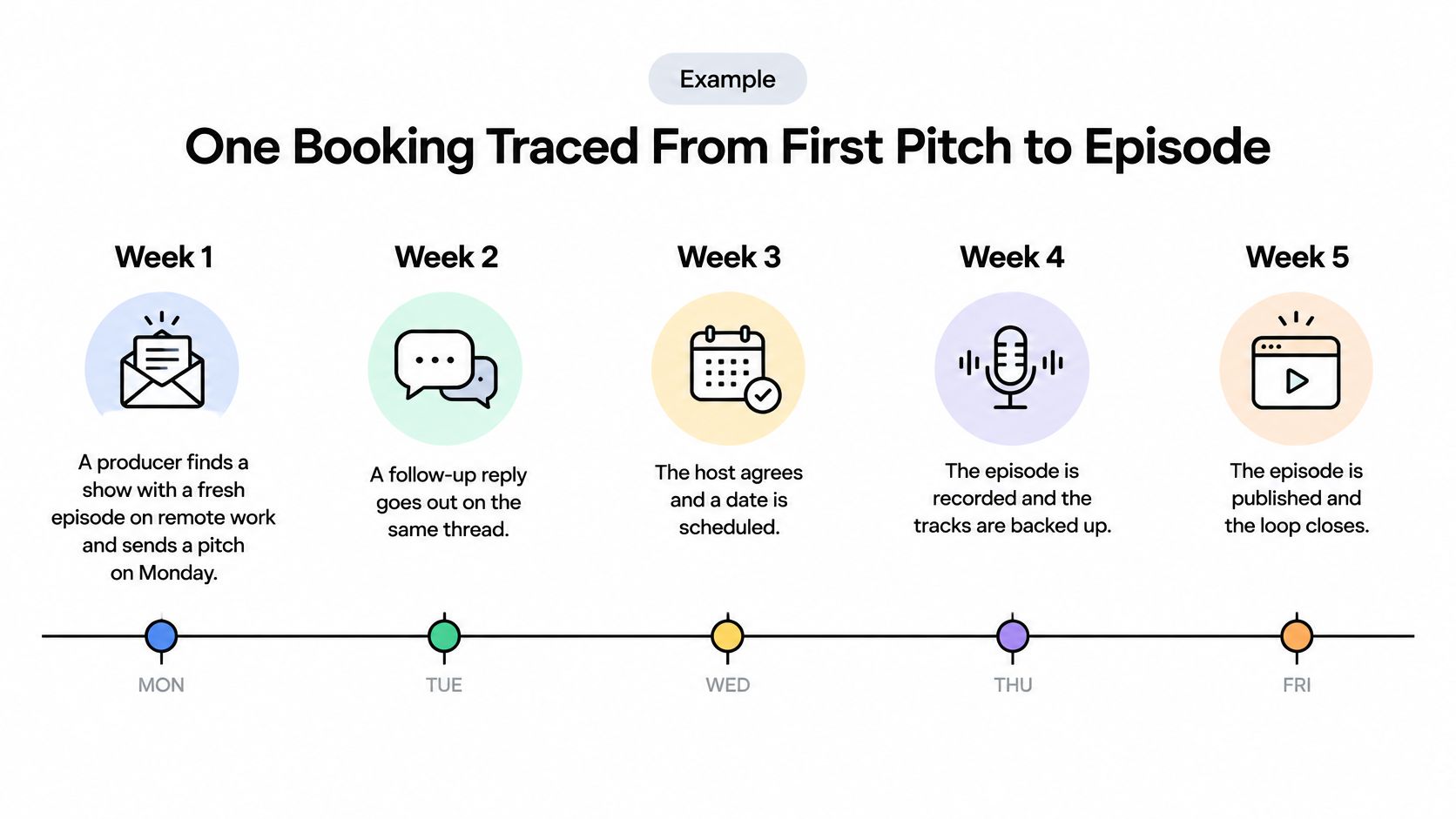
Week 1. She finds a show with a fresh episode about remote work and sends a pitch on Monday, opening with a point the host raised and didn't resolve. Day 6 brings a follow-up with a relevant data point. No reply arrives, so a final note goes out on day 14 and she closes it politely.
Meanwhile a second show on the same shortlist replies on day 9 of its own thread. That overlap is the whole trick: she isn't waiting on one show at a time.
Week 2. Three fixed slots go out, one is confirmed within two days, and a prep note lands 48 hours before the recording with an outline, a pronunciation guide and a tech check.
Week 3. The 45-minute session is recorded, with a local backup kept of each track.
Week 4. A transcript with speaker labels is produced, names and technical terms are corrected, a short clip is cut with enough context to stand alone, and a publish date is set.
Week 5. The episode goes live, the guest is thanked and shares it, and the booking record closes.
Look at where the calendar went. Most of the elapsed time was spent waiting for replies, not doing work. Three open pitches at once carried plenty of throughput, and the sessions themselves took under an hour each.
The one lesson: a pipeline's calendar is dominated by residence time, not effort. Count the days a pitch sits in a thread before you decide you need to send more pitches.
Where Pipelines Break and How Many Pitches You Can Sustain
Find the stage with the longest wait or the lowest conversion, and fix that before you add anything new to the top of the funnel. Adding pitches to a jammed stage just adds debt.
| Symptom | Bottleneck Stage | First Fix |
|---|---|---|
| Pitches sent, few replies | Pitch | Lead with a specific recent episode and shorten the pitch |
| Replies arrive, slots never confirm | Schedule | Offer three fixed slots instead of open availability |
| Interviews booked, recording keeps slipping | Schedule | Close the loop inside 48 hours with one invite, one prep note and one tech check in the same thread, and stop booking until two recordings land on the date first offered |
| Recordings done, episodes sit unedited | Record and after | Batch edits weekly and cap bookings to edit capacity |
| Many shows shortlisted, few pitched | Qualify | Re-sort the list into pitch now, watch and skip each week |
The numbers here are lopsided in a way that surprises people. In a 2025 survey of 558 independent podcasters, 72% named audience growth and discoverability as the leading challenge, 30% cited time commitment and burnout, and only 7% identified finding guests as a primary problem, per the Independent Podcaster Report 2025. The same research reports that 17% of U.S. podcast consumers had created or attempted to create a podcast, and that one in three of those creators stopped producing episodes.
That pattern points at the handoffs, not the hunt. Research, pitching, scheduling, preparation, editing and follow-up are where the hours go, and those are exactly the stages that break first.
Capacity planning for one person
Set a weekly episode budget from how many finished episodes you can edit, not from how many guests you could theoretically book. Cap open pitches at a workable number, ten at a time is realistic for a solo host, and stop at two follow-ups per pitch. A minimum viable week looks like one pitch day, one scheduling day and one recording day, which keeps the flow flat instead of lumpy.
Production debt is the failure mode to watch. A pipeline that books more guests than you can record and edit builds a backlog that turns a positive reply into an apology email three months later. Capacity compounds slowly, whether you're moving oil or moving interviews: even during the shale-driven buildout, the U.S. network expanded from 2007 to 2012 at an average of 1.6% a year, reaching almost 121,000 miles in 2012, according to Global Energy Monitor's Oil Infrastructure Tracker. Match booking rate to the lowest-capacity stage in your week, and the pipeline stays honest.
Set Up Your Pipeline Before the Next Booking
Four steps, all of them doable this week.
- Map your current stages and label the one with the longest wait. Use the six-stage list, or your own version of it, and write it where you'll see it.
- Set a weekly booking cap based on edit capacity. If you can finish one episode a week, don't confirm three recordings for the same seven days.
- Track each booking in one place. A single sheet with one row per show and one column per stage, recording the date each stage was entered, turns your list into something you can diagnose.
- Review after five bookings and ask which stage took longest. Rebuild that stage before you touch anything else.
Let's Make A Podcast is a marketplace and toolkit, not a service that pitches on your behalf: guests send pitches from their own inbox to the route the show itself publishes. Every pitch and booking sits in one pipeline you can track, and the Free plan covers up to 25 shows in that pipeline.
A pipeline is a system you can measure and improve. A list of hopeful emails is neither.
If you're tired of tracking pitches in four places and losing the thread on the ones that mattered, Let's Make A Podcast gives you one pipeline for pitches, replies and bookings, plus a directory of shows that publish. Build a one-sheet, find shows that match your topic, and see each booking move through its stages in one view. Start free at Let's Make A Podcast and map your first ten shows this week.