Pitch Follow Up Email Template: 5 Ready-to-Send Drafts

The familiar advice to wait a few days, send a bump, then declare the pitch dead is too blunt for podcast booking. A host planning a season needs a different follow-up from a producer filling an unexpected recording slot. Silence isn't a rejection, but it isn't permission to keep emailing, either.
A useful pitch follow up email template makes the proposed episode easier to evaluate and gives the host an easy next step. The wording matters. So do the show's booking cycle, what changed since your last message, and whether you've reached the point where you should stop.
Table of Contents
- Follow-Up Timing and the Four-Stage Sequence
- Copy-Paste Templates for Each Stage
- What Each Follow-Up Must Add
- Adapting Your Follow-Up to Each Reply
- Send Your First Follow-Up This Week
Follow-Up Timing and the Four-Stage Sequence
The common five-to-seven-day rule gives you a reminder date, not a diagnosis. It doesn't tell you whether the host missed your message, has a full recording calendar, or won't consider guests until the next season.
Podcast booking can take considerably longer than a quick inbox exchange. Podseeker's podcast guest guide reports a median time from initial pitch to confirmed booking of 3.7 days, while the 90th percentile was 56.6 days. Those are booking times, not recommended intervals between emails, but they show why a quiet thread shouldn't automatically become a rejected pitch.
Follow-ups deserve a place in your workflow. In its B2B cold-email analysis, Belkins found that follow-ups collectively generated 58.6% of all replies. Use that finding to justify a consistent process, not to predict podcast bookings.
Use the sequence as a decision framework
The following is a practical starting schedule, not a requirement to send every draft.
Podcast pitch follow-up sequence
| Stage | Send after | Goal | Template |
|---|---|---|---|
| First follow-up | 5 business days after the pitch | Confirm the host saw the pitch | Nudge |
| Value follow-up | About 2 weeks after the pitch | Offer a new reason to reply | Fresh angle |
| Reactivation | Several weeks later, only with new relevance | Reopen a dormant thread | Timely hook |
| Close-out | After the third message or a clear no | Mark as deferred and stop | Graceful close |
Treat the early dates as baseline checkpoints. When you change the schedule, count the next waiting interval from your last message, rather than cramming overdue reminders together because the original pitch is old.
Close-out is primarily an administrative action. You don't need to send another email just to announce that you're stopping. After an explicit no, record the pitch as declined, not deferred.
A deferred pitch remains potentially relevant but has no active reminder sequence. Give it a reason for reopening, such as the host's stated booking month or a relevant new episode. Don't give it a recurring task that produces another empty bump.
Practical rule: A long booking window justifies patience, not more messages.
Check the show's actual production rhythm
Before adjusting your next date, check:
- Publishing frequency. Read the public feed. Regular releases establish activity, but they don't prove the host is currently recording.
- Recording pattern. Check the guest page, application instructions, and episode announcements for rolling bookings or batch recording.
- Season status. Look for a finale, a return announcement, or a stated pause before interpreting silence.
Say a host has just announced a season finale. A reminder asking to record immediately ignores useful information. Defer the pitch until the announced booking window, or ask about the next season only if the host invites those enquiries.
For a rolling interview show, a concise nudge may be appropriate sooner. For a network producer coordinating several approvals, leave more room and make the episode proposal easy to forward internally.
Keep the existing subject when replying. If the original subject doesn't identify the idea clearly, use the examples in our follow-up email subject line guide to improve future pitches, rather than creating a fresh thread for every reminder.
Check the feed today, record what you can establish, and adjust the next follow-up date accordingly. Don't mistake an unknown booking cycle for an open calendar.
Copy-Paste Templates for Each Stage
Replace every bracketed field before sending, and add a real editorial detail, not generic praise. The drafts below keep the request short enough to assess without opening a biography or downloading an attachment.
Use these as working drafts beside your episode notes.
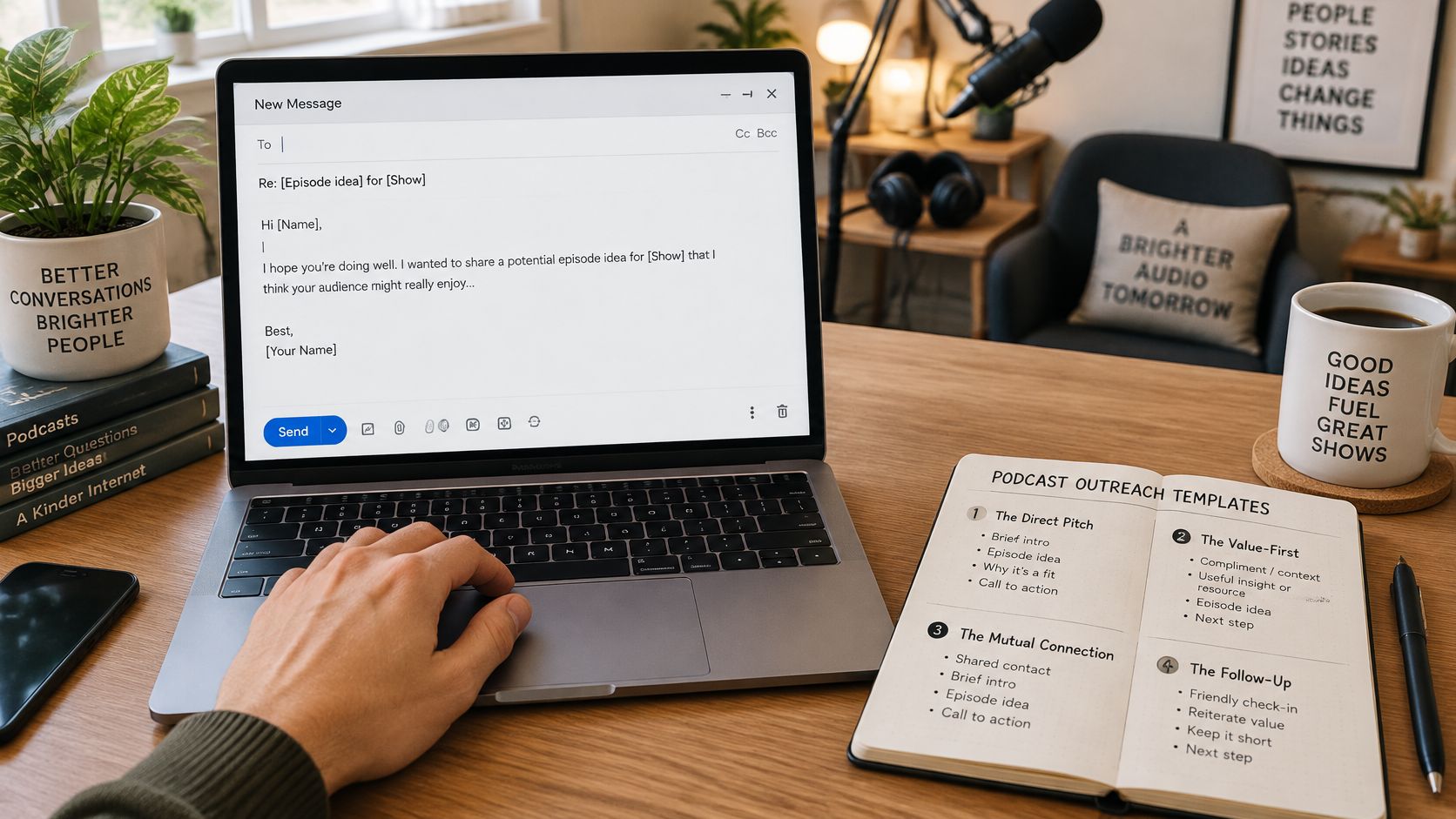
Template 1 The nudge
Subject: Re: [Episode idea] for [Show]
Hi [host first name],
Following up on my proposal for [Show name] about [specific episode angle]. I'd explain [practical takeaway], building on the question about [specific issue] in [recent episode title].
Would you be interested in considering this for an upcoming episode?
Thanks, [Your name]
Why it works: The host gets the idea, its editorial fit, and a yes-or-no decision without reconstructing the original pitch.
Template 2 The fresh angle
Subject: Re: [Original subject]
Hi [host first name],
Your discussion of [specific point] in [recent episode title] sharpened my proposed angle for [Show name]: [revised episode thesis].
Rather than a broad conversation about [topic], we could focus on [specific listener problem] and [useful outcome].
My background and suggested talking points are in my one-sheet: [one-sheet link].
Would that direction fit your upcoming interviews?
Thanks, [Your name]
Why it works: A sharper thesis gives the host something new to assess, with a single supporting link and no attachments.
Template 3 The reactivation
Subject: Re: [Original subject]
Hi [host first name],
Since my earlier pitch, [relevant launch, publication, or credential] has happened. It gives us a timely way to explore [episode angle], particularly your question about [specific issue] in [recent episode title].
I sent the original idea a while ago, so your plans may have changed.
Is this relevant to what you're booking for [Show name] now?
Thanks, [Your name]
Why it works: It explains why you're returning without pretending the earlier silence was an invitation.
Template 4 The graceful close
Subject: Re: [Original subject]
Hi [host first name],
Thanks for considering my idea about [episode angle] for [Show name]. I'll stop following up on this pitch.
If you revisit [specific topic from recent episode title] in a future episode, I'd be happy to help with [specific contribution].
No response needed.
Best, [Your name]
Why it works: It ends the request without guilt, manufactured urgency, or a demand for closure.
Read each draft aloud. Cut any sentence the host could skip without losing the idea, the fit, or the requested next step.
What Each Follow-Up Must Add
An empty bump asks the host to spend attention without offering anything in return. Repeating the original pitch with a new date doesn't make the proposal more useful.
The CanopyOps cold-email follow-up guide reports 4.9% reply rates for campaigns with follow-ups versus 3% without. That's general cold-email evidence, not a podcast booking benchmark, and it doesn't turn weak targeting into a good outreach strategy.
Test whether the update is substantive
A material change helps the host make an editorial decision. A newly published study might strengthen your argument. A launch might create a timely listener question. A tighter episode concept might turn an unfocused biography pitch into a useful interview.
These are the kinds of additions worth checking before you send.
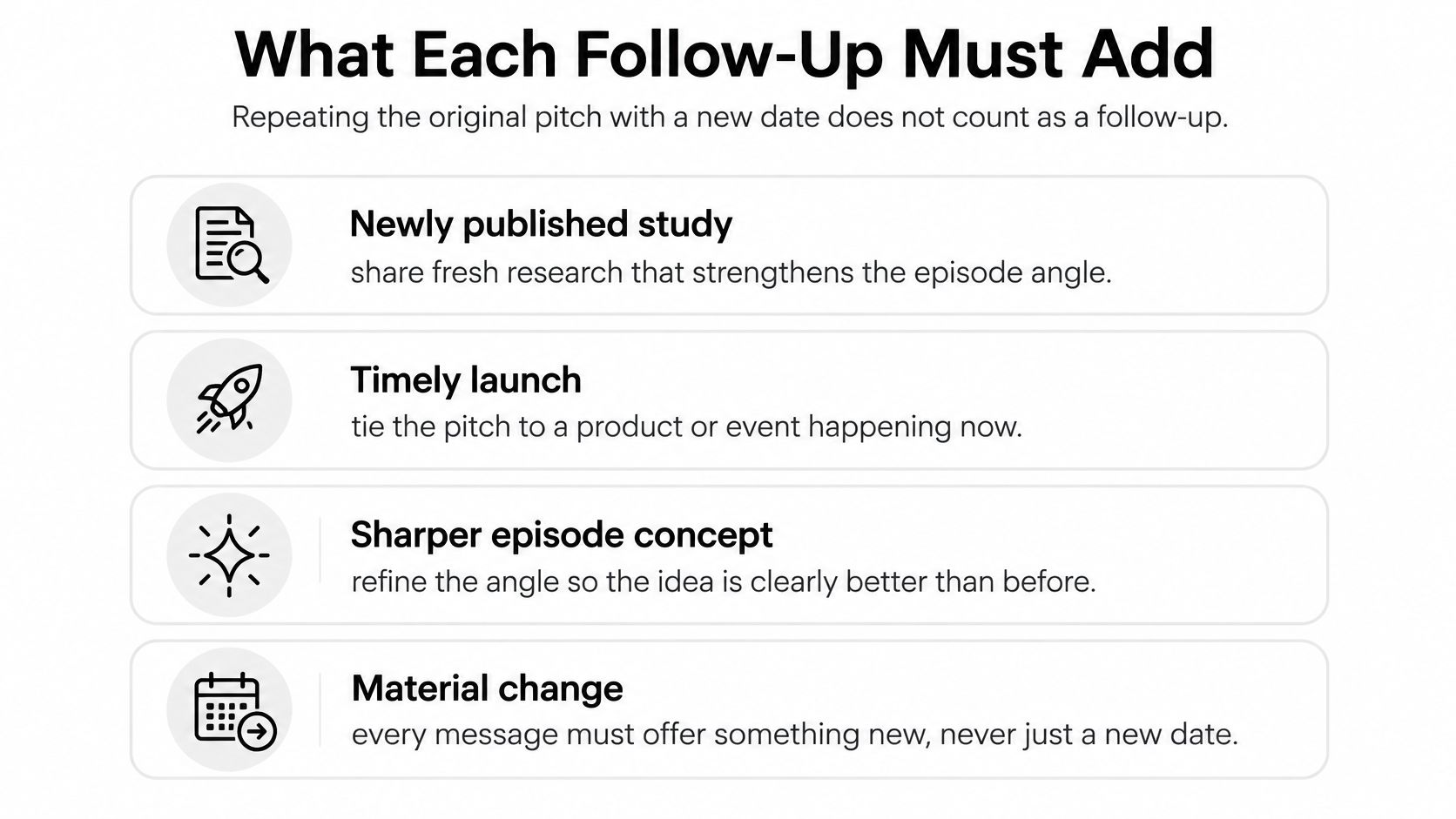
A launch alone isn't enough. Explain what listeners can learn from it without making the episode a promotional slot. Likewise, mentioning a recent episode only helps when you identify a question you can extend, challenge, or answer.
Run this checklist against the draft:
- New information. Does the host learn something they haven't already received?
- Link discipline. Is there at most a single useful destination, rather than competing links to your website, calendar, book, and biography?
- Standalone context. Would the message make sense if the original email were deleted?
- Defensible claims. Can you support every credential, result, and proposed takeaway without exaggeration?
If you can't pass that test, revisit the underlying offer with our podcast guest pitch template, rather than polishing another reminder.
A better reason to reply matters more than a cleverer way to ask for a reply.
Protect the relationship and your inbox reputation
Keep the sequence in the original email thread so the host can inspect the history. End an unanswered sequence after three messages in total, including the original pitch. Reactivation is a separate decision requiring changed relevance, not an automatic extra touch.
Stop immediately at disinterest, including a polite indication that the idea isn't a fit. Repeated low-value messages can annoy recipients and create sender-reputation problems, particularly when PR teams contact shared production inboxes across countries.
Apply the checklist to your next draft before sending it. If nothing substantive has changed, don't send it yet.
Adapting Your Follow-Up to Each Reply
Once a host answers, stop treating the pitch as cold outreach. Their response determines your next action, not the reminder already sitting in your calendar.
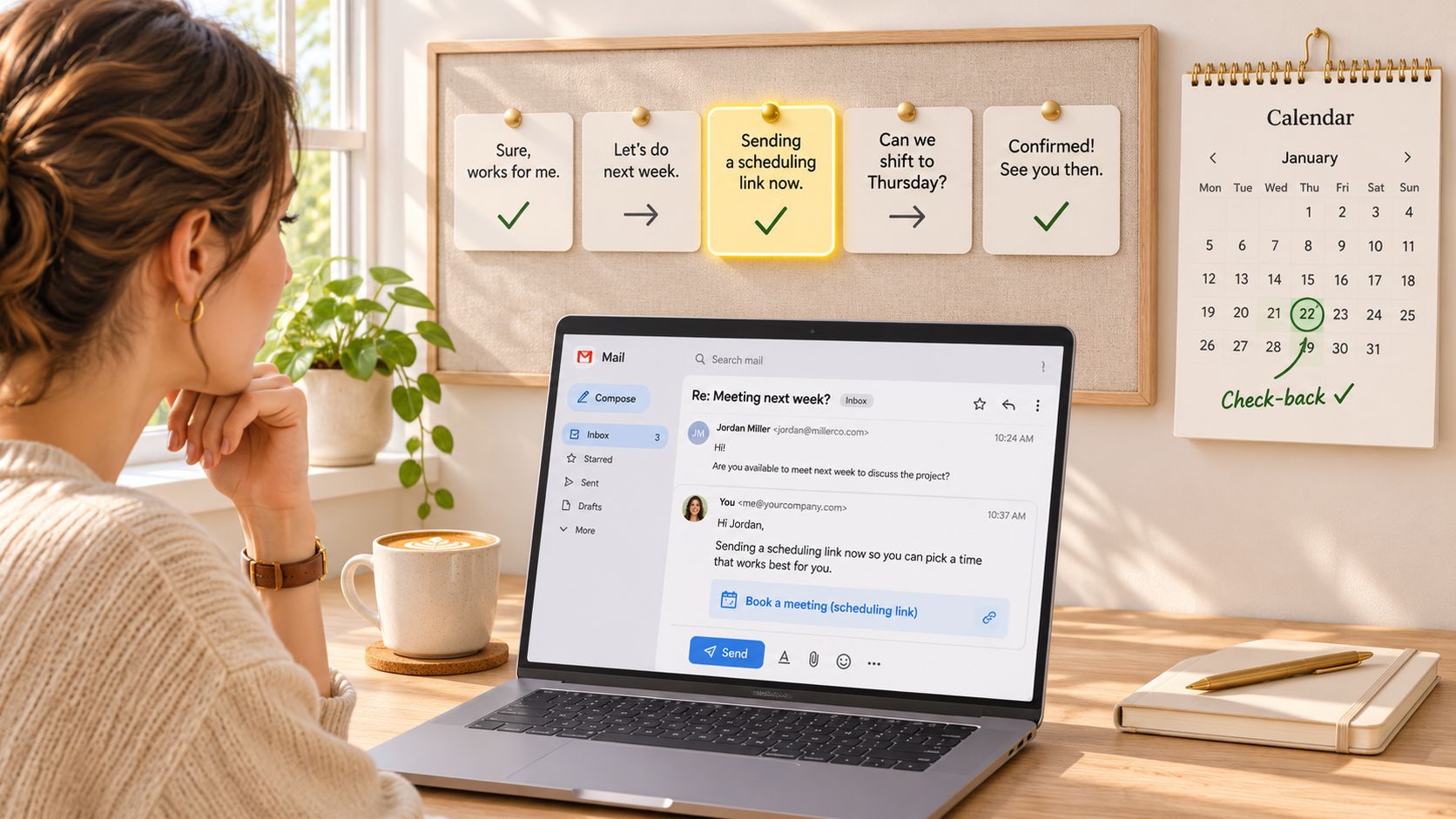
Keep the reply status and scheduling task together so you don't send a nudge after receiving a yes.
Outsolvi's discussion of Harvard Business Review's lead-response study concerns inbound sales leads, not podcast invitations. The useful operational distinction is between waiting respectfully on unsolicited outreach and responding promptly when someone has expressed interest.
Draft your response the same day when practical. Don't leave an interested host waiting until your next scheduled reminder.
Next move by host response
| Host response | Next move | Template |
|---|---|---|
| Yes, no date | Send scheduling link; follow up once in about a week | Template 1, adapted for scheduling |
| Not this season | Log as deferred; set check-back date; note angle still stands | Template 2 at check-back |
| Asks for more detail | Send one-sheet and two-line episode summary | Template 2, adapted to the request |
| No | Thank the host, confirm you will stop, close the thread | Template 4 |
| Silent | Continue the sequence per timing | Templates 1 to 3 by stage, within the message limit |
Match the next message to the answer
A yes without a date needs logistics, not another sales pitch. Use this additional draft once the host has accepted the idea.
Template 5 The scheduling reply
Subject: Re: [Original subject]
Hi [host first name],
Thanks, I'd be glad to discuss [agreed episode angle] on [Show name].
Here's my scheduling link: [scheduling link]. If you prefer to use your own booking calendar, please send it over.
Best, [Your name]
Not this season means deferred. Record the host's timing, remove active reminders, and note that the angle still stands; ask for a check-back window if none was offered.
A request for detail needs the requested material. Adapt Template 2 to provide a brief episode summary and the one-sheet, without adding an unsolicited media kit.
Use the workflow discussion below alongside your tracker, keeping the host's actual answer visible.
A no closes the opportunity. Thank the host without attempting to negotiate the rejection.
Silence remains unanswered, not declined. Our platform emails the guest a follow-up draft ready to send when a pitch goes quiet, but the guest still needs to judge whether another message is appropriate.
Tag each response in your tracker and cancel obsolete tasks. For more wording options, use our guide to replying to follow-up emails to match the message to the situation.
Send Your First Follow-Up This Week
The useful outcome isn't a cleared reminder list. It's a relevant message sent to the right host at a reasonable time, with a recorded decision about what happens next.
Start with the pitches you can assess today. You don't need to rewrite your entire outreach system before fixing the next draft.
Turn the queue into decisions
List pitches awaiting a response. Pull out pitches sent at least five business days ago and sort them by show. Check for booking instructions, season breaks, and replies before deciding which ones actually need attention.
Personalize the nudge. Start with Template 1 and add a specific detail from the host's latest relevant episode. Name the issue discussed and the contribution you can make, rather than telling the host their show is excellent.
Inspect the addition. If the draft only repeats the original offer, use Template 2 to develop a more focused angle. If you can't identify a useful improvement, leave the pitch unsent while you reconsider its fit.
Read it aloud. Remove apologies for following up, a repeated biography, and any sentence that delays the episode idea. Our Pitch grader takes a pasted pitch and returns a score with a fix for each weak line, which can help identify what needs rewriting.
Schedule the decision, not just another send. Put the value-review checkpoint around two weeks after the original pitch, then adjust it for the last message and the host's booking cycle. Add a close-out task that tells you when to stop, not an instruction to send a farewell regardless of context.
Keep control of the send
A free account opens a pre-addressed pitch draft in the guest's mail app, and the platform never sends it. That leaves you responsible for the final editorial check, the recipient, and whether today's timing makes sense.
Before sending: Write the next action into your tracker while the thread is still open.
Choose the pitch that deserves attention today, add its missing editorial detail, and put the next review date in your calendar. Leave the other pitches alone until you have a reason to act.
Let's Make A Podcast offers pitching tools, guest one-sheets, and pipeline tracking to help you manage outreach without losing the context behind each conversation. Visit Let's Make A Podcast to prepare your next draft, then review its relevance and timing before sending it from your own inbox.