How to Pitch a Podcast: A Five-Step Guide for Guests

You spent an hour writing a thoughtful email to a podcast host, attached your biography, hit send, and heard nothing back. Two weeks later, you try five more shows and get the exact same silence. Most guests blame their writing when the leak happens long before they type a word.
Podcasting is no longer a side channel where any polite email earns a microphone. In Edison Research's 2025 Infinite Dial study of 5,020 U.S. residents aged 12 and older, 73% had ever consumed a podcast in audio or video form (roughly 210 million people), 55% consumed one monthly (growing from 46 million in 2015 to 158 million in 2025), and 40% listened or watched weekly, representing an estimated 115 million Americans. Commercial investment reflects that scale too, with U.S. podcast advertising revenue reaching $2.862 billion in 2025, a 17.6% year-over-year increase according to the Interactive Advertising Bureau and PwC.
Because hosts field far more generic outreach than they can book, learning how to pitch a podcast starts with qualifying whether a show is active and bookable. Once your targeting is clean, tracking replies and bookings by show size and contact route tells you what to adjust next.
Table of Contents
- The Five-Step Process to Pitch a Podcast
- Finding Podcasts Worth Pitching
- Checking a Show Is Bookable Before You Write
- Finding an Episode Angle a Host Will Want
- Writing the Pitch and Presenting Your Credentials
- Sending and Following Up Without Being Pushy
- Measure Results and Pick Your Next Five Shows
The Five-Step Process to Pitch a Podcast
Say a management consultant spends an afternoon crafting a careful pitch to a leadership show, waits three weeks, and finally checks the RSS feed only to see the last episode aired eighteen months ago. That pitch didn't fail because the wording was flat. It failed because nobody verified whether the host was still recording.
A reliable guest booking process runs in sequence, following the five-step qualification-and-pitch workflow outlined in Libsyn's guest booking guide. Passing each checkpoint in order prevents the two biggest time-wasters in podcast outreach: contacting dormant or solo shows and sending a self-focused biography instead of a clear conversation idea.
The visual workflow below maps all five checkpoints from initial verification to final send.
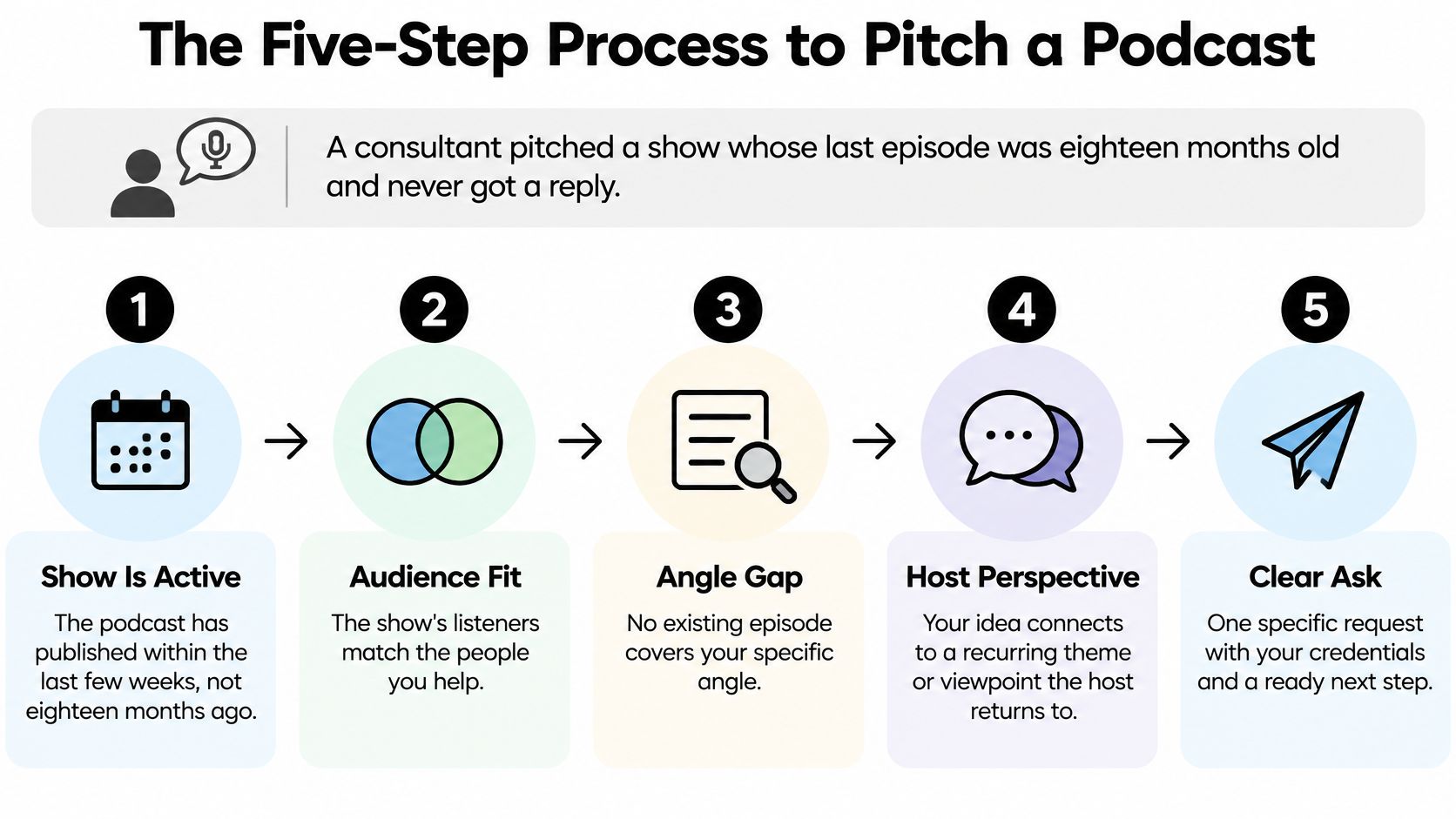
Every stage has a concrete finish line so you know when to advance and when to drop a show rather than polishing an email nobody will book.
| Step | What You Do | Done When |
|---|---|---|
| 1. Verify the show is active | Check the latest episode date and publishing cadence | Latest episode is recent and the schedule is steady |
| 2. Confirm external guests and the route | Look for past guests and the host's stated submission route | You know which channel the host wants |
| 3. Review recent episodes | Note one audience need or unresolved theme | You can name one specific angle |
| 4. Propose one defined conversation | Write one topic with one listener benefit | The topic fits in a single sentence |
| 5. Send proof and a next step | Add brief credentials and a short ask | The host can judge it in about 30 seconds |
If a podcast fails Step 1 or Step 2, cut it immediately instead of tweaking your draft. The finish line for the full process is a short pitch that leads with the episode topic, proves audience relevance, and lets a busy host say yes or no in roughly 30 seconds, backed by at most one brief follow-up about a week later if the thread goes quiet.
Finding Podcasts Worth Pitching
Start with your topic, not a giant spreadsheet of famous shows. Write one plain sentence describing the expertise you offer and the specific listener problem it solves. That sentence acts as a guardrail so you don't waste afternoons pitching high-profile feeds whose listeners have no use for your subject.
Searching Directories and Guest Pages
- Search Podcast Apps by Listener Problem: Open Apple Podcasts or Spotify and query the exact problem paired with the audience, such as small business cash flow podcast. Scan 20 to 30 results and keep only shows whose titles and descriptions closely match the problem you solve.
- Uncover Dedicated Guest Pages on the Web: Run a web search pairing your core topic with podcast and be a guest or guest submission. Hosts who publish an intake page or submission guidelines are actively signaling they review outside pitches. For deeper filtering tactics across directories, read our guide on how to search for podcasts.
- Inspect Recent Guest Backgrounds: Note two or three past guests on every show that catches your eye. A podcast that already interviews independent practitioners in your field is a strong prospect, while a branded show that only features its own executives is a weak target.
Building a Four-Column Candidate List
Set up a simple tracking sheet with four columns: show name, format (audio or video), last episode date, and listed contact route. Mark every last episode date as unverified while you build the list, because directory listings routinely stay online long after a host stops publishing.
Aim for 15 to 20 candidate shows and add one short line per row explaining why that audience fits your expertise. Treat this sheet purely as raw material for qualification. Any show that fails your pre-pitch checks moves to a hold list instead of your sending queue.
Checking a Show Is Bookable Before You Write
Most pitching advice obsesses over clever subject lines while ignoring the primary reason hosts say no. In a 2026 analysis of 416 host declines published by Kite, 30.3% cited wrong fit, whereas only 1.0% cited a generic pitch or insufficient credibility. In a separate dataset of 6,546 pitches from the same analysis, very-high-fit targets booked at 6.2% compared with 3.3% overall, 90% of first replies arrived within 28 days, and more than one-fifth of bookings required a follow-up. Those figures are useful for direction, not as universal conversion benchmarks. Your results will vary by show size, niche and pitch route, so track them separately and change one variable at a time.
Stale directories, dormant RSS feeds, closed guest policies, and missing contact routes drain hours from outreach campaigns. Let's Make A Podcast published research reading 383 public podcast RSS feeds from a 408-show directory. It found that 246 shows (60%) had published in the last six months and printed a contact route a stranger could use. That gap is why each show in the directory is checked for whether it is still publishing and whether its host says how to pitch.
Qualification rule: Ten minutes spent verifying show fit produces better booking odds than an hour spent rewriting copy for a show that does not accept outside guests.
Six Bookability Checks to Run First
Open the show's actual feed and website rather than trusting an aggregator profile that may be months out of date. Run every candidate through the six checks below before drafting a single sentence.
| Check | Where to Look | Red Flag |
|---|---|---|
| Recent publishing | Latest episode date in the feed or directory | Nothing published in about six months |
| Guest pattern | Guests across the last ten episodes | Only the host's own colleagues or solo episodes |
| Stated pitch route | Show page, guest page or host website | No contact route published |
| Topical match | Recent episode titles and descriptions | No overlap with your expertise |
| Format fit | Whether episodes are audio, video or both | Your topic needs video and the show is audio-only |
| Follow-up window | Your calendar and the route's response time | You cannot follow up within about four weeks |
Treat these checks as a sequence, not a vibe check. Start with publishing and pitch route, because a perfect topic match is useless if the show is dormant or gives you no way to send a pitch. Then judge guest pattern and topical match. Format fit matters when your best proof is visual, such as a product walkthrough or a live teardown. The follow-up window matters because you need enough time to send one concise nudge without turning into a nuisance.
Let's Make A Podcast also provides a pitch template for guests, and its free tools help users find podcasts to pitch, draft a cold pitch, grade it, and build a guest one-sheet. Use those tools after qualification, not before. A polished pitch aimed at the wrong show still wastes the same sending time as a rough one.
Acting on Red Flags and Tracking Declines
Apply a hard filter to your candidate sheet: any show that triggers two or more red flags goes onto a hold list, not into your outreach queue. If a show only misses on one signal, such as a vague contact route, decide whether the audience fit justifies a quick check of the host's main website before moving on.
Once outreach begins, separate three outcomes in your tracker: “no reply,” “not currently booking,” and “wrong fit.” A “wrong fit” response tells you to tighten your topical filter, “not currently booking” means you can revisit the show if applications reopen, and “no reply” closes out cleanly once your four-week window expires. Keep those buckets separate from show size and pitch route. If small, highly relevant shows keep declining for fit, your targeting is loose. If larger shows do not reply through a generic contact form, the route may be the problem. That distinction tells you what to change before you write another pitch.
Finding an Episode Angle a Host Will Want
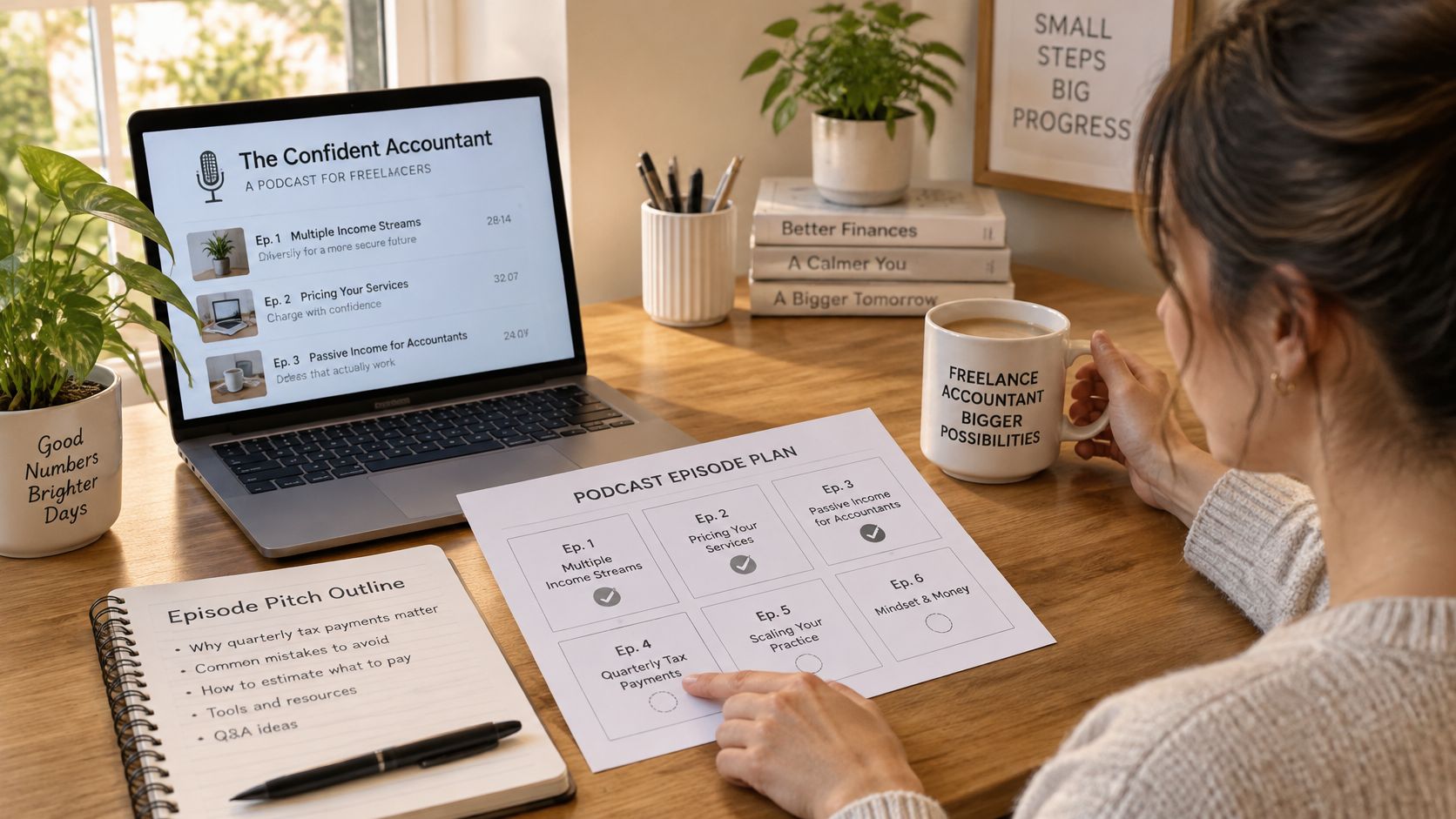
Say a freelance accountant wants to get booked on a creator-economy podcast. Instead of emailing a list of certifications, they scan the show's recent episodes, notice three interviews on growing creator revenue and zero episodes on quarterly estimated taxes, and pitch a practical breakdown of how solo creators avoid tax penalties.
Mapping that gap takes less time than most guests expect when you sit down with the episode feed and a notebook.
A Ten-Minute Episode Reading Routine
Pick the three to five most recent episodes on your target show and skim the titles, episode descriptions, and guest bios. Write down recurring listener questions, the guest archetypes the host gravitates toward, and any subject the host brought up briefly without dedicating a full interview to it.
From those notes, draft one or two tightly scoped episode angles. Pair each angle with a concrete listener payoff, such as a framework listeners can apply that afternoon or a costly mistake they can sidestep before making a decision.
Accounting for Video and Platform Discovery
Hosts no longer evaluate guests solely on how well they sound in an audio file. According to Edison Research's 2025 Podcast Consumer report, 51% of Americans had watched a video podcast at least once, 37% had watched one in the previous month, 26% had watched one in the previous week, and 48% had both listened to and watched a podcast. The same report found that YouTube was the service used most often by 33% of U.S. weekly podcast listeners, while total time spent with podcasts among Americans aged 13 and older had grown 355% since 2015 to 773 million hours per week in 2025.
Check whether your target show publishes full video episodes on YouTube or cuts short clips for social channels. If it records on camera, note that you have a clean video setup and are happy to share short clips when the episode goes live. If the show is audio-only, state that you can record remotely with a quality microphone in a quiet room.
Watch the video below for a practical breakdown of how hosts size up guest ideas and format readiness before saying yes.
If you can't state your episode angle and its listener payoff in one plain sentence, the pitch isn't ready to send.
Writing the Pitch and Presenting Your Credentials
Start from fit, not biography. Fit is the most common reason hosts decline, so the draft should prove the match before it sells the person.
Compare how a host reads a generic biography versus a topic-led opening.
- Before (self-focused): Hi Maya, I'm a fractional CFO with 14 years of experience helping startups scale, and I'd love to join your podcast to share my story and talk about financial leadership.
- After (audience-focused): Hi Maya, your episode last month on agency retainers nailed how hiring ahead of cash flow strains small teams. I'd love to walk your listeners through a 13-week cash buffer method so agency owners know the exact revenue point that funds a new hire.
Personalization works because it gives the host evidence that you did the work. In the Backlinko-Pitchbox study of 12 million outreach emails summarized by PrimaryInbox's cold-email benchmark report, personalizing the message body was associated with a 32.7% higher response rate, personalizing the subject line was associated with a 30.5% lift, and the same source put average cold-email response around 3.4%. Treat those as directional, not as a booking promise: list quality, deliverability, and the definition of "response" move the numbers. There is no universal podcast pitch conversion benchmark, so compare versions across shows of similar size and similar pitch routes.
The checklist below keeps the draft in the order a host scans it.
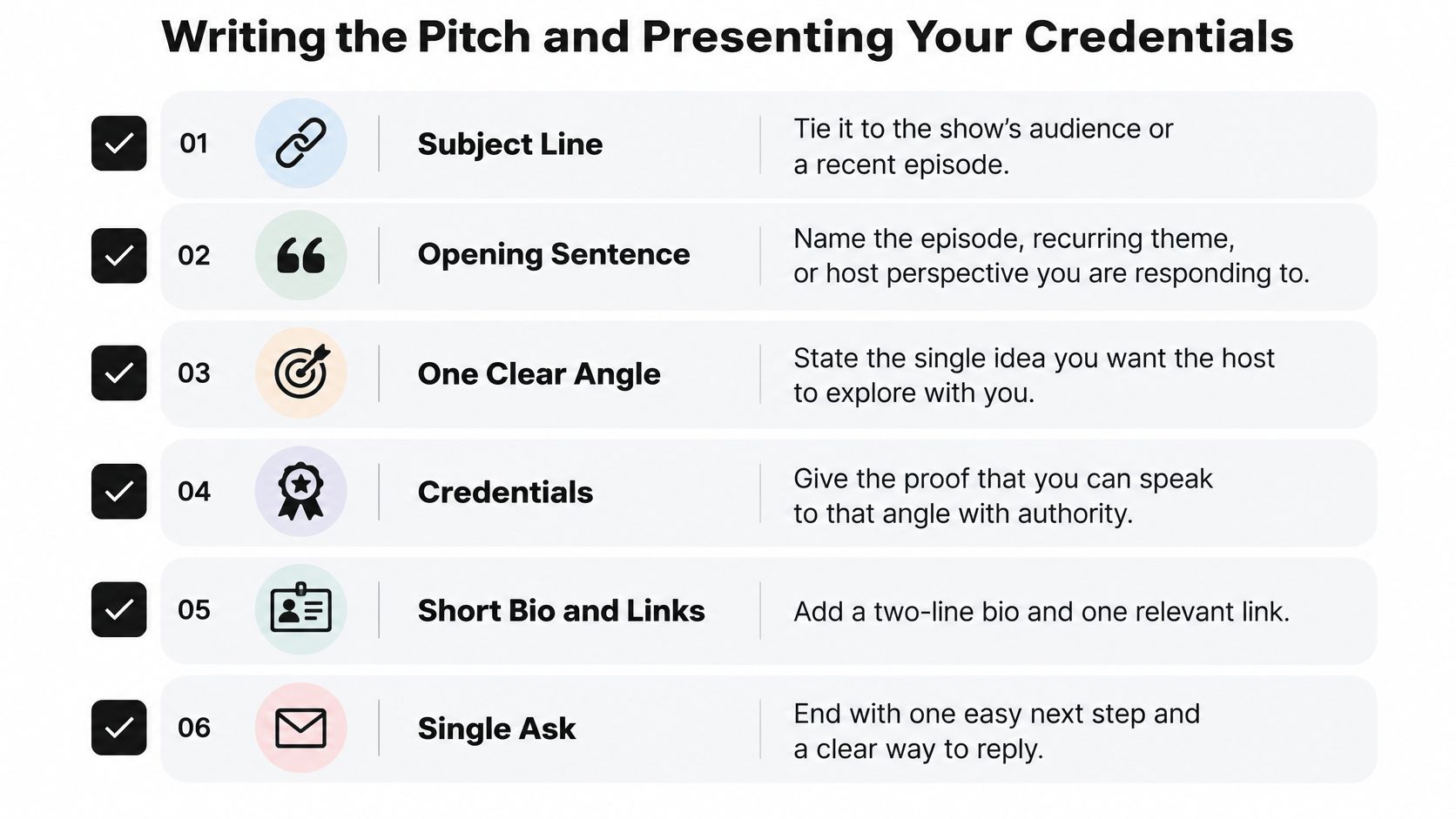
Structuring the Draft and Your Proof
- Fit Recheck: Write one private line before drafting: this show serves [listener], who currently wants [result]. If you cannot fill both brackets from episodes you checked, fix the target list before writing.
- Subject Line: Anchor it to the show's audience or a recent episode, such as Episode idea on 13-week cash buffers for agency owners, rather than a vague Guest Pitch.
- Opening Sentence: Name the specific episode, recurring theme, or host perspective that sparked your idea so the host sees immediately that you listen to the show.
- Outcome and Talking Points: Connect your expertise to one clear listener outcome in a single sentence, then list two or three concrete talking points the conversation can cover.
- Credentials and Media Proof: Keep your bio to two or three lines framed around listener value, citing one or two results you can name. Add one link to a past interview clip or a clean podcast one-sheet where the host can check your topics, bio, photo, and past episodes in seconds, plus a brief line confirming remote audio or video readiness.
- Single Low-Friction Ask: Close with one easy question, such as whether the angle fits their upcoming recording schedule or whether a quick ten-minute prep call would help.
Tightening Before You Send
Hold your finished draft to 120 to 180 words, one topic, one ask, and one link. Audit every sentence against a single standard: each line must either speak directly to the show's audience or prove a specific claim. Delete any sentence that does neither.
Cut throat-clearing first: "I hope this finds you well," long company history, and a second request buried in the sign-off. Keep the parts that reduce the host's risk: a relevant angle, credible proof, format readiness, and an easy next step. If the pitch still needs a paragraph to explain why you belong, the angle is too broad or the show is the wrong fit.
Sending and Following Up Without Being Pushy
Say a founder tracks down a host's personal inbox, sends a pitch Monday morning, follows up Tuesday afternoon, nudges again Wednesday, and sends a fourth note Thursday. By Friday, the host clicks report spam. Not only is that show permanently burned, the spam complaint drags down inbox placement for every future pitch the founder sends.
Guests send pitches from their own inbox to the route the show itself publishes. Don't bypass an application form or hunt for a private email address when a host explicitly states how they accept pitches. Following the host's instructions is the easiest way to show you respect their production workflow.
A Four-Week Outreach Sequence
A disciplined cadence gives busy hosts time to respond without crowding their inbox. Follow this sequence for every show you pitch.
| Day | Action | Why |
|---|---|---|
| Day 0 | Send the pitch from your own inbox to the stated route | The host's published route is the only channel to use |
| Day 7 | Send one brief follow-up that restates the topic | One follow-up is enough; more reads as pressure |
| Day 28 | Close the thread and log the outcome | Replies rarely arrive after four weeks, so closing keeps your pipeline honest |
| After Day 28 | Move the show to a hold list if no reply came | Revisit only if the show publishes a new guest call |
Writing One Brief Follow-Up and Logging Results
Hosts frequently open a pitch between recordings, intend to reply, and lose the email under fifty new messages. A single follow-up around Day 7 recovers a meaningful share of bookings without coming across as desperate. Reply inside the original thread, reference your earlier note, and restate your single topic in one sentence instead of repeating the whole pitch.
If you want crisp wording that stays polite and brief, adapt a pitch follow-up email template and cap yourself at one follow-up unless the host replies.
Sent-log discipline: Record the send date, contact route, subject line, and outcome on the day you send each pitch so you never double-pitch a producer or guess which subject lines actually pulled replies.
Keep that log updated on Day 7 and Day 28. Over a few weeks, those simple rows turn gut instinct into clear evidence you can act on.
Measure Results and Pick Your Next Five Shows
Start with an honest baseline: there is no trustworthy universal benchmark for podcast pitch success. A 2026 review from Media Morpheus Press found no independent survey publishing podcast-guest pitch response rates and warned that widely repeated figures often come from businesses selling booking-related services. Promising yourself a fixed conversion percentage only leads to frustration when your niche behaves differently.
Five Stages to Track Separately
Instead of tracking a single yes-or-no rate, separate five stages in your spreadsheet so you can pinpoint where outreach stalls.
- Delivery: Did your email land without bouncing, or did the show's web form confirm submission?
- Reply: Did anyone write back at all, including declines or timing updates?
- Qualified Interest: Did the host ask follow-up questions, request a pre-call, or express genuine interest in your proposed topic?
- Booking: Did you confirm a recording slot on the calendar?
- Publication: Did the episode go live on the feed so listeners can hear it?
Why Smaller Shows Often Beat Massive Feeds
Audience size changes booking odds dramatically. In one 2026 dataset reported in the same review, booking rates reached 5.7% for shows with fewer than 100 listeners per episode, 3.8% for shows with 100 to 1,000 listeners, and 0.3% for shows with 10,000 to 100,000 listeners. Because the 1,000 to 10,000 range had no reported value, treat these numbers as directional evidence rather than a guarantee.
| Listeners per Episode | Reported Booking Rate | What It Means |
|---|---|---|
| Fewer than 100 | 5.7% | Highest booking rate in the dataset |
| 100 to 1,000 | 3.8% | Middle band with a strong rate |
| 1,000 to 10,000 | Not reported | No value reported in the dataset |
| 10,000 to 100,000 | 0.3% | Lowest rate, despite the largest reach |
Pursuing the biggest podcasts in your category isn't automatically the smartest move. Smaller, specialized programs often deliver substantially better booking odds alongside tighter audience relevance, meaning more of the people listening care about your work. To compare pitch versions accurately, hold show fit and personalization roughly steady while tagging each row in your tracker by show size, topic, pitch route, and referral source.
Picking Your Next Five Shows This Week
I would start small and disciplined: pick five shows this week that pass your active-publishing and guest-policy checks, log each show name and one-sentence angle, and put Day 7 and Day 28 reminders on your calendar. If you'd rather skip manual feed checks, Let's Make A Podcast offers a free search tool, with no account needed, that searches real podcasts by topic and shows which are still publishing, which publish a contact route, and which show evidence they book outside guests.
Run this exact workflow across thirty qualified pitches before drawing big conclusions. Once you hit thirty, inspect which of the five stages lags furthest behind and change one variable at a time, whether that's your angle specificity, your target show size, or your subject line.
Joining Let's Make A Podcast is free, and creating a profile, browsing, pitching, inviting, messaging, and scheduling cost nothing. You can search verified active shows, check their published contact routes, and assemble a shareable guest one-sheet before sending your next round of outreach. Visit Let's Make A Podcast to find your next five bookable shows and start pitching with cleaner targeting today.