Podcast One Sheet Guide for Better Guest Bookings
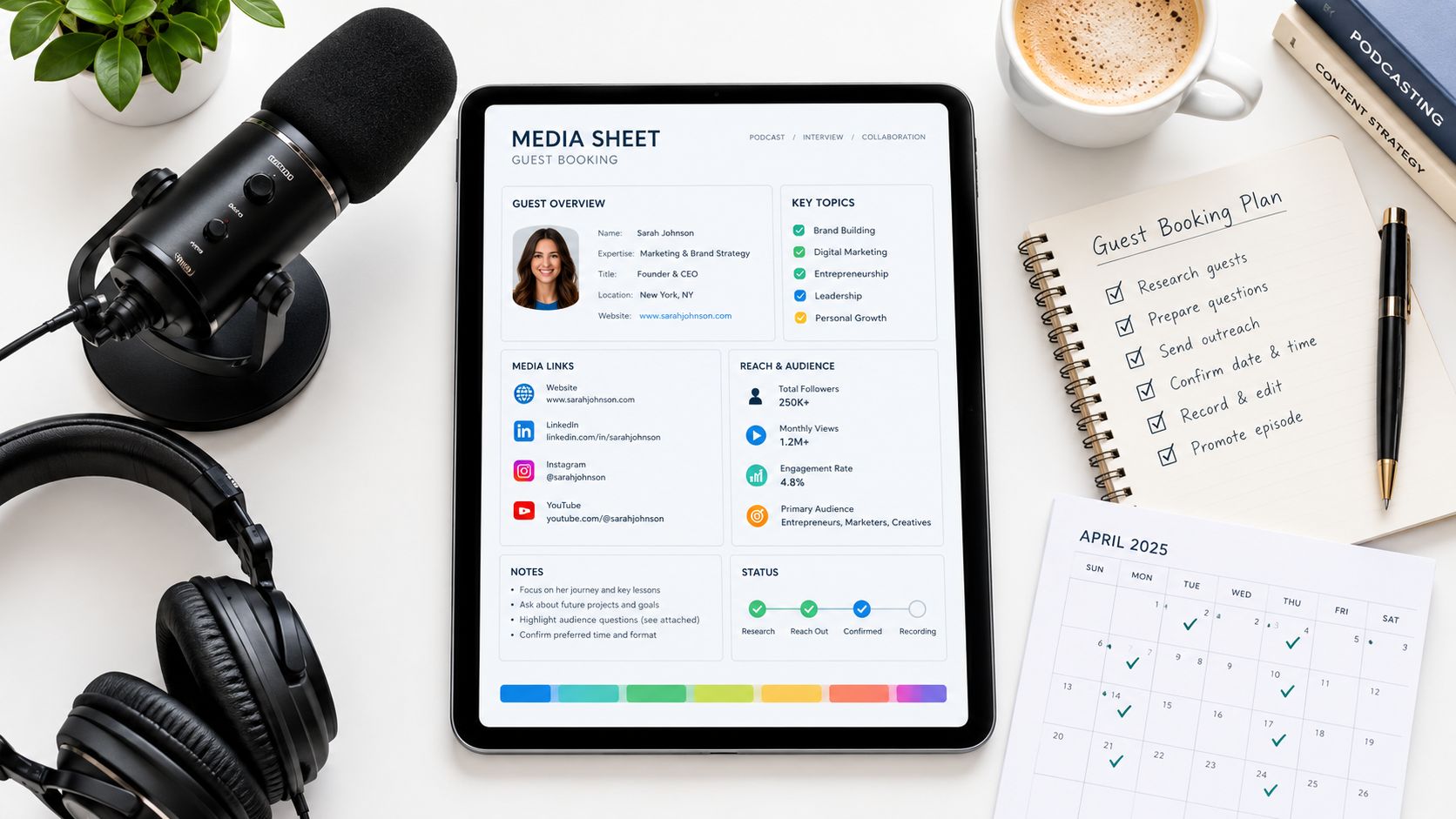
Most advice about a podcast one sheet starts with the wrong premise. It treats the document as a polished résumé with a headshot, a biography, and a stack of impressive logos. That may make you feel prepared, but it doesn't answer the question a producer has to resolve first: Can this guest fit our audience and our recording workflow without creating extra work?
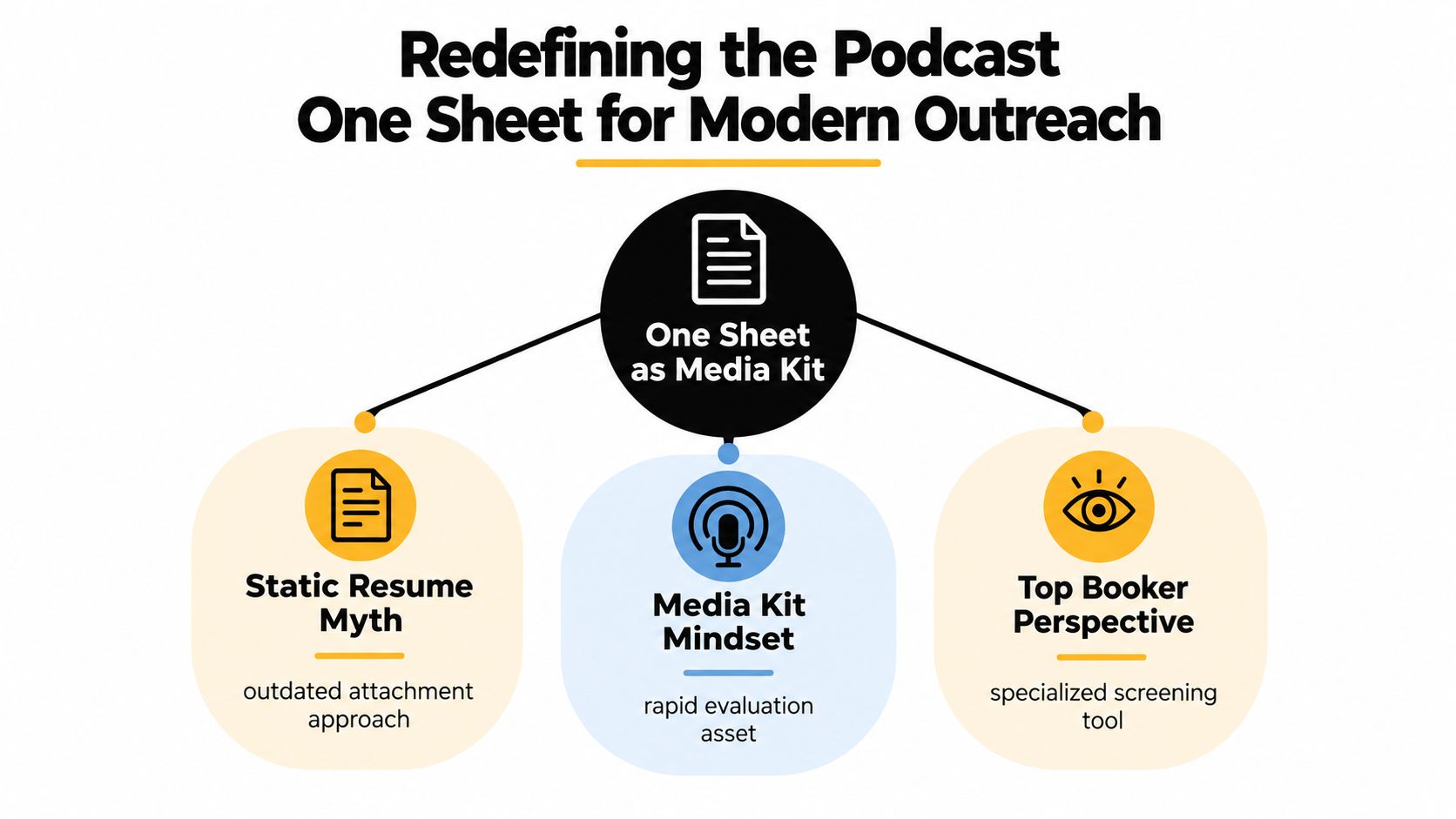
A one sheet is better understood as a specialized media kit. It packages your expertise, topics, proof, audience relevance, and booking details so a host can make a fast, informed decision. The document supports a strong pitch, but it won't rescue a vague angle or a poorly researched outreach email.
Table of Contents
- Redefining the Podcast One Sheet for Modern Outreach
- Core Elements of a High-Converting Guest Profile
- Proving Operational Fit and Booking Readiness
- Verifying Audience Metrics and Protecting Privacy
- Building and Distributing Your Shareable Profile
- Tracking Outcomes and Refining Your Pitch Pipeline
Redefining the Podcast One Sheet for Modern Outreach
Podcasting now operates at a scale that changes the value of concise guest information. In 2025, 55% of Americans aged 12 and older listened to podcasts monthly, while 40% listened weekly, both record highs reported by Edison Research's 2025 podcast consumer report. The same report found that 73% had consumed a podcast at some point, and Americans spent approximately 773 million hours per week with podcasts in 2025, an increase of 355% from 2015.
Those figures don't mean every show is difficult to reach, and they don't make design the deciding factor. They do show why producers need information that can be scanned quickly. A host shouldn't have to extract your qualifications from a website, a press release, several social profiles, and old interviews before deciding whether your proposed conversation belongs on the show.
Replace self-promotion with decision support
A résumé answers, “What have I done?” A useful podcast one sheet answers, “Why would this conversation work here, and what happens after we say yes?” That distinction changes what earns space on the page.
Include a short host-ready bio, focused episode concepts, relevant appearances, and one clear contact route. Then add the practical details that are often missing from guest collateral, such as recording format, time zone, availability, preparation expectations, and whether you can support promotion.
Practical rule: If a detail helps a producer decide, prepare, schedule, record, or promote the episode, it deserves priority over another accomplishment.
The document should also adapt to the recipient. An independent host may need confidence that you can record cleanly and communicate directly. A network or media brand may need a more formal booking route, approved assets, and clear availability windows. A static profile that ignores those differences remains a résumé attachment. A workflow-oriented profile helps the producer move.
Core Elements of a High-Converting Guest Profile
A producer needs to answer three questions quickly: Is this guest relevant? Are they credible? Will booking them be clear and manageable? Build the page around those questions instead of organizing it as a chronological biography.
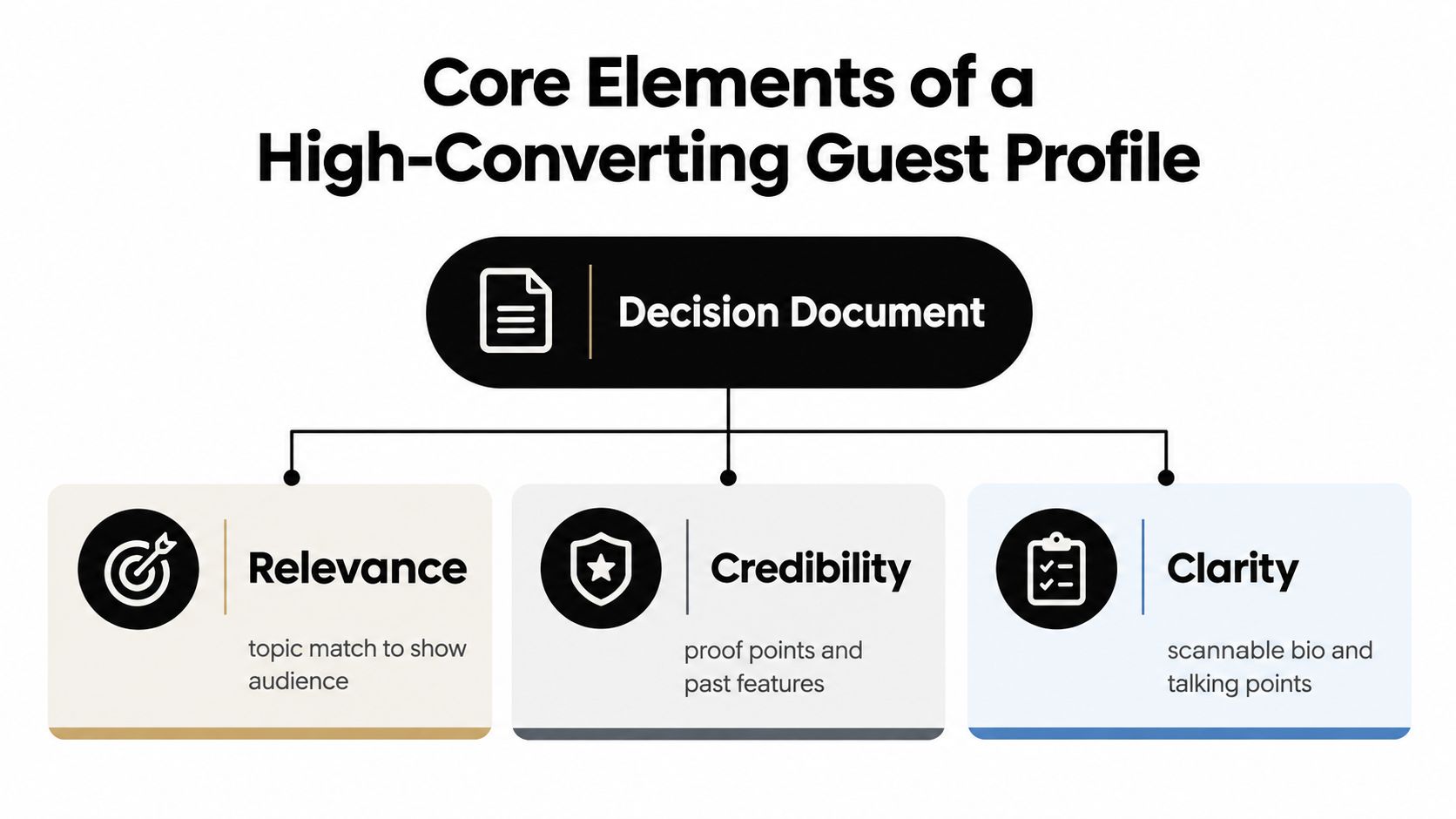
Relevance comes first
Lead with a positioning line that connects your expertise to the show's audience. “Leadership consultant” is a category, not an episode angle. “How first-time managers can give useful feedback without becoming overbearing” gives a host something they can evaluate.
Your profile should make the following visible without forcing the producer to open another page:
- Audience fit: State the industries, seniority, geography, or listener motivation most relevant to the target show.
- Conversation angles: Present specific episode concepts, not broad subjects such as business, wellness, or marketing.
- Host-ready questions: Offer questions that reveal your strongest frameworks, stories, or practical advice.
- Show context: When pitching a particular program, tailor at least one angle to its format, themes, or recent conversations.
Audience information works best when it explains who benefits from the appearance. A large social following may be less useful to a niche host than a precise explanation of the professional audience you can address.
Credibility should be selective
Use a concise bio written in the third person so the host can adapt it for an introduction. Add only proof that supports the proposed discussion, such as relevant media appearances, books, research, roles, or client work. A long award list dilutes the evidence that matters.
Clarity reduces the next email
Finish the decision layer with format and logistics. State whether you can record remotely, whether you support audio and video, your normal availability windows, the expected session length, and the direct booking route. Include a current photograph and links to selected appearances, but don't turn the page into a catalogue of every platform where you have an account.
The strongest layout is scannable on a phone. Clear headings, restrained design, readable type, and visible links outperform decorative complexity because the producer can find the answer without interpreting the design.
Proving Operational Fit and Booking Readiness
A guest can be highly qualified and still be a poor booking choice if the producer can't determine how to schedule or record the conversation. Existing templates often give credentials more space than logistics. That ordering reflects the guest's priorities, not the producer's workflow.
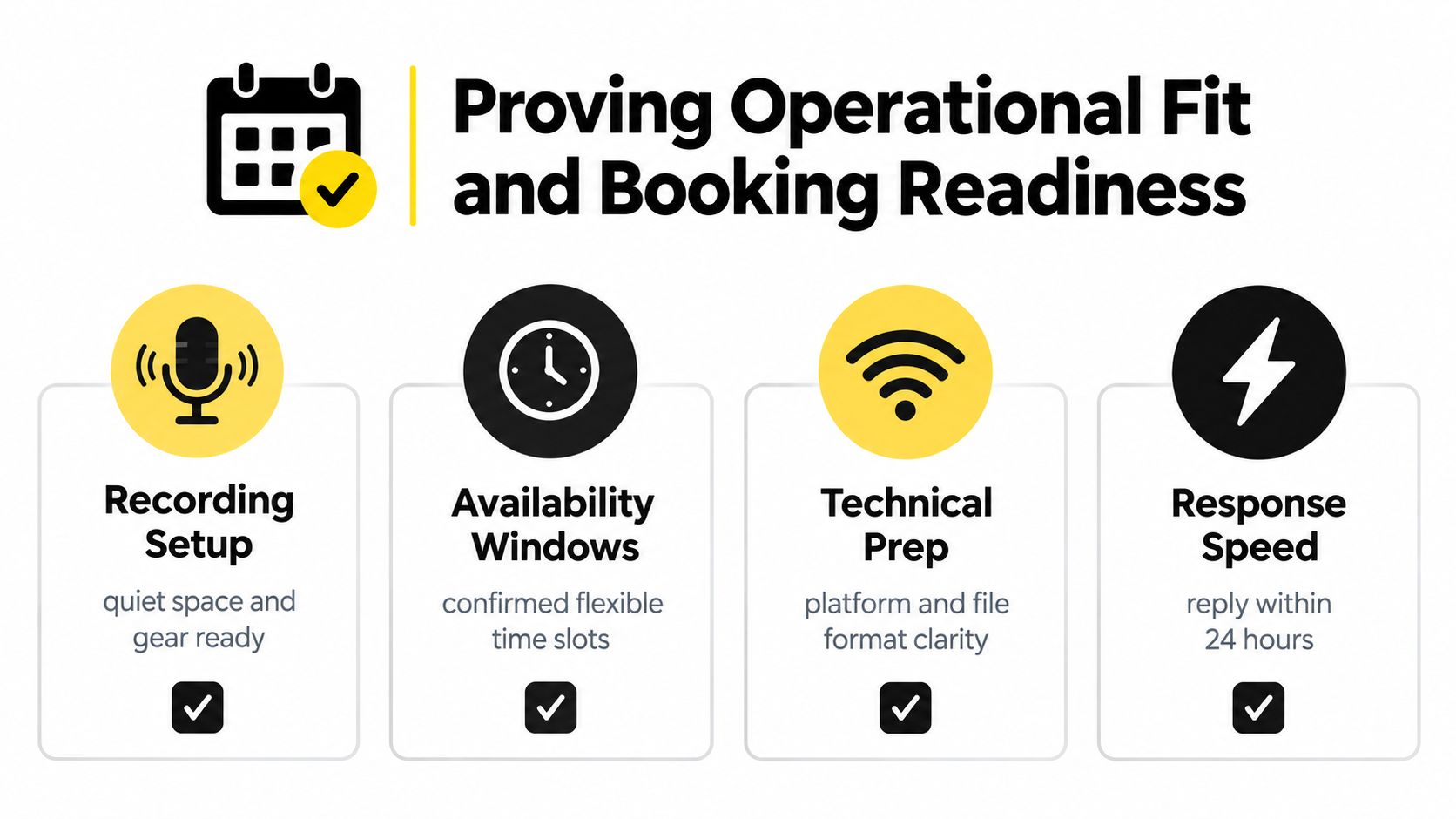
A booking-readiness section should remove predictable uncertainty:
- Recording setup: Identify your quiet recording location, microphone arrangement, camera availability, and backup plan in practical terms.
- Availability windows: Give normal days, hours, and time zone rather than writing “flexible schedule.”
- Technical preparation: State whether you can use the host's recording platform, complete a pre-interview, and provide requested files or assets.
- Accessibility needs: Mention requirements early and privately where appropriate, so the producer can accommodate them without last-minute disruption.
- Promotion expectations: Clarify whether you'll share the published episode and whether you can supply approved images or copy.
Match the document to the booking desk
An independent host may value a direct email and a few reliable time slots. A network-run show may use an application form, producer review, guest release, asset collection, and a separate scheduling process. Your one sheet shouldn't pretend those workflows are identical.
The available analysis of public podcast information found that only 31% of reviewed podcasts published checkable evidence that they book outside guests, while 69% did not make their openness knowable from public information. It also found lower apparent openness among network-run shows than independent shows. These findings appear in research on which podcasts book guests.
That doesn't prove a show is closed. It does mean you should avoid assuming that a generic contact address is the right route. If the show publishes an application process, follow it. If it doesn't, make your proposed next step explicit and keep your operational details easy to locate.
More accomplishments won't compensate for missing logistics. In some cases, they make the profile worse by pushing the information a producer needs below the fold. A short, current readiness checklist can communicate more practical value than another paragraph of praise.
Verifying Audience Metrics and Protecting Privacy
Metrics can strengthen a guest profile, but vague metrics create suspicion. Don't label a download figure as listeners, reach, or audience size unless you can support that interpretation.
The IAB Podcast Measurement Guidelines define a valid download using the ID3 tag plus at least 60 seconds of audio. Unique downloads are typically deduplicated using IP address and user-agent within a defined time window. Those technical distinctions matter because repeated requests, bots, partial transfers, and different attribution windows can make delivery figures look larger than the human audience they represent.
Label every claim precisely
Use a label that tells the reader what the figure means:
- Verified: Include the source, measurement period, episode cohort, and analytics platform.
- Self-reported: Say that the figure comes from your own reporting rather than presenting it as independently validated.
- Updated on: Add the date of the latest review so an old claim doesn't look current.
- Metric type: Write “average valid downloads per episode, first 30 days” instead of “listeners” when that is what the data represents.
A producer should be able to distinguish downloads, estimated listeners, survey-based demographics, social reach, and newsletter subscribers. If you can't verify a number, omit it or describe the audience qualitatively. Guidance on podcast guest statistics can help you decide which evidence belongs in a profile.
Keep access useful but safe
Don't publish a private calendar, personal phone number, client information, or confidential campaign results. Use a professional inbox, booking form, or representative's contact route. A public link can contain enough information for evaluation without exposing every operational system you use.
Tailor evidence to the show. One relevant audience insight and one episode concept will usually help more than a broad collection of social badges. A profile that proves relevance with restrained, traceable claims feels more trustworthy than one that makes every possible visibility claim.
Building and Distributing Your Shareable Profile
Start with the content, not the template. Draft the positioning line, third-person bio, focused topics, proof points, audience description, questions, and logistics in plain text. Remove anything that doesn't help a producer assess fit or take the next step.
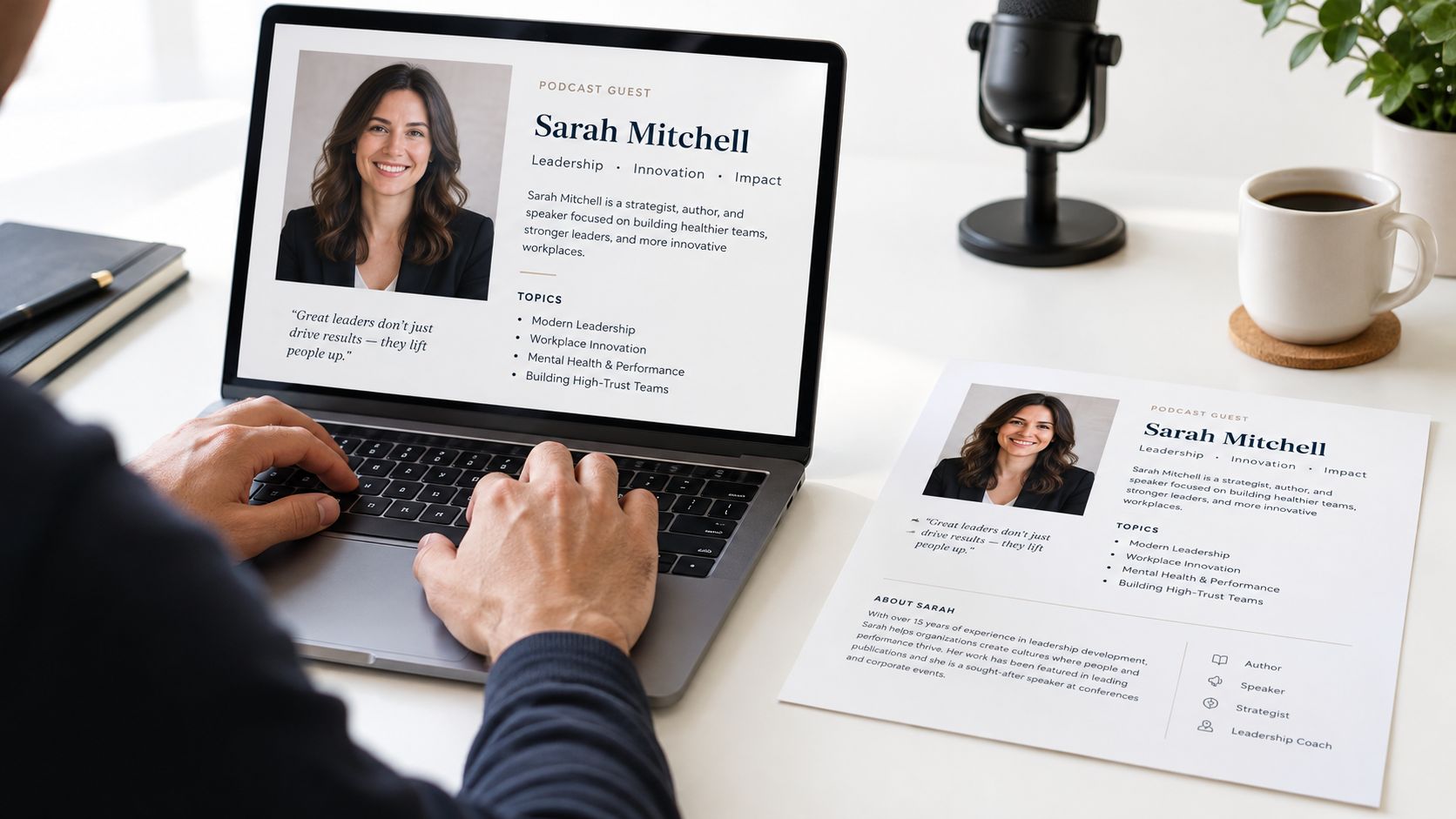
Choose the right publishing format
A live page is useful when the profile needs to stay current, load well on mobile, and be forwarded to a producer or booking team. A PDF remains practical when a network requests a controlled file, when a representative needs an attachment for an internal process, or when the recipient needs an offline version.
Use either format deliberately. A live page should have a stable URL, readable sections, working links, and a current photo. A PDF should have selectable text, accessible contrast, sensible file size, and a filename that identifies you clearly. Don't send an unrequested attachment when a short link can keep the pitch lighter.
Let's Make A Podcast provides a guest one-sheet builder that can create a profile with a headline, bio, topics, proof, and sample questions, then publish it as a shareable link or export it as a PDF.
Personalize the page before distribution
Create a core profile, then adjust the visible episode concepts for each serious target. The host should see why your proposed conversation belongs on that show, not merely why you are generally qualified to appear anywhere.
Place the profile link after the pitch has established relevance. The email should do the persuasive work, while the one sheet supplies structured evidence and booking details. Before sending, test every link on a phone, confirm the photo is current, and check that the contact route goes to the person or team who can respond.
A short walkthrough can help guests understand how a profile fits into a broader outreach process, but it shouldn't replace a clear written page.
Don't create multiple disconnected versions that drift out of date. Maintain one reliable source of truth, then make campaign-specific edits only where the target show's audience or format requires them.
Tracking Outcomes and Refining Your Pitch Pipeline
A one sheet earns its keep through the conversations it helps create, not through its appearance. Track what happens after distribution: replies, qualified conversations, booking requests, completed recordings, and whether hosts reuse your suggested questions or episode angles.
That evidence tells you where the problem sits. If producers open messages but don't reply, relevance or targeting may be weak. If they reply but ask basic questions already covered in the profile, the page lacks clarity. If conversations progress but scheduling stalls, the operational section needs work.
Keep the asset current
Review the profile whenever your positioning changes, a book launches, a major appearance becomes relevant, or your availability shifts. Remove campaign-specific claims after they stop serving the reader. Mark audience evidence with its source and update date, rather than allowing old proof to appear evergreen.
Use a pitch review tool such as Let's Make A Podcast's pitch grader to assess whether the outreach message connects the guest's expertise to the target show's audience. The grader can't replace judgment, but a structured review can expose generic openings, missing episode angles, or an unclear next step.
The useful habit is to treat the podcast one sheet as a living workflow asset. Improve the parts that reduce questions, preserve the proof that supports relevance, and remove anything that exists only to flatter the guest.
Let's Make A Podcast connects podcast hosts with prospective guests and supports the booking workflow through show discovery, shareable one-sheet profiles, pitching tools, messaging, and scheduling. Visit Let's Make A Podcast to create a practical guest profile and find a clearer route from relevant pitch to recorded interview.