Follow Up Email Reply: 8 Templates That Get Answers

You sent the pitch on a Tuesday. It was specific, it referenced the show, it had a one-sheet link and one clear question. Two weeks later the thread sits in your sent folder with no reply, and you're staring at a blank compose window trying to decide between "just bumping this" and writing the show off entirely.
Most guests pick one of those two options. Both cost the booking.
The follow-up is usually the message that gets read. A first pitch competes with everything else in a host's inbox that morning. A second message lands when the show is planning its next block of episodes and someone is scanning for guests. Treating silence as a verdict throws that away. Sending the wrong kind of second message throws it away harder, because it confirms you weren't paying attention.
What follows are eight follow up email reply formats. Each is a decision rather than a script: the situation it fits, how the tone shifts, what belongs in it, and the point where you stop. The running example is podcast guest outreach, because that's where the formats diverge most and where most guests send the same generic nudge into every situation.
Table of Contents
- 1. Simple Follow-Up Reminder
- 2. Recent-Episode Context Follow-Up
- 3. Value-Added Resource Follow-Up
- 4. Clear Availability and Scheduling Follow-Up
- 5. Permission-Based or Low-Pressure Close
- 6. Short Deadline or Recording-Window Follow-Up
- 7. Audience-Relevance Pitch Refinement
- 8. Personalized Connection and Question Follow-Up
- 8 Follow-Up Reply Formats Compared
- From Reply to Recorded Interview
1. Simple Follow-Up Reminder
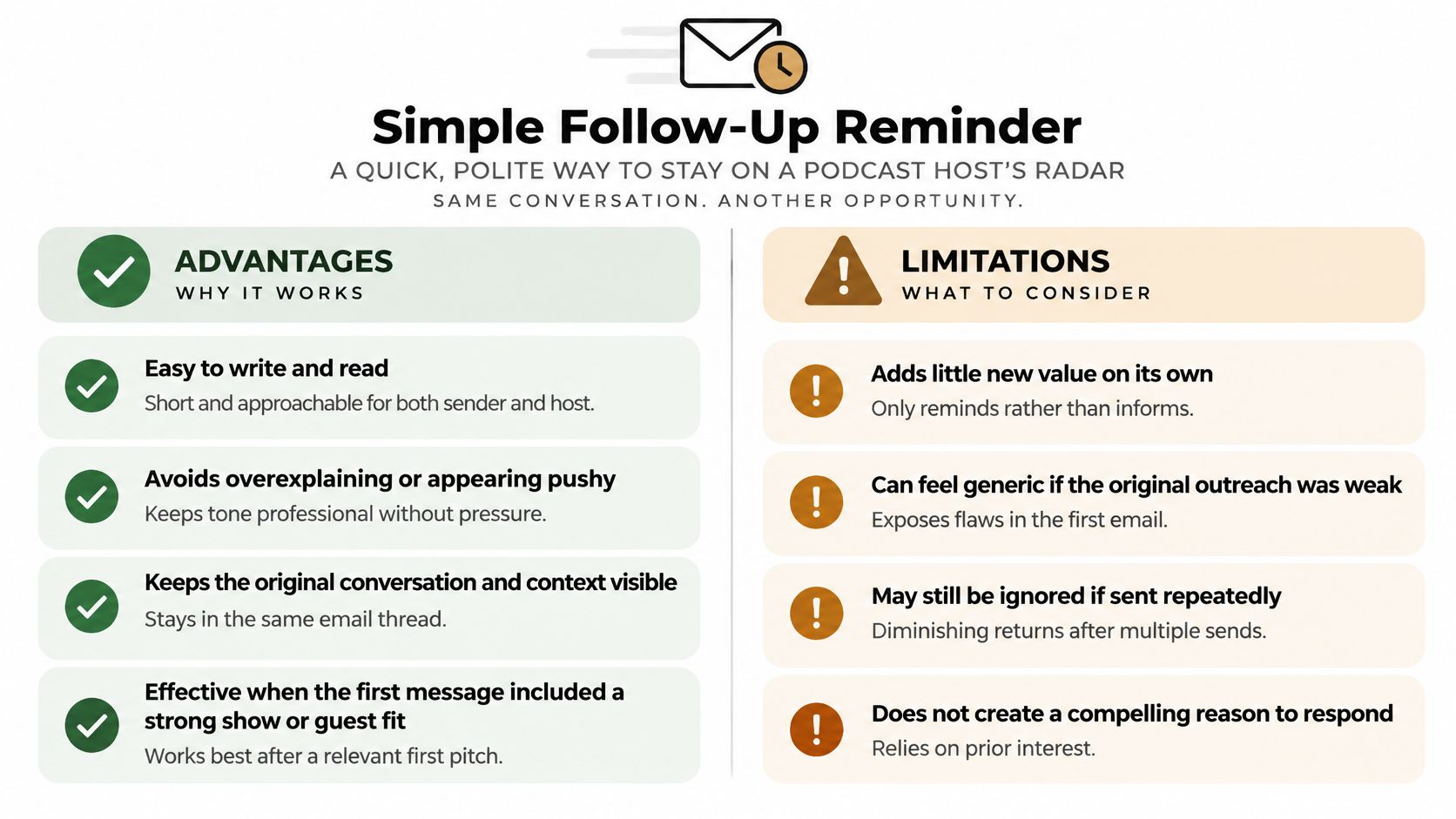
The plain reminder earns its place only when the first email was already strong. If the pitch was specific, referenced the show, and asked one answerable question, a short second note that resurfaces it does real work. If the first email was a template blast, the reminder confirms the impression instead of fixing it.
Timing benchmarks point to a short gap rather than an immediate repeat. An outreach dataset summarized by Inframail reported that a single follow-up generated 65.8% more replies than a one-touch send, and that a four-touch schedule on Day 0, Day 3, Day 7, and Day 14 lifted cumulative reply rates from 1.9% after the first message to 3.3%, 4.3%, and 4.9% after each later one. Read that as a shape, not a guarantee. The first follow-up carries most of the gain, and every additional step adds less.
The infographic below maps where a plain reminder helps and where it stops earning its keep.
One question, phrased to be answered from a phone
Podcast pitching rewards a narrow ask. A guest who originally pitched a discussion about responsible AI procurement can come back with one line: "Your season blurb mentions enterprise adoption. Would a 20-minute interview on how procurement teams vet AI vendors fit that block?" The host can decide that from a phone without opening an attachment.
- Keep it between 60 and 100 words. Longer versions read as a second pitch and get filed as one.
- Name the topic instead of writing "just following up." The reminder has to restate the subject, because the host won't scroll.
- Ask one question. Two questions turn a yes/no into a task.
- Reply inside the original thread. A fresh subject line forces the host to reconstruct who you are.
Subject lines carry more of this than senders expect, and a set of tested follow-up email subject lines keeps the thread findable without sounding like a chase.
Practical rule: Two plain reminders is the ceiling. If the second one lands in silence, change format or stop. A third identical note reads as automation rather than interest.
2. Recent-Episode Context Follow-Up
A follow-up that mentions a specific recent episode proves you listened, and that makes it a different message from a reminder. The second email can carry information the first one couldn't: evidence that you looked at the show as it is now, not as it was described in a directory listing two years ago.
The payoff shows up in aggregate. An analysis of more than 65,000 digital-public-relations campaigns and over 8 million emails found that sequences containing follow-ups achieved an 85% higher reply rate than campaigns that sent only one email, according to BuzzStream's follow-up email study. The same analysis makes a quieter point that matters more here: a follow-up earns attention when it references a recent episode, sharpens the proposed topic, or makes it easy for the host to decline.
Researching the catalogue is the step most guests skip.

Reference the episode, not the archive
Say a founder is pitching an episode on AI hiring and notices the show ran a segment three weeks ago about hiring managers in AI-heavy industries. The follow-up doesn't say "loved that episode." It says: "Your hiring managers segment kept circling the same problem, that teams screen for tool familiarity when they should screen for judgment. I can walk through the four criteria we apply to AI-adjacent roles and the two that turned out to be noise."
That message does three things at once. It proves attendance, it agrees with the host's framing, and it offers a concrete next episode.
- Use the latest relevant episode, not the most downloaded one. Recency signals you're a listener now.
- Keep the reference to one sentence. Two paragraphs of praise reads as flattery and buries the pitch.
- Build on the theme instead of grading it. Never position your episode as the correction.
- Verify title, date, speaker, and subject before you send. A misattributed episode is worse than no reference.
- Extend the conversation. The pitch should pick up where the episode stopped, not summarise it back to the host.
If you're rebuilding a pitch around a specific episode, real podcast pitch examples show how much detail the good ones carry before they ask for anything.
3. Value-Added Resource Follow-Up
The resource follow-up fails when the attachment exists to look professional. It works when the resource removes work from the host's side of the decision. That distinction is the whole format, and it gets flipped backwards by attaching a media kit nobody asked for.
Follow-ups aren't a nudge layer on top of outreach. They're where a large share of the decisions happen. In a B2B outbound benchmark covering 7.5 million emails, follow-up messages, steps two through six, generated 58.6% of all replies, as reported in Statistics Global's sales follow-up statistics. If more than half of replies arrive after the opening message, the follow-up deserves a payload better than "circling back."
One page, one link, one reason to open it.
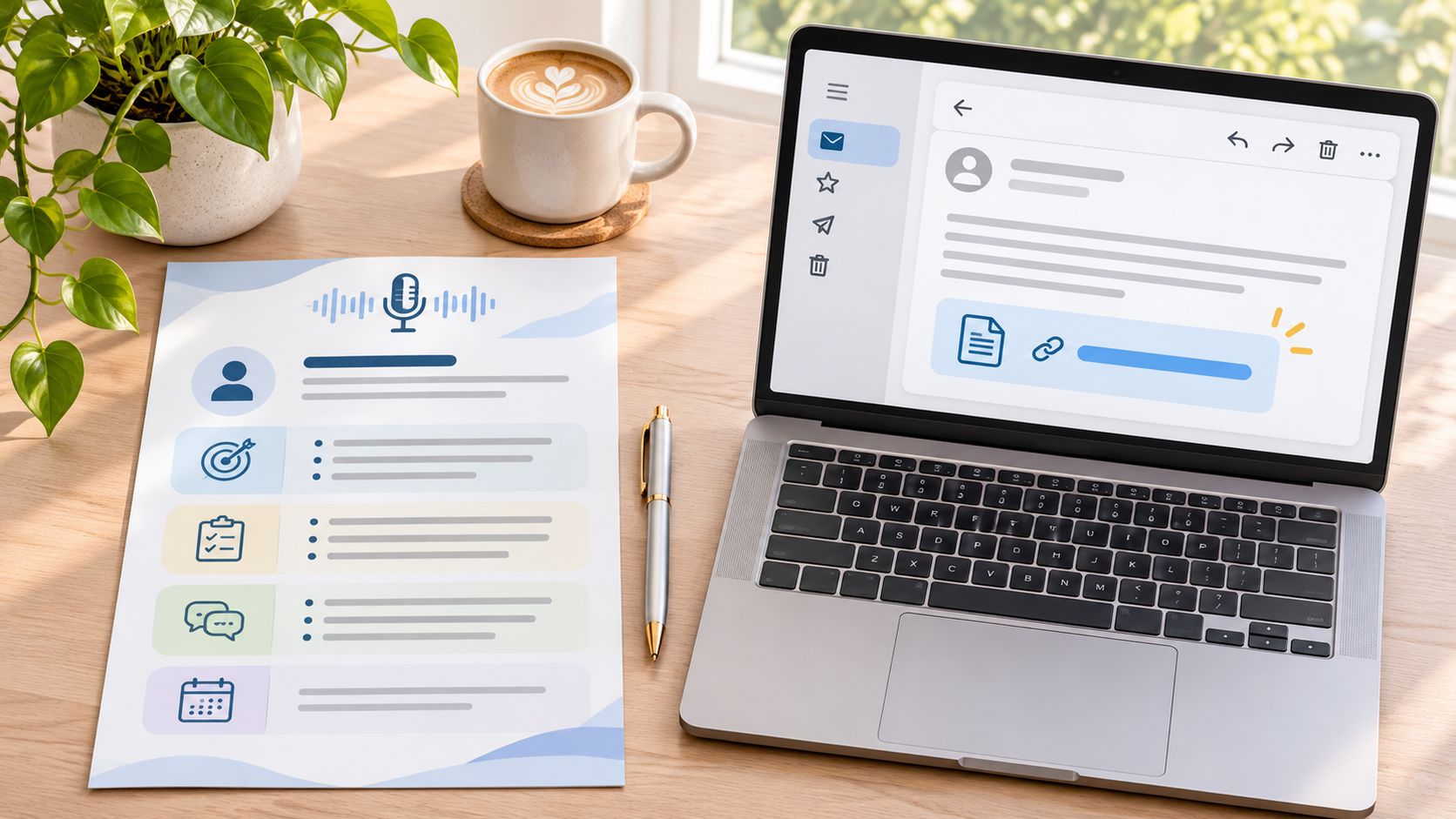
What counts as a resource and what doesn't
Picture a guest who follows up with a one-page briefing: five discussion prompts, two outcomes from comparable projects, and a link to the guest one-sheet. The host can read it in ninety seconds and forward it to a producer without editing anything. Contrast that with a 14-slide deck and a 40-minute video link, which transfer the work back to the busiest person in the thread.
- Send one artifact. A bundle signals you haven't decided what matters.
- Explain the value in a single line. "Prompts your producer can lift straight into the run sheet" beats "please find attached."
- Link, don't attach. A clean URL survives forwarding and avoids the spam filter.
- Build the one-sheet properly. A focused bio, topic description, photo, and relevant past appearances, nothing else.
- Keep it on topic. Generic thought-leadership PDFs unrelated to the pitch read as filler.
The test for any resource is simple. Could the host forward it to a producer and have that producer understand the episode without you in the room?
4. Clear Availability and Scheduling Follow-Up
When a host replies, “Happy to chat, send some times,” the next message should make choosing easy. This is a scheduling thread, not a reason to send another general reminder. Use this format only when the host has shown interest, such as asking a question or requesting availability. Sending time slots before a host responds can feel pushy and is unlikely to move the conversation forward.
Timing matters once the host asks for dates. A 2025 study cited in Growth Tribune's analysis of follow-up timing reported that 88.5% of cold-email replies arrived within 24 hours and 93.9% within 72 hours. The same research found that reply delays varied by time of day, with median response times under an hour in the morning and afternoon, and over seven hours in the evening and at night. If the host has asked for scheduling options, reply promptly rather than letting the question sit.
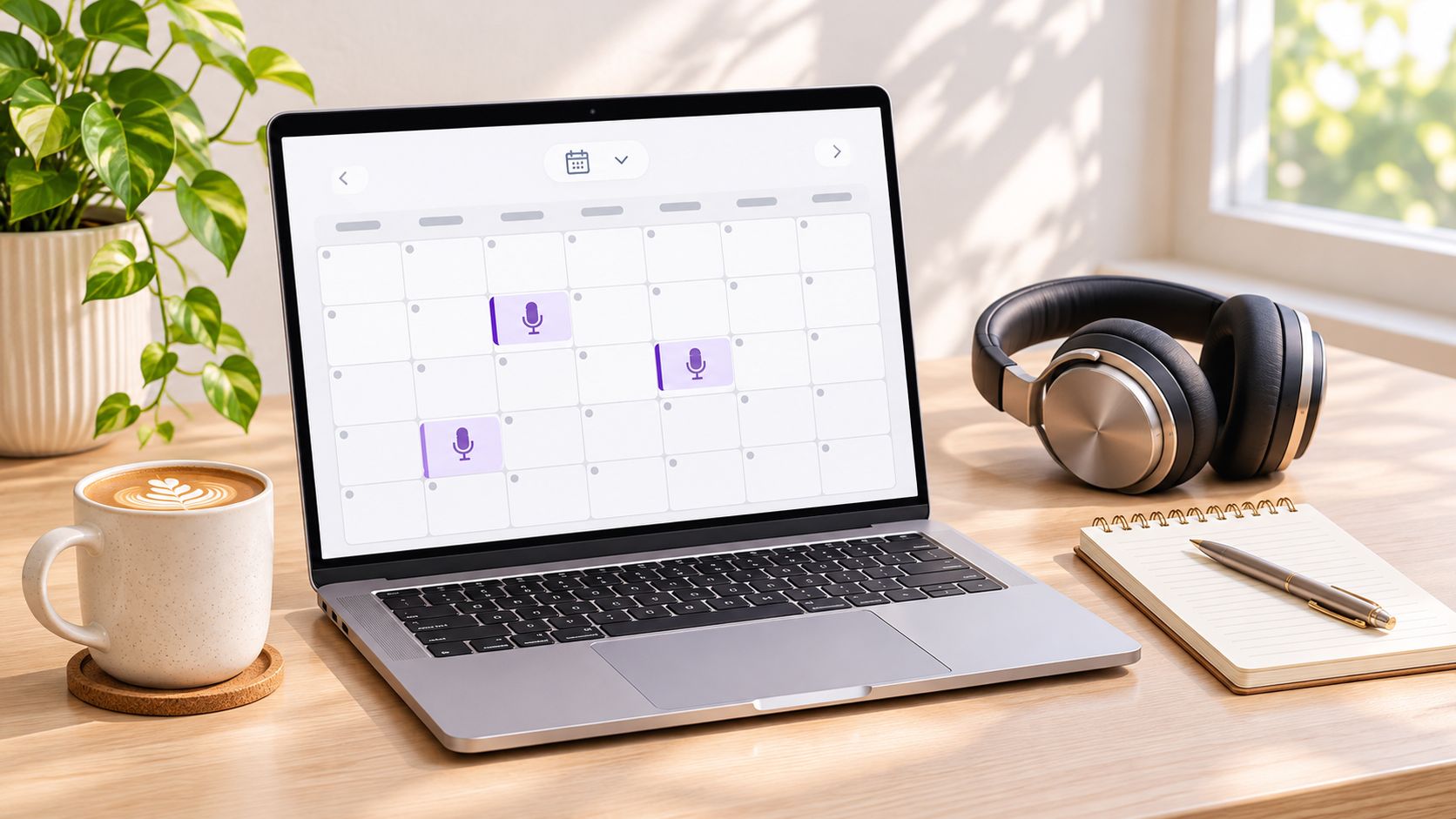
A useful scheduling reply resolves the open decision. Offer three concrete recording windows, include the time zone and duration, and give the host a calendar link if they prefer to book directly. Three specific options with a time zone will usually settle the scheduling question in a single message.
Give three windows, not an open invitation
“Whenever suits you” leaves the host with the work of proposing a time. Give a small set of realistic choices instead. For example, list three windows next week, each with a time zone and a clear duration. Keep the reply route open, too: some hosts will prefer to answer by email rather than use a booking tool.
- Offer three real options. A short list makes it easier to choose; a full diary makes the host sort through your availability.
- State the time zone and exact times. “Tuesday 10:00 to 11:00 ET” avoids an extra exchange to clarify when you mean.
- Add a calendar link as an option. Do not make clicking it the only way to respond.
- Confirm the details in writing. Include the date, format, recording deadline, and who will send the invite.
Reality check: “Let me know what works” hands coordination back to the host. Specific options make the next reply easier.
For a fuller walkthrough of subject lines and the details to reconfirm before recording, use this guide to writing an interview scheduling email.
5. Permission-Based or Low-Pressure Close
The close gets skipped because it feels like giving up. It isn't. It's the format that produces a real answer from hosts who are interested but not now, and that answer is worth more than another month of silence.
Inbox volume explains most of it. Microsoft's 2025 Work Trend Index, based on 31,000 workers across 31 countries, found that communication consumed 60% of users' work time, and workers read four emails for every one they sent, as Moor Insights & Strategy summarized. Silence is usually a volume problem rather than a judgement on your pitch. A close that lowers the effort needed to answer will outperform a reminder that adds to the pile.
Make no easy and you'll hear the real answer
A guest writes: "I don't want to keep landing in a busy inbox. Should I check back when you're planning next season's interviews, or would a different guest fit the current run better?" That message gives the host two clean exits and one door left open. Whichever one they take, you learn something usable.
- Use it after one substantive follow-up. As an opener it reads as a breakup email to someone you never dated.
- Offer a concrete occasion. "When you plan season four" beats "sometime next year."
- Drop the guilt framing. "I don't want to crowd your inbox" makes the host manage your feelings.
- Record the outcome. If the show is a no for this season, the pipeline should reflect that, so nobody sends a fourth email in eight weeks.
Three outcomes count as success here: a yes, a later, and a clear no. The only failure is a thread that stays ambiguous for a month.
6. Short Deadline or Recording-Window Follow-Up
Deadlines work. Invented deadlines work once, then cost you the relationship and, in a small podcast ecosystem, the next three pitches. The difference between the two is whether the timing belongs to the world or to your calendar.
Use this format when something external is closing: a book launch, an industry event where both of you will be present, a season wrapping, or a topic that will age out within weeks. The guest doesn't manufacture urgency; they point at it.
Compressing a gap only makes sense when you have something real to compress it for. A dataset covering more than 1.17 million cold-email recipients found that second emails sent 8 to 14 days after the first achieved a 0.66% human-reply rate, outperforming other tested intervals, while a third email still produced 0.38% human replies but declined against earlier steps, according to Sales.co's research on cold email follow-up reply rates. Outside a real window, the slower, more spread-out sequence wins.
Point at a deadline you didn't invent
An author with a book launching in six weeks follows up to say the conversation could cover the book's central argument and the questions readers are already sending in ahead of publication. That's a deadline the host can verify on a retailer page, and it makes the episode timely rather than merely available.
- Anchor to something checkable. A publication date, an event date, a release. If the host can't verify it, it isn't a deadline.
- Say what still happens if they miss it. "If the timing doesn't work, the topic holds in the spring" is honest and keeps the relationship.
- Never move the deadline twice. A second extension tells the host the first one was theatre.
- Send it inside business hours. Tuesday morning beats Friday at 11pm.
- Retire "last chance" unless it is one. Hosts read pitches for a living and recognize the pattern.
7. Audience-Relevance Pitch Refinement
Most first pitches are too broad because the guest is describing their expertise rather than a specific episode. The refinement follow-up fixes that in one message, and it's the format I'd recommend to any expert whose first email went out as a career summary.
The structure is narrow by design. Instead of resending a biography, propose one episode concept, state the audience takeaway in a sentence, and ask whether that angle fits or whether the host would prefer a related direction.
Only the honesty of the connection changes; the thread stays. Hunter's 2025 analysis of 31 million emails found three-message sequences produced a 6.8% reply rate against 3.3% for single-email outreach, as CardR's follow-up statistics summary reports. A fresh subject line restarts the conversation at step one. A reply keeps the earlier context attached, which is exactly what a refinement needs.
The walkthrough below shows how much sharper a pitch gets when it's built around one audience question instead of a career summary.
How to narrow without narrowing to nothing
Take a guest whose first pitch offered "entrepreneurship and scaling." The refinement offers one episode: how first-time founders decide when to hire a chief operating officer, and the three signals that the decision is premature. Same guest, same expertise, a completely different decision for the host.
- Read the declared topics and the last five episodes. The gap between them is usually where the episode lives.
- Frame the angle as a starting point. "I'd build it this way, and I'm happy to go where your audience pushes" keeps the host in control.
- Give three concrete discussion points. They show the episode exists rather than being promised.
- Keep the biography in the one-sheet. Email bodies that recite credentials read like press releases.
- Ask a routing question. "Would that angle fit, or would you steer it somewhere else?" gets a reply even from a host who says no.
8. Personalized Connection and Question Follow-Up
This is the highest-effort format and the one most often faked. It works when a genuine professional connection exists between the guest's work and something the host has published, built, or argued in public. It fails when the "connection" is a shared city or a mutual acquaintance you've never spoken to.
The structure is short. One honest sentence about why this show, one question the host would enjoy answering even without booking you, and one line with the one-sheet link. The question does the persuading.
Volume doesn't rescue a weak connection. Belkins reported a 0.59% reply rate for the first email in a sequence, declining to 0.28% by the sixth step, according to Exaclose's follow-up statistics roundup. Adding touches to a message nobody wanted to answer just spends the goodwill the first one earned.
Ask a question the host would answer for free
Say a show recently debated why so many technical founders avoid hiring for operations roles. The follow-up asks: "How do you tell a necessary first operations hire from a premature one? Founders keep asking me that, and I don't think the answer is headcount." That question is useful to the host whether or not you ever appear on the show, which is exactly why it gets answered.
- Stay on professional ground. Published work, public episodes, product decisions.
- Don't imply a relationship that doesn't exist. Hosts remember who overstated one.
- Make the question answerable in two sentences. A question requiring research waits indefinitely.
- Attach the one-sheet, not the life story. Evaluation should take one click.
- Send it once. If the question lands and the thread goes quiet, move to the permission-based close rather than repeating it.
8 Follow-Up Reply Formats Compared
| Format | Best Used After | Tone | Timing | Main Risk |
|---|---|---|---|---|
| Simple Follow-Up Reminder | A relevant initial pitch | Professional, conversational | 3-7 business days after the first email | Adds little new value |
| Recent-Episode Context Follow-Up | A pitch tailored to the show | Researched, individualized | After verifying a recent relevant episode | An inaccurate or forced connection undermines credibility |
| Value-Added Resource Follow-Up | An initial pitch with a relevant resource to share | Helpful, concise | After preparing a useful, accessible resource | An irrelevant resource can seem like spam |
| Clear Availability and Scheduling Follow-Up | The recipient has shown interest | Practical, direct | Once interest or a scheduling question is clear | Can feel premature without interest |
| Permission-Based or Low-Pressure Close | One substantive follow-up with no response | Courteous, low-pressure | After an unanswered substantive follow-up | May close the opportunity |
| Short Deadline or Recording-Window Follow-Up | A genuine launch, event, or production deadline applies | Calm, professional | Close enough to the real deadline to be useful | False or repeated urgency damages trust |
| Audience-Relevance Pitch Refinement | A broad pitch needs a clearer audience fit | Specific, collaborative | After reviewing the show's audience and format | A narrow angle may limit the conversation |
| Personalized Connection and Question Follow-Up | A genuine professional connection or relevant idea exists | Human, thoughtful | When a specific connection can be verified | Personalization may seem contrived or invasive |
From Reply to Recorded Interview
Match the format to the moment and the rest follows. After silence on a strong pitch, send the plain reminder: short, in-thread, one question, sent three to seven business days later. When you have something new to say, use the recent-episode or resource format, because those earn a reply by reducing the host's work rather than repeating yours. Once interest exists but the calendar has stalled, switch to availability with three real windows and a time zone. When a pursuit has run its course, close with permission and record the answer.
Two failures account for most dead threads. The first is sending the same reminder four times and calling it persistence. The second is stopping after one email because silence felt like an answer. Both come from treating follow-up as a single behaviour rather than a set of decisions.
Deadlines are the exception, not the default. If nothing external is closing, don't manufacture a window. A host who catches an invented deadline remembers it the next time your name appears in the inbox, and podcasting is a small, well-connected industry.
Let's Make A Podcast is built around that decision sequence. We read each show's public feed to confirm it's still publishing, so you're not spending a follow-up on a dormant show, and when a pitch goes quiet the platform emails you a follow-up draft that's ready to send. We usually reply to emails within a couple of business days, and questions, show listings, and feedback all go to the same address. Start with the free tools before you commit to anything: the follow-up generator, the pitch grader, and the one-sheet builder all run without an account, and you can test every format in this article against real shows rather than a spreadsheet of guesses. If something in here doesn't fit your situation, email hello@letsmakeapodcast.com and tell us what you're seeing.
The eight formats above only pay off against shows that book guests, which is why Let's Make A Podcast reads each show's public feed before listing it and shows you the pitch route the host publishes. When a pitch goes quiet, we send you a follow-up draft built from that show's recent episodes, so the second message has something new in it. Start with the free follow-up generator at Let's Make A Podcast, or email hello@letsmakeapodcast.com with a thread you're stuck on.