8 Interview Scheduling Email Templates
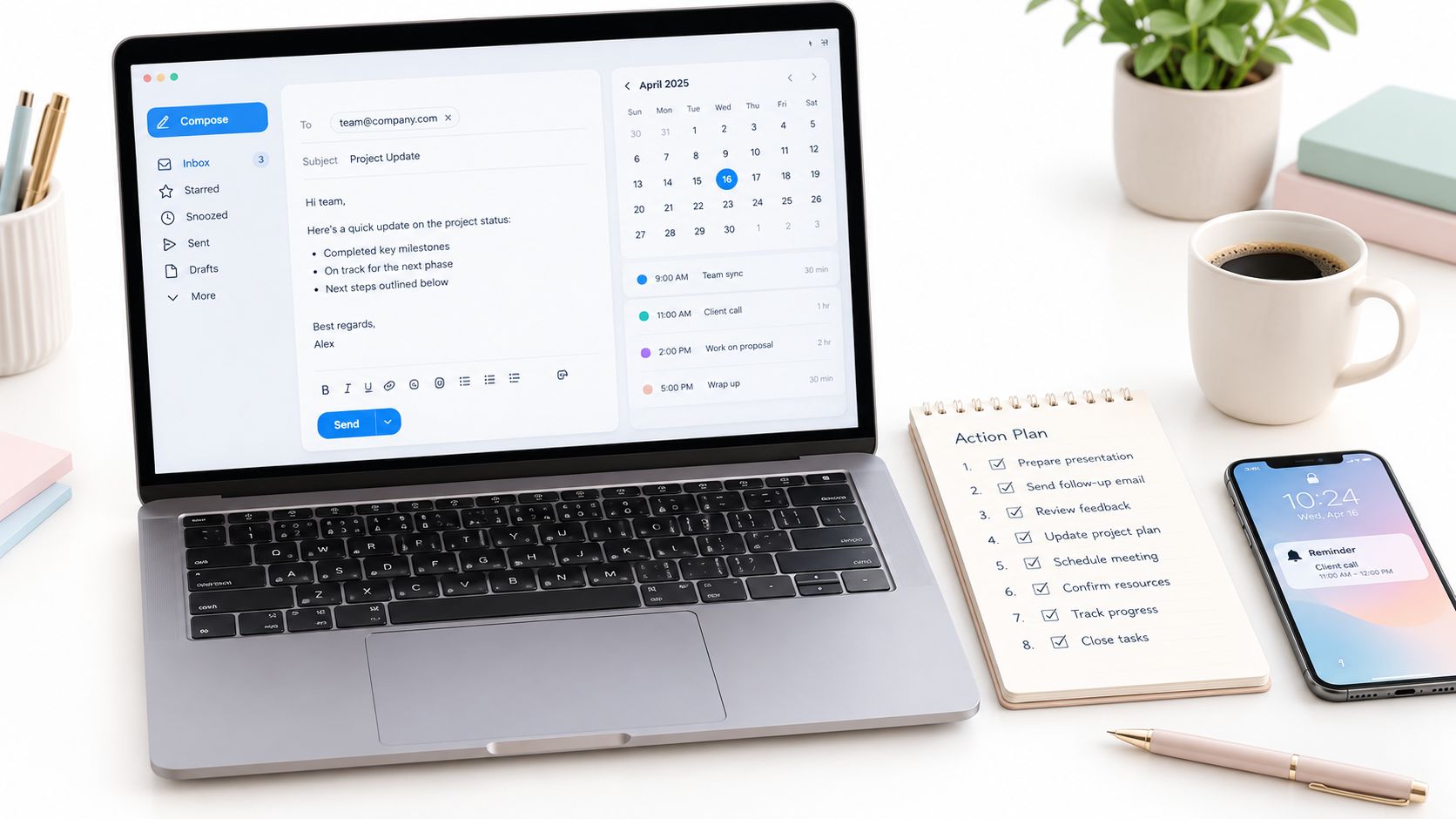
A promising guest has agreed to appear, but the interview still isn't safely on the calendar. The date is unclear, the time zone is missing, the recording format hasn't been explained, and the details are scattered across several messages. By the time everyone understands what happens next, the original momentum may be gone.
A strong interview scheduling email isn't one universal message. It changes with the booking stage, the recipient, the level of formality, and the action you need them to take. The eight templates below cover the full podcast booking lifecycle, from cold outreach and VIP recruitment to confirmation, preparation, group coordination, rescheduling, and post-interview promotion.
Use each template as a working draft, not a script. Keep the subject specific, display the date and time zone clearly, state the expected duration and recording format, and give the recipient one obvious way to respond. Where useful, Let's Make A Podcast can support show discovery, context-aware pitching, one-sheet sharing, messaging, and calendar-based scheduling in the same booking workflow.
Table of Contents
- 1. Initial Interview Confirmation with Calendar Invite
- 2. Pre-Interview Brief with Guest Talking Points
- 3. Follow-Up Scheduling Email After No Initial Response
- 4. Multi-Guest Group Interview Coordination Email
- 5. Rescheduling or Cancellation Email with Alternative Options
- 6. Post-Interview Thank You and Promotion Email
- 7. Strategic Guest Prospect Pitch Email
- 8. VIP Guest Recruitment Email
- 8-Point Interview Scheduling Email Comparison
- Turn Each Template Into a Reliable Booking Workflow
1. Initial Interview Confirmation with Calendar Invite
Once a guest accepts, remove every avoidable question from the next message. The confirmation should stand on its own if the guest never opens the earlier pitch. Include the episode topic, date, time, time zone, expected duration, recording platform, participants, and the calendar invitation in one thread.
Email coordination already consumes substantial working time. Research summarized from the McKinsey Global Institute estimates that knowledge workers spend approximately 28% of the workweek, or about 11.2 hours, on email. The same overview cites workplace interruptions of roughly 275 per day from email, messaging, and meeting notifications. The workplace email productivity overview explains why every missing detail creates unnecessary administrative work.
Practical rule: Send the calendar invite immediately after the guest agrees. Don't make them confirm the same information across a separate email, booking page, and calendar thread.
Subject: Confirmed, [Show Name] interview on [Date]
Hi [Guest name],
Thanks for joining [Show Name]. Your interview is confirmed for:
- Date: [Day, Month Date, Year]
- Time: [Time and time zone, with the guest's local time if useful]
- Duration: [Expected duration]
- Format: [Audio or video] via [Platform]
- Topic: [Specific conversation angle]
- Joining link: [Link]
I've attached the calendar invitation, which includes the recording link and preparation details. Please reply to confirm you've received it. If anything changes, reply in this thread or use [scheduling route] to suggest another time.
Best, [Host name]
If your booking process supports it, let the calendar event preserve the agreed details instead of asking the guest to copy them manually. You can also point guests to this interview schedule format when you need a consistent structure for dates, participants, and recording information.
2. Pre-Interview Brief with Guest Talking Points
A guest shouldn't have to reverse-engineer your show from its title. Send a separate brief before recording with enough context to help them prepare, while leaving room for a natural conversation. Explain who listens, what the episode will explore, how the interview will run, and which parts of the guest's experience are especially relevant.
The best brief feels personal. Pull topics from the guest's one-sheet, reference a recent episode that demonstrates your tone, and suggest a small group of talking points rather than writing a rigid script. A founder discussing product strategy may need a different angle from the same founder discussing leadership, even if both subjects appear in their biography.
Subject: A few notes for our [Show Name] conversation
Hi [Guest name],
We're looking forward to recording on [Date]. Here's a short brief to help you prepare:
- Audience: [Who listens and what they care about]
- Conversation angle: [One-sentence editorial focus]
- Format: [Conversational interview, structured Q&A, panel, or other format]
- Expected duration: [Duration]
- Suggested topics: [Topic one], [Topic two], and [Topic three]
- Recent episodes: [Episode link one] and [Episode link two]
- Preparation: [Anything the guest should bring, review, or avoid]
These are prompts, not a fixed script. I'd like to explore [specific aspect of the guest's work] and leave time for follow-up questions. If there's a topic you'd especially like to include, send it over before we record.
For accessibility and convenience, I can provide this brief as a written document or in another format that works better for you. Please also tell me if you'd prefer audio-only, need a different recording arrangement, or have any questions about the platform.
Best, [Host name]
Send the brief early enough for thoughtful preparation but close enough to the recording that it stays useful. The important detail is not a supposedly perfect send time. It's that the guest knows the format, duration, participants, and preparation expectations before joining.
3. Follow-Up Scheduling Email After No Initial Response
A follow-up should make replying easier, not make the recipient feel guilty. Refer to the original invitation, introduce a fresh reason the conversation is timely, and shorten the message. Don't paste the first pitch again or add exaggerated scarcity.
A useful follow-up has one job. It should either create a clear path to booking or give the recipient a comfortable way to defer. For example, mention that you're planning an episode about a topic connected to their recent work, then offer a scheduling link or ask them to reply with availability.
Subject: Following up on [specific interview topic]
Hi [Guest name],
I wanted to follow up on my invitation to discuss [specific topic] on [Show Name]. Your recent work on [article, project, talk, or episode] would give our audience a useful perspective on [clear question].
If you're interested, you can choose a suitable time here: [Scheduling link]. If this isn't a good period, no problem. I can also revisit the conversation later in [future month or season].
Best, [Host name]
Place the call to action above the signature and offer a reply-based alternative for people who don't want to use a booking link. Microsoft's telemetry indicates that Microsoft 365 employees are interrupted approximately every two minutes by meetings, email, or chat notifications. The discussion of email overload and workplace interruptions supports keeping the requested action visible and concise.
For hosts using Let's Make A Podcast, a follow-up can draw on the guest's one-sheet and the original conversation thread rather than forcing you to reconstruct the research. The interview schedule email reply guidance is also useful when the recipient has shown interest but hasn't selected a time.
4. Multi-Guest Group Interview Coordination Email
Panel scheduling fails when the email treats a group recording like several separate interviews. Every guest needs to understand who else will attend, whether the format is moderated or open discussion, how long the recording will run, and how the final time will be selected.
Start with the editorial purpose, then provide a controlled way to collect availability. A scheduling poll can work well, but it shouldn't replace a clear explanation of the episode. If participants choose a time without understanding the group format, someone may arrive expecting a one-to-one conversation.
Subject: Coordinating the [Show Name] panel on [Topic]
Hi everyone,
Thanks for joining this panel on [topic]. The conversation will include [names and roles], with [moderator name] guiding the discussion. This is a moderated panel, not a series of separate one-to-one interviews.
Please mark your availability here: [Poll or scheduling link]. When selecting times, check the time zone shown on the page. If none of the options work, reply with two or three alternatives and we'll find the strongest overlap.
The recording will last [duration] and take place on [platform]. We'll send the confirmed calendar invitation, discussion prompts, and technical details once the time is agreed.
Please flag any accessibility, privacy, audio-only, or platform constraints in your reply. We can provide a written list of options if you can't use the scheduling tool.
Best, [Host name]
After the poll closes, send a short summary of the best options instead of making every guest interpret a fragmented result. A separate confirmation to each participant can catch changes that a group reply may conceal. Send the moderator's prompts early, and give the other guests enough context to prepare without turning the panel into a rehearsed performance.
The following video can help hosts explain a group scheduling process internally before sending the invitation.
5. Rescheduling or Cancellation Email with Alternative Options
A rescheduling message should arrive as soon as you know the original time won't work. The recipient shouldn't have to ask whether the interview is still happening or start the scheduling process from the beginning. State the change, give a brief reason where appropriate, and present concrete alternatives.
Lead time affects attendance, so speed isn't the only consideration. An analysis of 93,783 scheduled interviews found a 28.0% no-show rate for interviews booked less than 24 hours ahead, compared with 8.4% for bookings 24 to 48 hours ahead and 8.1% for bookings 48 to 72 hours ahead. The analysis of interview no-shows and scheduling lead time is based on a scheduling-provider dataset, so treat the relationship as directional rather than universal.
Subject: A quick change to our [Show Name] recording
Hi [Guest name],
I'm sorry, but I need to move our recording scheduled for [original date and time] because [brief professional reason]. I know you've set aside the time, so I'd like to make the change as easy as possible.
These alternatives work on my end:
- [Date, time, and time zone]
- [Date, time, and time zone]
- [Date, time, and time zone]
- [Date, time, and time zone]
Reply with the option you prefer, or send two alternatives that suit you. I'll issue an updated calendar invitation as soon as we agree.
Thanks for your flexibility, [Host name]
If the guest is the one who needs to reschedule, remove any unnecessary apology from your response. “No problem, here are the times that work on our end” protects the relationship better than language that makes the guest defend the change. If a recording has to be cancelled rather than moved, say so plainly and explain whether you'll contact them again or whether the booking is closed.
For repeated conflicts, offer a lower-coordination alternative such as written answers or an asynchronous audio response. That preserves the editorial relationship without pretending the original format still works.
6. Post-Interview Thank You and Promotion Email
The recording may be finished, but the guest relationship is still active. A prompt thank-you message confirms that you value the guest's time and gives both sides a clear plan for publication and promotion. Include the expected release date, episode link when available, approved clips or graphics, and one specific promotional request.
Avoid sending a vague “please share this” message. A guest is more likely to act when you provide a ready-to-use caption, identify the preferred sharing window, and explain what you will promote yourself. Give them room to edit the wording so the post sounds like them.
Subject: Thank you, plus assets for the [Show Name] episode
Hi [Guest name],
Thank you for joining me to discuss [topic]. I enjoyed the conversation, especially your perspective on [specific moment or idea].
We're planning to publish the episode on [date]. Here are the details:
- Episode link: [Link]
- Preview clip: [Audio or video link]
- Graphics: [Folder or download link]
- Suggested sharing window: [Dates]
- Draft caption: [Short caption the guest can personalize]
Would you be open to sharing the episode with [specific audience, newsletter, community, or social channel] during that window? I'll also promote it through [your specific channels]. If you'd like any wording or image adjusted, tell me before publication.
Thanks again, [Host name]
Send the thank-you while the discussion is still fresh. Include the guest's name and image in promotional assets where appropriate, and use a trackable episode link only if the guest is comfortable with that arrangement. A request for a short testimonial can be separate from the main promotional ask, so the email doesn't become an exhausting list of obligations.
7. Strategic Guest Prospect Pitch Email
Cold outreach has to earn attention before it asks for calendar time. Lead with a specific connection between the guest's work and your audience. A recent article, product launch, research finding, public talk, or interview gives the recipient a reason to believe the invitation was written for them.
Cold email benchmarks commonly place reply rates around 5% to 10% and meeting-booked rates around 0.5% to 2%, but these are directional figures rather than universal standards. The cold email benchmark source notes that audience quality, personalization, sender reputation, and offer relevance materially affect results. Track positive replies and confirmed recordings separately from total replies, because interest doesn't always translate into a booked conversation.
Subject: Interview idea, [Specific topic] for [Show Name]
Hi [Guest name],
I enjoyed your recent [article, talk, episode, or project] about [specific subject]. Your point about [specific observation] connects directly with what our audience of [relevant audience description] wants to understand about [topic].
I'd love to invite you to [Show Name] for a conversation about:
- [Question or angle one]
- [Question or angle two]
- [Question or angle three]
The interview is [format] and takes approximately [duration]. Here's a recent episode so you can hear the show's style: [Specific episode link].
Would you be open to exploring this? You can reply here, or review the show and guest details at [show or one-sheet link].
Best, [Host name]
Keep the pitch focused on the guest's expertise and the audience's questions, not the host's need to fill a slot. Let's Make A Podcast can help hosts identify active, topic-aligned shows and draft context-aware outreach. Its podcast guest pitch template can also help guests present their background in a form that makes editorial fit easier to assess.
8. VIP Guest Recruitment Email
High-profile guests usually need a different approach because their inboxes are crowded and their appearances may involve an assistant, agent, or communications team. Don't send a long biography of your show in the first message. Establish a credible reason for the conversation, then invite a low-friction response.
The strongest VIP outreach is selective rather than flattering. Explain the angle the guest can explore with you, especially if it adds something beyond their recent interviews. If a mutual connection is relevant, ask that person for permission before naming them.
Subject: A focused conversation about [specific topic]
Hi [Guest name],
Your recent work on [topic] intersects closely with what our audience is exploring. I'd like to discuss [specific angle or unanswered question] in a focused conversation for [Show Name].
Worth exploring?
Best, [Host name]
If there is no response, follow with more context rather than a demand for attention:
Subject: Re: A focused conversation about [specific topic]
Hi [Guest name],
I know [Guest name or team] receives many interview requests, so I'll keep this brief. Our audience is particularly interested in [specific overlap with the guest's work], and I'd like to explore [new or under-discussed angle] rather than repeat the usual promotion-focused conversation.
If this is relevant to [book, product, initiative, or current work], I can send a short show profile and proposed questions. If someone else handles appearances, I'd appreciate being pointed in the right direction.
Best, [Host name]
Keep the tone peer-level and factual. Avoid claims such as “everyone wants you” or unsupported audience promises. For a prominent author or executive, a concise pitch to the verified representative may work better than a direct message. If the guest agrees, move quickly to a clear format, proposed dates, and a single owner for communication.
8-Point Interview Scheduling Email Comparison
| Item | Implementation Complexity 🔄 | Resource Requirements ⚡ | Expected Outcomes 📊 | Ideal Use Cases 💡 | Key Advantages ⭐ |
|---|---|---|---|---|---|
| Initial Interview Confirmation with Calendar Invite | Low, template + ICS embed, easy automation | Low, calendar integration and template setup | Fewer scheduling errors, reduced no-shows | Standard guest confirmations after acceptance | Centralizes details, auto-populates calendars, professional first impression |
| Pre-Interview Brief with Guest Talking Points | Medium, requires research and personalization | Medium, episode examples, one-sheet data, prep time | Higher-quality conversations and longer episodes | Expert interviews needing depth and alignment | Improves flow, reduces pauses, increases guest preparedness and promotion likelihood |
| Follow-Up Scheduling Email (After No Initial Response) | Low, single automated follow-up template | Low, follow-up generator and scheduling links | 20-30% lift in response rates, re-engages prospects | Cold/outreach with no initial reply | Boosts replies, creates soft urgency, automates repeat touches |
| Multi-Guest Group Interview Coordination Email | High, poll + consensus coordination, greater logistics | High, scheduling poll tools, moderator prep, tech checks | Consolidated availability data, higher reschedule risk | Panels/roundtables with 3+ guests across timezones | Eliminates long threads, creates group energy, defines roles and tech needs |
| Rescheduling/Cancellation Email with Alternative Options | Medium, curated alternatives + single-click reschedule flow | Medium, calendar widget, 3-5 suggested slots, possible compensation | Preserves goodwill, reduces ghosting, faster rebooking | Host/guest-initiated reschedules or last-minute cancellations | Shows respect, speeds rebooking, prevents lost pipeline opportunities |
| Post-Interview Thank You and Promotion Email | Medium, asset creation and tracking setup | High, graphics, teaser clips, UTM links, copy templates | Increased guest promotion, measurable referral traffic | Sent within 24 hours after recording to encourage sharing | Ready-made assets drive shares, UTM tracking measures guest impact |
| Strategic Guest Prospect Pitch Email (Cold Outreach) | Medium, targeted research and concise copy | Medium, research tools, pitch generator, one-sheet links | Modest response rates but higher-quality bookings | First-touch outreach to new prospective guests | Personalization raises response rates, clear low-friction ask |
| VIP Guest Recruitment Email (High-Profile/Influencer Outreach) | High, multi-touch, multi-channel, careful positioning | High, time, network, possible agent negotiation | Low hit rate, very high upside if secured | Outreach to high-profile authors, executives, celebrities | Peer-level positioning and exclusivity increase chance of premium placements |
Turn Each Template Into a Reliable Booking Workflow
Templates work best when each message has one job. The cold pitch introduces the editorial fit. The follow-up reopens the conversation without pressure. The confirmation converts agreement into a calendar event. The brief prepares the guest. The rescheduling email protects trust when plans change. The thank-you keeps the relationship active after recording.
A practical sequence looks like this:
- Initial pitch: Use a focused subject line that names the interview idea and show.
- Follow-up: Send one concise follow-up after a reasonable interval, then stop or offer a later opportunity.
- Booking confirmation: Once the guest agrees, send the confirmed date, time zone, duration, format, joining details, and calendar invitation immediately.
- Preparation: Send the guest brief before recording, with the audience, conversation angle, participants, and preparation expectations.
- Reminder and recovery: Monitor replies, confirm changes in writing, and make rescheduling straightforward.
- Post-interview follow-through: Send thanks, publication information, and specific promotional assets after the recording.
Speed matters, but speed without context creates new problems. An analysis of more than 2,200 U.S. companies found that organizations contacting a lead within one hour were nearly seven times more likely to have a meaningful conversation with a decision-maker than organizations waiting an additional hour. The same analysis reported that 23% of companies never responded at all. The research concerns business leads rather than podcast guests, but its workflow lesson applies: acknowledge interest promptly, make the next action clear, and don't leave a promising conversation without an owner. The email response-time analysis also supports treating scheduling as a sequence of actions rather than one isolated message.
Every scheduling email should answer the same practical questions. What is the interview about? Who will attend? How long will it take? Which time zone applies? What format will you use? What does the recipient need to do now? Put the requested action before the signature, and provide an alternative route for guests who can't use your preferred calendar system.
Let's Make A Podcast can support that workflow by helping hosts find active shows and qualified guests, review topic fit, create and share one-sheets, draft context-aware pitches, track outreach, and keep messaging and scheduling together. It can be useful when the problem isn't just writing one email, but maintaining a dependable path from discovery to a confirmed recording.
The best template is the one your team can adapt without losing essential details. Remove unsupported promises, avoid irrelevant audience claims, and don't bury the guest in operational information that belongs in a separate brief. A clear email respects the recipient's attention and gives the interview its best chance of reaching the calendar.
Let's Make A Podcast combines podcast discovery, guest one-sheets, pitching tools, messaging, and scheduling for hosts and prospective guests. Visit Let's Make A Podcast to find topic-aligned shows, create a stronger booking profile, and move promising conversations toward confirmed interviews.