8 Podcast Pitch Examples and Why They Work in 2026
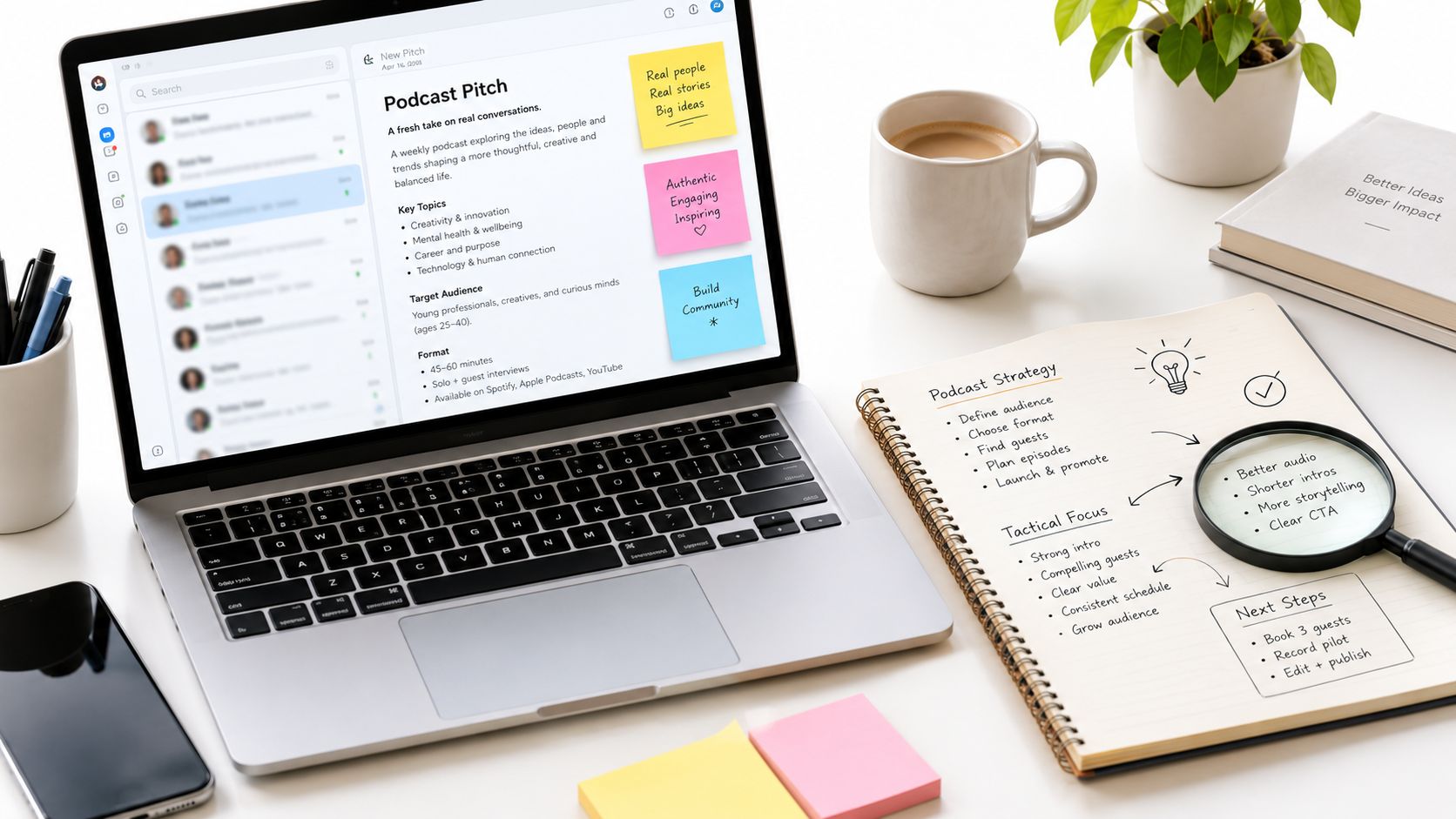
You've probably seen the same inbox pattern the host sees on a Friday afternoon. A pile of unread messages, most of them vague, self-focused, and easy to delete, then one email that references a recent episode, names a listener problem, and makes the episode feel ready to record. That difference is structural, not about writing flair, and the best podcast pitch examples prove it.
The market around podcasting also rewards precision. U.S. podcast advertising revenue moved from $708.1 million in 2019 to $842 million in 2020, then to $1.9 billion in 2023, which made the space more professional and more crowded at the same time, according to the IAB's podcast advertising research and its 2023 revenue update. That's why a good pitch is less about sounding polished and more about showing fit quickly, with a concrete angle a host can use.
Table of Contents
- 1. Guest Pitch Email to Podcast Host
- 2. Episode-Specific Teaser Pitch
- 3. Social Media Pitch
- 4. Cold Outreach Sequence
- 5. PR and Media Pitch for Podcast Placement
- 6. Collaboration and Cross-Promotion Pitch
- 7. Network Submission and Partnership Pitch
- 8. Sponsorship Pitch Email to a Brand
- 8 Podcast Pitch Examples Compared
- Turning These Podcast Pitch Examples Into a Repeatable Workflow
1. Guest Pitch Email to Podcast Host
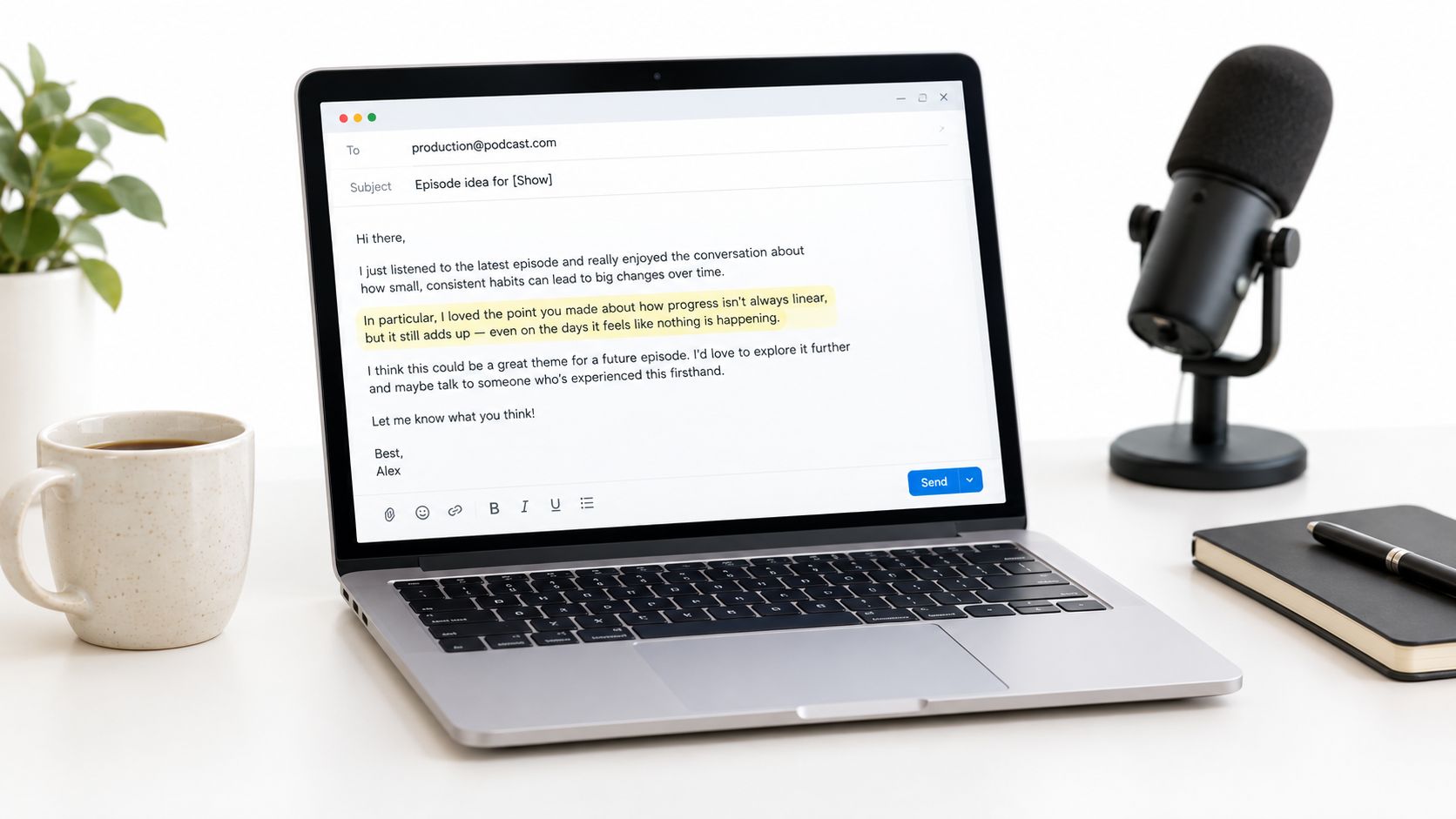
A cold guest pitch works best when it sounds written for one show. Open with a recent episode reference, then connect that episode to a listener problem the host already handles. A host can tell in seconds whether you listened or just pulled a name from a directory.
The mechanic that earns the reply
The reply comes from audience relevance plus evidence of homework. If the first sentence names a recent episode or a clear topic thread, the host can see right away that you are not blasting strangers. A pitch like that gives the host a clear reason to keep reading, because it shows fit before it asks for time.
A useful support point belongs in the pitch framework itself. If you want a fill-in structure for this format, the podcast guest pitch template walks through the same approach line by line.
A strong line often sounds like this: “Your conversation with [guest] on onboarding gave me a new way to think about retention, and I'd love to build on that angle for your audience.” It does two jobs at once. It proves you listened, and it points straight to the payoff for listeners.
The line worth copying
The best line to borrow is the one that turns the host's own content into your entry point. A subject line like Episode idea for [Show], why [specific point from Episode 112] matters for early-stage hiring gives the host a concrete frame before they open the email. In the body, offer two or three possible angles, then add a short credibility line and a one-sheet link.
That structure gives the host choices without making the pitch feel scattered. A subject-matter expert pitching supply-chain forecasting can reference a show's episode on inventory buffers, then propose a follow-up on forecasting without historical data. The host can immediately picture the episode shape, the audience benefit, and the conversation arc.
The mistake that sinks it
The pitch fails when it starts with biography, credentials, or a vague compliment. “I'm a founder with 15 years of experience and I'd love to share my story” does not help a host program an episode. It also falls flat if it offers a menu of unrelated topics instead of one clear fit.
Use the host's public feed first, then check the show's stated pitch route before you write. If the show says it takes applications or a form, follow that. Send one follow-up after five to seven business days, then stop unless the host responds.
2. Episode-Specific Teaser Pitch
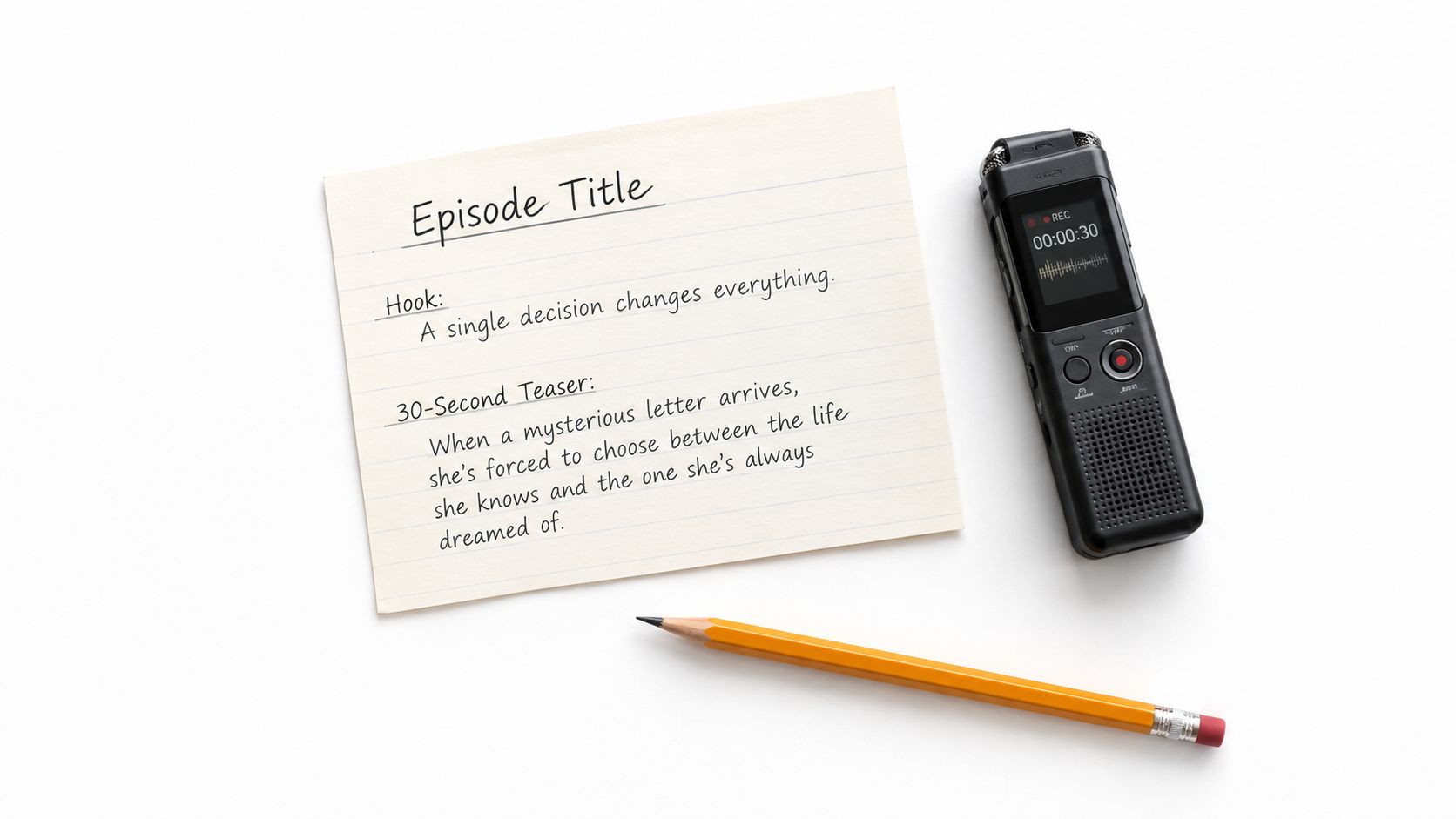
A teaser pitch is stronger than a general guest request when the host wants to see the finished episode before saying yes. You're not just saying, “I can talk.” You're saying, “Here's the exact episode, here's the hook, and here's how it could open.” That makes the decision easier because the host can judge the segment in a near-final form.
The mechanic that earns the reply
The reply comes from reduced production friction. Hosts are more likely to engage when they can picture the cold open, the core question, and the listener payoff without assembling it themselves. This format is especially useful for timely episodes, anniversaries, and series themes, because a specific moment gives the pitch urgency.
A useful teaser line could be: Why your onboarding email is losing readers before day three. That title promises a narrow takeaway, which is exactly what hosts want when they need a clean episode promise for their audience.
A teaser pitch also helps when you can supply promo material. If you hand over a 35-second cold-open script or a short social caption, the host sees extra value beyond the interview itself. That matters because many shows use guest-supplied assets to speed release-day promotion.
The line worth copying
The line worth borrowing is the one that names the episode outcome in plain English. Most growth teams are optimizing the wrong step, and there's one change that moves retention is the kind of line a host can read aloud, trim, or adapt. It works because it sounds like an episode intro, not a sales pitch.
A history podcast pitch can use the same pattern by framing a 1920s labor strike as a single episode tied to an anniversary date. The stronger the anchor, the easier it is for the host to imagine publishing it.
The mistake that sinks it
The common mistake is offering too many titles, too many angles, or a teaser that reads like an abstract summary. If the host has to figure out what the episode is, the pitch is doing too much work. Keep the teaser draft editable, not mandatory.
Don't insist on word-for-word use. The host needs a draft they can shape, not a script they have to defend.
3. Social Media Pitch
A social pitch is not a full ask. It's the opener that warms the relationship so the email doesn't land cold, especially on LinkedIn, X, or Instagram. Used well, it signals that you've already engaged with the host's content and understand their tone.
The mechanic that earns the reply
The reply comes from familiarity without pressure. A host is far more likely to answer a short DM that references a specific clip than a long message that arrives out of nowhere. The strongest social pitch usually starts after you've commented on two or three posts, because that makes the outreach feel earned.
A LinkedIn DM can be as simple as: “Loved your point on pricing experiments in that clip. I ran a similar test and got a comparable result, would you be open to a short pitch for a guest slot?” That message works because it's conversational, relevant, and short enough to read on mobile.
Keep the first message under 80 words. If you need more space, move the details to email.
The line worth copying
The best copyable line is the soft handoff: Would you be open to a short pitch by email? It gives the host control and avoids turning a DM into an unsolicited essay. That one question usually does more than a pasted bio ever will.
A public Instagram comment can do part of the work too, especially if it adds a thoughtful counterpoint to a clip and then asks whether the host accepts guest pitches by email. That public signal gives the DM context later.
The mistake that sinks it
The fatal move is dropping a full pitch into a DM. Long paragraphs, attachments, and a bio dump make the message feel like spam, even if the content is good. Another mistake is ignoring the host's preferred route when they've already published one.
Social outreach should point people toward the right channel, not replace it. If the show wants email or a form, respect that and move the conversation there.
4. Cold Outreach Sequence
A single email rarely does all the work. Three thoughtful touches usually do better, the first pitch, a value-adding follow-up, then a polite breakup email that closes the loop. That sequence keeps the outreach useful without turning pushy.
The mechanic that earns the reply
The reply comes from timing plus added value. Each follow-up should give the host one new reason to consider the pitch, such as a relevant stat, a tighter angle, or a 20-minute outline. Research summarized in Million Podcasts' follow-up analysis found that 58% of replies arrived after the first email, while 42% came from follow-up steps. That result is directional, not universal, but it makes a strong case for a deliberate sequence.
A second touch should add one new piece of value. A third should end the thread cleanly while leaving the relationship intact.
The line worth copying
The follow-up line worth copying is: Following up on my note about [episode]. I wanted to add one point that may help your audience. It stays light, specific, and additive. It also shows you are not treating the inbox like a slot machine.
A breakup email can sound like this: “I know your calendar is full, so I'll close the loop here. If guest slots open up later, I'd be glad to reconnect.” That is respectful and lowers pressure.
The mistake that sinks it
The mistake is sending the same note three times. Repetition reads as impatience. Another mistake is continuing past the breakup email when there is no reply and no sign of fit.
Use the podcast pitch follow-up generator so the dates do not blur together, and stop after the third touch. If the show says they do not take cold outreach, respect that route and move on.
5. PR and Media Pitch for Podcast Placement
A PR pitch is different from a guest self-pitch because you're representing a client, a launch, or a timely news hook. The host doesn't need your client's life story. They need a usable angle that fits the show's audience and sounds current enough to air now.
The mechanic that earns the reply
The reply comes from timeliness and utility. A publicist's job is to package the client as a source who can help the host produce a relevant episode quickly. That usually means a short email, a specific hook, and a press kit only if the show seems interested.
A book launch tied to a national survey result is a strong example because it gives the host a concrete angle and a reason to book now. The author is no longer just promoting a title, they're speaking into a story the audience can recognize.
The client is the source. The host is still buying an episode.
The line worth copying
The best line is the one that names the audience-first angle in plain language. We can offer your listeners a 30-minute conversation on return-to-office burnout tied to our new research is more effective than a paragraph of corporate background. It leads with usefulness, not branding.
PR pitches also work better when they reference a recent episode from the show, because that tells the host you know where the conversation belongs. If the past episode themes line up, the pitch feels easier to accept.
The mistake that sinks it
The mistake is burying the angle under the client's promotions. Hosts can feel when the pitch is built around the launch calendar instead of their audience. Another common issue is long attachments in the first email, which slow everything down.
Send a short bio, a clean one-sheet, and a clear topic. Keep the sale secondary to the story.
6. Collaboration and Cross-Promotion Pitch
Peer-to-peer pitches work differently because neither side is trying to “get booked.” Both hosts are trying to create shared value. That can mean a crossover episode, a guest swap, or a small co-produced series built around overlapping audiences.
The mechanic that earns the reply
The reply comes from reciprocity. If both shows get something useful, the decision gets easier. A startup-founder podcast and a marketing podcast can both win from a joint conversation about go-to-market experiments because the audience overlap is real, but the shows aren't competing for exactly the same space.
A good collaboration pitch names the shared theme, the release plan, and the deliverables. It should also say who handles what, because ambiguity kills momentum. Hosts are busy, and a vague “let's collaborate sometime” rarely survives inbox triage.
The line worth copying
A good line is: I think our audiences would both benefit from a two-part conversation on X, and I can handle the edit and release copy for my side. That sentence gives the other host a reason to engage and a reason to trust that the project won't stall.
A guest swap works for the same reason. Each host appears on the other show, and both feeds publish custom episode titles and coordinated social posts. That makes the exchange feel planned, not improvised.
The mistake that sinks it
The mistake is pitching collaboration without a deliverable. “We should do something together” is too vague. So is suggesting a partnership with a show whose audience overlaps too much with yours, because then the value of the exchange shrinks.
Be specific about episode length, release timing, and promotion. If you can't describe the collaboration in one sentence, it's not ready.
7. Network Submission and Partnership Pitch
A network pitch treats the show like a business asset, not just a creative project. That means the host or producer has to show consistency, fit, and a reason the network's catalog or services would improve the show's position. Networks evaluate many submissions, so the email has to be tight and evidence-led.
The mechanic that earns the reply
The reply comes from commercial readiness. A network wants to know whether the show is reliable, whether its topic fits the catalog, and what value the network would add. That could be ad sales, distribution, production support, or broader representation.
The pitch should include a one-page summary with verified metrics, a stable release cadence, and a clear genre match. It should also say what the show wants from the relationship instead of leaving the network to guess.
The line worth copying
The strongest line is a direct ask, such as: We're looking for ad sales support and broader distribution for a weekly interview show focused on B2B operators. That's plain, specific, and businesslike. It helps the network decide whether the show belongs in its portfolio.
Research the catalog first. A show that fits a company like iHeartPodcasts, SiriusXM Podcast Network, Wondery, or Audioboom should explain why the fit exists, not assume it. If the network isn't right, consider a creator monetization route instead of forcing the submission.
The mistake that sinks it
The mistake is sending an aspirational pitch with no proof points. “We're growing fast” doesn't tell a network anything useful. Neither does a loose description of the show's theme without a stated business case.
Show consistency. Show category fit. Show what kind of support you're asking for.
8. Sponsorship Pitch Email to a Brand
A sponsorship pitch flips the relationship. You're not asking to be a guest, you're selling a placement. That means the email has to sound like an advertiser conversation, not a creator introduction.
The mechanic that earns the reply
The reply comes from measurable audience fit. Brands want to know who listens, how the show is packaged, and what kind of placement they'd buy. Direct sponsors usually care less about polish than about whether the audience matches their ideal customer and whether the deal can be tracked.
The pitch should reference actual hosting analytics, the date range those numbers cover, and a package structure tied to a clear placement. A host-read spot, a sponsored segment, or a short run across multiple episodes all make more sense than a single lump sum with no context.
If the brand can't understand the audience or the measurement plan, it won't move forward.
The line worth copying
A clean line sounds like this: We're offering a three-episode sponsorship with a promo code and post-run reporting. That tells the brand what it's buying and how results will be measured. It also keeps the conversation grounded in a real media package instead of a vague partnership idea.
The internal podcast sponsorship rates guide is useful here because it keeps the math and the package structure in view before you send the pitch. That matters when you're pricing a host-read ad or a sponsored segment and need a defensible starting point.
The mistake that sinks it
The mistake is overstating reach without documentation. Don't claim “top 10” status or huge listener counts unless you can prove them. Brands are used to hearing inflated promises, and they'll move on if the numbers don't hold up.
Use a promo code or landing page so the sponsor can track the run. If the brand can't measure the result, the pitch loses weight.
8 Podcast Pitch Examples Compared
| Pitch Type | 🔄 Implementation Complexity | ⚡ Resource Requirements | ⭐📊 Expected Outcomes | 💡 Ideal Use Cases | Key Advantages |
|---|---|---|---|---|---|
| Guest Pitch Email to Podcast Host (Episode-Referenced Cold Pitch) | Medium, personalized episode reference and short bio | Low, Medium, ~10-30 min per pitch, one-sheet link | ⭐⭐, higher reply rate vs generic; steady bookings when targeted | Experts, founders, authors targeting niche or host-led shows | References recent episode + concrete angles → easier yes |
| Episode-Specific Teaser Pitch (Pitching a Specific Episode Angle) | Medium, High, craft hook, arc, and teaser script | Medium, outline, teaser copy, optional audio clip | ⭐⭐⭐, strong for themed/timely episodes; high acceptance when ready-to-run | Time-sensitive topics, themed series, hosts who want turnkey content | Reduces host effort; produces reusable promo assets |
| Social Media Pitch (DM or Comment-Based Outreach) | Low, concise, conversational opener | Low, quick DM/comment; prior engagement advised | ⭐, good for warm intros; lower direct booking conversion | LinkedIn/X/Instagram-first hosts and relationship-building | Low-pressure; public engagement can amplify visibility |
| Cold Outreach Sequence (Three-Touch Follow-Up with Breakup Email) | Medium, sequence design + staged personalization | Medium, pipeline/tracking, timed follow-ups | ⭐⭐, improves overall reply rates; breakup often elicits response | Systematic outreach to many shows; managing multiple targets | Predictable, measurable, avoids spamming when limited to 3 touches |
| PR and Media Pitch for Podcast Placement (Publicist to Host) | Medium, craft news hook and client positioning | High, press kit, scheduling, PR relationships | ⭐⭐, effective around launches; variable ROI on conversions | Book tours, product launches, research publicity | Timely hooks + professional materials; scheduling discipline |
| Collaboration and Cross-Promotion Pitch (Peer Host to Peer Host) | Low, Medium, define roles, timeline, deliverables | Low, mutual promotion time and simple logistics | ⭐⭐, low-cost audience growth if partner fit is good | Adjacent niches, guest swaps, crossover series | Reciprocal exposure; strengthens creator relationships |
| Network Submission and Partnership Pitch (Show to Podcast Network) | High, metrics-backed business case required | High, verified analytics, media kit, consistent archive | ⭐⭐, access to ad sales/distribution; selective and slow process | Shows with proven audience seeking scale and monetization | Provides production, sales, and distribution resources |
| Sponsorship Pitch Email to a Brand (Host to Advertiser) | Medium, sales framing, pricing & reporting setup | Medium, High, media kit, analytics, tracking element | ⭐⭐, direct revenue potential; requires proof of performance | Hosts/agents monetizing established audiences | Repeatable revenue packages; measurable campaign performance |
Turning These Podcast Pitch Examples Into a Repeatable Workflow
The cleanest workflow is simple. Pick the format that matches the target show, then personalize the opening from a recent episode or a public clip. Don't try to force a guest pitch where a PR pitch or a collaboration pitch is a better fit, because the mechanic changes with the relationship.
Track every send with the date, the route, and the next action. That matters more than many realize, because reply rates vary and timing matters. The Podseeker benchmark showed a 13.5% overall reply or conversation rate versus 17.2% for high-fit pitches, which reinforces a practical rule, fit first, volume second, according to Podseeker's outreach data.
A workable system looks like this. Start with a recent-episode hook. Add one clear episode angle. Include only the proof points the host or brand needs. Then send one value-adding follow-up, and stop after the third touch if there's no reply. That protects your time and keeps your outreach professional.
For many teams, a tool that stores the show, the angle, and the follow-up dates in one place is worth using, especially if you pitch often. Let's Make A Podcast fits that workflow because it combines show discovery, recent-episode context, pitch tools, and pipeline tracking in one place, which makes it easier to keep outreach specific instead of generic.
Use these podcast pitch examples as patterns, not scripts. The exact wording changes by show, but the mechanics stay the same, clear fit, one specific angle, low-friction next step, and a respectful stop point.
If you want help turning a rough idea into a pitch that matches the show's format, use Let's Make A Podcast to build the opening line, shape the episode angle, and track the follow-up without losing the thread. It's a practical way to keep your outreach specific, organized, and tied to the shows worth pitching.