Interview Questions Quality Assurance: 10 Answers for 2026

You're reviewing candidates for a QA role, and their answers sound almost identical. Both know the terminology. Both name automation tools. Then you ask how they'd investigate a calendar invite that sends a podcast guest to the wrong interview time, and the difference becomes obvious.
One candidate lists test techniques from memory. The other explains how they'd reproduce the failure, trace the time-zone conversion, assess affected bookings, report the defect, and prevent it from returning. That's the difference between recalling testing vocabulary and making quality decisions.
These are ten questions that separate testers from quality thinkers. Each includes a model answer, a concrete podcast-booking scenario, and a follow-up that distinguishes foundational knowledge from senior judgment. Hosts and producers interviewing technical guests can use the same scenarios to move a conversation beyond definitions.
For interviewers, the useful signal isn't whether someone repeats the model answer word for word. Listen for clear assumptions, observable evidence, and sensible trade-offs. A candidate who asks what happens when a calendar provider times out is giving you more to evaluate than someone who promises to test everything.
For candidates, rehearse the reasoning rather than the wording. Explain what you'd check, why you'd check it, and what evidence would change your decision. If you haven't handled a scenario professionally, say so and describe your proposed approach.
Interviewing rule: Ask for the next action after the definition. That's where memorized knowledge becomes visible judgment.
Table of Contents
- 1. What is the difference between Quality Assurance (QA) and Quality Control (QC)?
- 2. Explain the Software Testing Life Cycle (STLC).
- 3. What is the difference between verification and validation?
- 4. Compare black-box, white-box, and grey-box testing.
- 5. What makes a high-quality bug report?
- 6. What is the difference between severity and priority?
- 7. What is the difference between regression testing, smoke testing, and sanity testing?
- 8. How would you test an end-to-end pitch and scheduling workflow?
- 9. When should test automation be used, and what is the test pyramid?
- 10. Explain equivalence partitioning and boundary value analysis.
- How the 10 QA interview questions compare by focus, strong answer, and pitfalls
- Turning Questions Into a Fair, Repeatable Hiring Process
1. What is the difference between Quality Assurance (QA) and Quality Control (QC)?
Hiring signal: Does the candidate understand prevention as well as detection? Someone who defines QA as finding bugs misses the work that makes defects less likely in the first place.
Model answer: Quality assurance improves the process used to build and deliver a product. Quality control evaluates the output against requirements through inspection and testing. QA establishes review practices, acceptance criteria, and feedback loops; QC checks whether a particular release or artifact meets those expectations.
In a podcast-booking workflow, defining how scheduling requirements must describe time zones is QA. Testing whether an actual calendar invitation displays the correct local time is QC. Writing a review standard for guest one-sheets is QA; inspecting an exported PDF against that standard is QC.
Follow-up that reveals senior judgment
Ask how the candidate would respond if incorrect calendar times kept reaching production despite repeated fixes.
- Foundational answer: Add regression tests for the reported time-zone combinations and verify the fixes.
- Senior answer: Also examine ambiguous requirements, inconsistent date handling, missing integration checks, and release controls. Assign owners to process changes and check whether those changes prevent recurrence.
- Weak answer: Tell testers to be more careful without identifying what the team should change.
The trade-off is proportionality. A lightweight review rule may prevent the problem without creating an approval bottleneck for every small change.
Candidates should connect a detected defect to a preventive improvement. Interviewers should credit shared ownership across product, engineering, and QA, not a claim that one department can guarantee quality alone.
2. Explain the Software Testing Life Cycle (STLC).
A scheduling feature is ready for testing, but nobody has agreed what happens when a host changes availability after a guest books. A strong candidate starts by resolving that uncertainty, not by immediately opening a browser.
Model answer: The STLC organizes testing through requirement analysis, planning, test design, environment setup, execution, and closure. Each activity needs clear inputs and completion criteria, but teams can repeat and overlap them within agile delivery.
The flow below provides a practical reference for discussing those activities.
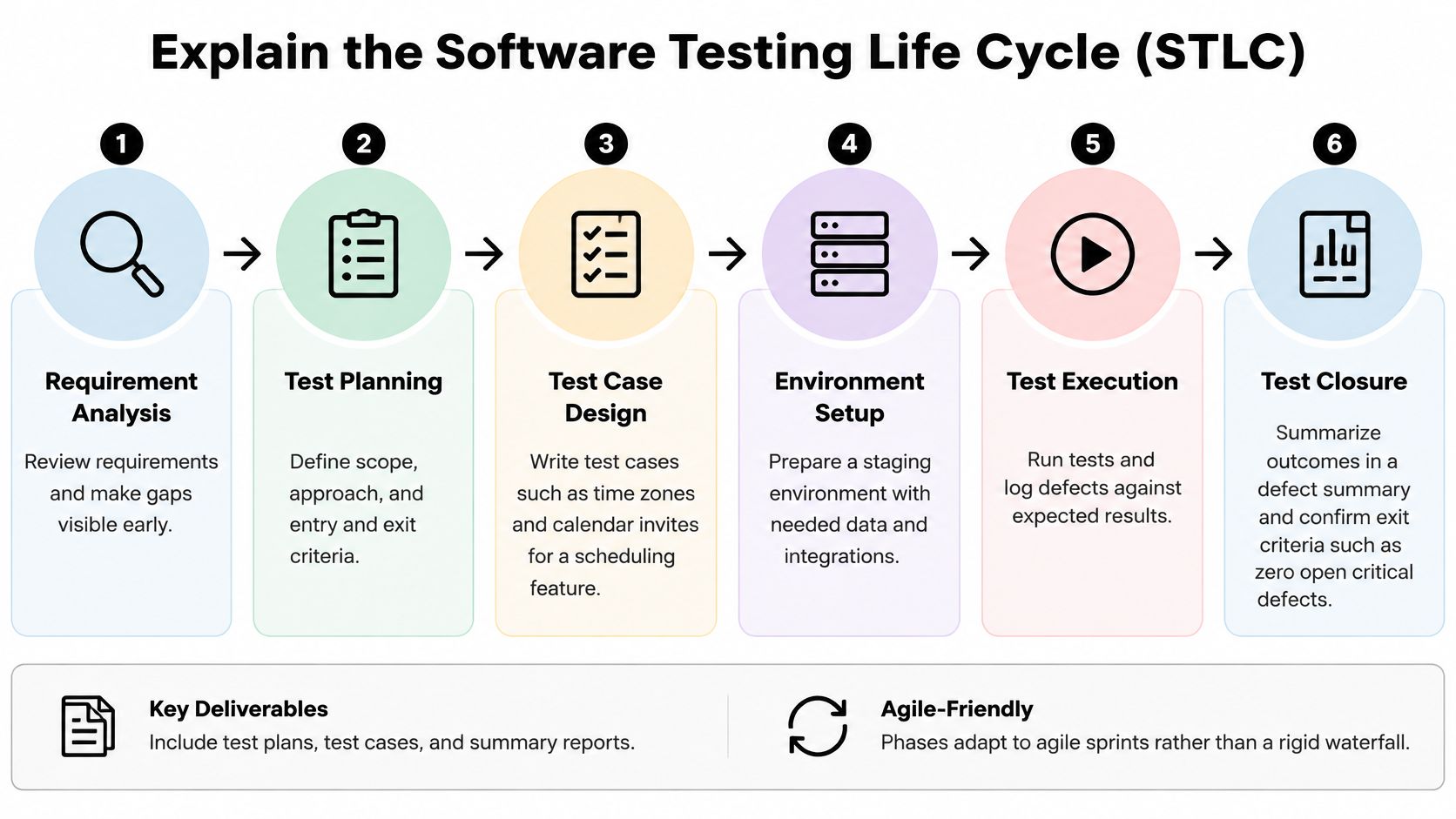
Apply the lifecycle to a booking release
- Analyze and plan: Clarify availability rules, rescheduling behavior, external dependencies, and the highest-risk failures.
- Design and prepare: Create cases for time zones, permissions, and calendar delivery. Prepare synthetic accounts and a controlled email environment.
- Execute and close: Record results, investigate failures, retest fixes, and summarize remaining risks for the release decision.
A podcast production checklist offers useful workflow context when translating a booking requirement into preparation, execution, and handoff checks.
Follow-up: What changes when requirements arrive during a sprint?
A junior candidate updates the test cases. A senior candidate also revisits affected assumptions, dependencies, scope, and release criteria with the team.
Common mistake: Presenting STLC as a rigid waterfall or equating closure with finishing test execution. A strong answer includes unresolved defects, coverage gaps, and explicit risk acceptance. A green test run isn't enough if the team hasn't tested the changed scheduling rule.
3. What is the difference between verification and validation?
A pitch email can match its approved template perfectly and still be useless to the host receiving it. That distinction makes this question more revealing than its familiar wording suggests.
Model answer: Verification checks whether the team built the product according to specifications. Validation checks whether the product meets the user's actual needs. You need both because a correct implementation can satisfy an unsuitable requirement.
For a podcast pitch flow, verification checks that the selected show receives the intended message, personalization fields render correctly, and the submission status updates. Validation asks whether hosts can judge guest relevance and whether guests understand what they're sending.
Ask for evidence, not reassurance
Follow-up: The pitch flow passes its acceptance tests, but hosts say the messages aren't useful. What would you do?
A foundational answer proposes reviewing the requirements and fixing the template. A senior answer investigates the mismatch first: observe hosts reviewing pitches, examine representative messages with permission, and identify missing decision-making information.
Useful validation evidence includes:
- Observed behavior: Can a host identify the proposed topic and the guest's relevant expertise?
- User explanation: Can guests explain why a show fits before sending?
- Workflow outcome: Can hosts accept, decline, or request clarification without unnecessary exchanges?
Common mistake: Treating stakeholder approval as conclusive validation. Approval is useful input, but observing users attempting realistic tasks reveals different problems.
Candidates should also avoid declaring the specification wrong before investigating. The requirement, implementation, audience assumptions, or interface could each explain the failure. Strong answers keep those possibilities separate until there's evidence.
4. Compare black-box, white-box, and grey-box testing.
Hiring signal: Can the candidate choose a testing perspective based on the risk, rather than rank techniques as universally better or worse?
Model answer: Black-box testing checks externally observable behavior without relying on internal implementation knowledge. White-box testing uses knowledge of code structure and logic. Grey-box testing combines external checks with partial internal knowledge, such as an API contract, data model, or system architecture.
Consider a podcast matching feature. Black-box tests submit topics and inspect the returned matches. White-box tests exercise the scoring function's branches and weighting rules. Grey-box tests use knowledge of indexing and stored profile fields to investigate why a relevant show disappears after a profile update.
Coverage tells you what your tests exercised. It doesn't tell you whether your assertions would detect the failure that matters.
Follow-up that separates technique from strategy
Ask how the candidate would investigate search results that remain stale after a guest edits their topics.
A junior candidate checks refresh behavior and repeats searches. A senior candidate traces the update through persistence, indexing, caching, and retrieval, then selects tests at the boundaries where stale data could enter.
What a strong answer adds: Internal knowledge helps isolate failure mechanisms, but the final check still needs to confirm the user-visible outcome. A passing scoring-function test doesn't prove the correct results reach the screen.
Common mistake: Equating black-box testing exclusively with manual UI testing. API tests can also be black-box when they evaluate documented inputs and outputs without depending on implementation details.
5. What makes a high-quality bug report?
A developer should be able to understand the failure and begin investigating without a long clarification exchange. Reproducible, specific, and actionable beats lengthy.
Model answer: A good report includes a descriptive title, environment and build details, preconditions, reproduction steps, expected and actual results, impact, and relevant evidence. It separates observed facts from suspected causes.
The reporting form is only the container. The quality comes from the evidence inside it.

Model report for a calendar defect
- Title: Guest calendar event shifts after the host reschedules across a daylight-saving transition.
- Preconditions: Host and guest use different named time zones, and the guest has accepted the original invitation.
- Steps: Create a booking, accept it, reschedule across the transition, and inspect the updated event.
- Expected versus actual: Both calendars should represent the same instant. The guest event instead represents a different instant.
- Evidence: Attach sanitized calendar payloads, relevant timestamps, and a recording of the displayed behavior.
Follow-up: What if the failure is intermittent?
A junior answer focuses on capturing a recording. A senior answer also records correlation identifiers, retry behavior, event ordering, and successful comparison runs. They preserve useful evidence without exposing access tokens or private guest messages.
Common mistake: Writing a confident root-cause diagnosis before isolating the problem. Label hypotheses clearly.
This is also a communication assessment. A useful interview question about communication probes how the candidate explains uncertainty and helps another person act.
6. What is the difference between severity and priority?
Severity describes impact. Priority describes urgency. They influence each other, but they aren't interchangeable.
Model answer: Severity measures how seriously a defect affects users or system behavior. Priority determines when the team should address it, considering exposure, release timing, workarounds, and business commitments. Teams should use documented definitions so the labels mean the same thing across reports.
In a booking workflow, confirmed invitations with incorrect dates can cause missed interviews. That warrants serious impact assessment and urgent triage. A clipped label on an infrequently used settings page has a different consequence, even if both defects look small in the code.
Use disagreement as the follow-up
Ask what the candidate would do when a product manager wants to defer a scheduling defect that QA considers urgent.
A junior candidate explains the severity rating. A senior candidate brings decision-relevant evidence:
- Exposure: Which booking states and user groups are affected?
- Consequence: Could people miss a recording, or is only the display confusing?
- Containment: Can the team disable the affected action, notify users, or offer a reliable workaround?
- Decision ownership: Who accepts the remaining risk, and where is that decision documented?
Common mistake: Assuming a particular defect type always has a fixed priority. A cosmetic error in a recording confirmation may be urgent if it obscures essential instructions, while a severe failure in a disabled feature may have limited immediate exposure.
The strongest candidates recommend a response, explain their assumptions, and collaborate on the decision. They don't turn triage into a contest over who owns the label.
7. What is the difference between regression testing, smoke testing, and sanity testing?
After a change to pitch submission, the team needs to know whether the build works at all, whether the changed behavior works, and whether established behavior still works. These are different testing decisions.
Model answer: Smoke testing is a broad, shallow check of critical functionality that determines whether a build is suitable for further evaluation. Sanity testing is a focused check around a specific change or fix. Regression testing checks that changes haven't damaged previously working behavior.
For a podcast-booking release, smoke checks could cover sign-in, discovery, and opening a conversation. Sanity checks could focus on the revised pitch-submission rule. Regression checks could cover replies, rescheduling, cancellation, and notification behavior affected by shared components.
Follow-up under release pressure
Ask: There's only enough time for a targeted regression run. What do you select?
A foundational answer chooses important user journeys. A senior answer combines business impact with change analysis: inspect modified services, shared dependencies, past failure areas, and the conditions that existing tests omit.
Run the smallest set that meaningfully addresses the release risk, then state what remains untested.
Common mistake: Explaining smoke and sanity as universally standardized labels. Teams use these terms differently, so a strong candidate confirms the local definition while preserving the distinction between broad build confidence and focused change confidence.
For candidates, name actual checks rather than saying you'd run regression. For interviewers, ask why a test was excluded. The explanation reveals whether the candidate understands risk or is following a familiar suite.
8. How would you test an end-to-end pitch and scheduling workflow?
Start with the journey a host and guest must complete, then investigate the points where their views or external systems can diverge.
The workflow illustration provides a useful prompt for mapping those handoffs.

Model answer: Map discovery, pitch submission, host response, slot selection, confirmation, rescheduling, and cancellation. At each transition, check permissions, persisted state, notifications, and what both participants can see. Include failure and recovery paths, not just successful completion.
Use synthetic host and guest accounts with controlled email destinations. Check duplicate submissions, exhausted quotas, expired routes, simultaneous slot selection, calendar-provider failures, and daylight-saving transitions. Use mocks for repeatable integration failures, but retain controlled checks against the service boundary because mocks can reproduce your assumptions rather than the provider's behavior.
Follow-up on partial failure
Ask: The booking is confirmed internally, but the calendar provider times out. What should happen?
A junior candidate retries the request. A senior candidate asks whether the provider accepted it before timing out, then checks idempotency, reconciliation, visible status, and duplicate prevention.
A clear interview schedule format also helps distinguish essential booking information from incidental interface details.
Use the video as an additional conversation prompt, then ask the candidate to identify the workflow's observable states.
Common mistake: Automating the happy path and calling it complete. Strong answers cover recovery, cross-role consistency, accessibility, and unauthorized access to other people's bookings.
9. When should test automation be used, and what is the test pyramid?
Hiring signal: Does the candidate optimize for trustworthy feedback, or merely for more automated scripts?
Model answer: Automate repeatable checks with clear expected outcomes and enough ongoing value to justify maintenance. The test pyramid suggests a broad base of fast unit tests, integration and API tests above them, and a smaller set of end-to-end UI tests. It's a design heuristic, not a mandatory distribution.
For a booking application, test date conversion and eligibility rules close to the code. Test pitch submission and booking-state transitions through APIs. Use Playwright or Selenium for selected browser journeys where interface integration matters.
Add an AI judgment follow-up
The 2025 State of Testing report found that fewer than one-third of teams had integrated AI into core QA workflows, citing low impact and integration complexity. Tool experimentation alone isn't evidence of a useful testing strategy.
Ask: An AI-generated regression suite passes, but production scheduling defects increase. How do you investigate?
- Foundational answer: Add cases for the escaped defects.
- Senior answer: Review test assumptions, assertion quality, environment differences, omitted states, and whether generated expectations came from an independent requirement.
- Safety judgment: Keep sensitive guest data out of unapproved tools and review generated cases before execution.
Common mistake: Automating unstable behavior before clarifying its expected outcome. Human exploratory testing remains valuable when the team is learning how users interpret availability or recover from failed bookings.
Flaky tests need an owner and investigation. Temporary quarantine can protect feedback quality, but silent exclusion turns known uncertainty into hidden release risk.
10. Explain equivalence partitioning and boundary value analysis.
A pitch allowance is a useful test-design exercise because the important question isn't just whether a counter changes. It's whether the system consistently enforces the rule across valid, invalid, and competing requests.
Model answer: Equivalence partitioning groups inputs expected to receive the same treatment, then selects representative cases from each group. Boundary value analysis checks the edges where that treatment changes, including values immediately below, at, and above a limit.
Use the image as a reminder to focus on the exact transition rather than collect arbitrary examples.

Work through the rule before choosing inputs
For a hypothetical booking platform, partitions might include an account below its allowance, an account at its allowance, and an account with invalid quota data. Boundary tests inspect the final permitted submission and the first rejected submission.
Follow-up: What happens if separate browser tabs submit pitches when only the final allowance remains?
A junior candidate tests each tab. A senior candidate tests concurrency and checks server-side enforcement, transaction behavior, and whether rejected requests create partial records or send notifications.
Common mistake: Treating a disabled button as proof that the quota works. Users can submit through stale pages, retries, or direct API requests.
For text fields, ask whether the requirement counts characters, bytes, or another unit. Include empty input, whitespace, and relevant Unicode cases. When allowance, account status, and pitch state interact, combine partitions with a decision table so the expected behavior remains explicit rather than guessed.
How the 10 QA interview questions compare by focus, strong answer, and pitfalls
| Item | Core Focus | Strong Answer Includes | Common Pitfall |
|---|---|---|---|
| What is the difference between Quality Assurance (QA) and Quality Control (QC)? | QA prevents defects by improving processes; QC detects defects in outputs. | QA is proactive and process-oriented; QC is reactive and product-oriented; give an example of both. | Treating QA as only testing or using QA and QC as exact synonyms. |
| Explain the Software Testing Life Cycle (STLC). | The phases that organize testing from requirements through closure. | Requirement analysis, planning, test design, environment setup, execution, and closure, adapted to agile work with clear exit criteria. | Applying rigid phase gates or creating documents without improving coverage. |
| What is the difference between verification and validation? | Verification checks conformance to specifications; validation checks whether user needs are met. | Explain “building the product right” versus “building the right product,” with an example and user feedback methods. | Assuming a product that meets specifications necessarily works for users. |
| Compare black-box, white-box, and grey-box testing. | Testing behavior, internal code, or a combination of both. | Black-box tests inputs and outputs; white-box tests code paths; grey-box uses partial internal knowledge. | Relying only on black-box tests or treating coverage metrics as proof of quality. |
| What makes a high-quality bug report? | A clear, reproducible, actionable description of a defect. | Include a specific title, environment, reproduction steps, expected and actual results, severity, priority, and evidence. | Vague reports or omitting details that make reproduction difficult. |
| What is the difference between severity and priority? | Severity measures impact; priority measures urgency to fix. | Explain that severity reflects technical or user impact, while priority reflects business needs and release timing. | Conflating impact with urgency or overlooking changing business context. |
| What is the difference between regression testing, smoke testing, and sanity testing? | Different test scopes for build health, specific changes, and existing functionality. | Smoke is broad and shallow; sanity is narrow and change-focused; regression checks for unintended side effects. | Confusing the terms or allowing regression suites to become slow and hard to maintain. |
| How would you test an end-to-end pitch and scheduling workflow? | Validate a multi-step workflow across users, states, and integrations. | Cover roles, state transitions, happy paths, edge cases, permissions, notifications, time zones, and stable test data or mocks. | Ignoring integration risks or relying on slow, fragile tests with unpredictable external services. |
| When should test automation be used, and what is the test pyramid? | Use automation for stable, repeatable checks; balance test layers. | Describe a broad base of unit tests, integration and API tests in the middle, and a small set of critical UI tests; retain exploratory testing. | Automating unstable features or tolerating flaky tests that undermine trust. |
| Explain equivalence partitioning and boundary value analysis. | Reduce tests by grouping similar inputs and checking values near limits. | Identify valid and invalid input classes and test minimum, maximum, and just-outside values. | Testing only representative values or missing interactions between multiple inputs. |
Turning Questions Into a Fair, Repeatable Hiring Process
Use these questions as a scored rubric, not a trivia quiz. Define the role's competencies first, then decide which answers demonstrate them. A junior role may require accurate test design and clear reporting; a senior role should also demonstrate risk ownership, investigation across system boundaries, and improvements to team practice.
The U.S. Office of Personnel Management's structured-interview guidance states that increasing interview structure improves validity, rater reliability, and interviewer agreement. Apply that principle by giving candidates the same core scenarios and evaluating them against criteria written before the interview.
Score evidence consistently
Create behavior-based anchors for each competency rather than relying on whether an answer feels impressive. Google's structured-interview guidance recommends consistent questions and grading rubrics, including behaviorally anchored assessments.
Useful anchors for the scheduling scenario include:
- Foundational evidence: Defines the concept correctly and proposes a relevant check.
- Applied evidence: Identifies failure states, test data, and observable expected results.
- Senior evidence: Explains dependencies, recovery, competing risks, and decision ownership.
- Insufficient evidence: Names tools or repeats definitions without showing how to investigate.
Record what the candidate said before discussing ratings with other interviewers. Distinguish a missing skill from missing evidence: if the question never tested API investigation, don't infer inability from silence. Use planned follow-ups to close relevant gaps.
Keep the assessment job-related. The EEOC's Uniform Guidelines questions and answers explain validation in relation to job requirements and recognize interviews as selection procedures. Avoid personal questions that don't help establish whether someone can perform the role, and have qualified reviewers assess employment-law requirements for your jurisdiction.
Rehearse decisions rather than scripts
Candidates should prepare a truthful example for each competency: the problem, their action, the evidence, and the outcome. When using a hypothetical example, label it clearly. Don't turn a model answer into an invented career story.
Interviewers should also test their own prompts. Good interview questions, quality assurance scenarios, and consistent evaluation belong together. If a question rewards obscure terminology more than relevant judgment, revise it.
For hosts preparing a technical conversation rather than a hiring decision, our free bank of 100 podcast guest interview questions can provide a starting point for the conversation arc. Our Interview Question Generator creates a timed plan for the guest, sized to the episode. Neither replaces a role-specific hiring rubric, but both can help organize a purposeful discussion.
Let's Make A Podcast connects hosts and prospective guests and provides tools for interview preparation. Visit Let's Make A Podcast to explore the free question bank and build a timed interview plan, then adapt these QA scenarios into follow-ups that reveal how your guest thinks.