Interview Questions Problem Solving: 8 That Work

Most advice on interview questions problem solving gets the diagnosis backwards. Interviewers blame candidates for polished, rehearsed answers, then ask the exact prompt that produces them. "Tell me about a challenge you faced" invites a rehearsed hero story with no constraints, no alternatives, and no way to tell who did the work.
The fix isn't a longer list of clever prompts. It's structure. A meta-analytic comparison in the Wiley handbook chapter on employment interview validity reported validity correlations of approximately 0.51 for structured employment interviews versus 0.38 for unstructured interviews. Same candidates, better instrument. When every candidate gets the same scenario, the same probes, and the same anchored rubric, you're measuring reasoning instead of conversational fluency.
That's how the eight questions below are built. Each one isolates a single skill, diagnosis, triage, estimation, prioritization, negotiation, or detection, so you can mix three or four that match the role and score them consistently. Every example is grounded in podcast booking and production, because vague prompts produce vague evidence. Pick the skills, write the rubric first, and probe until the story either holds up or collapses.
Table of Contents
- 1. Behavioral Problem-Solving Question (STAR Method)
- 2. Scenario-Based Operational Question The Last-Minute Cancellation
- 3. Fermi Estimation Question
- 4. Root-Cause Analysis Question (Five Whys)
- 5. Prioritization Under Constraints Question
- 6. Brainteaser Question (Use With Caution)
- 7. Data Quality and Detection Question
- 8. Stakeholder Conflict Resolution Question
- The 8 Problem-Solving Interview Questions at a Glance
- Build Your Question Set Then Put It to Work Booking Guests
1. Behavioral Problem-Solving Question (STAR Method)
Ask this: "Tell me about a time you solved a problem with incomplete information. Walk me through what you knew, what you didn't, and what you did anyway."
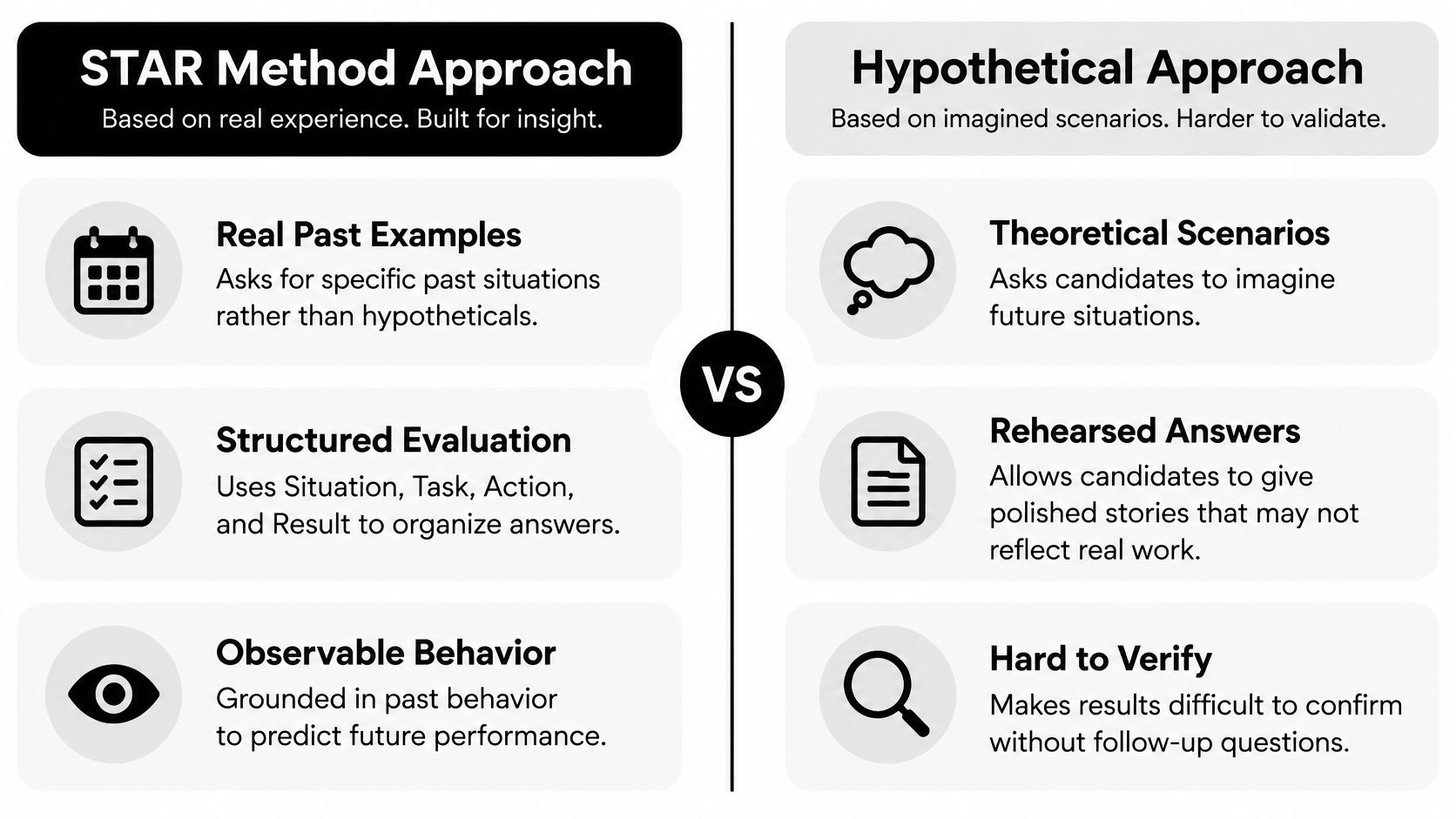
This is your baseline question, and it only works if you score it with STAR, Situation, Task, Action, Result. The U.S. Office of Personnel Management structured interviews guidance states that structured interviews built around competencies identified through job analysis demonstrate high validity, rater reliability, and agreement among interviewers. That agreement disappears the moment one interviewer accepts a vague story and another demands specifics.
What a Scored Answer Looks Like
Say a booking coordinator describes recovering a guest lineup after two cancellations in the same week. A strong answer names the shows, the dates, who she called first, and which backup guests said yes. A producer fixing a recording-quality issue mid-season should name the actual fix, a gain setting, a mic swap, a new quiet-room rule, and confirm the release schedule held.
Score it. Problem definition gets points for constraints named, not adjectives. Action gets points for "I" statements with sequence. Result gets points only when it's measured, episodes shipped, reply rates, hours saved. I recommend building the probes into a reusable interview question template for consistent scoring so every panelist asks "What would you do differently?" and "What metrics showed it worked?" in the same order.
Practical rule: If the candidate can't give you a date, a number, or a name, you're listening to a composite story. Score it as one.
The failure mode is real. STAR rewards candidates who've had interesting jobs, which isn't the same as candidates who reason well. That's why you pair it with the hypothetical questions that follow.
2. Scenario-Based Operational Question The Last-Minute Cancellation

Ask this: "A guest cancels two hours before recording. Give me your first three actions, in order."
Don't let them narrate a philosophy. You want a sequence, because triage is sequence. Situational questions like this carry real predictive weight when the scenario matches the job. A meta-analysis in the Journal of Applied Psychology situational judgment research covering 102 validity coefficients and 10,640 people found a generalizable validity estimate of approximately 0.34 for situational judgment tests. Moderate, not magic, and only when you score against a key you wrote in advance.
Scoring the Sequence
- Confirm before reacting: Strong candidates verify it's a hard cancel, not a tech problem or a timezone mix-up, and offer a specific reschedule window in the same message.
- Protect the slot: They pull a backup from a maintained shortlist of reserve guests, ideally someone pre-briefed who can record on short notice.
- Tell the host early: The host hears about it within minutes, with options attached, not an apology with nothing behind it.
A weak answer apologizes to the host and stops. A middling answer finds a replacement but never confirms the original guest, so you end up double-booked when the first guest resurfaces. Probe with "What if your backup also declines?" Candidates who've run bookings have a second layer, a solo episode outline, a re-release, a co-host Q and A. Candidates who haven't will improvise on the spot, and you'll hear the difference.
One caution. This question tests preparation systems as much as live judgment. A candidate from a disorganized team may reason well but have no shortlist to reference. Score the reasoning, then ask what system they'd build in week one.
3. Fermi Estimation Question
Start with the answer you'd hope to hear, because it won't sound impressive. "I don't know, but here's how I'd break it down." That's the whole point.
Ask this: "Roughly how many podcast episodes are recorded in the United States each week? Talk me through your math."

You're not testing trivia. You're watching someone decompose a problem, state assumptions out loud, and stay calm when the numbers get ugly. A solid attempt starts from directory categories, estimates active shows per category, applies an average publishing cadence, then adjusts for seasonal and dormant shows. A business-flavored variant works too. Ask a growth candidate to size how many guest-booking requests a platform might receive per month, starting from active hosts and average guests per show.
How to Score It
Reward the structure, not the final figure. Did they define the unit before counting it. Did they pick round, defensible assumptions and flag the shakiest one. Did they sanity-check the result against something known, like total listening hours or the size of a single large network's catalog.
Deduct for false precision. A candidate who lands on a suspiciously exact number with no ranges is performing confidence, and that's the opposite of what estimation should reveal. I'd also limit where you use this. It's a strong question for research, analytics, and operations roles where sizing unknowns is weekly work. For a booking coordinator, it measures a skill they'll rarely use, and you'll screen out good operators for no reason.
The best Fermi answers end with the candidate telling you which assumption they'd go verify first. That instinct is the actual job skill.
4. Root-Cause Analysis Question (Five Whys)
Hand the candidate a number and watch what they do with it. Ask this: "Our reply rate to cold pitches dropped sharply this quarter. What do you investigate first, and in what order?"

Weak candidates jump straight to rewriting the pitch template. Strong candidates ask whether the drop is even about pitch quality. Maybe the team started pitching dormant shows whose feeds hadn't updated in months. Maybe pitches stopped referencing a recent episode, or a scheduling link broke, or send timing shifted. The Five Whys discipline means refusing to treat the first plausible cause as the root cause.
Give them a small data set to work with, sends by week, replies by show category, last-episode dates for target shows. Then ask which metric they check first and why. You're scoring hypothesis quality, do they generate several, can they rank them by how cheaply each can be tested, and do they know what evidence would kill their favorite theory.
The short walkthrough below shows the Five Whys applied step by step, which is a useful calibration reference before you run this question with a panel.
The Confirmation Probe
Always close with "How would you confirm that's the root cause, not just a correlation?" Look for a controlled test, pitch two matched batches of active shows, hold the template constant, change one variable. Teams that think this way also tend to prepare better interviews, which is why pairing this hiring question with strong questions to ask on a podcast when diagnosing a guest's expertise makes practical sense. Diagnosis is diagnosis, whether the subject is a funnel or a founder's decision.
5. Prioritization Under Constraints Question
Ask this: "You have 40 pitches to send this week, one producer, and two hosts asking for urgent updates. Plan your week. What doesn't get done?"
That last sentence is where the signal lives. Anyone can list tasks in a sensible order. Fewer candidates will explicitly cut something and explain the trade-off to the person affected. The market context makes this worth testing directly. The World Economic Forum Future of Jobs Report 2025 skills outlook reports that seven out of ten companies identified analytical thinking as essential, and prioritization is analytical thinking with a calendar attached.
A strong answer segments the 40 pitches instead of treating them as identical units. Personalized pitches to high-fit shows with recent episodes go first, because fit and recency drive replies. Follow-ups get ranked by how recently a show published, since an active host is more likely to be booking. Generic outreach to broad, unqualified lists gets cut or automated, and the candidate says so without apologizing for it.
Probes That Reveal Flexibility
- Change a constraint mid-answer: "The producer just called in sick for two days. What moves?" Rigid planners restart from scratch. Good ones re-rank in seconds.
- Ask about the update itself: Strong candidates send hosts a short status note early, even when the news is "no replies yet," because silence reads as inaction.
- Push on effort estimates: "How long does one good pitch take you?" Vague answers here usually mean the whole plan is fiction.
Score three things, impact ranking, explicit trade-offs, and stakeholder communication. A candidate who nails the ranking but never tells the waiting hosts anything will create the exact friction this role exists to prevent.
6. Brainteaser Question (Use With Caution)
I'll be direct. I wouldn't ask "How many golf balls fit in a school bus?" in a hiring loop for a podcast team, and I'd push back if a panelist suggested it.
Brainteasers had a long run in technology hiring, and they do surface lateral thinking in the moment. The problem is what else they surface. Research in the Cambridge Industrial and Organizational Psychology article on structured interview validity notes substantial variation in the validity of structured interviews, meaning question quality and scoring criteria still determine whether you're measuring reasoning or polish. Brainteasers sit at the bad end of that variation. They reward rapid verbal processing and comfort performing under observation, neither of which predicts whether someone can book guests or fix a production problem.
There's an access problem too. Guidance summarized in the Metaview guide to neurodivergent interview accommodations recommends sending questions or their format in advance, allowing thinking time, and offering a written alternative, adjustments that are incompatible with a surprise puzzle. If thinking aloud on command isn't central to the job, scoring it penalizes capable candidates for an irrelevant trait.
The Role-Specific Replacement
Keep the creativity test, drop the puzzle. Ask a producer candidate, "Pitch me an episode topic this host has never covered, and tell me why their audience would stay for it." Ask a booker how they'd reframe a guest's expertise for a show in an adjacent niche. You get the same generative thinking, scored against criteria you can defend, audience fit, novelty, and clarity of the pitch. If a hiring manager insists on a classic brainteaser, confine it to one question, score only the reasoning steps, and never let it outweigh the job-relevant questions in this list.
7. Data Quality and Detection Question
Ask this: "Our directory includes shows whose feeds haven't updated in 18 months, and hosts keep pitching them. How do you find them, and what do you do with them?"
This question separates people who clean data once from people who build detection rules. A strong answer starts with a threshold, flag every show whose latest episode date is older than a defined cutoff, then layers a manual review on top before anything gets hidden. That second step matters. Seasonal shows pause for months between seasons, limited series end on purpose, and a blunt auto-hide rule will bury legitimate shows and damage trust with hosts.
Probe the edge cases directly. "How do you tell a paused show from a dead one?" Good candidates look for corroborating signals, a farewell episode title, a show page announcing a hiatus, social activity, or a pattern of seasonal gaps in the feed history. They'll also think about adjacent data rot, like detecting closed booking routes by checking whether published pitch instructions or contact details have changed or disappeared.
Scoring the Validation Plan
- Rule definition: A precise, written rule another person could apply and get the same result.
- Sample checks: Manually auditing a small batch of flagged shows before trusting the rule at scale.
- False-positive thinking: An explicit plan for shows the rule mislabels, including how a host gets reinstated.
- Status honesty: Labels like "dormant" shown to users only when the evidence supports them, since a wrong label misleads pitchers.
Weak answers describe a one-time spreadsheet cleanup. The directory will be dirty again in a quarter, and the candidate has told you they won't notice. For any role touching a catalog, CRM, or outreach list, that distinction is worth more than a polished STAR story.
8. Stakeholder Conflict Resolution Question
End your loop with people, because most production problems are people problems wearing a scheduling costume. Ask this: "A host wants a 90-minute interview. The guest has 30 minutes. Both are confirmed for Thursday. What do you do?"
Watch the order of operations. Strong candidates ask clarifying questions before proposing anything. Why does the host want 90 minutes, a deep-dive format, or just habit. Is the guest's limit a hard stop or a preference. What does the episode need to accomplish. Candidates who jump straight to splitting the difference at 60 minutes have solved an arithmetic problem, not the conflict in front of them.
A good resolution might be a focused 30-minute episode built around a tight agenda shared in advance, with an optional follow-up session if the conversation earns one. Or the host records a solo intro and reflection segment to reach episode length without consuming guest time. Either works if both parties chose it knowingly. For the underlying skill, it helps to study how a well-framed interview question about communication reveals negotiation habits before you finalize your rubric.
What to Score
Ask the candidate to tell you, word for word, what they'd say to each side. You're listening for empathy without capitulation. The guest hears their constraint respected, not negotiated away. The host hears a format that still delivers a strong episode, not a lecture about flexibility.
Then probe the unglamorous part. "How do you make sure this doesn't blow up on Thursday?" The right answer involves documentation, the agreed length, agenda, and hard stop confirmed in writing to both parties, in the calendar invite, before anyone opens a recording app. Candidates who skip documentation will re-litigate this same conflict live on the call, with the guest watching the clock.
The 8 Problem-Solving Interview Questions at a Glance
| Question Type | Skill Tested | Difficulty | Best For | Scoring Ease |
|---|---|---|---|---|
| Behavioral Problem-Solving (STAR) | Reasoning, ownership, follow-through | Moderate | Cross-role hiring | Easy with a rubric |
| Scenario-Based Operational: Last-Minute Cancellation | Triage, communication, contingency planning | Moderate | Booking and production roles | Moderate; needs clear criteria |
| Fermi Estimation | Structured reasoning, assumptions, rough math | Challenging | Research, analytics, and planning roles | Moderate; prioritize reasoning |
| Root-Cause Analysis (Five Whys) | Diagnosis, hypothesis testing, data use | Moderate | Marketing, operations, and product roles | Moderate; needs sufficient context |
| Prioritization Under Constraints | Planning, judgment, stakeholder communication | Moderate | Coordinators, producers, and outreach roles | Challenging without a rubric |
| Brainteaser | Lateral thinking, communication under ambiguity | Variable | Limited use; consider role-specific prompts | Difficult to score objectively |
| Data Quality and Detection | Data analysis, accuracy, rule design | Moderate to challenging | Analytics and data-focused roles | Moderate; technical judgment required |
| Stakeholder Conflict Resolution | Negotiation, empathy, communication | Moderate | Hosting, guest management, and PR roles | Difficult to score objectively |
Build Your Question Set Then Put It to Work Booking Guests
You don't need all eight questions. You need three or four that cover different skills without overlap. For a booking coordinator, I'd run the cancellation scenario for triage, the prioritization question for trade-off thinking, and the stakeholder conflict for negotiation. For a producer or operations hire, swap in root-cause analysis and data detection. The behavioral STAR question works as an opener for almost any role, as long as you score it instead of enjoying it.
Whatever you choose, write the rubric before the first interview, not after you've met a candidate you like. Decide what a strong, adequate, and weak answer contains for each question, in observable behaviors, problem definition, assumption testing, sequenced actions, measured results. Then probe. "What would you do differently?" and "What showed it worked?" will do more for your hiring accuracy than any new prompt you add, because rehearsed stories rarely survive a second layer of specific follow-up.
The demand side supports the effort. Reporting on the National Association of Colleges and Employers Job Outlook 2025 survey found that in 2025, nearly 90% of recruiters prioritized problem-solving abilities when reviewing recent graduates' resumes. Everyone claims the skill. Your interview is where the claim gets tested, and structure is what makes the test fair enough to trust.
Here's the part hiring managers in podcasting often miss. The same discipline that makes interview questions problem solving work in hiring makes guest interviews worth listening to. A host who asks every guest "tell me about a challenge" gets the same polished noise you'd reject in a job interview. A host who probes constraints, alternatives, evidence, and what changed afterward gets a story with actual decisions in it.
That's the logic behind the free resources at Let's Make A Podcast. The site offers a free bank of 100 podcast guest interview questions you can copy into a prep document. In that bank, 75 questions follow a five-stage interview arc in order, and the last 25 are swap-ins for particular kinds of guest, founders and operators, authors and researchers, coaches and practitioners, and first-time interviewees. The Interview question generator builds a timed interview plan for the guest, sized to the episode, so your probes land in sequence instead of wherever the conversation drifts. If you have questions or need help, you can reach the team at hello@letsmakeapodcast.com, and they read every message that comes in.
Systematize the questions and the scoring, whether you're hiring the person who books your guests or preparing to interview the guests themselves. The candidates and the conversations both get better the moment you stop improvising.
If you're ready to apply this same structured thinking to your guest interviews, Let's Make A Podcast gives you a free bank of 100 guest interview questions and a generator that builds a timed plan sized to each episode. Use the five-stage arc for your core conversation, swap in the founder, author, coach, or first-timer sets when the guest calls for it, and probe for constraints and results instead of accepting the polished version.