10 Questions to Ask on a Podcast: Prompts for Every Guest
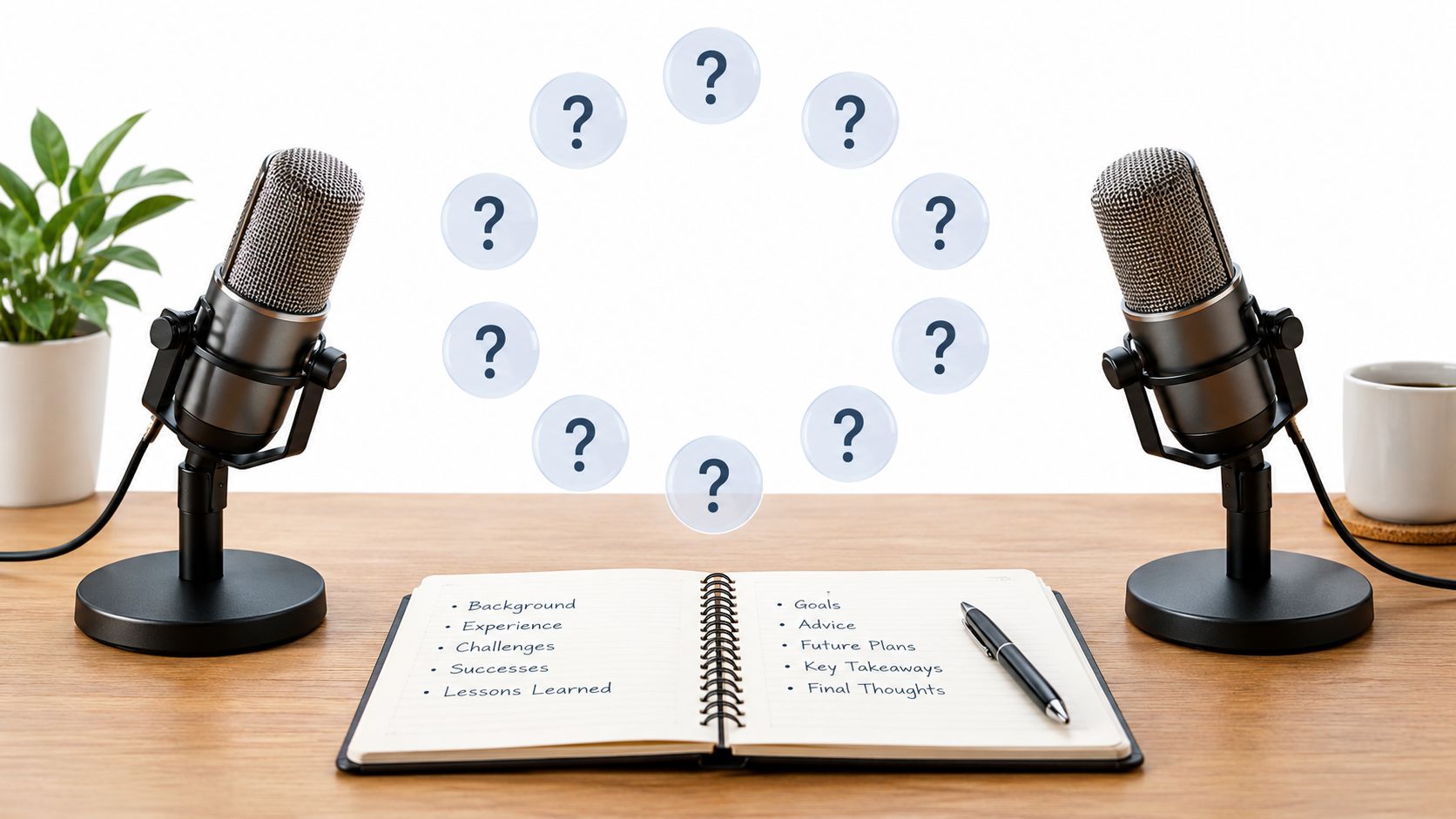
Thirty minutes before a recording, the guest is confirmed, the microphones are ready, and the first ten minutes are still blank. You know the guest's job title and have skimmed their website, but “Tell us about yourself” feels too broad to carry the opening.
Most weak episodes don't come from weak guests. They come from questions that weren't designed to do a job. A prompt might produce an answer, but not a story, useful explanation, challenge, or clear takeaway. Sorting your questions by purpose gives you a practical plan without forcing the conversation into a script.
Podcasting now reaches a substantial recurring audience. In 2025, 73% of Americans aged 12 and older had ever consumed a podcast, while 55% listened in the previous month and 40% in the previous week, according to Edison Research's 2025 Podcast Consumer report. Your guest may be speaking to beginners, specialists, or both. The best questions help everyone follow the conversation.
Use the following prompts as building blocks. Each one includes its place in the flow, a follow-up that keeps the answer moving, and an example of how to make the question specific.
Table of Contents
- 1. The Origin Story and Background Question
- 2. The Current Problem and Pain Point Question
- 3. The Contrarian and Unpopular Opinion Question
- 4. The Tactical How-To and Step-by-Step Question
- 5. The Failure and Lessons Learned Question
- 6. The Prediction and Future Vision Question
- 7. The Personal Habit and Routine Question
- 8. The Audience Q&A and Crowdsourced Question
- 9. The Mistake and Misconception Question
- 10. The Advice to a Past Self and Retrospective Question
- Top 10 Podcast Questions Comparison
- Build Your Question Bank Before the Next Recording
1. The Origin Story and Background Question
Open with the path, not the résumé. Ask, “What first pulled you into this work?” or “Can you take us to the moment you realized this was the problem you wanted to solve?”
This works because the guest can answer from experience rather than performance. A founder might describe the customer complaint that led to a product. A researcher might explain the question that changed their field of study. A chef might remember the first kitchen where the work became serious. The answer gives listeners context, stakes, and a reason to care about what comes next.
Place this question in the first part of the interview, but don't let it consume the episode. If the guest starts with a long chronology, interrupt gently after a useful milestone and ask, “What surprised you along the way?” That wording often moves the answer beyond polished biography.

Make the story concrete
Avoid asking for a complete life history. Choose one doorway:
- First attempt: “What did your first version look like?”
- Early setback: “What failed before the approach started working?”
- Turning point: “What changed your direction?”
- Unfinished assumption: “What did you believe then that you no longer believe?”
A guest who has answered this question on other shows may give you a familiar version. Review their recent appearances first, then use this podcast guest questionnaire to identify a less-used detail. The goal isn't novelty for its own sake. It's to find the origin point that best serves this episode.
Keep the opening story focused. If the first answer already contains a failure, decision, or surprising consequence, follow that thread instead of returning to your prepared list.
2. The Current Problem and Pain Point Question
Listeners stay with an interview when the problem matters to them. Ask, “What problem are people in your field struggling with right now?” Then follow with, “Why do you think this problem exists?”
The first question identifies the pain. The second asks the guest to explain the cause. Without that follow-up, guests often name a familiar trend and move straight to their solution. Root-cause questioning creates a more useful conversation. It can reveal incentives, outdated assumptions, missing skills, or constraints that the audience hasn't considered.
Use this prompt near the beginning, after a short introduction. It establishes relevance and gives the rest of the episode direction. For a marketing guest, you might ask about unreliable attribution. For a workplace guest, you could ask why teams keep adopting productivity systems that nobody maintains. For a health guest, ask what makes a particular behavior difficult to change, while keeping the discussion within the guest's expertise.
Turn pain into a usable frame
Don't accept an abstract answer such as “people need more clarity.” Ask for a recognizable situation:
Follow-up wording: “What does that problem look like on an ordinary Tuesday for the person experiencing it?”
Then test the boundaries:
- Who feels it most: “Which group is most affected?”
- What gets misdiagnosed: “What do people usually blame first?”
- What makes it urgent: “Why should listeners pay attention now?”
- What isn't a solution: “What advice sounds useful but doesn't address the cause?”
The question earns its place when it helps listeners locate themselves in the episode. Research the guest's current work before recording, including their recent writing, talks, or public posts. That preparation lets you ask about an active problem rather than a broad topic from their biography.
3. The Contrarian and Unpopular Opinion Question
A useful contrarian question isn't an invitation to perform outrage. It's a request for reasoning. Ask, “What's something people in your field commonly get wrong?” or “Which widely accepted piece of advice would you challenge?”
Place it after the guest has established their background and explained the problem. Earlier, the question can sound like a demand for a hot take. Later, the listener has enough context to understand why the disagreement matters.
Follow with, “Walk us through your reasoning.” That phrase keeps the guest from stopping at a slogan. If they claim that a standard practice fails, ask what evidence, experience, or mechanism supports the claim. You can also ask, “When does the conventional advice still work?” A credible answer includes limits.
Challenge an idea, not a person
Before recording, review the guest's previous interviews and published positions. Don't ask them to repeat a disagreement they've already explained in the same terms unless your audience needs the introduction. Instead, identify a point where their view has changed or where their experience gives them a different perspective.
For example, a startup operator might say that rapid experimentation creates noise when teams lack a clear decision rule. The next question could be, “What would you put in place before running the next experiment?” That converts a provocative opinion into an operating principle.
A contrarian answer becomes valuable when the listener can test it against their own situation.
Avoid false confrontation. You don't need to imply that the guest's field is foolish or dishonest. A calm prompt often produces more detail than an aggressive one, especially when the guest needs to explain a nuanced position rather than defend an identity.
4. The Tactical How-To and Step-by-Step Question
When an episode needs a practical payoff, ask the guest to demonstrate a process. Use wording such as, “Can you walk us through how you do that from the first step?”
The phrase “walk us through” matters. It asks for sequence, decisions, and dependencies. “How can people improve their focus?” invites general advice. “What do you do in the first hour when you need to produce focused work?” creates something listeners can examine and adapt.
Ask for a small framework, not an encyclopedia. “What are the first three steps?” is usually stronger than asking for every step the guest has ever used. If the process has more stages, let the guest identify the essential ones and explain what can wait.
Keep instructions usable
Follow with, “What's the biggest mistake people make at this point?” Then ask, “How would a beginner know they've completed the step correctly?” These prompts surface hidden decisions and help listeners avoid copying a process mechanically.
A tactical answer should also include constraints. Ask:
- Starting condition: “What needs to be true before someone begins?”
- Time or resources: “What does this require that people often overlook?”
- Adjustment: “What changes when the first attempt doesn't work?”
- Proof: “What result tells you the process is working?”
For an episode about customer research, the example might be: “Show us how you turn one customer conversation into a testable product question.” That is more useful than “How do you understand customers?”
If you want a timed outline that moves from warm-up to depth and closing, use the podcast interview question generator. Treat its output as a starting plan, not a script. Your follow-ups should respond to what the guest says.
The following video can also help you think through a process-led interview format:
5. The Failure and Lessons Learned Question
A failure question works best once the guest has settled in and the audience trusts them enough to hear something messier than a polished success story. Put it in the middle of the interview, after background and tactics, and ask, “What failure taught you the most?” That wording gives the guest room to explain judgment, consequence, and change, which is what listeners can use.
Then guide the answer toward ownership. If the guest stays abstract or blames the market, the team, or timing, ask, “What part of that outcome was yours to own?” Keep the tone calm. You want an honest account of a decision, not a dramatic confession.
What makes this question worth keeping in your rotation is the follow-up. Ask, “How did that change what you did next?” That turns the segment from story into application. In a real episode, that might mean a founder explaining how a failed launch changed their customer research, a manager showing how a hiring mistake reshaped their interview process, or a creative professional describing how rejection changed their development process.
Silence helps here.
If the guest slows down, let the pause sit for a beat. Rushing in too early usually cuts off the useful part, the moment where they move from what happened to what they learned. Listen for specifics you can press on, and use follow-ups based on the job you need the question to do at that point in the conversation:
- To identify the choice: “What decision led most directly to the outcome?”
- To surface the missed clue: “What warning did you miss at the time?”
- To show the immediate response: “What did you do in the following weeks?”
- To make it useful for listeners: “How can someone spot that risk earlier in their own work?”
Before you record, prepare for the podcast interview by checking what the guest has already discussed in public. That helps you frame the topic without surprising them with private material. If the area is sensitive, set boundaries ahead of time.
A strong answer leaves the audience with a decision rule. Ask what changed in the guest's behavior, standards, or method, and you will usually get something they can apply.

6. The Prediction and Future Vision Question
Late in the interview, the room usually changes. You have the guest's history, their process, and a few hard lessons. That is the right moment to ask where things go next.
Use a forward-looking question that forces a clear claim: “What change do you expect to see in your field over the next few years?” Then pin it to observable evidence: “What signal should we watch to know that prediction is starting to happen?” This pair works because it gives the audience both the forecast and the basis for judging it later.
Keep the guest out of vague language. If they say “soon,” narrow it: “Do you mean within two years, or later?” If they answer with a trend statement, ask what would be visible on the ground. Customer behavior, a new constraint, a shift in hiring, and a change in buying criteria are all stronger than abstract optimism.
I use this question near the end because it changes the energy of the episode. It also tells you whether the guest can connect present conditions to future consequences.
Rather than dropping into another checklist, work the prediction in sequence during the conversation. Start with the claim. Then ask, “What has to happen for that to become true?” After that, ask, “What would people do differently if you're right?” A workplace technology guest might predict a tool will reshape how teams assign routine work. Press on the practical effect, then the trade-off: “Who benefits first, and who has the roughest adjustment?”
That last move matters. It keeps the answer honest. Every meaningful forecast creates winners, losers, delays, or second-order effects.
Close by testing the guest's confidence without turning it into a debate: “What assumption would have to fail for your forecast to be wrong?” Save the answer. If you bring the guest back later, you have a clean way to revisit the prediction, the conditions behind it, and the signal they asked listeners to watch.
7. The Personal Habit and Routine Question
A guest gives their best practical answers when you stop asking for philosophy and ask for behavior. Use this in the middle of the interview, after the audience understands the work and before the conversation drifts back into broad advice: “What practice helps you do this work consistently?” Then narrow it fast: “Walk me through a normal day when that happens.”
That second prompt does the important work. Guests often reach for labels such as “deep work” or “I meditate regularly.” Labels are tidy. Recordings need actions. Ask what starts the routine, where it happens, how long they protect it, and what changes when the day goes sideways. Listeners can judge a practice only when they hear the conditions around it.
Then shift from description to choice. Ask, “Why this practice and not another one?” That answer tells you what problem the habit is solving. Some routines cut decision fatigue. Others protect attention, lower stress, or create a clean start. The reason matters because a listener with a different constraint may need a different pattern.
I also like one pressure-test question here: “What happens when you skip it?” You learn very quickly whether the routine supports the work, or just supports the guest's image.
Use concrete versions that match the guest's craft. With a writer, ask, “Before you begin a difficult draft, what do you do in the first ten minutes?” With a team leader, ask, “How do you prepare for a meeting where the decision is likely to be unpopular?” If the answer still stays polished, follow with “What part of that is repeatable, and what part depends on a good day?”
A short probe set works well at this stage:
- Trigger: “What tells you it's time to begin?”
- Sequence: “What do you do next?”
- Interruption: “What usually breaks the routine?”
- Recovery: “How do you get back into it?”
Keep the segment tight. One habit, placed in context, is usually enough.
8. The Audience Q&A and Crowdsourced Question
You have covered the guest's views. Then a listener asks the question that cuts through the prepared answers.
That is why audience Q&A works best in the final third of an episode. By then, the guest has already explained their framework, and you can test it against a real situation in the audience's own words. A useful prompt is, “A listener sent this in. How would you answer them?” Keep the wording specific. Vague submissions produce vague answers.
The gathering process matters as much as the question itself. Ask for situations, not themes. Email, social replies, and community posts all work if you give people a narrow ask. “How do I grow?” is too broad to air. “What should a small team measure when referrals are inconsistent?” gives you a real case, a clear constraint, and a better chance of a practical answer.
I do not try to read everything. I sort for coverage. Pick one question that helps a beginner get started, one that forces a decision, one that adds a resource constraint, and one that challenges an assumption. That mix changes the rhythm of the interview and keeps the segment from sounding like a mailbox dump.
Give the guest themes ahead of time if the topic needs preparation. During the recording, keep your setup short, then hand over the floor. If the answer drifts into abstraction, use a tighter follow-up: “What should this person do first?” If the advice sounds universal, ask, “Which part of that depends on resources not everyone has?”
For example, a listener might ask whether the guest's method still works outside a well-funded company. That question earns its place because it forces scope, limits, and applicability. It also helps you close strong. The guest is no longer speaking in generalities. They are answering someone specific, and listeners can hear where the advice fits, and where it does not.
9. The Mistake and Misconception Question
Ask, “What's a common mistake or misconception you wish people understood differently?” This question can educate without requiring the guest to attack a named person or organization.
Follow with, “Why do you think this idea became so widespread?” That investigates the source of confusion. A myth often survives because it sounds intuitive, worked under older conditions, or benefits someone who repeats it. Understanding the appeal makes the correction easier to remember.
Then ask, “What's the truth instead?” Don't leave the audience with a negation. If a nutrition guest says a popular rule oversimplifies behavior, ask for a more accurate principle. If a finance guest corrects a misunderstanding, ask what decision the listener should make differently.
Ask for support and limits
When the topic involves health, finance, education, or other high-stakes decisions, request the basis for the correction. Say, “What evidence or experience supports that view?” The guest should explain the reasoning in language the audience can assess.
Also ask, “Who should be cautious about applying this advice?” Responsible expertise includes boundaries. A general statement can become harmful when listeners treat it as universal.
For example, a cybersecurity guest might challenge the belief that a single tool solves every security problem. The practical follow-up is, “What should a small organization do first, and what should it not spend time on yet?” That produces a better takeaway than a simple myth-busting headline.
Use this question after the guest has explained their method. The audience can then compare the misconception with the actual process and see why the correction matters.
10. The Advice to a Past Self and Retrospective Question
Use the retrospective question as a penultimate prompt. Ask, “What do you wish you had understood when you were starting?” Make it specific by naming a stage, such as “What would you tell yourself at the beginning of your first company?”
A defined moment produces better advice than “What advice do you have?” It anchors the answer in a real decision. The guest might discuss choosing collaborators, setting boundaries, learning a technical skill, or recognizing an opportunity earlier.
Follow with, “When did you learn that lesson?” This invites a story rather than a slogan. Then ask, “How would that advice have changed your path?” The answer shows the cost of learning late and helps listeners judge whether the principle applies to them.
Turn reflection into a listener takeaway
A strong closing sequence moves from memory to action:
“What would you tell someone facing that decision this week?”
That wording prevents the answer from floating above the listener's life. It asks the guest to translate experience into a next step without demanding a universal prescription.
You can also ask:
- Trade-off: “What would someone have to give up to follow that advice?”
- Early signal: “How can a beginner tell they're making the same mistake?”
- Exception: “When would you ignore your own advice?”
- One sentence: “What should listeners remember tomorrow?”
Keep this question warm but precise. It isn't a request for a motivational speech. It is a chance to synthesize the guest's experience into guidance that feels earned.
End with a brief invitation for the guest to share where listeners can follow their work. The episode should close with a clear idea, not another broad prompt.
Top 10 Podcast Questions Comparison
| Question | 🔄 Complexity | ⚡ Resources | 📊 Expected outcomes | 💡 Ideal use cases | ⭐ Key advantages |
|---|---|---|---|---|---|
| The Origin Story / Background Question | Low, simple prompt, time-boxing needed | Low, relies on guest knowledge | 📊 Authentic connection, memorable storytelling; ⭐ high relatability | Intro segments, guest vetting, human-interest episodes | Builds rapport, sets tone, natural segue into deeper topics |
| The Current Problem / Pain Point Question | Medium, requires topical framing and follow-ups | Moderate, host research on market trends | 📊 Actionable, relevant content that positions guest as solver; ⭐ high practical value | Solution-focused shows, entrepreneurs, coaches | Generates shareable, high-value clips and clear audience relevance |
| The Contrarian / Unpopular Opinion Question | Medium, High, needs careful moderation to avoid blowup | Moderate, prep on guest stances and rebuttals | 📊 Provocative, viral potential; ⭐ high engagement but higher risk | Debate-oriented, thought-leadership, provocative episodes | Distinctive content that reveals authentic, less-rehearsed viewpoints |
| The Tactical How‑To / Step‑by‑Step Question | Medium, structured facilitation and pacing | Moderate, guest prep, possible frameworks/assets | 📊 Concrete takeaways, evergreen value; ⭐ very high usefulness | Practical/tutorial shows, repurposing into guides or downloads | High listener ROI; easy to repurpose into checklists and resources |
| The Failure / Lessons Learned Question | Medium, requires empathetic handling and timing | Low, Moderate, sensitivity prep, selective prompting | 📊 Deep trust and emotional resonance; ⭐ high loyalty | Long-form interviews, vulnerability-focused episodes | Reveals surprising wisdom and builds profound audience trust |
| The Prediction / Future Vision Question | Medium, needs prompts for specificity and grounding | Moderate, request evidence, timelines, signals | 📊 Forward-looking insight, follow-up episode potential; ⭐ moderate (depends on guest) | Trend, tech, business, innovation shows | Positions guest as thought leader and seeds future content |
| The Personal Habit / Routine Question | Low, straightforward but needs specificity prompts | Low, guest examples suffice, minimal prep | 📊 Practical, clip-friendly tips; ⭐ moderate-to-high applicability | Self-improvement, productivity, wellness episodes | Easily actionable content that listeners can try immediately |
| The Audience Q&A / Crowdsourced Question | High, curation, moderation, and flow management required | High, audience collection tools and pre-screening | 📊 Very high engagement and loyalty; ⭐ excellent interactivity | Community-driven shows, live episodes, special returns | Direct audience relevance, reduces some host prep burden |
| The Mistake / Misconception Question | Medium, needs evidence-based framing and humility | Moderate, fact-checking and supporting data | 📊 Educational myth-busting; ⭐ high credibility if well-supported | Educational, expert-led, health/finance shows | Corrects false beliefs and reinforces guest authority |
| The Advice to Past Self / Retrospective Question | Low, Medium, best used later in interview for impact | Low, guest reflection; minimal prep | 📊 Relatable, distilled wisdom; ⭐ high emotional resonance | Closing segments, reflective interviews, career retrospectives | Synthesizes experience into actionable, earned advice |
Build Your Question Bank Before the Next Recording
A question bank shouldn't be a large document you read line by line. It should be a set of prompts organized by the job each one performs. Before you record, choose the questions that fit the guest, the episode goal, and the audience's level of knowledge.
Start with three prompts:
- Opening: Choose the origin story or current problem question.
- Deep dive: Choose the tactical, contrarian, failure, or misconception question.
- Audience engagement: Choose a crowdsourced question or a listener-facing implementation prompt.
Write one follow-up beside each prompt. If your opening question is, “What first pulled you into this work?”, your follow-up might be, “What surprised you along the way?” If your deep-dive question is, “Can you walk us through the process?”, add, “What mistake causes people to get stuck?” If your audience question is broad, rewrite it until it describes a real situation.
The purpose of preparation isn't to control every answer. It is to make sure the conversation has somewhere useful to go when an answer is short, vague, or unexpectedly interesting. Interviews appear in a significant share of prominent podcast programming. Pew Research Center found that 23% of top-ranked podcasts used a format where the host interviewed a guest or group of guests in every episode, as reported in its analysis of podcast formats. A repeatable question system helps hosts handle that format with intention.
The questions should also serve different listener needs. A qualitative Journalism Studies research paper on podcast host qualities identified host knowledge, storytelling, and parasocial relationship as audience expectations in its focus-group research. In practice, that means your bank should include at least one question that tests an idea, one that elicits a specific story, and one that reveals motivation or personal consequence.
Review the bank after every recording. Mark the prompt that produced the clearest explanation, the follow-up that uncovered a useful detail, and the question that went nowhere. Remove prompts that repeatedly generate biography without insight. Keep prompts that help guests explain mechanisms, acknowledge constraints, and give listeners something they can understand or do.
You can use Let's Make A Podcast's free interview question generator to draft specific versions based on the guest, topic, and episode length. Edit every generated question for your audience and your own voice. A tool can speed up preparation, but the host still has to listen closely, notice the answer beneath the answer, and decide when to leave the plan.
The next recording doesn't need twenty perfect questions. It needs a clear opening, a reasoned middle, a specific story, and a closing takeaway. Choose the prompts that create those moments, prepare the follow-ups, and leave enough room for the guest to surprise you.
Let's Make A Podcast helps hosts find guests, prepare interview questions, and manage the booking process through a podcast directory, guest profiles, pitching tools, messaging, and scheduling. Use its free interview question generator to build a practical question plan for your next recording, then visit Let's Make A Podcast to explore the toolkit.