Interview Question Template for Podcast Episodes
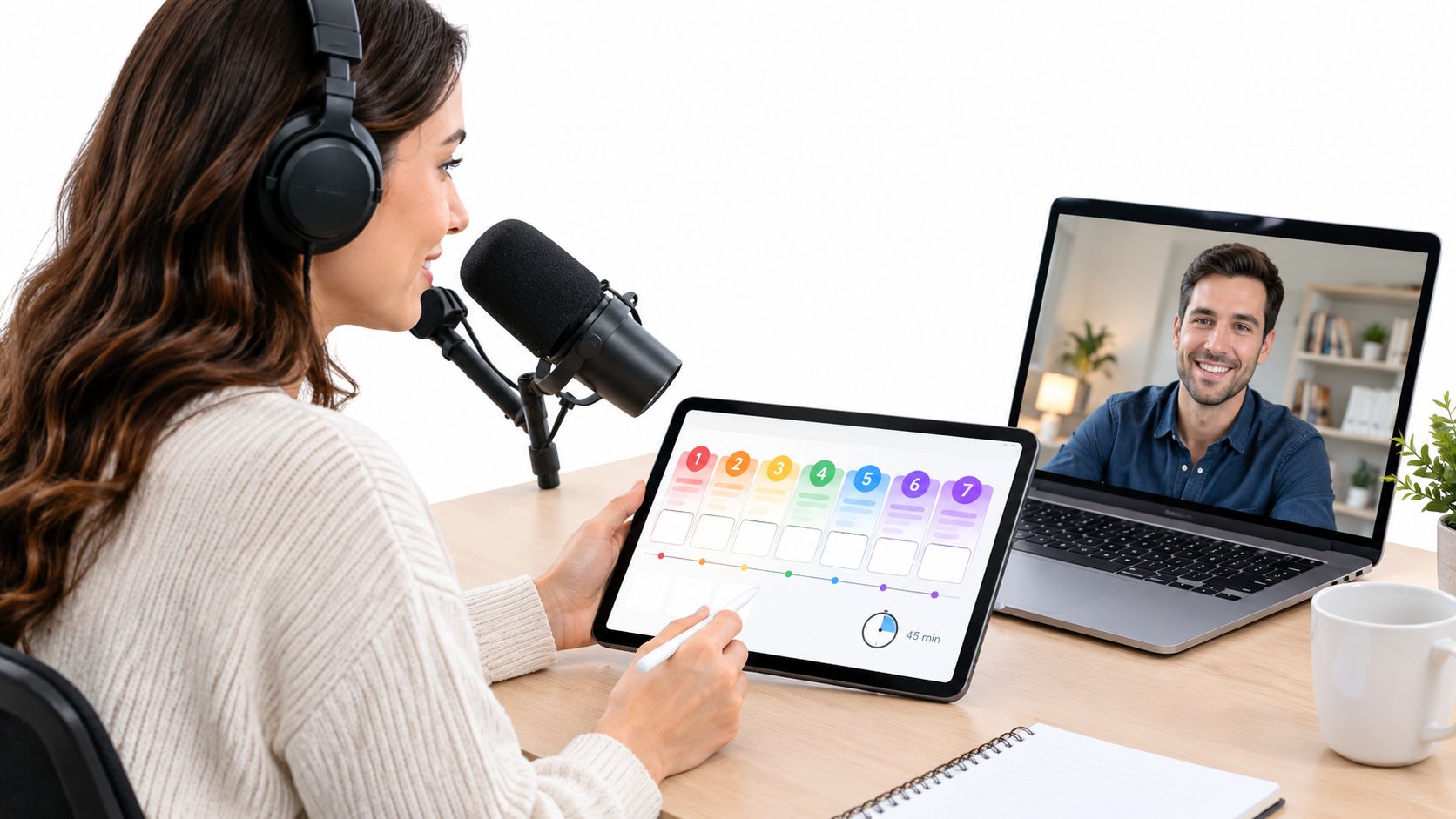
You've got a dozen prompts in a notes app, a guest with plenty to say, and a recording slot that looked generous when you booked it. Halfway through, you're still talking about how they got started. The interesting disagreement hasn't happened, and the listener's practical takeaway is becoming whatever you can squeeze in before goodbye.
A usable interview question template isn't just a list of things to ask. It's a timed rundown that tells you what each question needs to accomplish, where to follow an answer, and what to cut when the guest takes the scenic route.
Table of Contents
- The 45-Minute Episode Rundown
- How to Build the Template
- Question Types That Earn the Next Minute
- Pacing for 30, 45, and 60 Minutes
- Guest Pre-Fill and Recording-Day Tips
- Run the Next Guest on This Rundown
The 45-Minute Episode Rundown
Start with this proposed schedule for a one-guest episode. These are working time allowances, not measured rules about how long good interviews take.
Podcast interview question template for a 45-minute guest episode
| Block | Minutes | Question type | Job of the block |
|---|---|---|---|
| Cold open and guest intro | 2-3 | Background | Who they are and why this episode exists |
| Origin or expertise | 5-6 | Background story | One concrete credential, not a résumé |
| Core story | 12-15 | Past behavior | What they did, chose, and what changed |
| Tension | 8-10 | Challenge or situational | Disagreement, failure, or a real fork |
| Proof | 6-8 | Outcome or how-to | A number, method, or result |
| Listener takeaway | 4-5 | Closing | One action the audience can use |
| Outro | 1-2 | Logistics | Links, offer, and next episode |
Don't add the upper limits together. These are expandable block envelopes, not a promise to spend the maximum everywhere. Even their lower limits leave little breathing room, so a buffered recording needs tighter combined allocations, particularly when tension and proof overlap.
For this example, reserve about five or six minutes for an unexpectedly useful answer, laughter, or a delayed remote connection. The length table below gives an executable allocation with that breathing room included.
Give every block a different job
The opening establishes relevance, not prestige. Use a background line that explains why this guest can answer today's question; the guide to introducing a podcast guest can help you separate useful context from biography.
Origin earns the guest's authority through something they did. Core story supplies the scene and decisions. Tension makes room for the objection a listener would raise, while proof establishes what happened beyond the guest's interpretation.
There's a useful design principle behind this approach: the structured-interview review hosted by ERIC describes how standardizing questions and interviewer behavior reduces unwanted variation. For a podcast, borrow the preparation discipline, not a hiring scorecard.
Keep the core questions stable across a series, with two blank wildcard slots for the individual guest. Those slots are room for relevant preparation, not permission to add unrelated topics.
Fit check: Write the episode's thesis in a sentence. Every block should help establish, test, or apply it; removing a block should leave a gap the listener would notice.
If removing a question changes nothing, remove it before recording.
How to Build the Template
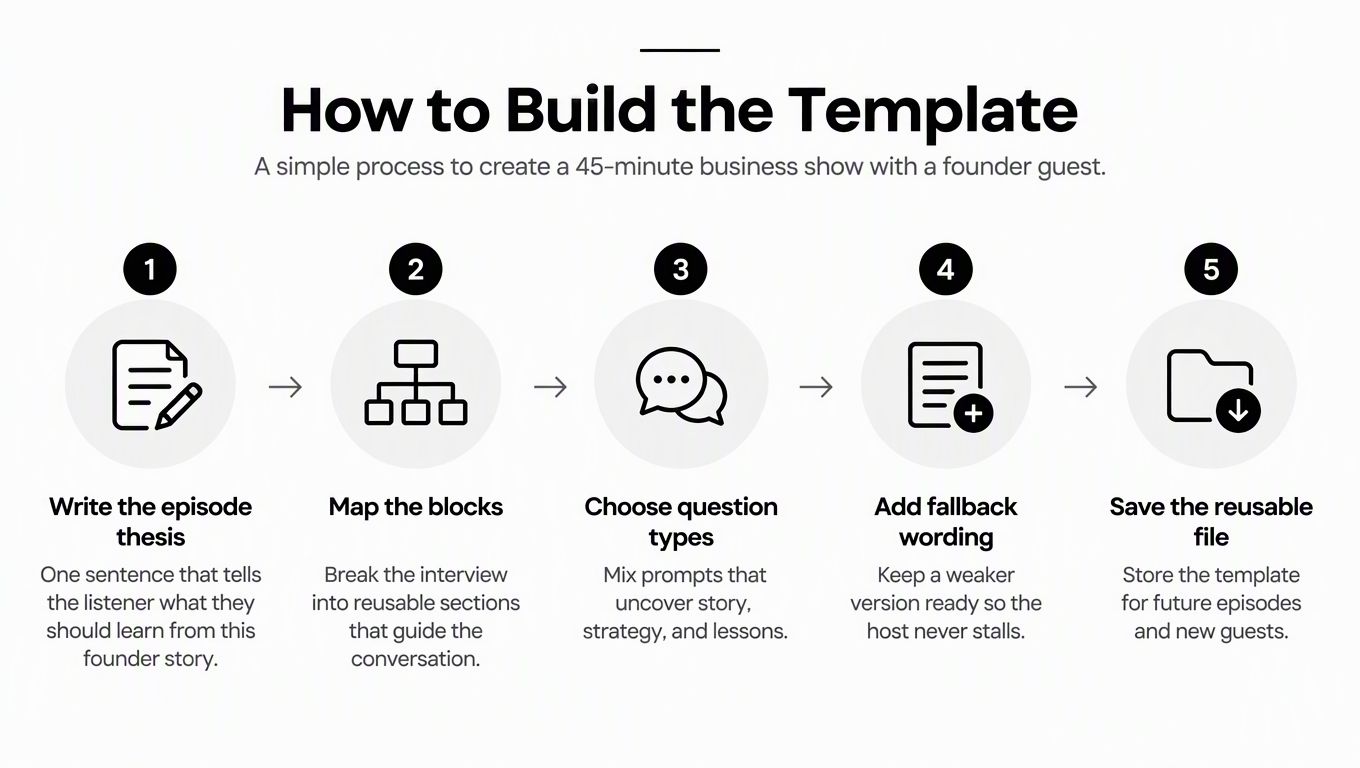
Use a hypothetical founder episode about reducing refunds without adding headcount. Build the file in Google Docs, Notion, or whatever the host and producer can both open during recording.
Build the reusable spine
Write the listener's thesis. For this example: a founder reduced refunds by fixing the customer's first experience rather than expanding support. Treat that as the proposition to investigate, not a success story you've already agreed to endorse. The usual slip is choosing a subject, such as customer experience, instead of a specific lesson.
Lock the format and duration. Put the booked slot, guest name, recording setup, and block allocations at the top. Use the proposed schedule for the actual session length rather than planning a longer show. If there's a co-host, assign the tension block to a named person so both hosts don't soften the same objection.
Draft primary questions in spoken language. Prepare a lead and a backup for each block, but don't treat both as compulsory. For the founder's core story, the lead might be: Walk me through the week you realized refunds weren't just a support problem. The backup could ask which customer interaction changed their diagnosis. Topic labels like refund strategy won't help when you need a clean sentence on mic.
Add a planned follow-up beneath each primary. Ask for an example, a decision, or a consequence. Under the refund question, write: What did you change first, and what did you leave alone? Don't stack several requests into a single breath; you'll usually get an answer to the easiest part.
Add the guest-specific layer
Leave the wildcard lines empty. Label them Wildcard A, guest pre-fill, and Wildcard B, guest pre-fill. Place them beside the blocks where guest-specific material could fit. Filling them before hearing from the guest defeats their purpose.
Add a private answer-quality note. Write scene, choice, result in the host margin. This isn't a guest rating; it's a reminder to notice what the listener still needs. If the answer stays abstract after a focused redirect, move forward rather than conducting a prolonged rescue.
Read the rundown aloud and delete repeats. Listen especially for multiple versions of how the company began. On a remote recording, shorten the first question so connection lag doesn't bury its meaning. Protect the close while editing instead of assuming you'll somehow find room for it live.
Save a master and duplicate it per guest. Keep the master's core wording intact and make guest-specific changes in the duplicate. A shared podcast interview prep sheet can hold the thesis, blocks, follow-ups, and production notes without scattering them across messages.
The finished file should let you prepare a new guest without rebuilding the episode's structure. Writing everything on recording morning encourages familiar questions, while a master makes omissions visible before anyone joins the call.
Question Types That Earn the Next Minute
A question earns its place by producing something the listener can use: context, a scene, a decision, evidence, an objection, or an action. Don't confuse variety of wording with variety of purpose.
The U.S. Office of Personnel Management's structured-interview guidance connects useful questions to explicit objectives and consistent interpretation. Translate that principle into editorial terms: know what kind of answer you're trying to get before you ask.
Match the wording to the job
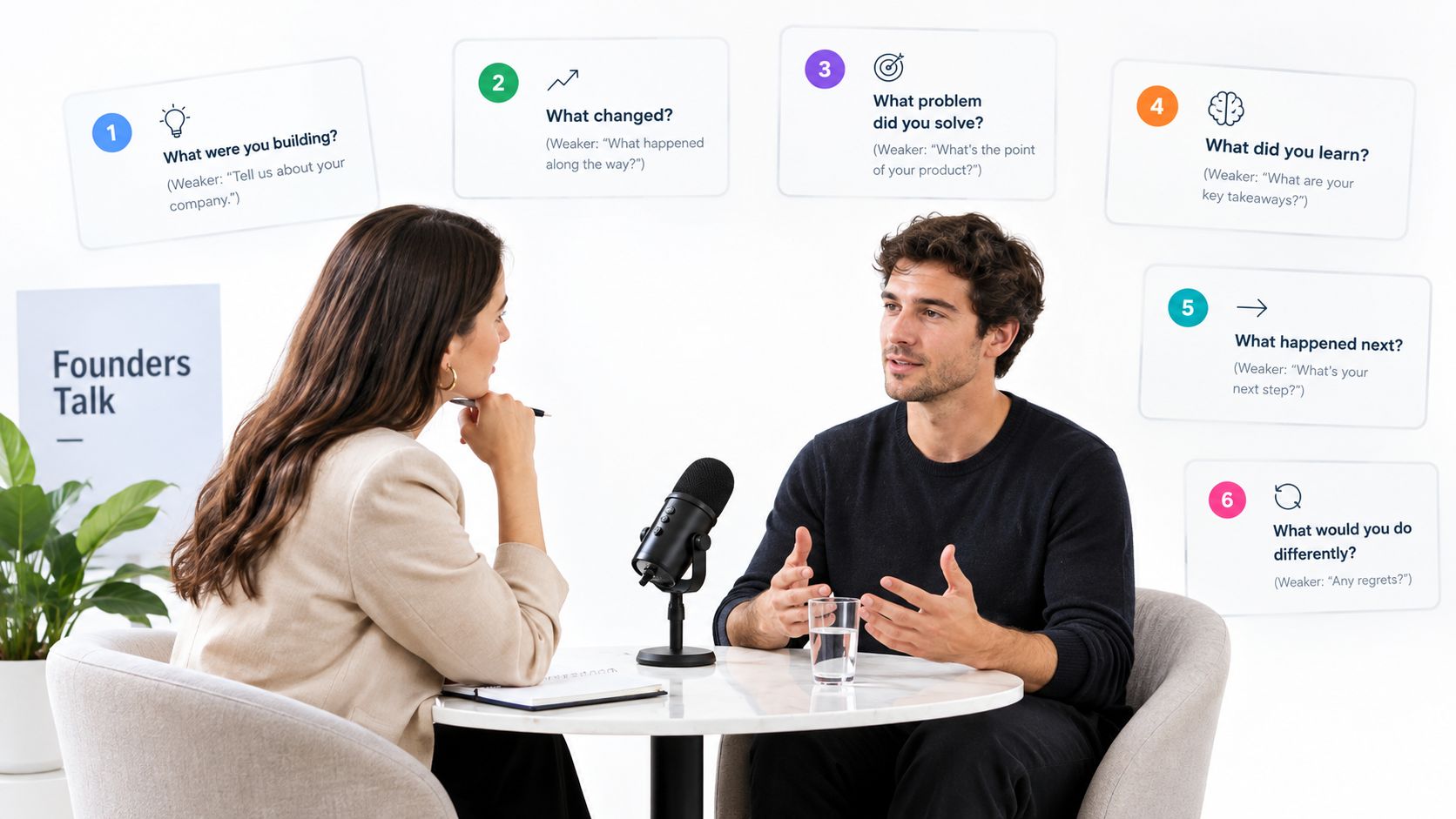
| Question type | Strong founder prompt | Weak version to avoid |
|---|---|---|
| Background | What were you doing the week before this company existed? | Tell us about yourself. |
| Past behavior | Walk me through the week refunds spiked and what you changed first. | How do you approach customer service? |
| Situational | If refunds jumped again next quarter and you could change only one thing, what would it be? | What does the future hold? |
| Outcome or how-to | Which refund measure changed, over what period, and what had you stopped doing? | Did it work? |
| Challenge | A critic might argue you reduced refunds by making returns harder. What's fair about that objection? | What was your biggest challenge? |
| Closing | What should a listener facing the same problem do this week? | Any final thoughts? |
Background should locate the guest, not invite a life history. Past behavior gives you something that happened; situational questions reveal how the guest would choose under a constraint. Don't substitute a hypothetical answer for evidence of an actual result.
Outcome questions need definitions. A lower refund count means something different from a lower refund rate, and neither automatically establishes happier customers. Ask what the guest measured and what other explanation they considered.
Challenge questions work when you state a fair objection without turning the exchange into a prosecution. Let the guest qualify the claim. An honest limitation can be more useful than another polished success line.
Move forward instead of circling origin
A weak sequence asks how the founder started, where the idea came from, and what inspired the business. Those are different sentences doing the same job.
A stronger core-story sequence moves from scene to choice to result:
- Scene: Which customer message made you stop and investigate?
- Choice: Why did you change onboarding rather than add support coverage?
- Result: What happened after that change, including anything that got worse?
Keep the primary question's purpose stable across guests, but let the follow-up respond to what someone really said. If a scene is missing, ask where they were or what happened next; don't mechanically ask for a result they've already supplied.
Avoid trivia piles and yes-or-no prompts that require you to restart the conversation. Leave health, family, and other sensitive personal circumstances alone unless the guest has explicitly offered the subject and it serves the episode's thesis.
Pacing for 30, 45, and 60 Minutes
How to retime the same template by episode length
The allocations below are proposed production budgets for hypothetical sessions. Each row totals the booked slot, including unscripted time.
| Episode length | Open including origin | Core story | Tension and proof | Takeaway and outro | Unscripted buffer |
|---|---|---|---|---|---|
| 30 minutes | 3 | 12 | 6 | 4 | 5 |
| 45 minutes | 8 | 14 | 12 | 5 | 6 |
| 60 minutes | 8 | 22 | 16 | 6 | 8 |
Changing the slot shouldn't require a completely new interview. Change how thoroughly you investigate the story, not how many unrelated subjects you introduce.
For the shortest example, fold origin into the opening and keep tension to a focused objection. Protect the closing allocation by collecting links beforehand and delivering the logistics crisply. The buffer is for real conversation, not an invitation to add a bonus topic.
In the longest example, use the extra room for another scene within the core story and another proof point. A second example can reveal whether the founder's method held under different conditions; another biography passage usually won't.
Cut optional depth before essential meaning
Mark the cut order directly in the host's file:
- First cut: Drop the additional proof example once the main result is understandable.
- Next cut: Shorten origin to the credential the listener needs.
- Final compression: Reduce tension to the strongest objection and its answer.
Don't remove the listener action or rush through links the guest was promised. Those are commitments, not spare parts.
When you're ahead, deepen the answer already in progress before opening another subject.
Try a consequence follow-up in the core story, then a listener scenario if there's still useful room. Stop expanding when the remaining time belongs to the close.
Use clock checks to make decisions
For the proposed middle-length episode, a producer can mark a checkpoint at minute fifteen: the host should already be inside the core story. At the two-thirds point, the conversation should have reached tension or proof; with six minutes remaining, prepare the transition into the takeaway.
These are intervention cues, not reasons to interrupt a valuable sentence. The producer can signal the host through a private chat or a simple note on the shared rundown.
If the guest is delivering a monologue at minute eight, use the planned follow-up to narrow it: Which moment made you change course? Don't reward the drift by introducing another broad topic.
If they arrive with a product pitch, acknowledge it and reserve the offer for the outro. Then return to the thesis question. You can be a generous host without giving away the episode's editorial direction.
Guest Pre-Fill and Recording-Day Tips
Send a short pre-fill before recording rather than a questionnaire that lets the guest rewrite the show. For this workflow, sending it forty-eight hours ahead gives you a defined preparation deadline without making an empirical claim about response times.
Ask for these fields:
- Bio: A sentence you can use to introduce them.
- Story: The experience they most want to discuss.
- Proof: A number or result they can explain and stand behind.
- Boundaries: Topics they'd rather skip.
- Outro links: The destination or offer listeners should hear.
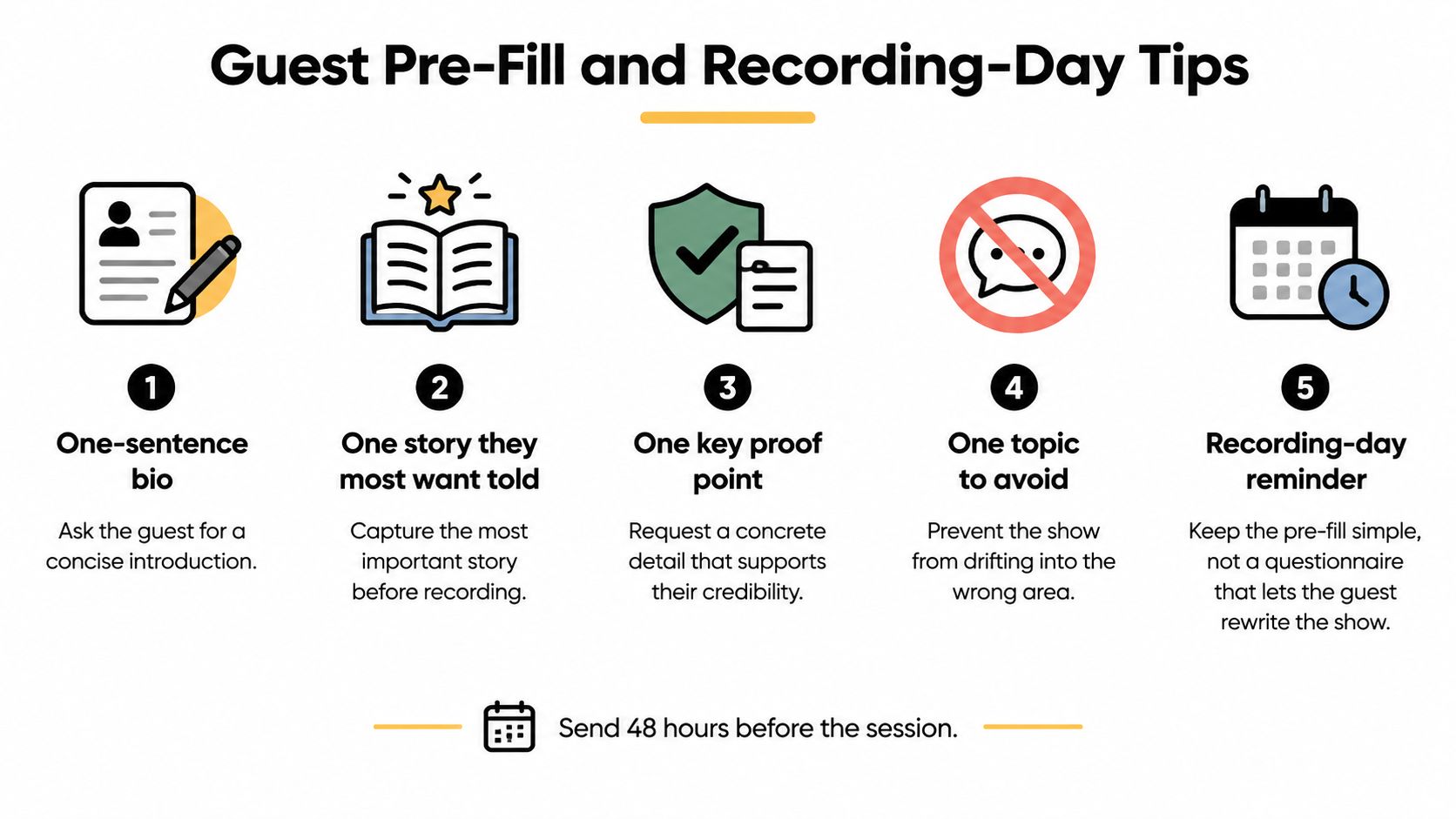
Use the answers to fill the wildcard slots and mark boundaries. If the requested story doesn't serve the thesis, thank the guest and keep it as a possible separate clip rather than rebuilding the main conversation. A podcast guest questionnaire provides a practical starting format.
Keep the live page readable
Put the rundown on another screen or a printed sheet, with only the lead question in each block bolded. Keep backups visually subordinate so you don't read a string of prompts before the guest can answer.
Mark potential clips in the margin when an answer contains a scene and a concrete result. Don't interrupt a useful exchange just to announce that you've found a clip.
Guest briefing: Share the thesis and block themes when someone requests questions in advance. Keep responsive follow-ups responsive, while agreeing beforehand on sensitive or technically demanding material.
Treat generated questions as drafts. Alongside a manually written Google Doc, the free interview question generator from Let's Make A Podcast is an option for preparing candidate prompts. A human still needs to delete repeated blocks, irrelevant questions, and personal material the guest hasn't offered.
Run the Next Guest on This Rundown
A strong rundown gives the guest room to answer while keeping the episode pointed at one listener takeaway. Before recording, confirm that the lead questions support the thesis and that the closing action follows from it, rather than from the guest's promotional priorities.
The night before, read each lead question aloud without its backups. If a prompt sounds unnatural, rewrite it. Keep the rundown short enough to follow on mic, with the two wildcard slots ready for useful stories from the guest's pre-fill.
Duplicate-file checklist
- Name the episode: Put the guest's name and listener thesis at the top.
- Set the clock: Add the time allocation for the booked slot.
- Send the pre-fill: Include it with the calendar invitation and set a return deadline.
- Assign ownership: Decide who opens, who raises the objection, and who watches the clock.
- Check the landing: Make sure the final action addresses the problem raised at the start.
A complete interview does not require every prepared question. Keep the context, evidence, and challenge that help listeners understand the lesson and act on it. If time slips, cut a backup prompt before you cut a core question.
Duplicate the master for the next guest. Write the thesis first, then fill the two wildcard slots.
Let's Make A Podcast connects hosts and prospective guests and offers tools for guest preparation, interview-question drafts, and booking coordination. Visit Let's Make A Podcast to find a relevant guest or prepare a first-pass question list, then edit those prompts into a rundown you can use on mic.