How to Start an Interview Podcast: A Step-by-Step Guide

Most new interview podcasts don't stall because the host bought the wrong microphone or couldn't book a famous guest. They stall because nobody can tell who the show is for, or because the release schedule slips before listeners have a reason to return.
A stronger launch starts with the listener, then builds a production routine the host can sustain. Choose the promise and cadence before you pitch guests. Record a reserve before announcing the show. Make every interview useful beyond the recording itself.
Table of Contents
- Interview Podcast Launch Roadmap at a Glance
- Define Your Listener and Format Before You Record
- Recording Setup and Settings That Hold Up
- Book Guests Who Fit Your Topic
- Set a Publishing Cadence You Can Keep
- Publish Episodes Your Listeners Can Find
- Build Discovery Into Every Interview
- Batch Record Three Episodes Before You Announce
Interview Podcast Launch Roadmap at a Glance
| Phase | Typical timing | Output to have before moving on |
|---|---|---|
| Define listener and one-sentence promise | Week 1 | Written listener profile and show promise |
| Choose format, cadence and platforms | Week 1 | Format sheet with publishing schedule |
| Set up and test recording | Week 2 | Tested gear with checked levels |
| Batch-record three to six episodes | Weeks 3 to 6 | Finished episodes held in reserve |
| Book guests and send briefings | Starts in week 2 and runs ahead of recording | Confirmed guest calendar with briefings sent |
| Publish with transcript and show notes | Launch day | Live episode with backup files kept |
The order matters. If you book guests before defining the listener, you're more likely to choose people who sound impressive but don't help your audience. If you announce a launch before you have finished episodes in reserve, a guest cancellation or editing delay can break the schedule right away.
The roadmap works for a solo host interviewing rotating guests and for a co-hosted show. The phases stay the same, but co-hosts need to agree on the show's promise, recording roles and approval process. A solo host may have fewer coordination steps, but still has to protect time for research, guest booking, editing and publishing.
Use the timing as a working sequence, not a deadline to rush toward. If a test recording reveals room noise or the first guests don't fit the promise, fix the problem before moving to the next phase. A reliable launch is built by completing each phase's output, not by checking off dates while key decisions remain unsettled.
Start today by writing the one-sentence promise and the planned episode frequency. Don't send a guest pitch until those two decisions are clear.
Define Your Listener and Format Before You Record
Podcasting has a large potential audience, but that doesn't mean your show should try to serve everyone. Edison Research's 2025 U.S. podcast-consumer study estimated that 210 million Americans aged 12 and older, or 73% of the population, had consumed a podcast in audio or video form. That's a broad market, not a listener profile. A useful show promise names the person you want to reach and the problem your interviews help them solve. (Edison Research's 2025 U.S. podcast-consumer study)
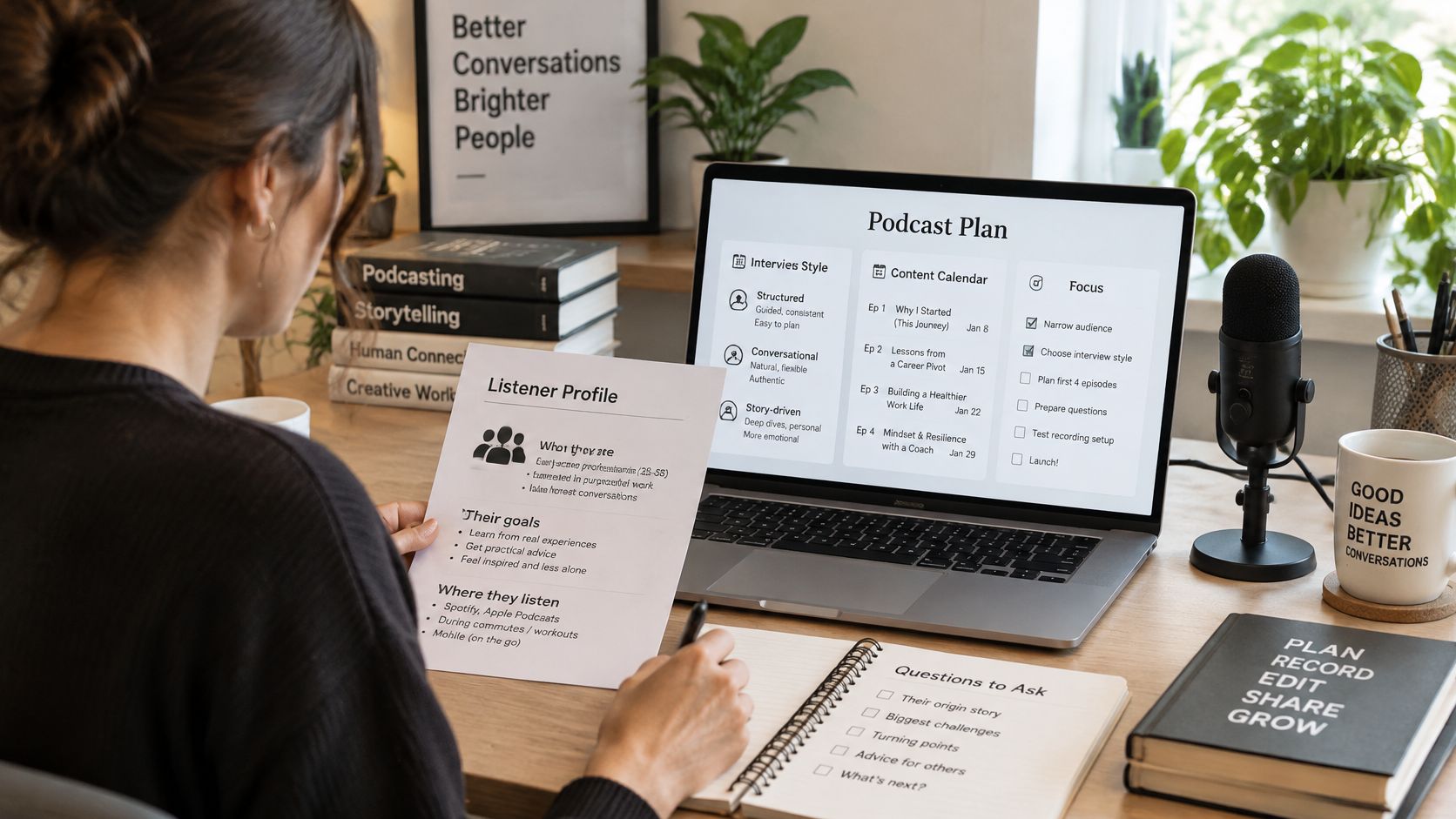
Make four decisions in order
First, write the promise. Name the listener and what they'll learn from the interviews. For example: “A show for fintech operations leads learning how mid-size teams hire their first analyst.” That gives you a practical filter. If a possible guest can't help answer the listener's questions, the guest may not fit, regardless of their job title or profile.
Second, choose a format. A solo host with rotating guests gives one person control over the pace and questions. A co-hosted show adds another perspective but requires coordination and agreement on the show's voice. A limited run on one theme can help a new host stay focused, while a continuing interview show needs a topic broad enough to sustain new conversations.
Third, set the schedule around available production time. Include guest coordination, preparation, recording, editing and publishing, not just the time spent in conversation. A schedule you can meet consistently is more useful than an ambitious one you keep missing.
Fourth, choose the platform mix. Edison Research reported that among U.S. weekly podcast listeners, YouTube was the service used most often by 33%, followed by Spotify at 26% and Apple Podcasts at 14%. If you want the show to be discoverable in both audio and video, plan a repeatable setup that can produce clean audio and usable video. You don't need to turn each episode into a studio production. Start with reliable audio, then add a simple, consistent camera setup if your recording space and editing capacity support it.
A short video can be useful for discovery, but it shouldn't jeopardize the main episode. Decide whether a guest is comfortable on camera and whether the topic benefits from visuals. Then make an audio-only fallback part of the recording plan, so a camera or video-file problem doesn't cancel the release.
Put the promise, format and publishing frequency at the top of a one-page show brief. Reuse it when you contact guests, write episode descriptions and decide whether a topic belongs on the show.
Recording Setup and Settings That Hold Up
Start with gear that solves real recording problems. Use one microphone per person, an audio interface or USB input for each mic, and closed-back headphones for everyone on the call. Record in a quiet room with soft furnishings to reduce reflections. Add a stable camera only if video is part of a workflow you can maintain.
A dedicated, dependable setup is more useful than an expensive one that's difficult to repeat. Keep the microphone, chair and recording position consistent so each episode starts from a familiar baseline.
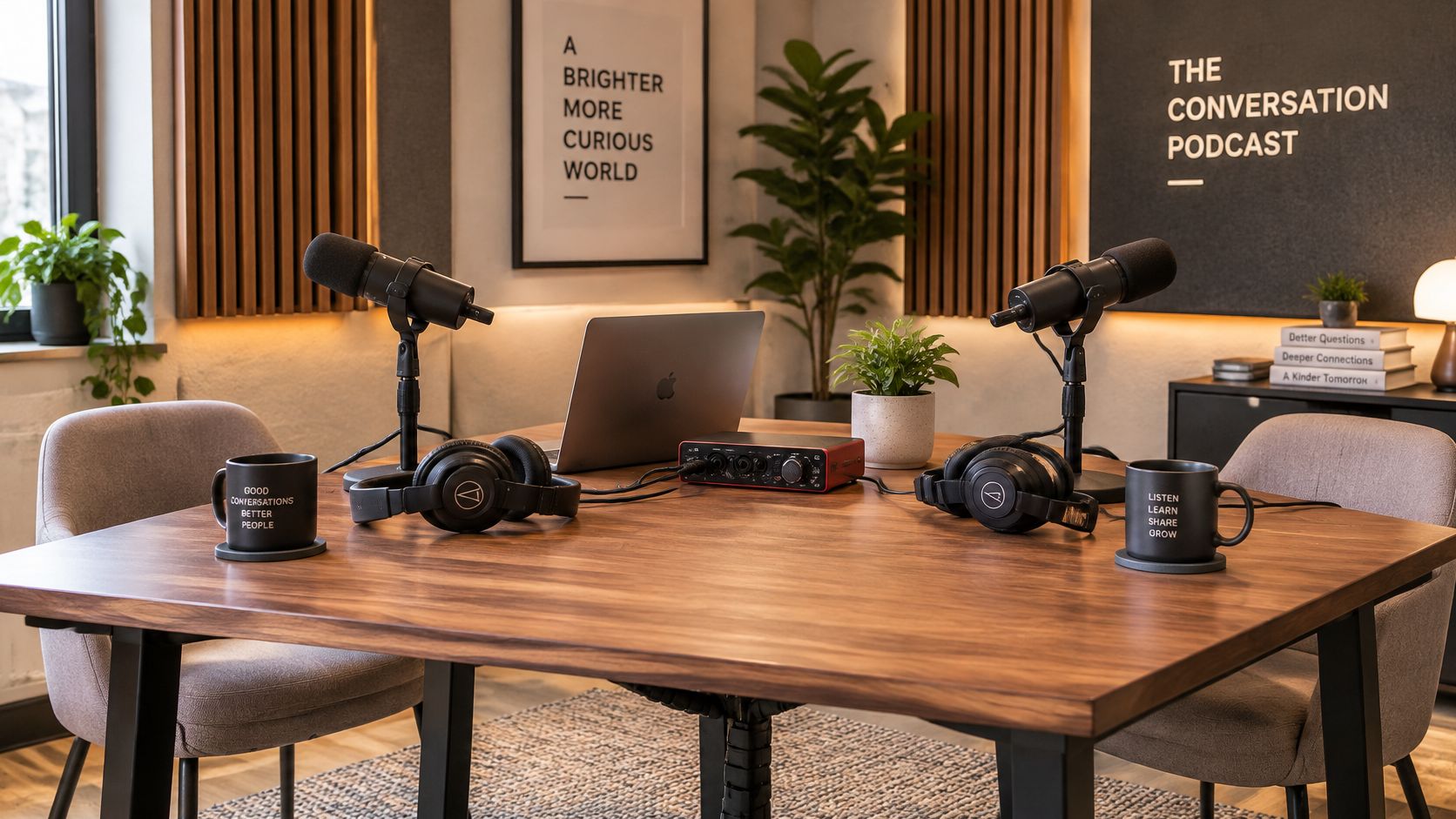
Use these settings as a starting point for recording and exporting:
| Setting | Target value | Why it matters |
|---|---|---|
| Recording file | Lossless WAV or AIFF at 48 kHz/24-bit | Keeps full quality for editing and later clips |
| Recording level | Peaks around −18 to −12 dBFS | Leaves headroom so loud laughs or coughs don't clip |
| Distribution loudness | About −16 LUFS integrated | Helps keep the episode's volume consistent across listening apps |
| True peak ceiling | −1 dBTP | Helps stop distortion after the file is compressed for distribution |
| Remote guest audio | Each person records locally | Captures audio before network compression degrades it |
| Call recording | Keep as a backup only | Gives you a safety copy if a local file fails |
For remote interviews, record separate local tracks whenever possible. The call recording is useful as a backup, but relying only on the compressed call mix leaves you with fewer options if one person's connection degrades or the mix has uneven levels.
Run a sound check before the conversation
Record a short test with each microphone, then listen back on headphones. Set the input levels so ordinary speech lands comfortably below the top of the meter and louder moments don't clip. Ask guests to keep a steady microphone distance, and use a simple marker or verbal reminder to help them hold that position.
Before the interview, close the door, switch off fans and air conditioning if you can, and listen for hum, traffic or room echo. Don't assume noise is unnoticeable just because it fades into the background while you're speaking.
Practical rule: A recording that sounds clear during the call can still be difficult to edit. Check the captured files before you start the interview, not just the live connection.
Three common mistakes are preventable: recording only the compressed call mix, skipping the sound check and allowing microphone distance to drift. Make a brief test recording part of every session, even when the setup hasn't changed.
Book Guests Who Fit Your Topic
Guest booking starts with relevance, not reach. A person with a smaller platform but deep experience in the listener's problem can make a stronger episode than a prominent guest whose expertise doesn't match the show. Before pitching, confirm that the guest or show is active and has a contact route. A show that has stopped publishing or offers no usable way to get in touch can waste time that belongs in your booking pipeline.
Let's Make A Podcast read 383 public podcast RSS feeds from a 408-show directory, and 246 of those shows (60%) had published in the last six months and printed a contact route a stranger can use. That kind of activity check helps you prioritize outreach to shows that are open to contact.
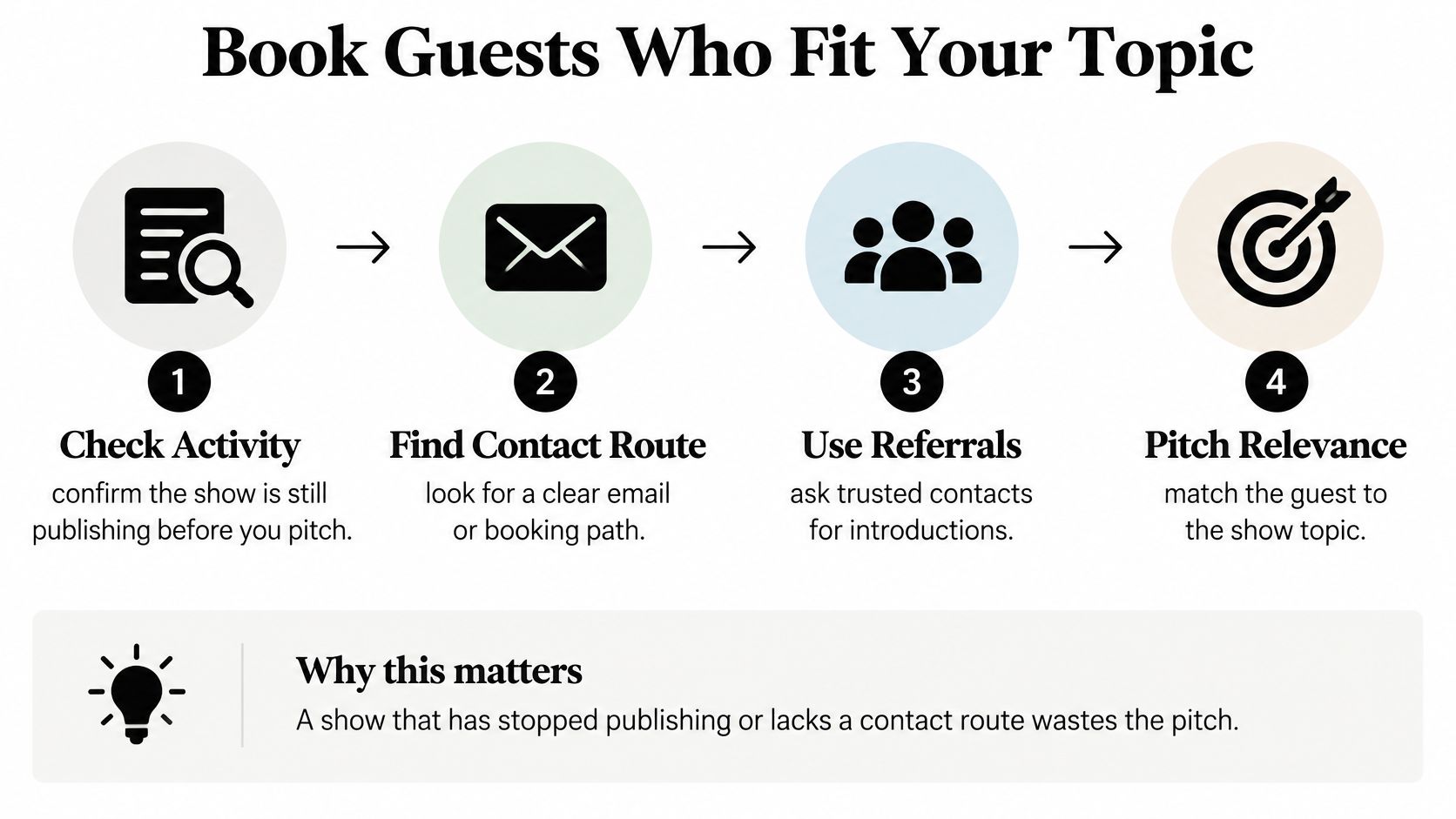
Use a simple booking sequence
Build a candidate list. Find people whose expertise directly answers the question in your show promise. Referrals from past guests are often a good starting point, and a two-sided marketplace such as Let's Make A Podcast lets hosts and guests publish profiles, find possible fits and make contact.
Check that each prospect is active. Look for recent episodes, current work or another clear sign that the guest is still available for conversations. Confirm the contact route before you draft a pitch.
Rank topic depth above status. Ask what a guest can explain, demonstrate or challenge. A strong match gives the listener something concrete to take away, rather than a name to recognize.
Write a specific pitch. Mention a recent episode or piece of work, explain why the guest fits the show, and state the benefit for the listener. Offer a couple of possible times, so the next step is easy to answer.
Follow up once, then move on. A polite follow-up after about a week is reasonable. Don't let a lack of response stop you from approaching other well-matched guests.
Send a briefing after confirmation. Include the episode objective, five to eight thematic questions, timing, pronunciation notes, release expectations and consent requirements. The guest should know what the conversation is for and what will happen to the recording.
For more practical ways to find suitable guests, use this guide to find guests for your podcast. Keep the pitch focused: you're inviting someone to help a defined listener, not asking them to make your show successful for you.
Set a Publishing Cadence You Can Keep
Work out capacity before choosing a release day. Estimate the time you'll need for research, guest coordination, recording, editing, approval, artwork and distribution. Multiply that per-episode effort by the schedule you're considering, then leave room for changes. Keep at least one finished episode in reserve so a busy week doesn't immediately become a missed release.
Editing can take more time than new hosts expect. One industry compilation reports that 38% of producers spend one to three hours editing each episode and 22% spend more than three hours. The same compilation reports that roughly 76% of U.S. podcast consumers listen to shows that publish on a regular schedule. Those figures point to a practical choice: keep the schedule regular, but make sure the work fits your actual capacity. (Riverside's podcast statistics compilation)
Track four operational measures from the beginning:
- Guest-confirmed-to-recorded conversion: Shows whether booking confirmations turn into actual interviews.
- Recording-to-published cycle time: Reveals whether editing or approvals are slowing releases.
- Episode completion or retention: Helps you see whether the structure holds listeners.
- Schedule adherence: Shows whether the production plan is realistic.
Don't optimize for download totals before you know whether the format, opening and guest fit are working. A late episode or a meandering introduction can make it harder for listeners to build a habit around the show. A weekly or biweekly release is a sensible starting point if your available time supports it.
Copy this publishing workflow
- Preflight the recording. Check for clipping, dropouts, room noise, mismatched levels and misspelled guest names.
- Edit for clarity. Tighten the opening, remove avoidable digressions and keep the conversation's most useful ideas.
- Export the distribution master. Use the loudness and true-peak targets in your recording settings.
- Add show notes and a transcript. Give listeners a useful summary and a way to follow the conversation's details.
- Schedule the release. Publish on the same day each week or on the same day every other week.
Publish Episodes Your Listeners Can Find
Choose a podcast host that creates a public RSS feed. Podcast directories use that feed to receive your episodes, while your recording software is for capturing the conversation. Once you've chosen a host, follow this release routine:
- Upload the master file. Fill in the title, description, season and episode number, and explicit-content flag.
- Attach show notes and a transcript. Add relevant guest details and make each name easy to find.
- Prepare consistent cover art. Use artwork that's legible at small sizes, and keep the same show identity across episodes.
- Submit the feed to your chosen directories. Confirm the episode appears after the first release, then check that subsequent releases arrive correctly.
- Publish video where planned. If you're releasing on YouTube, use a matching title and a static image for audio-only episodes.
- Check the live episode. Open it on two devices and listen to the first few seconds to catch a broken upload or an awkward opening.
- Archive the production files. Keep the local tracks, backup call recording and project file together in a folder named for the episode.
A transcript and clear show notes give people more ways to find and understand the episode. For a wider set of practical ways to connect with the right listeners, use this guide to build an audience for your podcast.
Build Discovery Into Every Interview
A famous guest won't automatically carry a new show. Independent-creator research identified growing an audience or discoverability as the leading recurring challenge for 72% of active podcasters, while finding guests was reported as a challenge by 7%. A guest may share an episode selectively, or send listeners who never return. That's why a guest should deepen the topic, not merely lend the show a recognizable name. (The Independent Podcaster Report 2025)
Test the show's positioning before committing to a season. Record a small set of episodes around one narrow listener problem, then compare which conversations hold listeners and bring them back. If an episode gets attention but doesn't attract repeat listening, don't assume the next guest should be even more famous. Check whether the subject, promise and audience actually fit.
After each interview, make several pieces of content from the strongest moments. Choose short clips or written takeaways that address the same listener problem as the full episode. Share them where that listener already looks for ideas, and use clear titles that make the episode's subject easy to understand.
Choose the guest for the next useful conversation, not for the biggest possible announcement.
Use the interview question template to prepare a conversation around the listener's problem, rather than assembling questions that only invite a biography.
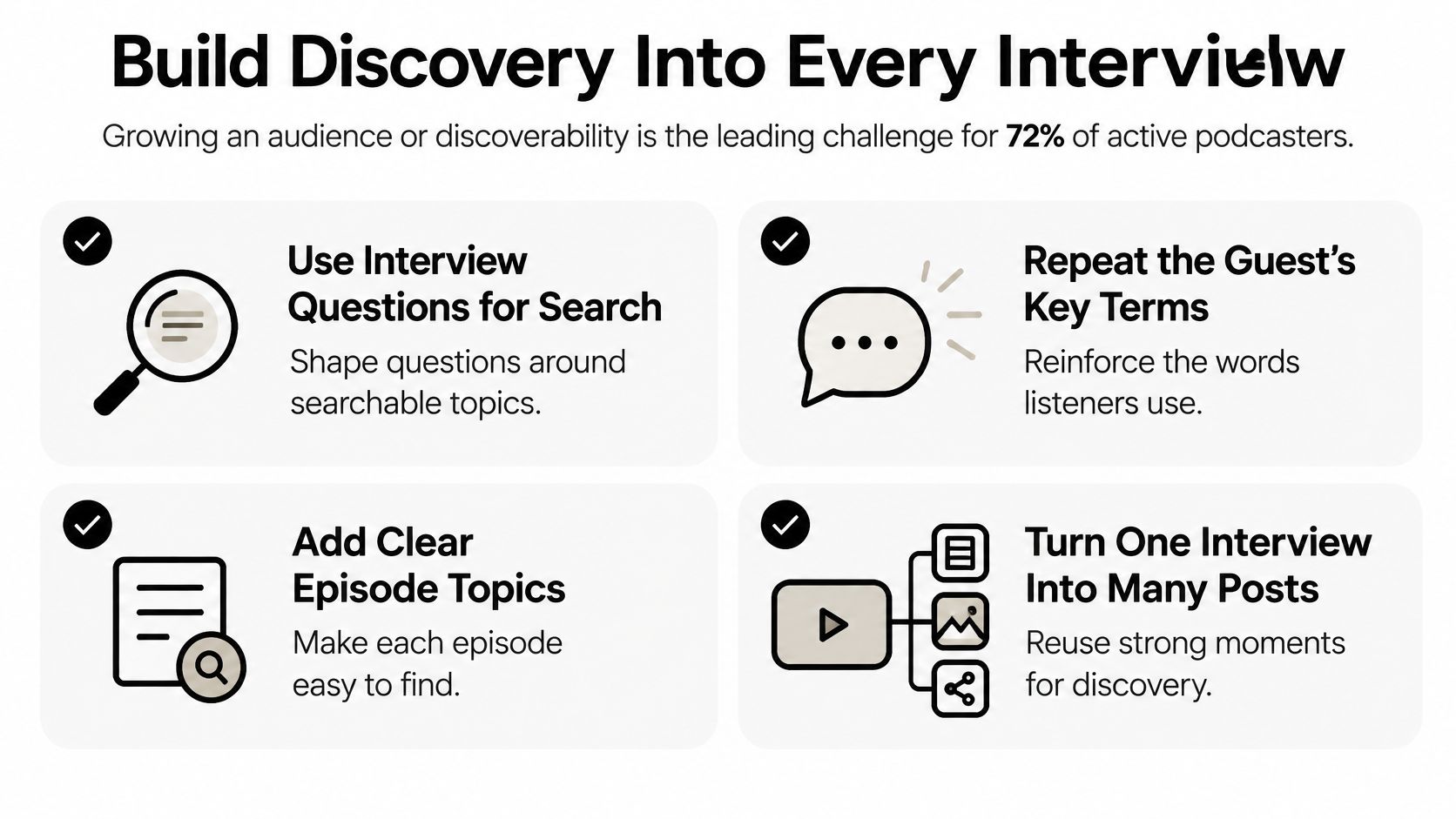
Use this checklist after every recording:
- Name the problem: State the specific listener need this episode addresses.
- Check guest fit: Confirm the guest was chosen for topic depth, not just recognition.
- Make the follow-up content: Cut a few clips or write takeaways while the strongest moments are easy to find.
- Review repeat listening: Check retention and returning-listener measures after the episode has had time to reach its audience.
Batch Record Three Episodes Before You Announce
A launch announcement creates an expectation. Build a production cushion before you make that promise public.
- Write the show promise and publishing cadence on the one-page show brief.
- Book the first guests using a focused pitch and a clear briefing.
- Batch-record a reserve of episodes before announcing the show.
- Pick a fixed release day and keep a finished episode in reserve.
- Put the launch date on the calendar, then count back through the roadmap so each phase has a clear output.
After the first month, check whether episodes are releasing on schedule, whether the guest pipeline has confirmed conversations ahead, and whether listeners are returning. If the schedule is slipping, reduce the production load before adding more promotion. If listeners aren't coming back, revisit the promise and guest fit before increasing the number of episodes.
The first action is straightforward: write the show brief. Fix the listener promise and cadence before you send a single pitch.
Use Let's Make A Podcast to find active shows and potential guests by topic, then organize outreach around the listener your interview podcast is built to serve. Joining is free, and creating a profile, browsing, pitching, inviting, messaging and scheduling cost nothing.