How to Build an Audience for a Podcast in 2026

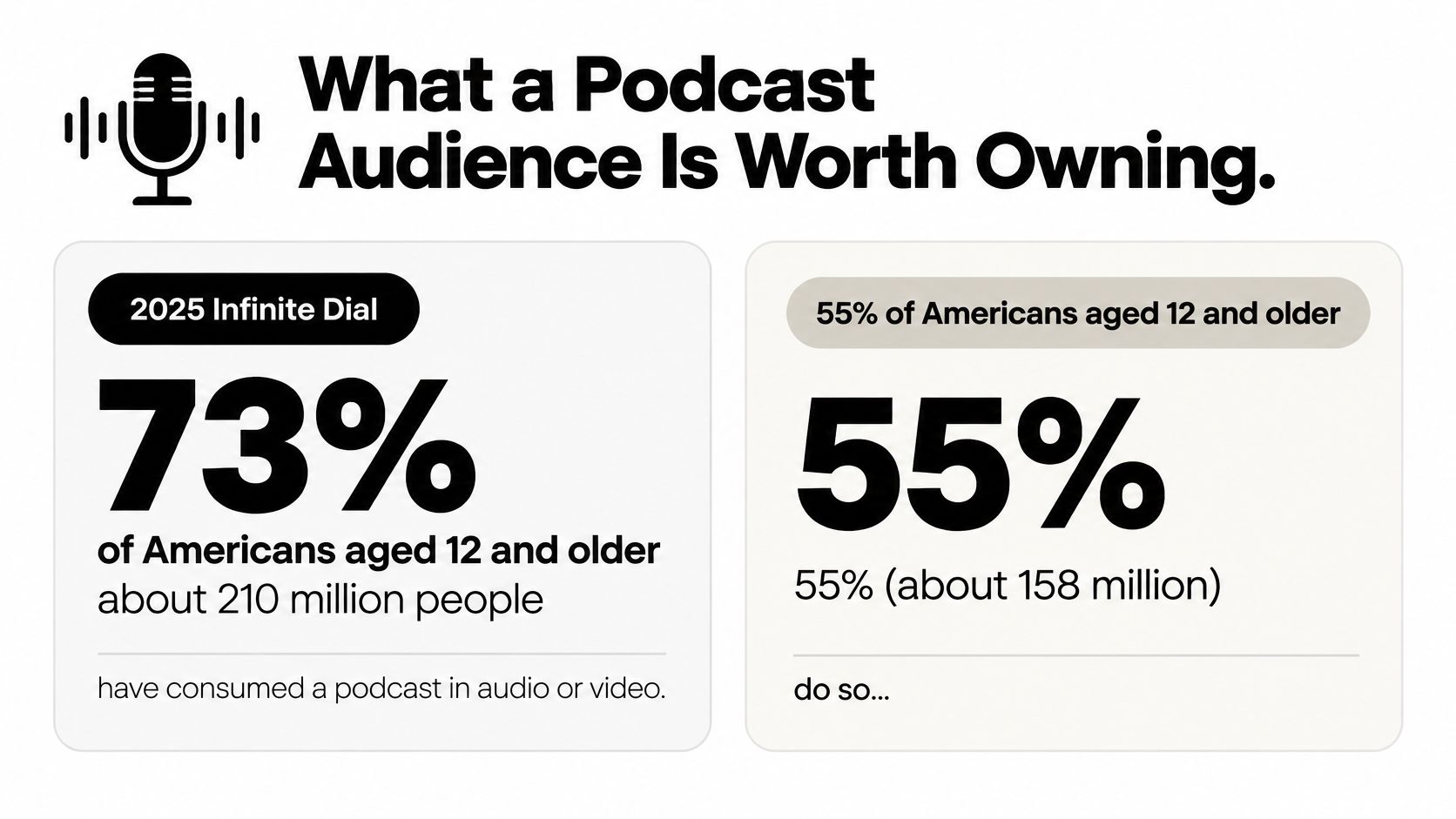
73% of Americans aged 12 and older, about 210 million people, had ever consumed a podcast in audio or video form, according to Edison Research's 2025 Infinite Dial. The same survey put monthly consumption at 55%, approximately 158 million people, and weekly consumption at 40%; 37% of monthly podcast consumers used video podcasts.
Table of Contents
- What a Podcast Audience Is Worth Owning
- Choose Audio or Video by Listener Context
- Book Guests Who Bring Their Own Listeners
- Make Every Episode Findable Off the Feed
- Score Email and Return Listeners Weekly
- What Growth Looks Like in 90 Days
- Run Your First Audience Week
What a Podcast Audience Is Worth Owning
Those figures support two decisions for independent hosts. Consistent publishing can compound within a large category, and your distribution plan needs to accommodate watching as well as listening. Neither decision requires you to become a full-time video producer.
The audience opportunity is substantial, but the useful distinction isn't between a small show and a big show. It's between people you reached once and people who have a reason to return.
The scale of podcast consumption is worth keeping in view:
Separate borrowed attention from durable relationships
Borrowed audience includes impressions, platform follows, chart spikes, and a guest's one-time share. Owned audience, in practical operating terms, includes permission-based email contacts, direct visits, and repeat listening. You don't own listeners, and a return listen isn't permission to email someone. What you're building is a relationship that doesn't depend entirely on another recommendation from an algorithm.
A platform follow tells you someone might see you again. A measured return listen tells you they actually came back.
The trap is maximizing followers on a platform, especially by producing full video for every interview, while nobody develops a listening habit. Video reach is rented. It becomes more valuable when viewers can find your show elsewhere or choose to hear from you directly.
Write the job your listener hires you to do
Before choosing channels, finish this sentence: This show helps a specific listener accomplish a specific job. That might mean learning a production workflow, finding better-fit guests, or keeping current in a specialist field.
- Name the listener: Independent interview hosts is more useful than people interested in podcasting.
- Name the outcome: Help them prepare interviews that produce usable answers.
- Reject mismatched ideas: An impressive guest isn't enough if the conversation doesn't serve that outcome.
Use that sentence to connect your podcast brand-building decisions to an editorial promise people can recognize. Learning how to build an audience starts with giving the right person a dependable reason to return.
Choose Audio or Video by Listener Context
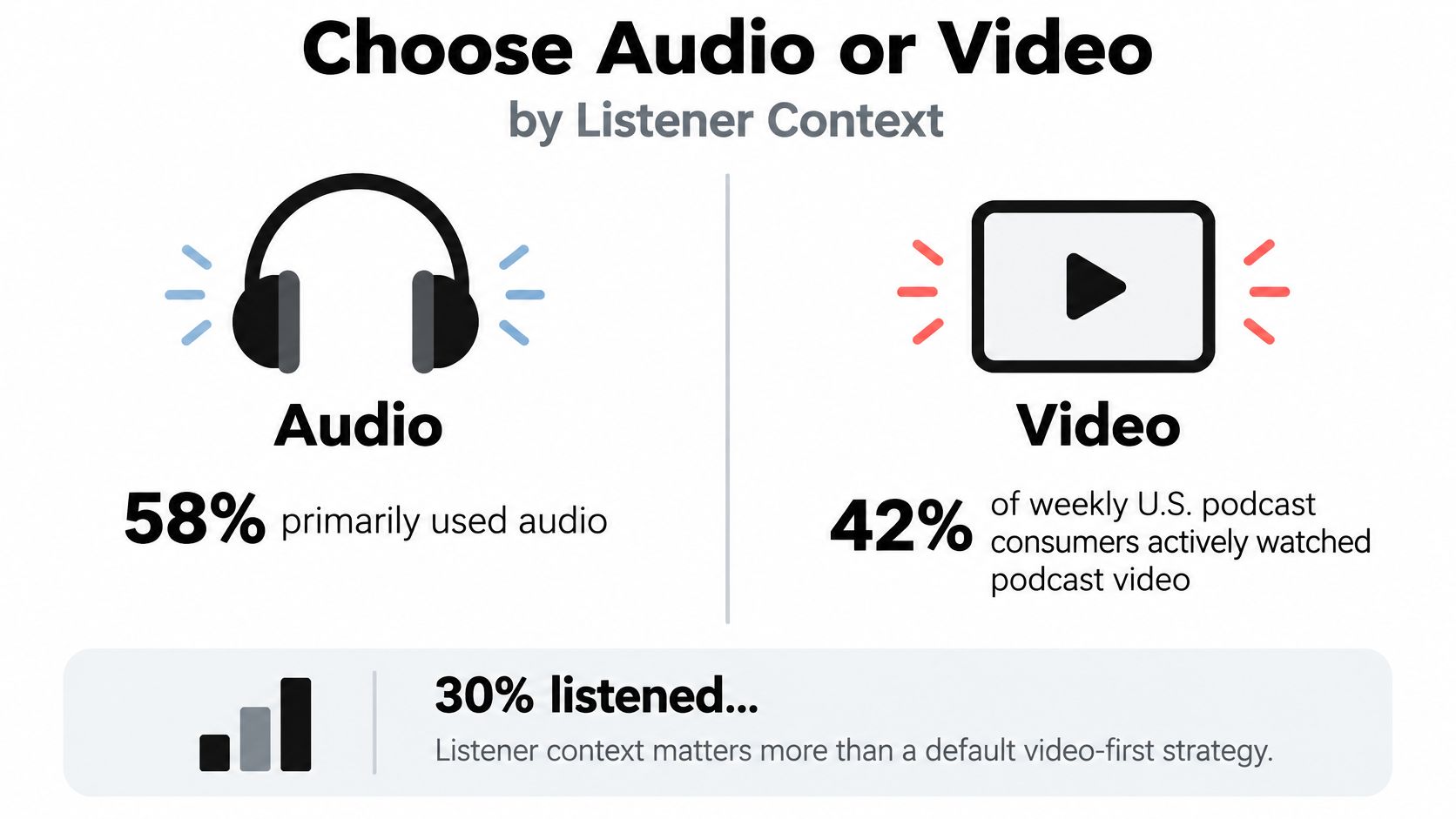
Video-first isn't a universal growth strategy. In spring 2025, 42% of weekly U.S. podcast consumers actively watched podcast video, while 58% primarily used audio, according to the Cumulus Media and Signal Hill Insights Podcast Download report.
Choose the production format around how someone will use the episode, not around what looks most ambitious on your content calendar. This comparison captures the broad split:
Format choice by listener context
Treat the genre rows below as starting hypotheses. Your own completion and returning-audience reports should determine whether the extra production work earns its place.
| Listener context | Master format | Still produce | Judge by |
|---|---|---|---|
| Commute, exercise, chores | Audio | Two short clips, transcript or summary | Completion and 30-day return |
| Science, history, fiction, arts, true crime | Audio | Searchable clips only if a visual helps | Return listens, not view count |
| Music, sports, kids and family, comedy, news | Video plus audio export | Platform-native clips | Watched completion and referrals |
| Video on, attention elsewhere | Audio-first, optional minimized video | Chapters and a clear spoken CTA | Whether they finish with video off, where measurable |
| Accessibility, language, or low bandwidth | Audio with transcript | Written summary and one follow-up link | Summary clicks and return visits |
| Unsure after one test | Keep the provisional winner for four episodes | Don't add full video by default | Completion, return, qualified referrals |
For a commuting audience, make the explanation understandable without seeing a screen. Read essential labels aloud, describe the relevant part of a demonstration, and remove phrases such as you can see it here unless you explain what matters.
For a visually engaging conversation, capture video without neglecting the audio export. A viewer may enjoy facial reactions; a listener still needs intelligible voices and transitions that make sense without pictures.
A transcript also serves a different purpose from a summary. Provide the transcript when someone needs the conversation in text; provide the summary when they need the answer quickly.
This video is an optional viewing resource:
Make video justify its cost
Full video adds framing, lighting, editing, rendering, and thumbnail work. Keep it when a comparable listener segment produces stronger completion, return behavior, or qualified referrals. Don't mistake extra impressions for evidence that the additional work paid off.
Before recording, agree on the depth episode, discovery clips, written companion, and follow-up resource. Get permission to reuse excerpts rather than negotiating it after the guest has moved on.
Run a format test during the coming week, holding the subject and intended listener as steady as possible. Review completion first, then allow the return-listening window to mature. A single episode offers a clue, not a reliable verdict.
Book Guests Who Bring Their Own Listeners
A guest is a distribution partner, not an empty recording slot. Their audience should have a natural reason to care about your show after the interview ends.
YouTube was the discovery source for 45% of U.S. weekly podcast listeners who started a new show in the previous six months, yet 70% of YouTube podcast consumers said they'd switch platforms if a show became available only elsewhere, according to the Cumulus Media and Signal Hill Insights podcast report. Build guest collaborations around that portability rather than asking everyone to follow the same account.
The booking process starts with audience fit:
Build the booking path
Publish what you're booking. Put the subjects you're seeking on your host page. Explain who listens and what a useful guest can teach them. Broad invitations produce broad pitches.
Check current activity and topic overlap. Read public feeds and recent descriptions before approaching a potential partner. Let's Make A Podcast is one option alongside manual feed checks and a spreadsheet: its guest finder emphasizes declared topic matches, while its directory provides publishing-status signals.
Make evaluation easy. Exchange a one-sheet containing topics, bio, photo, and past appearances. A shareable page or PDF should answer whether this person can contribute without requiring a scavenger hunt.
Send a specific invitation. Reference a recent episode or relevant piece of work, explain the audience overlap, and make a clear ask. Don't send a biography disguised as an invitation.
Keep coordination together. Store the acceptance, recording details, calendar invitation, and promotional agreement in the same thread. Put the distribution commitment somewhere you'll check before publication.
Agree on the audience handoff
Before recording, ask the guest to share a prepared asset during the launch window. Offer something useful in return: an accurate spoken introduction, a relevant destination for their work, and an excerpt they can publish without editing it themselves.
Give their audience a dedicated landing page or a tagged URL using UTM parameters. A new listener might want the episode's checklist; an existing subscriber might benefit more from a related episode.
Booking rule: The tracked next step is non-negotiable. The size of the guest's following isn't.
Don't make the exchange sound contractual when it isn't. Confirm what the guest is comfortable sharing, supply the caption and asset, and follow up courteously after publication.
A guest's smaller, closely aligned audience can be more useful than a celebrity audience with no interest in the show's promise. Book for that overlap, then measure whether the introduction brought suitable people into your orbit.
Make Every Episode Findable Off the Feed
Your episode is the hub. Search results, guest posts, social clips, and peer recommendations are useful entry points, but each should lead somewhere that answers the promise made in the post.
Start with the episode page, not the trailer. A stranger should understand the problem you'll help solve before they recognize the guest's name.
Package the answer before promoting it
Write the title around a question or task someone would search for. For a hypothetical interview about guest outreach, How to write a podcast invitation that gets a useful reply says more than An inspiring conversation with a booking expert. Add the guest's name when it helps someone choose the episode.
Open the show notes with a direct answer, then add chapters, timestamps, and the tool names, roles, and problems discussed. Don't bury the useful material below a long biography or a list of social accounts.
- Make text useful: Publish an edited transcript or a substantive summary, not a block of uncorrected automated captions.
- Connect related answers: Link to the episode that resolves the listener's likely next question.
- Check the destination: A clip about invitation writing should land on that resource, not a homepage that makes someone search again.
Use this guide to publishing podcast transcripts when deciding how to turn the recording into a readable companion. Text makes the episode usable by people who can't listen at that moment; it doesn't guarantee search rankings.
Adapt the entry point to the channel
About one-third of U.S. adults regularly received news from Facebook and YouTube in Pew Research Center's 2024 survey. That's evidence of information consumption on those platforms, not a podcast-discovery conversion rate.
Consider a broader explanatory cut for YouTube or Facebook and a self-contained visual excerpt for Instagram or TikTok. Start where your intended listeners already participate, and adapt the opening, captions, and framing to that environment.
An announcement saying an episode is live gives strangers little reason to stop. A clip that explains why a guest invitation feels generic gives them something useful immediately. Remove introductory chatter and include enough context for the excerpt to stand alone.
Peer-show swaps deserve the same care. Supply a host-read recommendation naming the listener problem and a specific episode, rather than asking another host to praise your entire catalog.
Before scheduling any asset, run this packaging check:
- Search fit: Would a stranger use language like this title?
- Standalone value: Can someone understand the clip without watching the interview?
- Landing-page value: Does the click deliver something useful before asking for a follow?
Score Email and Return Listeners Weekly
An email list is a conversion path, not a trophy cabinet. Its value comes from permission, relevance, and actions that show subscribers found something useful.
Build that path deliberately. Deliver the promised resource promptly, tailor the next message to the subscriber's role, and make the next action easy to understand.
Build permission into the workflow
Offer a resource tied to the show's job, such as a guest-pitch checklist or interview-planning template. Make newsletter consent explicit rather than adding everyone who downloads a file without clear permission.
Tag subscribers by role and meaningful behavior. A producer who clicks a planning resource needs a different follow-up from a prospective guest who completes a profile. Keep the tags manageable enough that you'll use them.
Your onboarding should deliver the resource, demonstrate a workflow, and ask for a relevant action. Test an episode-research email against a booking-opportunity email using comparable subscriber groups and identical delivery timing.
Owned-audience scorecard
The general email benchmarks below are contextual reference points, not podcast-specific targets, from Salesforce's email benchmark guidance.
| Metric | How to read it | Healthy signal | Ignore this trap |
|---|---|---|---|
| Email click-through | Clicks divided by delivered emails | About 2% to 5% | Optimizing subject lines forever |
| Unsubscribe rate | Unsubscribes divided by delivered emails | Near or below 0.10% | Blaming the channel instead of the promise |
| Net list growth | (new − unsubscribes − bounces − complaints) ÷ list size | Positive after complaints | Celebrating gross sign-ups |
| Social engagement rate | (likes + comments + shares) ÷ reach | Useful only beside a next step | Viral clips with no click |
| Qualified sign-ups per 1,000 reached | Matching opt-ins ÷ reach × 1,000 | Improves when the CTA matches the clip | Raw follower count |
| 30-day return | Identifiable audience members who consume again within the chosen window | Repeat behavior, not a spike | One guest-share week |
Use the social calculations as operating measures, not proof that engagement causes loyalty. Community-engagement guidance from Oxford Academic also emphasizes judging channel quality through downstream sign-ups, activation, and retention.
The metric that proves a listener came back is repeat consumption by the same identifiable listener, within the limits of the reporting system. Use a platform's returning-listener report or consented first-party measurement. Total downloads, email clicks, and repeat page visits don't establish that someone listened again.
Keep platform cohorts separate when you can't identify people across services. Define the return window consistently, and don't present anonymous download growth as a retention rate.
Privacy protections can inflate email opens, so prefer clicks and qualified actions. Investigate rising unsubscribes by checking the promise, frequency, and audience fit. Choose net list growth or measured return listeners as the owned metric you'll protect through the coming month.
What Growth Looks Like in 90 Days
Set a baseline before changing your production routine. Compare episodes at the same age, use consistent definitions, and record missing measurements instead of filling them with guesses.
Review the work in phases
- Opening month: Publish on your chosen schedule. Log episode downloads or views at a consistent post-publication checkpoint, clip reach, delivered-email click-through, and net subscriber additions. You're building a usable record, not chasing a launch spike.
- Middle month: Run the format experiment and compare similar subjects for the same intended listener. Review completion promptly, but wait for the return window before judging retention.
- Closing month: Audit the guest pipeline. Check which guests shared their tagged destination, which audiences produced qualified contacts, and which partnerships deserve another invitation. Don't reject a guest solely because a small sample produced no conversions.
- Final review: Keep the format you can sustain, prioritize the channel producing useful audience movement, and pause work that adds cost without evidence of value.
A quiet opening month can still show progress if identifiable listeners return and suitable subscribers stay. A viral post without tracked movement is a discovery event, not evidence of a durable audience.
Keep uncertainty visible. If your analytics can't establish return listening, improve the measurement rather than claiming retention from rising totals.
Run Your First Audience Week
Run an ordinary production week before adding channels or rebuilding your identity. You need a process that survives a busy calendar, not a launch plan that requires uninterrupted attention.
Use the checklist as a working document. Assign each block an owner, even if your name fills every row, and keep the episode's destination URL beside the tasks.
Weekly podcast audience checklist
| Block | Do this | Output | Check |
|---|---|---|---|
| Promise | Restate the listener job in a sentence | Episode angle that matches it | Job still fits the guest |
| Guest | Confirm an overlapping guest and their share ask | Booked interview plus a tracked link | Guest agreed to a specific post |
| Record | Capture the episode and three clip moments live | Master audio or video plus markers | Three usable moments marked |
| Publish | Ship title, summary, chapters, transcript or notes | Live episode in the feed | Title matches how a stranger would search |
| Clips | Post two short clips and a quote card | Native posts with the same next step | Each asset has an owned CTA |
| Send the useful bit, not an announcement | A role-specific email | Click to the episode or magnet | |
| Score | Log reach versus owned movement | A four-measure weekly note | Subscribers up after unsubscribes |
On Monday, write the listener job and select an angle. Reject the interesting tangent that would attract a different audience. Write the destination page's promise now, while the intended outcome is clear.
On Tuesday, prepare the guest invitation, one-sheet, and sharing request. Use a readiness check, guest finder, or invitation generator if it shortens the work, but inspect the draft before sending it. Confirm the guest can teach the subject rather than merely discuss the industry.
Minimum viable week: Protect publication, a useful clip, and the email. Drop extra platforms before dropping the relationship-building work.
Produce with distribution already decided
During the recording block, mark excerpts as they happen. Capture the answer's beginning and conclusion so the editor doesn't have to reconstruct the argument from scattered sentences. Ask the guest to restate an answer cleanly when it relies on missing context.
At publication, check the feed, mobile episode page, transcript formatting, and destination links. Test the opt-in yourself. A broken form makes otherwise competent promotion pointless.
On Friday, publish the selected clips and send the useful email. Teach something in the message itself rather than making subscribers click just to learn what the episode covers. Give readers a reason to reply, such as a question about the workflow they're trying to improve.
On Sunday, record the weekly measures and annotate what changed. Separate a guest share from an ordinary publishing week, and note whether a clip was promoted or organic. Keep experiments interpretable by changing the main variable rather than redesigning everything simultaneously.
Don't delete every asset that fails to convert immediately. Preserve work that attracts suitable listeners, but stop repeating packaging that attracts the wrong people.
Stop doing work you can't justify
- No additional platform without a working handoff: Finish the destination and measurement before widening distribution.
- No full video for appearances alone: Production polish isn't evidence of audience fit.
- No mismatched guest bookings: Availability doesn't make someone useful to your listener.
- No unearned retention claims: A busy dashboard isn't proof that people returned.
A practical first-week success is a functioning route from discovery to episode to permission-based contact, with the guest's share delivered as agreed. Your assignment is to complete that route, publish, and record what happened. Then repeat the work you can sustain.
Let's Make A Podcast offers host show pages, guest one-sheets, topic-based discovery, and messaging and scheduling tools for coordinating interviews directly. Visit Let's Make A Podcast to prepare your next guest booking, then pair the appearance with a useful destination and a measurable invitation to return.