Follow Up Message Example for Podcast Pitches
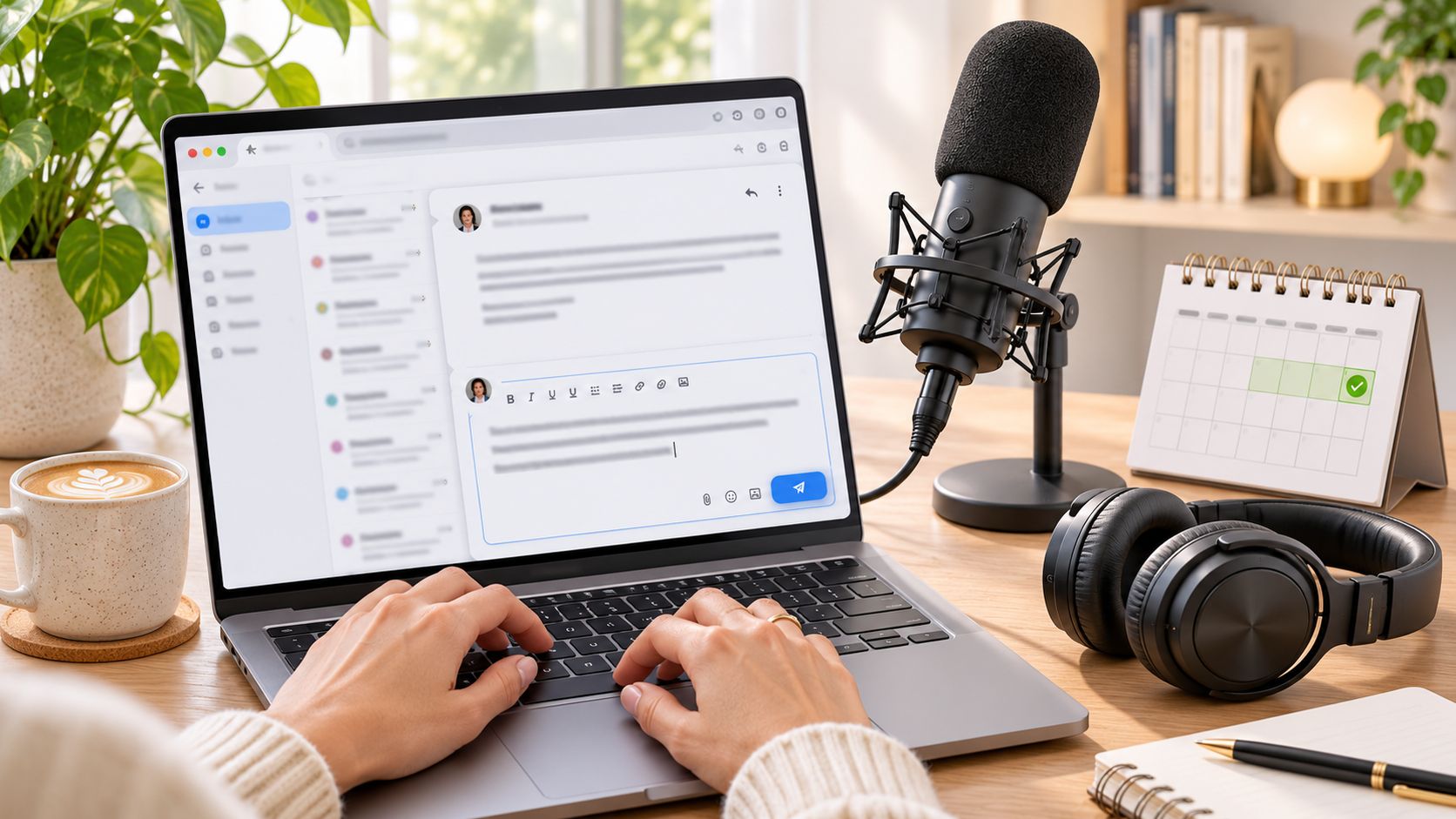
Send your first follow-up on day three, add a new angle on day ten, close the loop around day seventeen to twenty-one, then stop at four messages. That cadence treats silence as a scheduling signal. A host who has not answered yet may have seen the pitch and moved into this week's recording work. The follow-up should make the next decision easy, not repeat the original pitch.
You know the scene. You sent a pitch you were proud of, the show is still publishing weekly, and the thread has gone quiet for six days. The temptation is to write "just checking in" and hope.
That message gives the host no new reason to answer, and it implies they owe you one. A better follow-up adds one useful detail from the show, restates the value for listeners, and offers a reply that takes seconds. By the last note, make the stop clear. If there is no answer, the thread is closed.
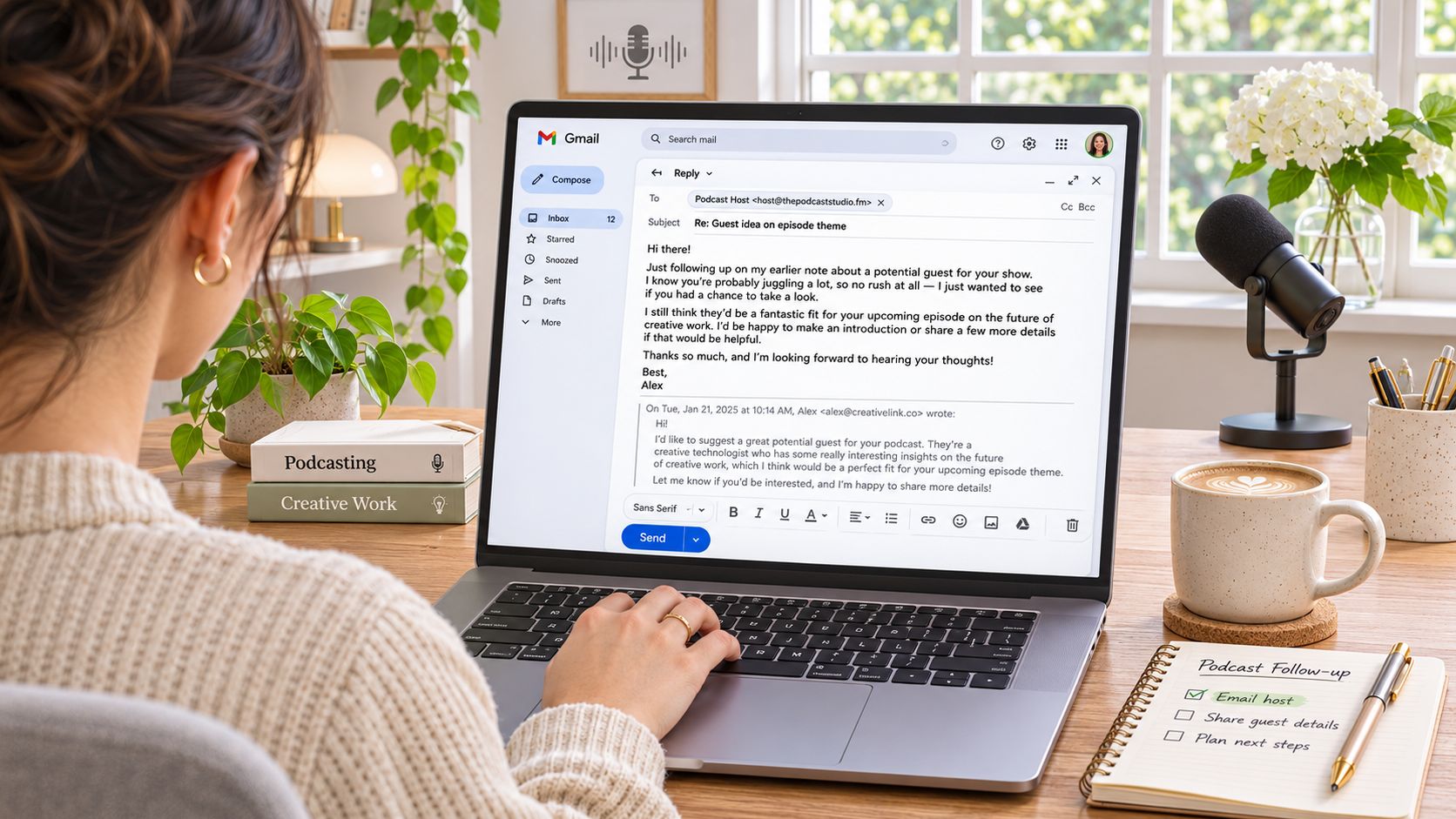
Here's the version I'd send instead, as a reply in the original thread so the history stays visible:
Subject: Re: Guest idea on [episode theme]
Hi [Host first name],
Following up on my note about [specific theme]. Your episode on [topic from the feed] raised [one question], and I have a concrete answer from [your experience or research] your listeners could use. I can record in any 45-minute window over the next two weeks.
Would a short call work, or should I send a one-paragraph outline first?
Thanks, [Your name] [link to one-sheet]
Seventy-five words, one question, one link. The frame is repeatable across shows. Only four pieces of it change.
Table of Contents
- Copy-Ready Follow-Up Example for a Podcast Pitch
- When to Send Each Follow-Up and When to Stop
- Specific Follow-Ups and the Mistakes That Cost Replies
- Adapting the Follow-Up to Five Host Responses
- Send Your First Follow-Up Within Three Days
Copy-Ready Follow-Up Example for a Podcast Pitch
The message above does three jobs in under a hundred words. It reopens the thread with context attached, it proves you listened to something the host made, and it hands them a decision small enough to answer from a phone between recordings.
Send it as a reply in the original thread, never as a fresh email with a new subject line. The host gets the whole history in one scroll and doesn't have to reconstruct who you are.
The four slots you swap
- The episode or theme. The bracketed topic has to come from something the host published, whether that's a full episode title, a segment inside one, or a guest topic the show lists on its own page. One reference is enough.
- One observation. A single sentence about the question that episode raised. Not a summary of the episode, not praise, just the gap you noticed.
- One audience benefit. What the host's listeners walk away with if you record. Concrete beats impressive: "a 20-minute walkthrough of how to audit a feed before launch" beats "insights on podcast growth."
- One ask. A yes or no question with two easy paths, a call or an outline. Two options make replying faster than ignoring.
The message works because it functions as a reminder rather than a second pitch. The original pitch already made the case. This one says: the offer still stands, here's the specific reason it fits, here's how little effort a reply takes.
That's why it stays a short paragraph with exactly one question. Two questions turn a yes/no into homework.
Practical rule: if the host can't verify the bracketed topic from their own public feed, delete the sentence. A guessed episode title is worse than no reference at all.
The substitution writers get wrong most often is that bracketed topic. It gets filled with a theme the sender finds interesting, or a topic from a different show in the same niche, or a half-remembered episode title from three months back. A host who spots a fabricated reference stops reading and remembers the name.
When to Send Each Follow-Up and When to Stop
Timing is the part most example pages skip. An analysis of more than 850 million cold emails found that 93.9% of replies arrived within 72 hours (Growth Tribune's follow-up timing study). A reminder on day three is not early. By then the host has had three working days to see the pitch, check the calendar and decide.
The same study found that three-message sequences generated a 6.8% reply rate against 3.3% for a single message. That's a reply measure, not a booking measure, so read it as evidence that later touches carry weight rather than as a promise about your show.
| Touch | Send on | Purpose | What to include |
|---|---|---|---|
| Original pitch | Day 0 | Introduce the guest idea | One specific reason for this show and one clear ask |
| Follow-up 1 | Day 3 | Remind without repeating | Two sentences in the same thread and one question |
| Follow-up 2 | Day 10 | Add new value | A new angle or recent-episode link and two available slots |
| Close the loop | Day 17 to 21 | Let the host decide | An easy yes, no or later option and thanks either way |
| Stop | After close the loop | Protect the relationship | No further messages unless the host reaches out |
Before any of this starts, confirm the route the show publishes for pitches, so the sequence lands in the inbox the host monitors (how to contact a podcast host).
The stopping rule is firm: four messages in total, no weekend sends, and nothing further after the close-the-loop message unless the host replies. A 2013 Velocify analysis of roughly 3.5 million leads found that 93% of leads that eventually converted had been contacted by the sixth call attempt, which measures the presence of repeated contact in conversions, not a conversion rate for six attempts (Ivristech's summary of the Velocify analysis). The same evidence warns against treating persistence as unlimited repetition.
Two adjustments keep the schedule realistic. Push the day 10 follow-up to two weeks during a show's launch period or the December holidays, when booking decisions stall. And when a host answers "not now," set a revisit date in your calendar and send nothing in between.
Two lines you can paste. Day 3: "Hi [Host first name], bumping this in case it got buried. The idea on [theme] still fits your listeners." Day 17 to 21: "Should I close this out? An easy yes, not now, or a later month all work."
Measure each touch by reply rate, qualified reply rate and unsubscribes, not opens. Compare the day-3 and day-10 messages directly, because the sequence gets judged as a whole rather than message by message.
Specific Follow-Ups and the Mistakes That Cost Replies
Start with the subject line, because it decides whether the body is ever read. Name the episode theme so the host can file the message without opening it: "Following up on guest idea on [specific theme from episode]." A subject line carrying the actual topic gets sorted into the right mental folder. A blank or generic one gets archived with the other cold mail.
Then apply the body test. One verifiable observation (an episode title, a question the host asked on air, a topic the show lists publicly), one audience benefit, one ask. If the show has no recent episode that fits, quote the guest topics the show publishes on its own page instead of inventing a connection.
Personalization has to be evidence-based, not decorative. Experiments on cold email consistently show that sender identity and subject-line clarity shape whether a message gets opened and answered, and that a personalized greeting outperforms a bare one. The effect has limits, though: research testing the recipient's first name in the subject line found no reliable improvement in open or click-through rates (Public Opinion Quarterly). The lesson is narrow: the name isn't the personalization. The episode reference is.
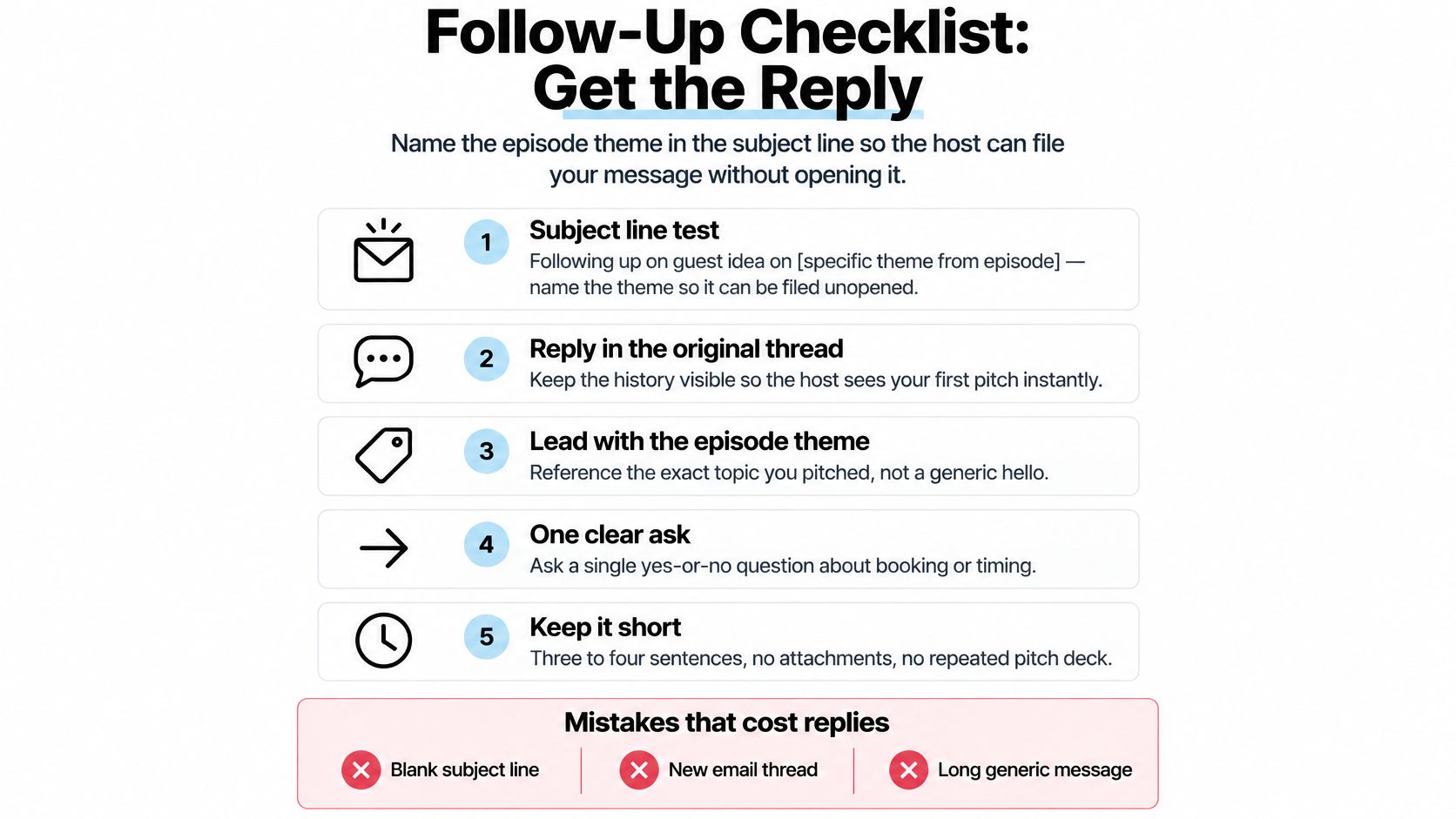
Seven things to cut, and what to put in their place
- "Just checking in" with nothing attached. Add one fact the host didn't have before, such as a new statistic, a listener question you can answer, or a recent episode link.
- Generic praise like "great show." Name one episode and one moment inside it.
- A biography longer than two sentences. Cut to one line: who you are and why that makes you useful to this audience.
- Invented episode details. Delete anything the host can't find in the public feed, including half-remembered titles and paraphrased quotes.
- A full resend of the original pitch. Reply in the same thread with two sentences and one question.
- Attachments or a second pitch disguised as a follow-up. Link the one-sheet instead, so nothing gets flagged or bloats the thread.
- Daily follow-ups, more than four touches, or email plus social plus a contact form on the same day. Keep to the schedule and one channel.
Silence is the baseline in cold outreach, not a verdict on your pitch. The average cold-email reply rate was 5.1% in 2024, down from 7% in 2023 (Stylograph's summary of Belkins data). Read that number as a scheduling signal. If roughly nineteen in twenty first messages go unanswered, silence is the default state of a busy inbox, and your follow-up exists to resurface the thread at a moment the host has time, not to argue them out of a rejection they never made. That's why the message changes shape by day: a quick bump early, a new angle in the middle, a clean close at the end, and then a full stop.
What separates a sequence that works from one that annoys is measurement. A BuzzStream analysis of more than 65,000 digital-PR campaigns and over 8 million emails reported that sequences containing follow-ups achieved an 85% higher reply rate than one-message campaigns (BuzzStream's follow-up email study). That dataset covers digital PR rather than podcast bookings, so treat it as proof that later touches matter rather than as an expected response rate for your own pitches.
A quick walkthrough of the sequencing logic makes the pattern easier to apply:
If you're testing subject lines across a batch of shows, run the comparison on one variable at a time and keep the body identical, so the result tells you something (follow-up email subject lines that get opened).
Run a ten-second self-check before sending. Can the host verify every claim from their public feed? And does the message still make sense as the only thing they read today? If either answer is no, cut until both are yes.
Adapting the Follow-Up to Five Host Responses
The same template can't carry every situation. What changes is the content of the message and, in two cases, whether you send at all.
| Host response | What to change | Example line |
|---|---|---|
| No reply after the second follow-up | Keep the ask and add a new angle | "A different angle could fit a future episode: [new point]." |
| Maybe later | Name a date to revisit | "Happy to reconnect in [month]. Shall I check back then?" |
| Asked for another topic | Send a one-paragraph outline on that topic | "Here is a three-point outline on [topic] if useful." |
| Show looks dormant | Use the published pitch route and shorten the note | "Is the show still booking outside guests this season?" |
| Declined | Thank them, leave one future angle and stop | "Thanks for the honest answer. I'll keep you in mind if [topic] comes up." |
Two misreads that change what you do next
A "maybe later" is not a no. It's the most useful reply in the whole sequence, because it tells you the fit is right and the timing isn't. Name a specific month, confirm it in one line, and put the date in your calendar. Then send nothing until that date. A follow-up sent three weeks into a stated pause converts a warm maybe into a closed door.
A feed that looks active doesn't mean the host is booking. Plenty of shows publish weekly while running a guest queue six months deep or a temporary pause nobody announced. Check the show's published pitch route before writing another message, and send from your own inbox to the address the show itself lists, rather than replying to an old thread or hunting for a personal address.
Not every silence is fixable with another message. An analysis of 7.53 million cold emails found that 46.4% of booked meetings came from the first email (Lacleo's cold email follow-up data). The follow-up's job is to reduce the effort of answering, not to manufacture interest that isn't there.
When a host asks for a different topic, don't restart the pitch. Send a three-point outline on the topic they named, keep it to one paragraph, and let them pick the angle. For a decline, thank them in one line, leave a single future angle, and stop. That last message costs you nothing and occasionally brings a booking eight months later when the show changes format.
Send Your First Follow-Up Within Three Days
Three actions, in order. Pull up the original pitch thread and confirm it names one real episode or topic; if the pitch was never sent, write it first, because no follow-up rescues a vague opener. Set calendar reminders for day 3, day 10 and day 17 to 21, and paste the schedule into the thread notes so the sequence survives a busy week. Before each send, test the message against the feed: one verifiable reference, one ask, under 90 words, no second bio.
Treat silence as a scheduling signal, not a verdict. A host who hasn't replied is usually triaging a full inbox, recording week, or a queue of pitches, and the message that gets an answer is the one that costs the least effort to answer. That is why the follow-up changes shape by day. Day 3 is a short nudge on the same thread, one or two lines. Day 10 adds something new, a fresh angle or a recent piece of your work, so the host isn't re-reading the same pitch. Day 17 to 21 is the close-out, a friendly note that you'll stop writing and the door stays open. After that, you stop. A defined endpoint is what separates persistence from pestering, and hosts remember the difference.
Campaigns that include follow-ups tend to earn more replies than single-send outreach, but the lift comes from making replying easy, not from volume.
If you'd rather not rebuild the sequence by hand, the platform handles part of it. When a pitch goes quiet, the platform emails you a follow-up draft ready to send, and the one-sheet link you paste into any message lets the host check your topics, bio and past episodes without a second email.
Then write the next pitch with the same discipline, so the follow-up has something real to refer back to (how to pitch a podcast).
Silence usually means a busy host, so the follow-up's job is to make replying easy.