Can a Podcast Be One Person? Yes, Here's How
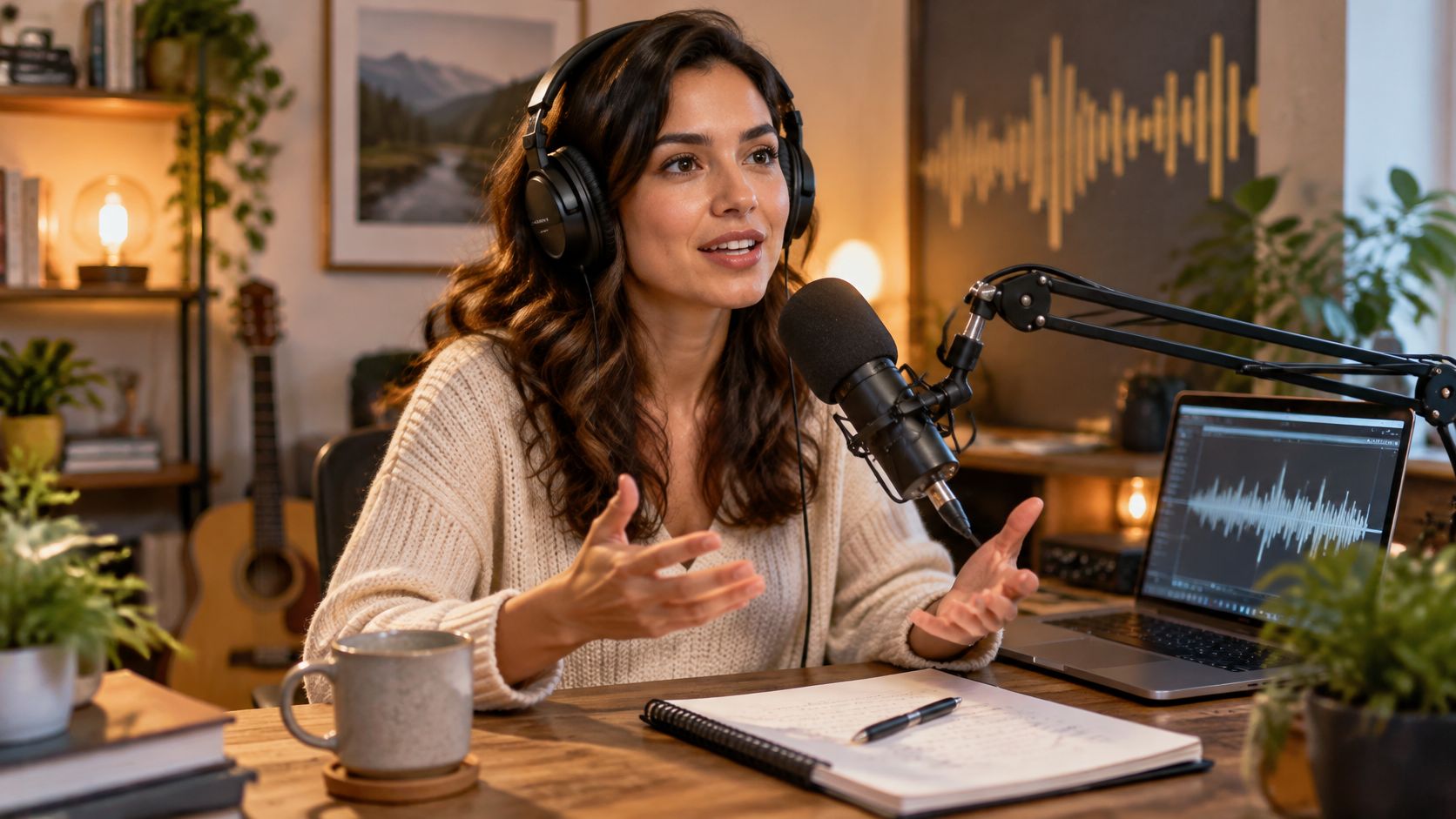
Can a podcast be one person? Yes. One person can research, script, record, edit, publish and promote every episode without a co-host, a guest or a network. The format decision that follows matters more than any equipment choice, because it sets your hours, your publishing rhythm and whether guests are optional or load-bearing.
Solo hosting looks like a small technical question until month four. That's when the calendar stops being hypothetical, the episode you meant to bank never got recorded, and you discover that the only person who can miss a week is you. The honest answer to whether one person can make a podcast is yes, and the harder question is whether that one person can keep making it after the first flush of enthusiasm burns off.
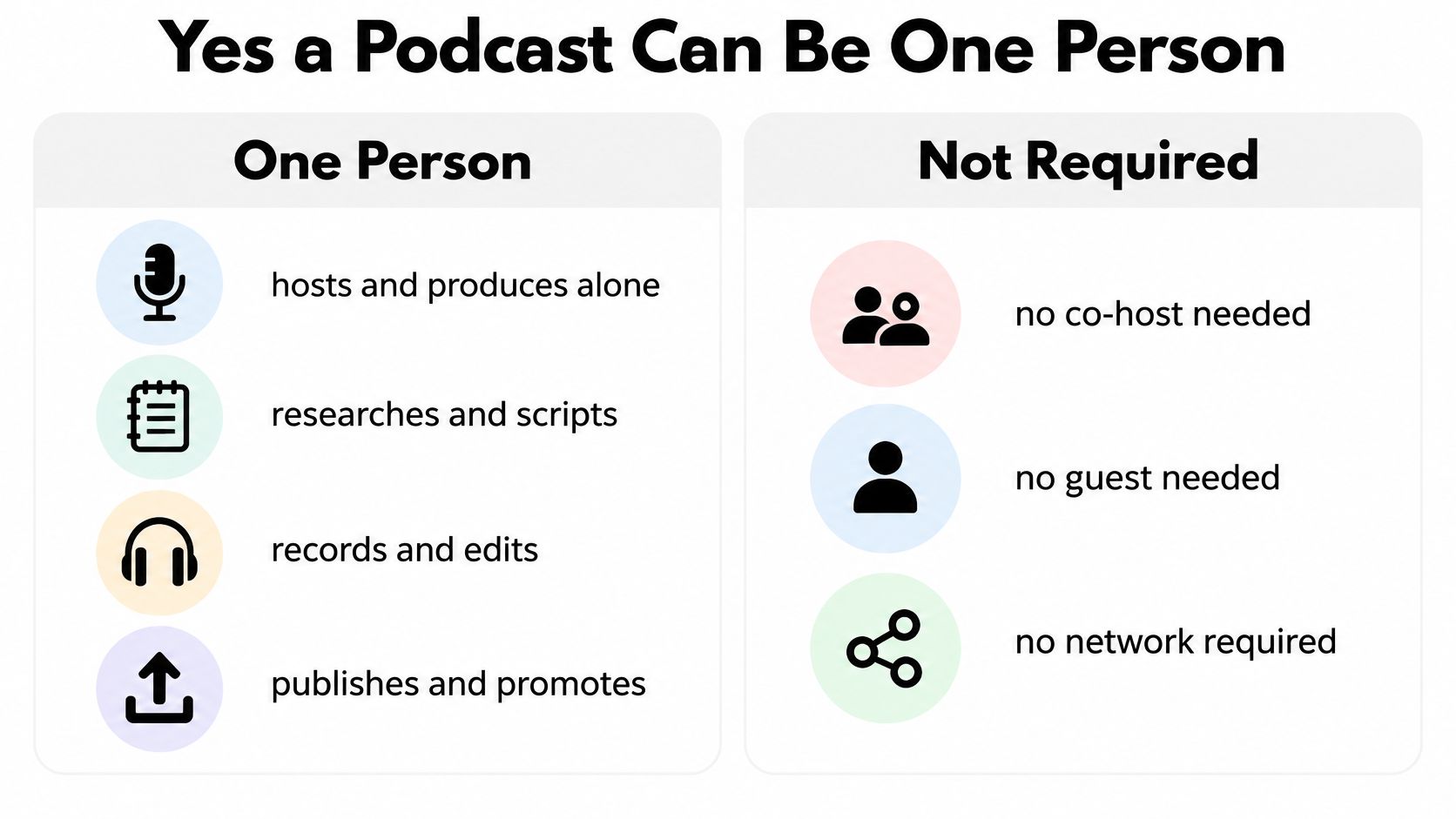
Table of Contents
- Yes a Podcast Can Be One Person
- What Listeners Expect From a Solo Show
- Hours That Make Solo Podcasting Sustainable
- Audio Standards and the Video Choice
- How to Keep a Solo Episode Engaging
- Solo Show Patterns and Ways to Earn
- Lock Cadence Before the First Guest
Yes a Podcast Can Be One Person
A solo show is a legitimate format, not a compromise you settle for until you find a co-host. The proof is in the listening market itself: in a 2023 announcement about its Podcast Consumer Tracker, Edison Research reported that 54% of weekly U.S. podcast consumers had listened to an unaffiliated, independent podcast in the previous week. Independent programs, many made by individual producers, are a substantial slice of the audience rather than a fringe category. Edison has been measuring the medium since 2006, which tells you the low-barrier, independent publishing structure isn't a recent accident. It's the medium's original shape.
One person can own the research, the script, the recording, the edit, the upload and the promotion. That doesn't mean one person must own all of it forever. You can hand off a task as the show grows without changing what the show is. The editorial voice is the identity; the labor is negotiable.
Here's the part most guides skip: the format you pick sets your workload and your fragility far more than your microphone does.
| Format | Who talks | Guest required | Best when | Main risk |
|---|---|---|---|---|
| Monologue | Host only | No | Teaching or commentary | Flat energy without a structure |
| Reported narrative | Host plus clips | No | Story or explained reporting | Edit time swallows the week |
| Interview | Host and guest | Yes, every episode | Access and outside authority | The show stops when booking slips |
| Hybrid | Host most weeks, guest sometimes | Optional | Solo identity plus occasional depth | Listeners cannot tell what the show is |
Walk that table before you buy anything. Each row carries a different failure mode, and the failure modes are not equivalent.
Monologue is the cleanest start: no scheduling, no one else's audio, no dependency. It fails when the host runs out of structure and starts filling time, because a single flat voice with no shape gives the listener nothing to hold onto.
Reported narrative keeps one voice at the center but drags in clips and tape. It's the most rewarding format to listen to and the most expensive to make, because the edit is the show. If a week collapses, the episode doesn't ship half-finished.
Interview requires a guest every single time. That's a booking job on top of a production job, and when booking slips, publishing slips with it.
Hybrid is where most solo hosts should land, and it's the row I'd circle for a host with real expertise. The host carries the show, guests arrive for subjects outside the host's direct experience. It preserves the solo identity and buys outside authority when you need it, without renegotiating the format every month.
One person means one editorial owner, not a ban on help. That distinction frees you from both traps: hiring a team you don't need, and refusing an editor out of some purity test.
The lean toward solo isn't a hunch. In 2025, 53% of pre-launch independent podcasters surveyed said they planned to host a solo show, according to The Podcast Host's Independent Podcaster Report analysis. Flip that around and nearly half planned something else, which is why the format table earns its place at the top of your plan rather than buried under gear talk.
Pick the row first. Whichever format you choose becomes your hours, your guest policy and your failure mode. Choose it deliberately, because it will choose your calendar for you.
What Listeners Expect From a Solo Show
The audience is big enough that you don't need network scale to matter. Edison Research's 2025 summary, published by SSRS, reported that 73% of Americans aged 12 and older had ever consumed a podcast, while 55% had consumed one in the previous month and 40% in the previous week. The same summary put total time spent with podcasts among Americans aged 13 and older up 355% since 2015, reaching 773 million hours per week.
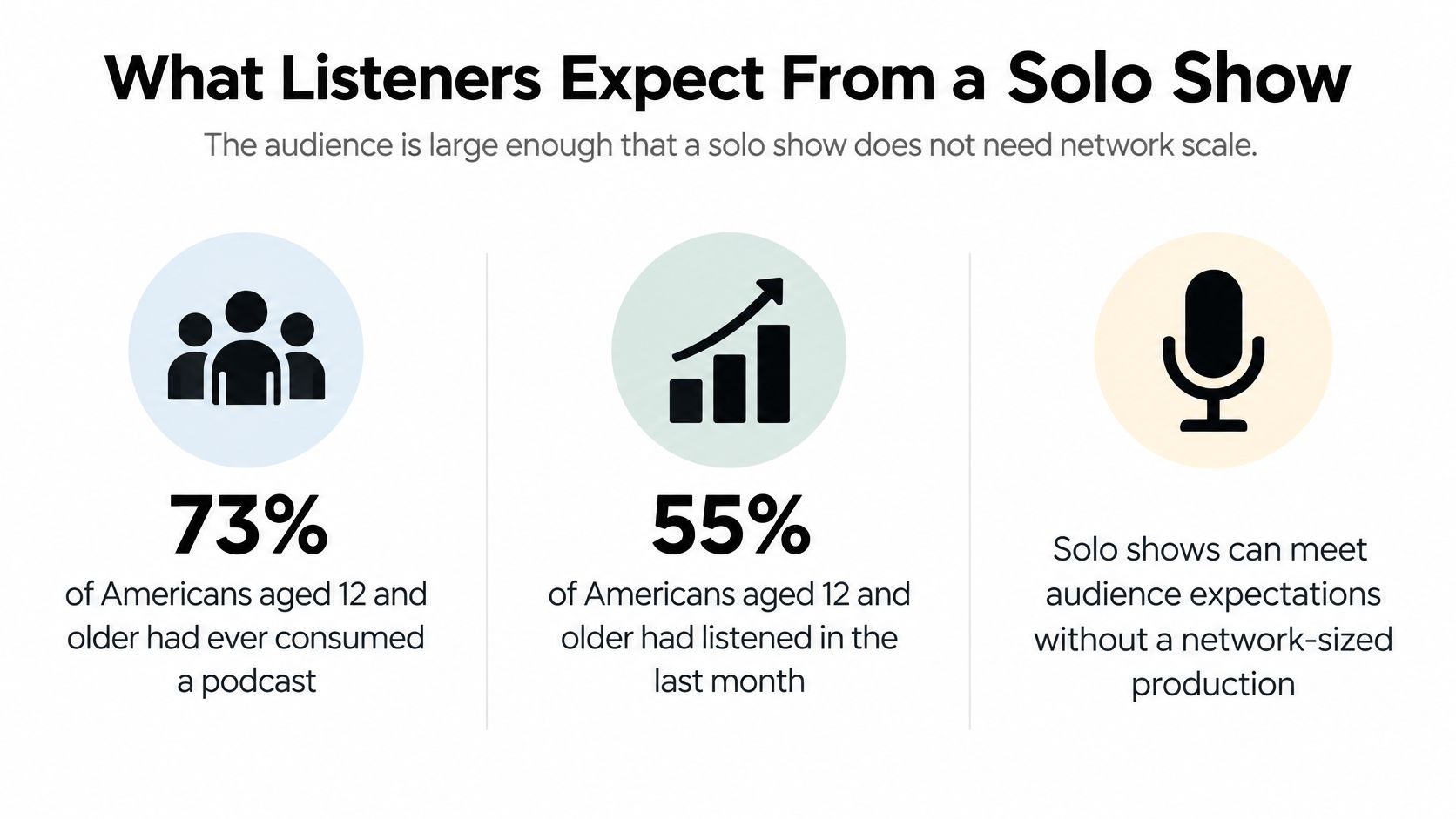
Read those numbers correctly. They don't mean you should chase a mass audience. They mean the listening pool is deep enough that a show serving one profession, one community, one problem or one worldview can find its people. Your competition isn't the biggest show in the country. It's the listener's decision to spend an hour somewhere else.
That reframes the goal. Stop trying to be the show everyone knows. Be the show one specific person recommends when a colleague asks.
What a solo show is forgiven for, and what it isn't
Listeners forgive a single microphone. They forgive a home room with a bit of bounce, a host who isn't a trained broadcaster, and a show with no celebrity access. They do not forgive wandering.
The pattern I see in shows that hold an audience: the point arrives early, the episode shape repeats, and the host gets out on time. The pattern in shows that lose people: a five-minute preamble before the topic, an episode that promises news and delivers a diary entry, and a level that swings enough that the listener touches the volume twice.
A commuter audience wants a clean finish they can follow without looking at a screen. A practitioner audience wants a takeaway they can use before the day ends. Name which one you serve, and build every episode for that person only.
The tells are small and cumulative. Dead air after a thought ends. A guest booked for a topic the host could have covered better alone. Artwork, show description and first minute pointing at three different listeners.
The one-sentence positioning test
Before you record anything, write one sentence that names the listener, the problem and the recurring payoff. Something like: "This show helps newly promoted engineering managers run their first performance reviews without guessing, every Tuesday in under 20 minutes."
If the sentence has three possible listeners in it, it isn't finished. If it could describe any show in your category, it isn't finished either. That sentence becomes your description, your episode filter and your reason to say no to a topic you'd enjoy but your listener wouldn't.
Hours That Make Solo Podcasting Sustainable
A solo podcast is easier to launch than a guest show and harder to keep alive. The host is the single point of failure: researcher, editor, marketer, publisher, and the only person who can let a week slip.
Alitu's 2025 Independent Podcaster Report puts hard numbers on that load: 65% of creators do all production work themselves, 53% identify as solo shows, and the time cost runs 4 to 5 hours per episode for 28% of them, 6 to 8 hours for 20%, and more than 10 hours for 13%. The same report found audience growth was the top challenge for 72% of podcasters, burnout and time constraints affected nearly a third, and 71% of pre-launch independent podcasters planned to do everything themselves.
Sit with that last figure. The majority walk in planning to be the whole production line, and the majority also name growth as their biggest problem. Those two facts connect. When you are the entire production line, marketing is the task that gets dropped first, because it is the only task with no episode deadline attached.
The operating model table
Pick one row and commit to it before episode one. Each protects something different, and none protects everything.
| Model | Hours per episode | Cadence | What you protect |
|---|---|---|---|
| Full DIY long edit | 6-10 or more | Weekly | Polish, not the calendar |
| Short focused episode | 4-5 | Weekly | A streak listeners can trust |
| Season of 6-8 | 6-8 | Then a planned break | Recovery between seasons |
| Batch recording | 4-8 | One block, then scheduled releases | Days that are not recording days |
| Outsource one task | 3-5, the work you keep | Weekly | The bottleneck, usually edit or research |
A long-edit weekly show is a real choice, and it is the row that breaks most often: six-plus hours of work against a weekly promise leaves no slack for a bad week. A short weekly episode in the 15 to 25 minute range sits inside the 4 to 5 hour band and keeps the streak alive. A season of six to eight episodes gives you a legitimate stopping point instead of a silent feed, and batching concentrates recording into one block so the rest of the month belongs to editing, promotion and everything else. Outsourcing works when you hand off exactly one task. You keep research, recording and publishing, someone else cuts and levels, and your 6 to 8 hours becomes the 3 to 5 you control.
The sustainability test: name the one task you will drop when a week falls apart. If you cannot name it now, you will drop the episode instead.
Write that task on your production checklist before you record anything. "When a week collapses, the long research pass goes and I ship a shorter episode" is a plan. "I'll figure it out" is the sentence people say in month two and abandon in month five.
Why the calendar beats the gear budget
A better microphone does not buy you a single extra week of publishing. A cadence you can hold does. The hosts who last set a rhythm the worst week of their quarter can still meet, then treat the rhythm as the commitment and the production as the variable.
The practical version: the fixed number is the publishing date, and the flexible number is the runtime. An 18-minute episode shipped on schedule beats a 40-minute episode that slips into next month.
Audio Standards and the Video Choice
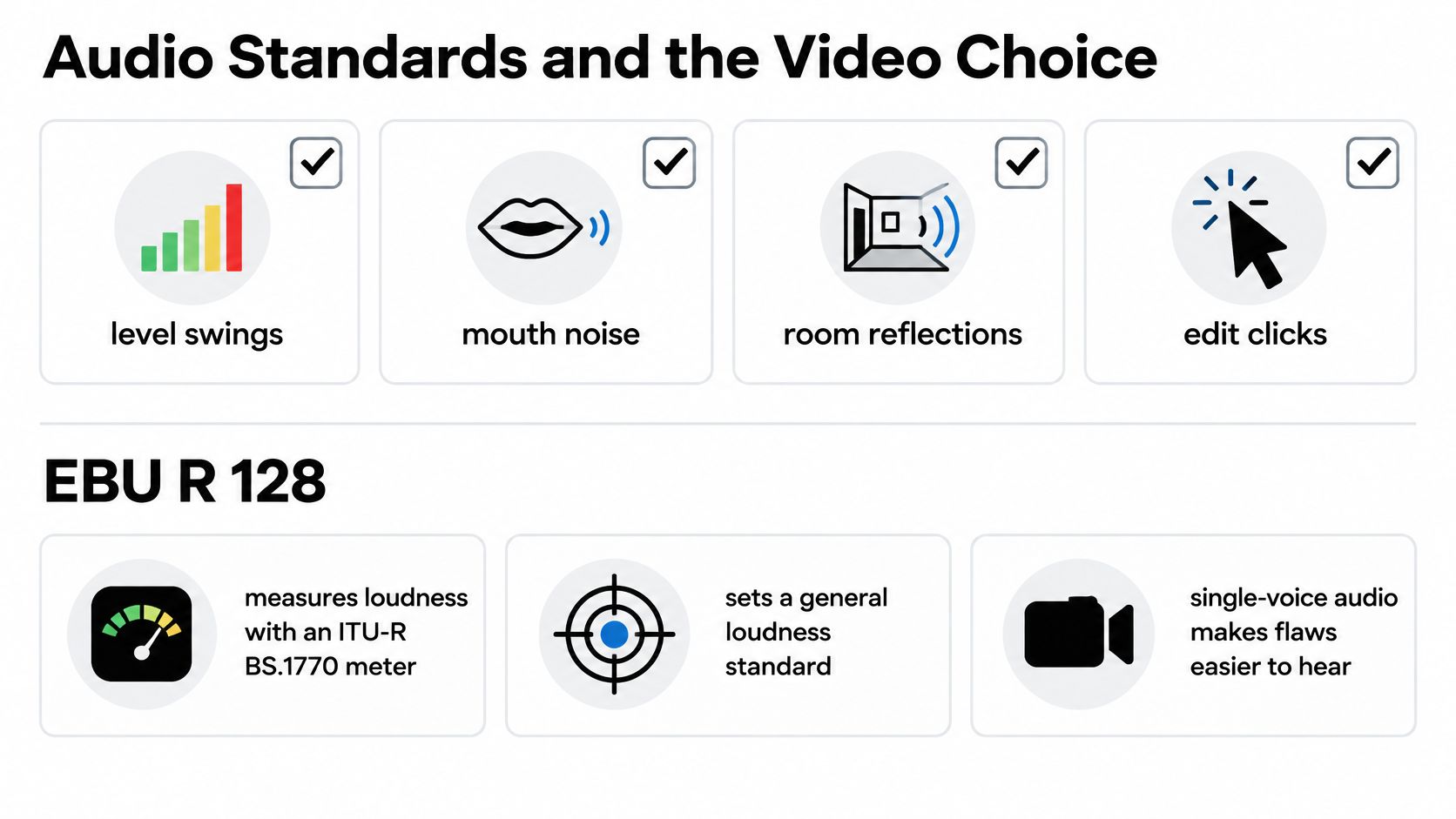
A single voice exposes everything. Level swings, mouth noise, room reflections and edit clicks that would hide under a two-person conversation sit at the front of a solo episode. There is no co-host whose take covers a bad phrase and no second pair of ears to catch a clipped file before it ships, so the answer is a short checklist run the same way every time.
The loudness checklist
The EBU R 128 loudness recommendation specifies measurement with an ITU-R BS.1770-compliant loudness meter, sets a general programme target of −23.0 LUFS, and limits production true peak to −1 dBTP.
The operational sequence for one person is short:
- Record conservatively. Leave headroom on input gain so a laugh or a loud consonant doesn't clip before you can fix it.
- Cut before you process. Remove pauses, false starts and the breath before a sentence starts. Editing first means compression has less to fight.
- Apply light compression. Just enough to even out intelligibility. Heavy compression on one voice makes room tone audible between phrases.
- Measure integrated loudness across the whole episode. Not the first two minutes, not the loudest segment. The full file, with the meter set to integrated.
- Limit true peak below −1 dBTP. Codecs add their own overshoot, so a file that peaks at zero distorts after upload.
Consistent loudness stops listeners riding the volume knob between your episode and someone else's. Controlled peaks stop clipping and codec distortion. These are repeatable checks you can run in minutes, which matters when you are the only person who will run them.
Decide what video is for before you record it
Two facts sit awkwardly together. Fall 2025 U.S. research from Cumulus Media and Signal Hill Insights found that 92% of podcast consumers still primarily choose to listen even when video is available. At the same time, the independent-creator data published by Alitu shows audio-only creators are more likely than video podcasters to spend six or more hours per episode, about 45% versus 36%. Video is not automatically the heavier job. Editing style and workflow matter more than whether a camera is on.
That kills both dogmas. Audio-only isn't automatically leaner, and video isn't automatically required for discovery.
The practical split is between recording video and producing video. A solo host can capture a static-camera take once, publish the audio episode as the primary product, and cut clips only from moments that demonstrate something. A teaching or commentary show earns that treatment because the visual carries information. A commute-oriented show should ship clean audio first and treat clips as marketing, not as the format. Every camera, lighting decision and clip pass adds a second production line to a show that already has exactly one person keeping it alive. If you're still learning the loudness checklist, get the full podcast production process repeatable on audio first, then add a camera to a workflow that already survives a bad week.
How to Keep a Solo Episode Engaging
There's no second voice to create turns, so the structure has to do that work. Research analyzing 81 podcasts found that solo monologue formats generally show limited audience participation, according to the study in Journal of Radio & Audio Media. If interaction is part of your growth plan, you have to build it deliberately with prompts, listener questions, polls or a clear call to action. It doesn't happen on its own.
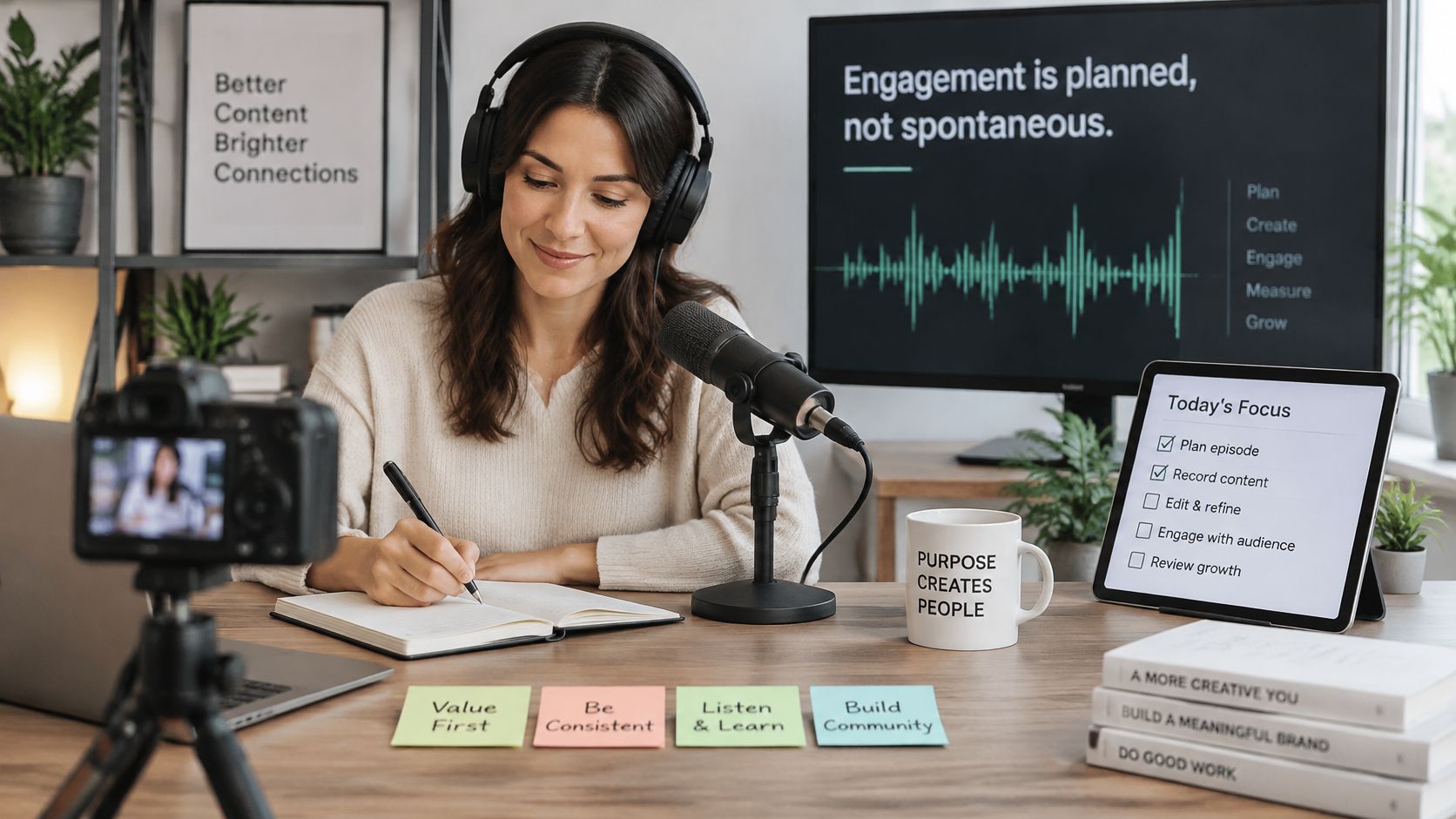
The four beats that replace turn-taking
Every solo episode gets the same skeleton, and the listener learns it without being told.
- The problem, stated in the open. One or two sentences naming what this episode is about and who it's for. No throat-clearing, no "welcome back to the show" ritual.
- The evidence you checked. The study, the document, the spec, the numbers. If you can't point at it, it isn't evidence, it's opinion wearing a lab coat.
- Your interpretation. This is the part only you can supply, and it's the reason someone returns. What does the evidence mean for the listener's situation?
- The action. One thing they can do this week. Not five, one.
Why this works for a single voice: turn-taking in a conversation creates natural movement. Without it, movement has to come from the argument. A problem, then evidence, then interpretation, then an action is a shape that rises and resolves.
If you can't fill the four beats on a page before recording, the episode isn't ready. Record it anyway and you'll spend the edit discovering that.
Vocal variety comes from pace, a short story, a listener's quoted question, a turn in the argument. Not from fake banter with nobody in the room. That's the tell of a solo host who hasn't found their format yet.
The 15-minute pre-record outline
Working title. The problem in one line. Three evidence points. Your take. The ask. That's it, and it fits on an index card.
Practical inserts that suit one person: answer one listener question on mic each episode, run a poll with a stated deadline, keep a cold open under 20 seconds, drop a one-sentence recap at the midpoint, and close by naming the question next week answers. Skip long preambles and inside jokes that need a co-host to land. Once the structure is stable, the work of building an audience gets much easier, because you finally have something repeatable to promote.
Solo Show Patterns and Ways to Earn
Four patterns you can copy structurally without copying anyone's brand:
Weekly commentary. One development in your field, 15 to 25 minutes, recorded the same day each week. Cheap to sustain, builds a habit fast, and depends entirely on you staying current.
Teaching. One skill per episode, one worked example, one exercise. It's the most durable solo pattern because the syllabus does the planning for you, and a guest slots in naturally when a topic sits outside your experience.
Reported essay. Rarer, longer to edit, better sold as a season than promised weekly. The edit is the product here, which makes it the riskiest choice for a host already near capacity.
Hybrid season. Say eight solo episodes and two interviews, with the guest conversations booked for subjects you can't speak to from experience. The solo identity stays intact and the interviews add depth instead of redefining the show.
Match the pattern to money you already control
| Path | Fits when | Needs | Wait or skip |
|---|---|---|---|
| Service, course or book | The host already sells that expertise | A niche listener with one recurring problem | Do not wait for network ad rates |
| Listener support or small paid community | Regulars want more of the same payoff | A predictable episode shape | Skip if there is no returning listener yet |
| Disclosed affiliate | The host already recommends specific tools | A clear disclosure on the episode | Skip generic product dumps |
| Host-read mid-roll or sponsorship | Downloads are steady over many episodes | A repeatable cadence | Wait past episode three |
| Charging a guest for airtime | The spot is sold as advertising | An on-episode label that it is an ad | Skip if it is presented as a normal interview |
The sequencing matters more than the menu. Early on, realistic income comes from something you already sell: your service, your course, your book. Host-read ads only make sense once a download pattern is steady across many episodes, and treating sponsorship as the business plan from the start means measuring yourself against network rates you'll never see. To sanity-check what a show your size could reasonably charge, the sponsorship rate calculator is a faster route than guessing.
Affiliates work when you already recommend specific tools and disclose it. Charging a guest for airtime turns the show into an ad slot, and if you do it, label it as one on the episode. Presenting a paid placement as a normal interview costs you the thing you spent months building.
One more income path that costs nothing: appearing as a guest on other shows markets your own without turning your feed into an interview series.
Lock Cadence Before the First Guest
The final question isn't whether one person is allowed to podcast. It's whether this person can still publish in month four. Three moves settle it.
Write the format in one line. Monologue, reported narrative or hybrid, plus the listener, the problem and the recurring payoff. One sentence, not a strategy document.
Circle one publishing model. Short weekly episodes in the 4 to 5 hour band, a season of six to eight then a break, or one batch block with scheduled releases. Under that line, name the single task you'll drop or hand off when a week collapses, usually the long edit or the research pass.
Publish three solo episodes before sending the first guest email. By episode three, your voice and your promise are already on the feed, and a guest becomes an addition rather than a crutch. Add one only for a subject outside your experience, for credibility you can't manufacture alone, or for an audience you can't otherwise reach. A show that needs a guest every week stops when booking slips, so booking is never the production system.
Pair your chosen pattern with one early income path you already control. Then record episode one alone.
If you've picked the format and the cadence, the next step is making guests optional rather than essential. Let's Make A Podcast is free to join, and creating a profile, browsing shows, pitching, inviting, messaging and scheduling all cost nothing, so you can start with a solo feed and add interviews when a topic needs one. Our free search tool, with no account needed, lets you search real podcasts by topic and see which are still publishing, which publish a contact route, and which show evidence they book outside guests. When you're ready for that first guest, visit Let's Make A Podcast and build the pitch from the format you've already locked.