Sponsorship Rate Guide: Benchmarks, Formulas, Calculator

U.S. podcast advertising revenue reached $2.43 billion in 2024, increasing 26.4% from 2023, according to the IAB digital advertising revenue report for 2024. That scale doesn't tell you what one episode should cost. A sponsorship rate only becomes useful when you separate audience size, placement, extras, guarantees and measured outcomes, because the same headline price can be fair for one package and expensive for another.
Table of Contents
- Podcast Sponsorship Rate Benchmarks by Audience Size
- How to Calculate a Sponsorship Rate with CPM, Flat Fees and Episode Tiers
- What a Quoted Rate Actually Includes
- How Show Type and Placement Shift the Rate
- Judging a Rate When Attribution Is Weak
- How to Use the Sponsorship Rate Calculator Step by Step
- Negotiation Moves That Protect Your Rate
- Confirm the Rate and Terms Before You Sign
Podcast Sponsorship Rate Benchmarks by Audience Size
A sponsorship rate is the fee an advertiser pays for a defined placement, and a host or network can quote it per spot, per episode, per series, or per thousand downloads. The last basis is CPM, or cost per thousand. Two hosts can charge the same CPM and deliver very different bills because their download counts differ.
In 2025, average podcast advertising CPMs were reported at $18-$50 per 1,000 downloads, according to Million Podcasts. A narrower reference for one host-read mid-roll is $15-$30 CPM. Treat the narrower range as the tighter benchmark when you're pricing a single host-read spot, and use the broader range as a blended view across formats, placements and niches.
Sponsorship Value per Spot by Episode Downloads
Every cell uses the same arithmetic. Divide downloads by 1,000, then multiply by the CPM. A show with 10,000 downloads therefore has ten units to sell per spot.
| Downloads per episode | Host-read mid-roll at $15-30 CPM | Blended at $18-50 CPM |
|---|---|---|
| 1,000 | $15-$30 | $18-$50 |
| 5,000 | $75-$150 | $90-$250 |
| 10,000 | $150-$300 | $180-$500 |
| 25,000 | $375-$750 | $450-$1,250 |
| 50,000 | $750-$1,500 | $900-$2,500 |
| 100,000 | $1,500-$3,000 | $1,800-$5,000 |
The worked check is simple. At 10,000 downloads, 10 × $15-$30 = $150-$300 per spot, while 10 × $18-$50 = $180-$500. Neither answer is automatically right. The host-read column describes one defined spot, while the blended column can reflect stronger audience fit, premium placement or additional deliverables that you need to identify before comparing quotes.
Practical rule: Start with verified downloads, apply the range that matches the actual spot, then explain every movement away from that starting band.
Small shows shouldn't expect CPM alone to produce meaningful revenue. At 1,000 downloads, even $30 CPM produces only $30 per spot, so a host needs a highly relevant audience, a flat-fee package or several episodes to make the administration worthwhile. Larger shows face the opposite trap. Their audience can make a weak CPM look like a large fee, even though the sponsor may be buying inefficiently.
How to Use Your Download Band
- Find your band: Use average downloads per episode from your hosting dashboard, not subscribers or a best episode.
- Match the format: Use the host-read range for a host-read mid-roll and the blended range only when formats or extras are genuinely mixed.
- Quote a range, then narrow it: Move inside the band only after you've priced placement, audience fit, exclusivity and permanence.
- Separate episode income from the rate: A sound price per spot doesn't reveal total show earnings, which also depend on sell-through, episode frequency and the topics covered in this guide to how much podcasts make.
Your download band is a starting position, not a verdict. A sponsor shouldn't accept the top of the band without evidence of fit or delivery, and a host shouldn't settle at the bottom just because a buyer quotes an average. The defensible rate is the one whose arithmetic and deliverables both hold up.
How to Calculate a Sponsorship Rate with CPM, Flat Fees and Episode Tiers
CPM is the market's dominant quoting language. The IAB reported that 93% of U.S. podcast advertising revenue in 2020 was priced through CPM arrangements, while flat-fee deals represented 2% and series-ownership arrangements accounted for 5%, according to the IAB 2020 podcast advertising revenue report. That was a substantial shift from 84% CPM in 2019, so older flat-fee conventions no longer describe most quoted deals.
The chart below puts those three pricing bases into proportion.
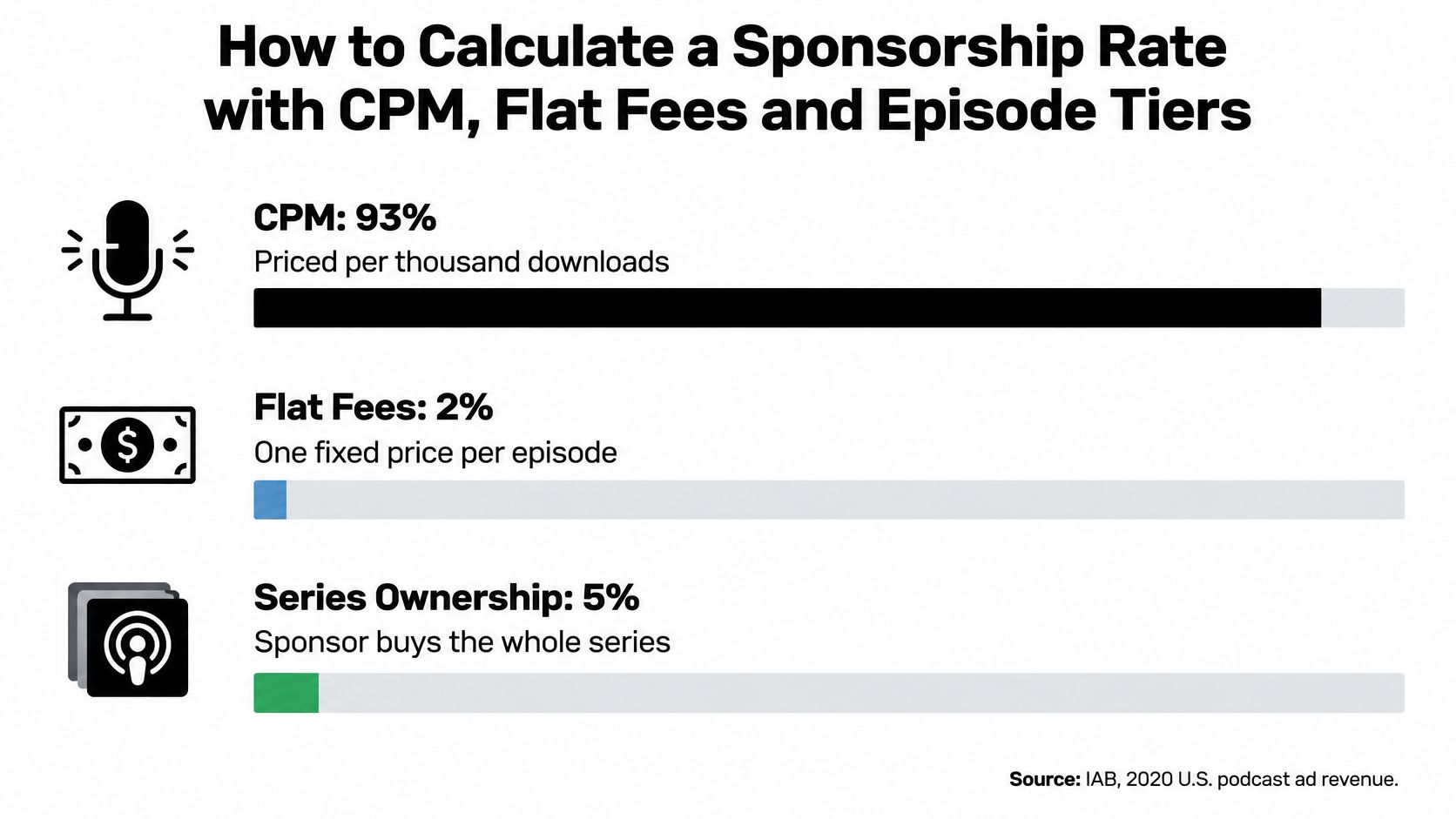
CPM dominance doesn't mean every contract should settle by measured downloads. It means CPM gives both sides a common way to compare offers, even when the final agreement uses a flat fee or a tier. You still need to know whether the quoted audience is expected, guaranteed or retrospectively reconciled.
Three Sponsorship Pricing Models Compared
| Model | Formula | Best fit |
|---|---|---|
| CPM | (Downloads ÷ 1,000) × CPM | Shows with stable, measurable downloads |
| Flat fee | Agreed fixed fee per episode | Shows with a known, steady audience and simple deals |
| Episode tier | Per-episode fee × episodes × (1 − tier discount) | Multi-episode campaigns and series deals |
| Effective CPM (check) | (Total fee ÷ total spot impressions) × 1,000 | Comparing offers that use different models |
Use the same hypothetical audience for each model. Say an episode receives 10,000 downloads and both sides test a $25 CPM. The CPM calculation is (10,000 ÷ 1,000) × $25 = $250 per spot. That figure changes with delivery if the contract reconciles against actual downloads, or stays fixed if both sides merely used CPM to set an upfront price.
A flat fee removes that per-download movement. The host might charge $300 for one mid-roll, regardless of whether the episode finishes slightly above or below forecast. This suits a small, well-matched show where audience quality matters more than small download changes, but the sponsor should still ask what delivery range supports the fee.
An episode tier prices commitment. Four hypothetical episodes at $250 each total $1,000 before discount. With a 10% tier discount, the invoice becomes $1,000 × 0.90 = $900. The host receives a firmer booking, while the sponsor pays less per episode. The discount should follow commitment, not appear automatically on a one-off test.
Convert Every Offer to Effective CPM
The effective CPM makes unlike models comparable. Divide the total fee by total spot impressions, then multiply by 1,000. If a sponsor pays a hypothetical $300 and the spot receives 8,000 downloads, the effective CPM is ($300 ÷ 8,000) × 1,000 = $37.50.
A CPM is a quoting convention. The guarantee, measurement window and make-good terms determine what the advertiser actually pays for.
Don't compare a guaranteed CPM with an unguaranteed flat fee as if they carried equal risk. Put both on the same expected impressions, convert them to effective CPM, then price the risk difference separately. That's where many apparently cheap offers stop looking cheap.
What a Quoted Rate Actually Includes
A headline CPM hides what the sponsor bought. Two quotes can show identical dollars per thousand downloads while one includes a host endorsement and permanent exposure and the other buys a short-lived inserted spot with no reporting. You can't judge either price until you unbundle it.
U.S. podcast advertising revenue reached approximately $2.86 billion in 2025, up 17.6% year over year, while podcasting represented only about 2.8% of total internet advertising revenue, according to the IAB and PwC full-year 2025 internet advertising revenue report. Demand is growing, but the channel is still small enough that audience size alone can't explain a package price. Relevance, trust and deliverables carry unusually large weight.
Separate Every Deliverable
Ask whether the quoted rate includes each item below, then assign it a price or mark it excluded.
- Delivery method: Host-read copy creates endorsement value, while dynamically inserted audio is easier to traffic and remove.
- Placement: A pre-roll, mid-roll and post-roll don't command equal attention.
- Episode permanence: A spot baked into the episode can keep receiving back-catalogue downloads after the campaign ends.
- Category exclusivity: Blocking rivals removes inventory the host could otherwise sell.
- Promotion beyond audio: Social posts and newsletter inclusion create separate exposure and production work.
- Usage rights: Permission to reuse the host's voice or clips in paid media isn't part of ordinary episode placement.
- Reporting: Download reconciliation, links, codes and campaign summaries require time and support the sponsor's renewal decision.
Build the package from priced components instead. Start with guaranteed downloads or impressions, then add host-read production, brand-safety and audience fit, campaign length, exclusivity and any measurable conversion obligations. This structure lets a sponsor remove an item without demanding an unexplained discount from the host.
Say two sponsors each offer $300 for the same hypothetical 8,000-download episode. Both equal $37.50 per thousand downloads. One buys only a dynamically inserted spot. The other expects a host-read mid-roll, episode permanence and a social post for the same $300. The second package delivers more, so its effective price per deliverable is lower even though the CPM looks identical.
Free extras slowly erode the rate. If a sponsor wants an extra post, usage rights or exclusivity, either price it as a line item or remove it from the agreement. A host who protects the bundle can negotiate intelligently. A host who keeps adding unpaid work is discounting without admitting it.
How Show Type and Placement Shift the Rate
Average host-read mid-roll podcast advertising rates were reported at $15-$30 CPM in 2025, according to Podscan's summary of Adopter Media's rate analysis. That band anchors one format only. Audience type and contract terms explain why a given deal lands at the low end, the high end or outside it, and the same CPM can be fair on one show and overpriced on another.
Factors That Move a Sponsorship Rate
| Factor | Usual effect on rate | Why it matters |
|---|---|---|
| Host-read versus dynamically inserted | Host-read usually priced higher | Endorsement by a trusted voice drives recall |
| Niche audience with high trust | Can justify a higher CPM | Advertiser buys relevance, not reach |
| B2B or high-value buyer audience | Higher per-thousand value | A few customers can cover the spend |
| Category exclusivity | Higher, sometimes priced separately | Blocks competitors for the campaign period |
| Evergreen episode permanence | Higher | Ad keeps earning downloads after launch |
| Longer campaign or more episodes | Lower per episode | Commitment reduces the seller's booking cost |
| Social or newsletter add-on | Higher if not already included | Extra reach outside the episode |
There's no reliable published multiplier for most of these factors, so you negotiate the size of each adjustment from audience value and opportunity cost rather than applying a universal surcharge table. A host who invents precision loses credibility the moment a sponsor asks for the basis. The honest position is simpler: each row changes what the sponsor receives, and the rate follows the deliverables.
A smaller, tightly matched show can rationally charge more per thousand than a broad entertainment show, because fewer impressions are wasted. The sponsor buys access to listeners who already trust the host and match the product, not undifferentiated reach.
Say a hypothetical 3,000-download show reaches procurement managers and charges $35 CPM. One spot costs 3 × $35 = $105. A hypothetical 20,000-download lifestyle show at $15 CPM charges 20 × $15 = $300. The niche show is more expensive per thousand but cheaper per spot, and it may need far fewer conversions to justify its invoice. Two deals can even carry identical CPMs and still deliver different value once you divide the price by what each package includes.
Placement still matters after niche fit. A mid-roll reaches listeners who stayed past the opening and gives the host room for a fuller endorsement. Pre-roll offers early exposure, while post-roll speaks to finishers. Hosts weighing direct sales against network-sold inventory should understand the mechanics in this overview of podcast hosting ad programs, because control over placement and pricing decides who captures the value.
Exclusivity and permanence belong on their own lines of the quote. Either can be dropped to meet a budget without cutting the underlying spot rate, which protects the next negotiation and shows the sponsor exactly what its money buys.
Judging a Rate When Attribution Is Weak
Two sponsors can pay the same CPM and receive completely different value, because the headline number says nothing about what the deal actually delivered. Dividing total podcast ad revenue by listener counts produces a per-listener figure that cannot be compared to a headline CPM. Not every listener hears every sold spot, inventory is not monetized evenly, and one episode may carry several paid spots while the next carries none.
Value accumulates only when impressions, attention and action are connected, as the visual below suggests.

That measurement gap forces a choice. A host can discount because attribution is imperfect, or defend the rate with evidence that the audience acted. Discounting without evidence trains sponsors to treat uncertainty as a permanent price cut. Evidence gives both sides a better basis for renewal, even when the first campaign is only a test.
Measure Outcomes Beyond Downloads
Report several outcome measures so one weak tracking method doesn't decide the deal.
- Effective cost per qualified listener: Divide spend by listeners who match the sponsor's intended audience, where the host can support that audience definition.
- Landing-page visits: Use a campaign-specific page or link so visits aren't mixed with ordinary traffic.
- Promo-code redemptions: Count completed uses, not mentions or unconverted clicks.
- Assisted conversions: Record purchases where the podcast exposure contributed but another channel received the final click.
- Incrementality where possible: Compare exposed and unexposed groups or use a controlled pause when campaign scale allows it.
Say a hypothetical $500 spot produces 25 promo-code redemptions. The cost is $500 ÷ 25 = $20 per redemption. Compare that figure with the advertiser's acquisition target and expected customer value. If the target is comfortably above $20, the rate is defensible even at a high CPM, because the bundle of impressions plus verified action earned its price. If the target is below it, audience size alone won't rescue the deal.
Downloads describe potential exposure. Cost per verified outcome tells the sponsor whether the rate worked.
Deduplication is the other trap. The same listener may hear several episodes, subscribe to multiple shows carrying the campaign, or encounter both audio and video versions. Adding every download as if it were a new person inflates reach and distorts frequency, which makes a fair rate look inflated and a weak rate look efficient. Reconcile the counts before comparing shows, and state plainly when deduplication isn't possible.
Judge the rate against verified delivery and outcomes together. A high CPM with strong redemptions can outperform a cheap spot nobody acts on. A low CPM with duplicated reach and no conversions is still expensive.
How to Use the Sponsorship Rate Calculator Step by Step
The free sponsorship calculator in the Let's Make A Podcast host toolkit turns the formulas in this guide into a repeatable check, and the tool doesn't save your data. Use the same underlying podcast sponsorship calculator whether you're preparing a rate card or testing a sponsor's counteroffer. The value isn't the arithmetic alone. It's that both sides can see every assumption that produced the number.
The process diagram below summarizes the inputs before you run a full campaign example.
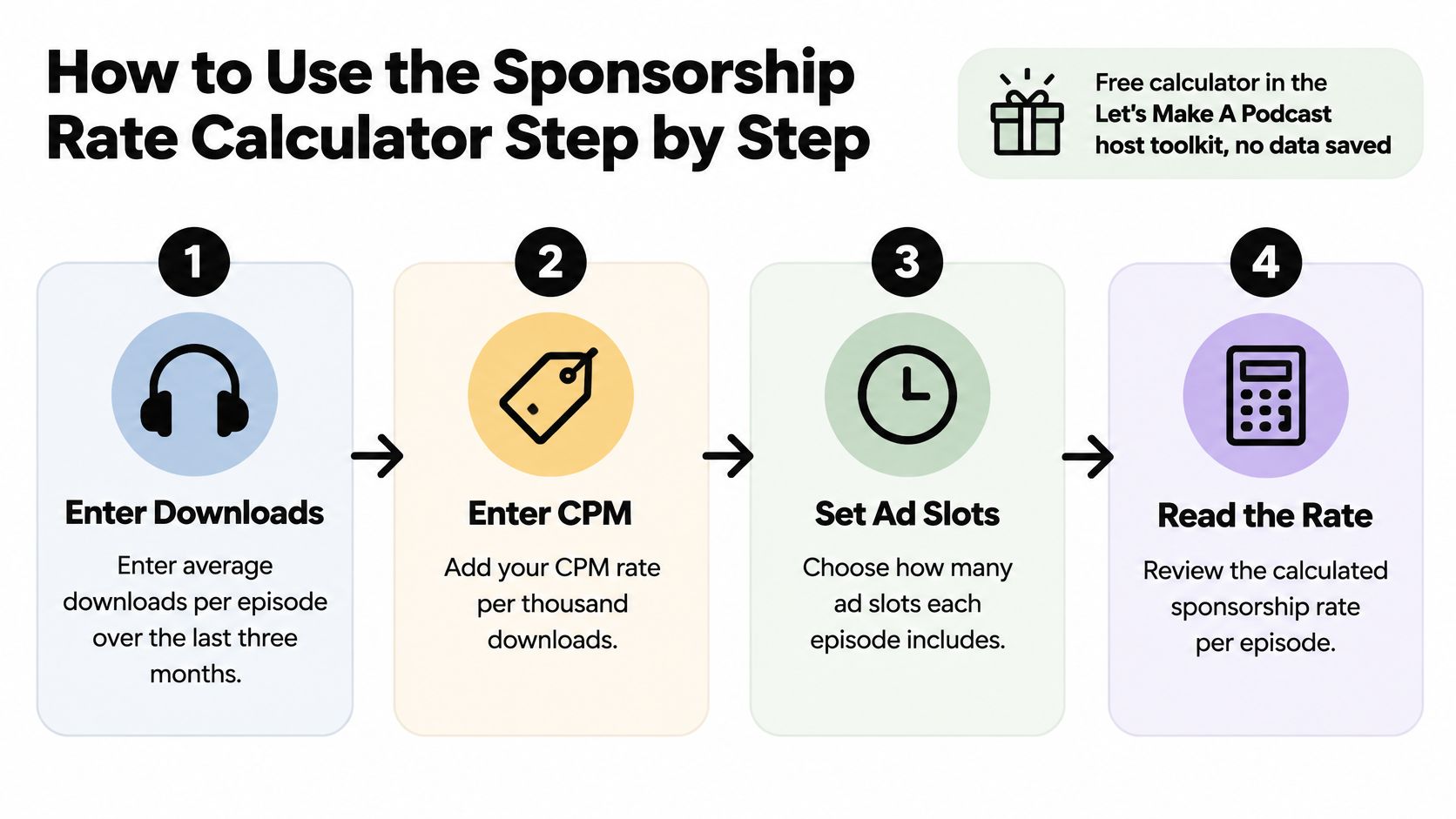
Run the Calculation in Order
- Enter average downloads per episode: Take the figure from your hosting dashboard for the last 30 days, using the same window you'll offer the sponsor.
- Enter spots and placement: Record how many paid spots each episode carries and whether each is a pre-roll, mid-roll or post-roll.
- Choose a CPM: Start with the host-read or blended benchmark that matches the format, then adjust deliberately for fit and extras.
- Calculate one spot: Use downloads ÷ 1,000 × CPM before you think about the full episode.
- Scale the campaign: Multiply the spot value by spots per episode and by the number of episodes.
- Apply any tier discount: Deduct it only when the sponsor gives a genuine multi-episode commitment in return.
- Check effective CPM: Divide the discounted total fee by total spot impressions and multiply by 1,000, then compare the result with your starting band.
Now run one complete hypothetical. A show averages 12,000 downloads per episode, sells 2 spots per episode, uses $25 CPM, and books 4 episodes with a 10% tier discount. Each spot is 12 × $25 = $300. Each episode is $300 × 2 = $600, and four episodes total $2,400 before discount.
After the 10% discount, the campaign fee is $2,160. Total spot impressions are 12,000 × 2 × 4 = 96,000. Effective CPM is therefore ($2,160 ÷ 96,000) × 1,000 = $22.50. The host began at $25 CPM, but the sponsor's commitment reduced the effective rate to $22.50. Both figures belong in the conversation because they describe different things.
The walkthrough below shows the same inputs being assembled visually, which helps when a sponsor asks why one changed assumption moves the total.
A sponsor uses the routine in reverse. It starts with budget and target impressions, tests the host's CPM, then checks whether the resulting effective CPM still makes sense after discounts and extras. A host uses it to avoid quoting a campaign total that accidentally prices each spot below the intended band. The calculator exposes assumptions. It doesn't decide audience value for you.
Negotiation Moves That Protect Your Rate
Negotiation gets easier when each concession buys something. Hosts lose money when they cut the total before identifying which deliverable, guarantee or commitment changed. Sponsors overpay when they accept a headline CPM without checking delivery and outcomes.
- Anchor on the bundle: Quote each deliverable separately, including the spot, permanence, social promotion and reporting. If the sponsor needs a lower total, remove an item instead of discounting everything that remains.
- Ask for the download source and window: Request hosting-platform figures for the last 30 to 90 days and agree which measure counts. A rate built on one exceptional episode isn't a sustainable campaign assumption.
- Trade length for rate: Offer a tier discount only for a firm multi-episode commitment. The sponsor receives a lower effective CPM, and the host receives predictable bookings.
- Price exclusivity and permanence separately: Define the blocked category, start date and end date, then state the charge. The sponsor can drop either feature if budget matters more than protection or long-tail exposure.
- Offer a test campaign with a success metric: Run one episode at an agreed test rate, then judge it against visits, redemptions or qualified leads. Don't let an undefined test become a permanent discount.
- Write make-good terms: If guaranteed downloads are missed, specify extra spots, an extension or a refund for the shortfall. Part of payment can also be tied to verified delivery, which allocates measurement risk more fairly.
- Counter with arithmetic: Show the effective CPM, total impressions and cost per outcome rather than defending a feeling. A sponsor can challenge an assumption, but it can't dismiss transparent maths as arbitrary pricing.
Sponsors should run the mirror-image check. Ask whether the host's effective CPM sits above the appropriate band, what evidence justifies the premium, and which deliverables disappear if the price falls. A host who can prove fit and delivery may deserve the premium. A host who can't explain the number hasn't earned it.
The strongest agreement names the trade behind every change. Lower price, fewer rights. Longer commitment, lower effective CPM. Stronger guarantee, firmer rate. That structure protects both sides because nobody pays for value they didn't receive.
Confirm the Rate and Terms Before You Sign
Use this checklist before either side signs. Each line should produce a document, figure or clause you can point to later.
- Confirm the download figure: Match the hosting-platform number to the measurement window written in the agreement.
- Confirm the band: Check that the quoted per-thousand rate fits the show's download range and spot type.
- List every deliverable: Price the spot, placement, promotion, rights, reporting and permanence separately.
- Recalculate effective CPM: Apply discounts, total the spot impressions and confirm the final rate still sits within the intended band.
- Confirm make-goods: Sign the exact remedy for missed guaranteed downloads, not a verbal assurance.
- Define exclusivity: Name the category and the period during which competitors are blocked.
- Confirm commercial terms: Record campaign length, episode dates, invoice points and payment schedule.
Apply one walk-away rule. If the effective CPM is well below the band and the sponsor won't remove paid extras or add make-goods, decline or counter. Run the final figures through the free calculator, record the effective CPM, and use that record in the next conversation. Let's Make A Podcast's free host tools give you a clean reference point before you commit.
Price your next deal from verified downloads, separate every deliverable and check the effective CPM before you negotiate. Visit Let's Make A Podcast to use its free host toolkit, sponsorship calculator and guest-booking marketplace, then turn those figures into a rate card you can defend with confidence.