10 Public Speaking Podcast Picks for Better Talks
Which speaking problem is holding your talks back right now? A public speaking podcast can help you manage nerves, think on your feet, design clearer slides, shape stronger stories, lead difficult conversations, or build a paid speaking practice. Those are different skills, so choosing a show by popularity alone often sends you toward useful advice that doesn't solve your immediate problem.
This roundup follows a practical listening path: fundamentals, presentation design, storytelling, leadership communication, and the speaking business. Each pick is evaluated by the specific obstacle it addresses, its best-fit listener, a realistic limitation, and a way to turn listening into practice.
Start with the skill that currently limits your talks. Then save the episode notes, choose one technique, and test it in a short recording or live presentation. Podcasting has become a broad spoken-word medium since Apple added a podcast directory to iTunes in 2005, and by the mid-2020s there were more than 4 million podcasts worldwide and roughly 100 million Americans listening to at least one podcast each month, according to this overview of podcasting and public speaking. The opportunity is large, but the right show is the one that changes what you do in your next talk.
Table of Contents
- 1. Think Fast, Talk Smart
- 2. The Toastmasters Podcast
- 3. The Speaker Lab Podcast
- 4. The Presentation Podcast
- 5. The Moth Podcast
- 6. The Speaking Club
- 7. The Big Talk with Tricia Brouk
- 8. The Storytelling Lab
- 9. The Story Blender
- 10. Speak as a Leader
- Top 10 Public Speaking Podcasts Comparison
- Turn Listening Into Speaking Practice
1. Think Fast, Talk Smart
The hardest speaking moments are often unscripted. You know your subject, but a challenging question, awkward pause, or senior audience can make your answer ramble. Think Fast, Talk Smart addresses that gap with practical communication guidance from Stanford Graduate School of Business, hosted by Matt Abrahams.
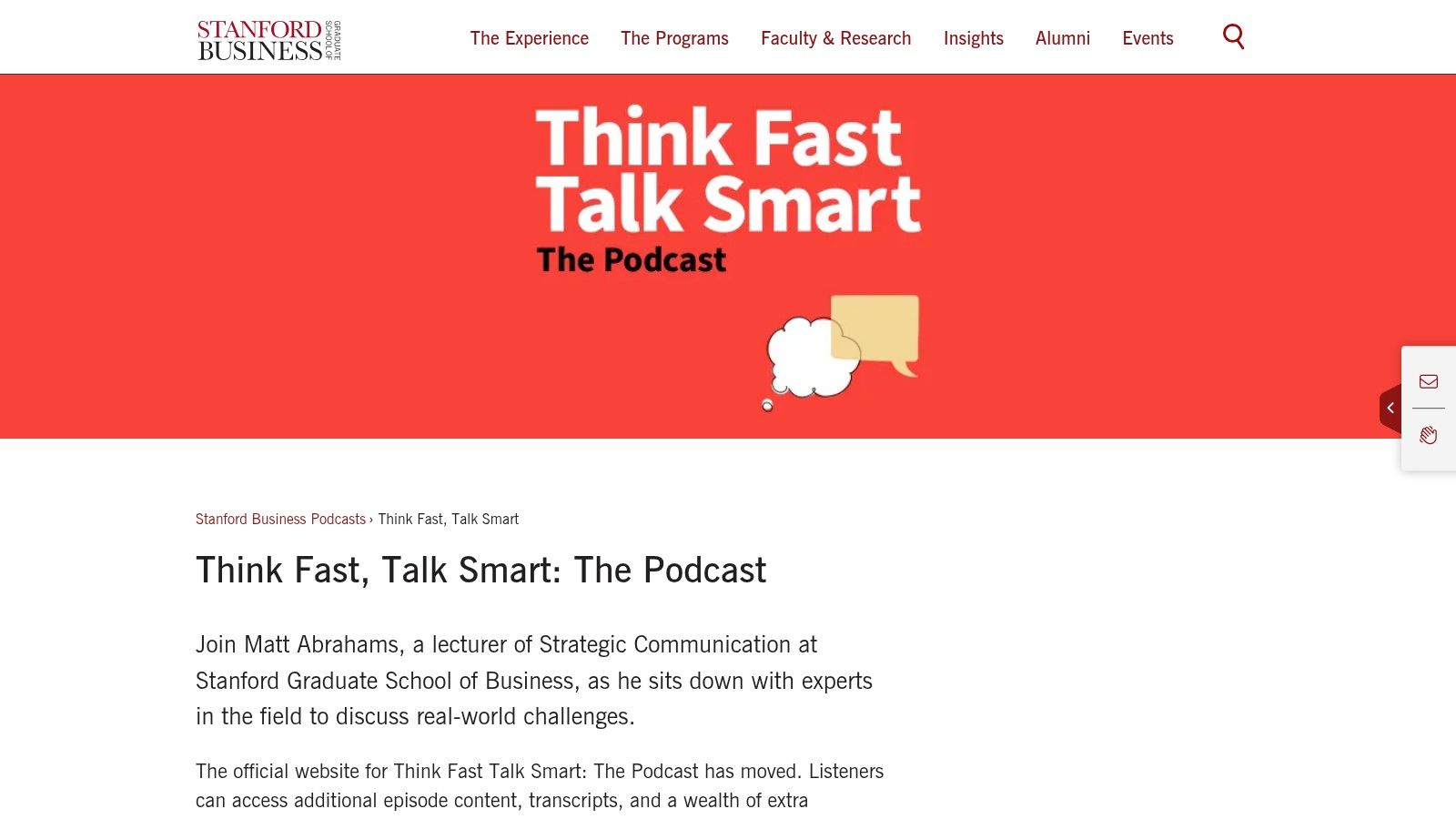
The show focuses on spontaneous speaking, anxiety management, clear structure, and audience-first messaging. Its mix of short “Quick Thinks” episodes and longer interviews makes it easier to choose the right depth. The Stanford archive also organizes episodes for browsing, which is useful when you want help with a specific situation rather than a general course in communication. Visit the Think Fast, Talk Smart podcast for the current archive.
Best fit and practical limitation
Choose it if you want applied, science-grounded advice for speaking clearly under pressure. It suits managers, educators, consultants, and specialists who need to explain ideas in meetings as well as on stages.
The limitation is equally clear. This isn't a slide-design resource, and it isn't an independent interview show that most prospective guests can pitch. Its institutional format also means you'll need to translate broad communication principles into your own rehearsal routine.
After each episode, record a one-minute answer to a difficult question. Review whether you led with the main point, used a clear structure, and stopped before adding unnecessary detail. Readers interested in interview-based opportunities can also explore guest possibilities related to Think Fast, Talk Smart, while remembering that a listing doesn't guarantee an invitation.
2. The Toastmasters Podcast
Some speakers don't need another clever speaking hack. They need a sequence for building competence, repeated practice, and a community that treats public speaking as a skill rather than a personality trait. The Toastmasters Podcast is designed around that more structured path.
The official show of Toastmasters International highlights members, speaking techniques, and leadership communication. Its collections cover Leadership, Communication Skills, Public Speaking, and Confidence, while related magazine and organizational resources give listeners more ways to continue learning. The Toastmasters Podcast website is a sensible starting point for listeners who want fundamentals presented in a community context.
Best fit and practical limitation
This is a strong choice for a beginner who wants authoritative guidance on speech basics, confidence, and leadership. It can also help a returning speaker rebuild consistency after a long break, because the material points toward deliberate progress rather than passive inspiration.
The trade-off is tone. The show can feel more institutional than entrepreneurial, particularly if your interests include personal branding, keynote positioning, or selling speaking services. Guest appearances are generally shaped by Toastmasters' own programming, so it isn't a straightforward route for pitching yourself as a guest.
Use one episode as the theme for a practice meeting or peer session. Write a short speech, deliver it without reading a full script, and ask listeners for feedback on one defined skill, such as the opening, transitions, or conclusion. That approach turns the podcast's community orientation into a useful feedback loop instead of leaving the lesson in your headphones.
Practice rule: Don't ask whether you “liked” the advice. Ask which observable behavior you'll repeat in your next speech.
3. The Speaker Lab Podcast
A polished talk doesn't automatically become a speaking business. Experts who want paid work must also define a marketable topic, find prospects, explain their offer, handle proposals, and convert opportunities. The Speaker Lab Podcast, hosted by CEO Dan Irvin, concentrates on that commercial side of speaking.
The show covers niche selection, prospecting, pricing, demos, proposals, and paid gigs. Its interviews and coaching-derived frameworks are especially relevant to authors, consultants, and subject-matter experts who already have knowledge but lack a repeatable pipeline. The Speaker Lab website provides access to the wider business-of-speaking ecosystem around the podcast.
Best fit and practical limitation
Pick this show when your speaking problem is not vocal delivery but turning expertise into an offer buyers understand. It gives business-minded listeners practical prompts for defining a signature topic, preparing outreach, and thinking about the path from free exposure to paid work.
It won't replace rehearsal. The show leans toward business-building rather than breath control, stage movement, slide composition, or the fine details of delivery. Some episodes also promote The Speaker Lab's products, so separate the useful framework from the commercial context and test the advice against your own audience.
Before listening, write down the speaking service you currently offer. After the episode, revise only one element, such as the audience, problem, result, or format. If you're preparing to appear on interview shows, use this guide to preparing for a podcast interview to convert your expertise into concise answers and usable examples.
4. The Presentation Podcast
A speaker can deliver excellent ideas and still lose the room with crowded slides. The Presentation Podcast solves the presentation-design problem, not the confidence problem. Hosted by Troy Chollar, Nolan Haims, and Sandy Johnson, it examines the tools and production decisions behind effective decks.
The show covers PowerPoint, Keynote, Google Slides, visual storytelling, production workflows, artificial intelligence, and conference presentation work. Its detailed notes make episodes easier to apply because you can return to the specific tools or process discussed. The Presentation Podcast is particularly useful for speakers who want practical guidance from experienced presentation designers rather than generic advice to “make slides simpler.”
Best fit and practical limitation
Choose it if your talks depend on slides and your current deck is doing too much of the talking. It suits consultants, trainers, conference speakers, and internal presenters who need to make complex material easier to follow visually.
The limitation is that the content can become technical for beginners. It also spends less time on voice, physical presence, spontaneous answers, and anxiety. A better deck won't compensate for an unclear argument, so use the show after you've defined what the audience needs to understand or do.
Take one existing slide and remove everything that doesn't support its single point. Then say the point aloud without looking at the screen. If the slide still feels necessary, its visual structure should reinforce your explanation, not duplicate every sentence.
Design test: If the audience can read the slide while you're speaking, check whether the slide is helping them listen or competing with you.
5. The Moth Podcast
Storytelling is often taught as a formula, but speakers can learn a great deal by listening to people tell true stories in front of an audience. The Moth Podcast offers a particularly strong observational education in stakes, pacing, detail, vulnerability, and emotional change.
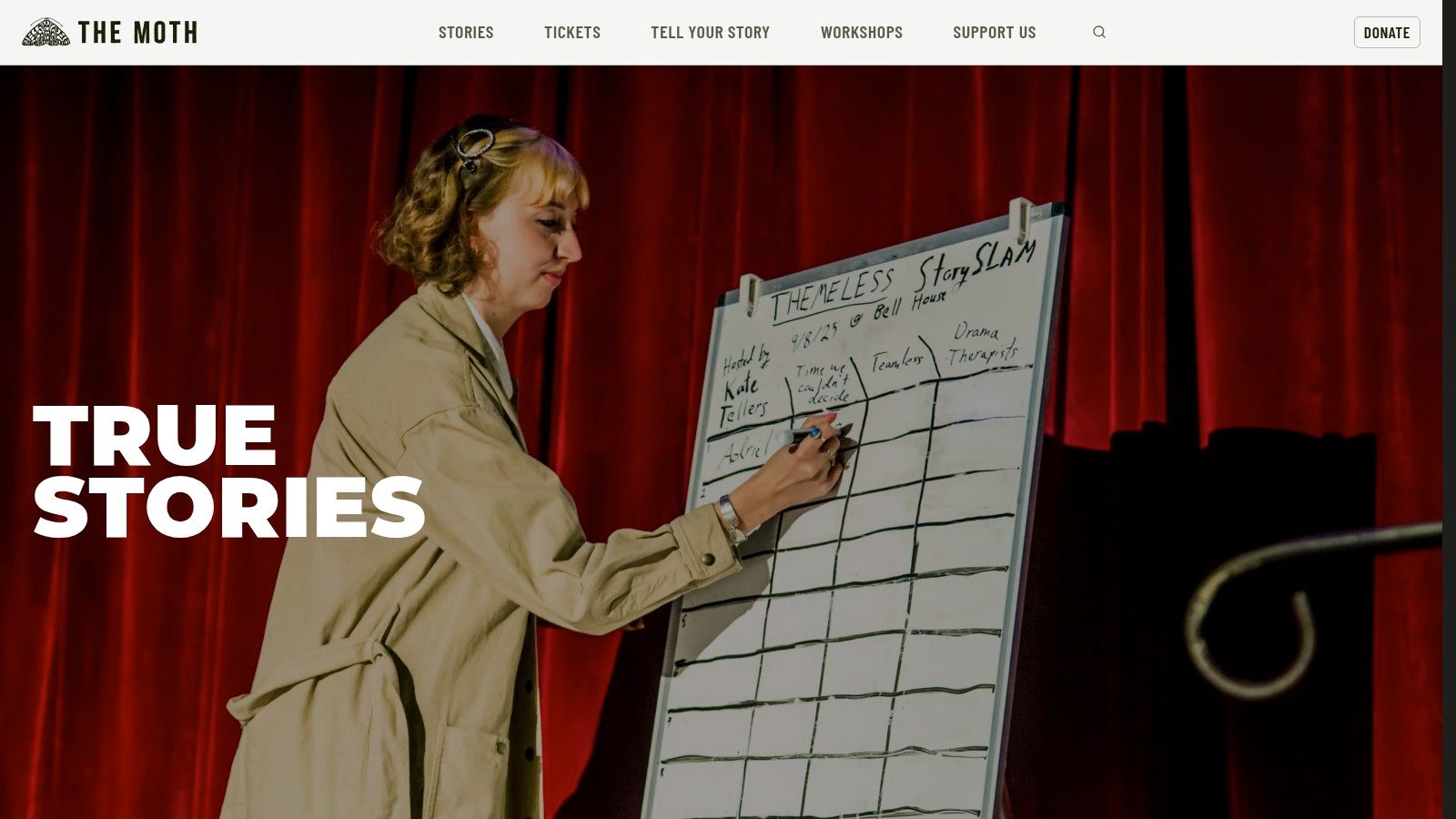
The Moth presents curated, live-recorded true stories through its podcast, radio programming, events, and workshops. Its storytelling archive and program give listeners a broad collection of examples, including stories that demonstrate how a small personal moment can carry a larger idea. The show has also developed into a Peabody Award-winning storytelling institution, which helps explain its value as a source of carefully shaped live narratives.
Best fit and practical limitation
Listen when your speeches contain information but lack human stakes. The Moth is useful for keynote speakers, founders, educators, and leaders who want audiences to remember an experience rather than a sequence of points. It can show you how storytellers enter a scene, withhold information, create tension, and arrive at meaning without explaining every emotion.
The limitation is that the podcast rarely teaches those techniques directly. You're learning through observation, and not every story's structure will suit a business presentation. A dramatic personal story can also distract from an audience's real question if you copy the emotion without preserving relevance.
After an episode, outline the story using five prompts: where the speaker began, what changed, what was at stake, which detail made the scene vivid, and what the audience was left to understand. Then apply that structure to a professional example. For a complementary list of shows in this area, browse podcasts about public speaking.
6. The Speaking Club
Humor can make an expert talk more memorable, but forced jokes can damage trust. The Speaking Club, led by UK-based coach and comedian Sarah Archer, deals with that tension by combining humor, story, mindset, and performance.
The show includes solo coaching episodes and guest interviews, with practical techniques for adding humor to business and specialist talks. Its challenges and practice-oriented resources encourage listeners to try the techniques rather than just collect ideas. Visit The Speaking Club for the podcast and associated resources.
Best fit and practical limitation
This is a good fit for an expert whose material is accurate but flat, overly formal, or difficult to connect with emotionally. It can help you make examples more vivid, use humor with more control, and treat delivery as part of the message rather than an afterthought.
Some references and examples have a UK orientation, which may not always map neatly to another audience. The site experience is split across different pages, and some content promotes paid programs. Those aren't reasons to dismiss the show, but they mean you should judge each exercise by whether it improves your particular talk.
Choose one paragraph from your presentation and rewrite it as a short story with a setting, a problem, and a consequence. Read it aloud twice, first without humor and then with one light, relevant comic observation. Keep the version that makes the point clearer, rather than the one that just sounds funnier.
7. The Big Talk with Tricia Brouk
Some speakers can explain an idea in conversation but struggle to shape it into a keynote. The Big Talk with Tricia Brouk focuses on that larger transformation, including message development, stagecraft, thought leadership, and the demands of high-visibility speaking.
Hosted by award-winning director and producer Tricia Brouk, the podcast uses interviews and live coaching-style episodes to examine how speakers develop a message and perform it with authority. Its resources connect with The Big Talk Academy, and the Big Talk podcast archive supports listeners who want sustained attention on stage presence and presentation craft.
Best fit and practical limitation
Choose it if you're aiming for TEDx-style talks, keynotes, or a stronger public thought-leadership platform. The coaching orientation can help you assess whether your message has a clear point of view, whether your stage choices support it, and whether your personal story serves the audience.
The show also places noticeable attention on visibility and personal brand. That can be valuable for an ambitious speaker, but it may feel less relevant if your immediate need is a better team briefing or a clearer technical presentation. Guest opportunities are typically connected to the host's network or programs, so listening shouldn't be confused with an open pitching route.
Take one episode and identify the change the speaker wants the audience to make. Then write your own talk in terms of that change, rather than starting with your biography or credentials. Record the opening and listen for whether you establish audience relevance before describing your expertise.
8. The Storytelling Lab
Storytelling becomes more useful for business speakers when it helps an audience understand, believe, or act on an idea. The Storytelling Lab, hosted by Rain Bennett, focuses on that practical connection between story and outcomes in business, fundraising, branding, talks, and media appearances.
The podcast features weekly interviews with practitioners and explores frameworks for finding and shaping core stories. Its emphasis is less on vocal mechanics and more on the decisions behind a story: what to include, what to leave out, and how a narrative can carry an argument. Visit The Storytelling Lab for its current episodes and resources.
Best fit and practical limitation
This show fits founders, nonprofit leaders, marketers, authors, and experts who need to sell an idea without making the presentation feel like a sales pitch. It can help you find a central narrative for a keynote, campaign, fundraising appeal, or thought-leadership presentation.
The limitation is that its guidance leans toward brand and story strategy. It won't give you much coaching on vocal projection, posture, slide timing, or managing a hostile question. Its release pattern can also vary by season, so treat the archive as a resource rather than relying only on new episodes.
Apply each episode to one real presentation. Write the audience's current belief, the belief you want them to adopt, and the story that makes the shift credible. If the story is interesting but doesn't move that audience from one belief to another, it's probably an anecdote, not yet a presentation narrative.
9. The Story Blender
A memorable speech needs more than a beginning, middle, and end. It needs tension, a compelling voice, and carefully controlled information. The Story Blender, hosted by Steven James, studies those narrative mechanics through conversations with storytellers and screenwriters.
The show offers craft-focused interviews and a multi-season archive covering structure, tension, character, and voice. Those subjects may sound literary, but they transfer directly to signature talks, origin stories, case-study presentations, and keynote narratives. The Story Blender podcast is a strong choice for speakers who want to understand why a story holds attention, not just collect presentation templates.
Best fit and practical limitation
Choose it when your speech feels like a list of events or claims and you need a more deliberate narrative engine. Authors, creative professionals, advocates, and experienced speakers can use its deeper craft discussions to improve the shape and emotional movement of a talk.
The show isn't designed as a delivery course. It offers little direct coaching on gestures, voice, pacing in a room, or stage anxiety. Some episodes also lean toward literary and author-centered subjects, so you'll need to translate the lesson into the constraints of your professional audience.
While listening, mark the moment when a story raises a question the audience wants answered. In your own talk, introduce a meaningful question early, delay the answer long enough to create interest, and remove any detour that doesn't increase understanding or stakes. That exercise is more valuable than copying a screenwriting label without changing the speech itself.
10. Speak as a Leader
Leadership communication creates a different pressure from ordinary presentation work. A leader may need to communicate during uncertainty, influence a skeptical room, speak on camera, or answer publicly without the protection of a fully rehearsed script. Speak as a Leader, hosted by communications coach Nausheen I. Chen, is built around those situations.
The podcast features executives, TEDx speakers, and creators discussing stage fright, executive presence, clarity, influence, and high-stakes communication. Its interview-first format combines mindset reframes with practical exercises, making it relevant to people whose speaking responsibilities extend beyond formal stages. Explore Speak as a Leader for the current show and its leadership communication resources.
Best fit and practical limitation
This is the best fit for leaders and ambitious experts who already speak regularly but want more presence and influence. The case-based conversations can help you examine how other communicators handle fear, simplify complex ideas, and project authority without sounding rehearsed.
Listeners seeking step-by-step tutorials may find fewer standalone lessons than they would in a solo coaching show. Guest booking routes also aren't openly listed, so the podcast is better treated as a learning resource than as a direct promotional opportunity.
After each episode, write one sentence that describes the decision, behavior, or belief you want your audience to adopt. Deliver that sentence in three versions: to a peer, to a skeptical executive, and to a large audience. Compare the recordings for clarity, confidence, and unnecessary qualifiers. Leadership presence becomes easier to improve when you can hear the specific choices you're making.
Top 10 Public Speaking Podcasts Comparison
| Podcast | Core Focus ✨ | Guest Access 💰 | Best for 👥 | Unique Strengths 🏆 | Quality ★ |
|---|---|---|---|---|---|
| Think Fast, Talk Smart (Stanford GSB) | Spontaneous speaking, anxiety management; short minisodes + research-backed tips | 💰 Institutional / invited (not open to public pitches) | 👥 Academics, execs, evidence-driven speakers | 🏆 University editorial rigor; actionable research insights | ★★★★ |
| The Toastmasters Podcast (Toastmasters Intl.) | Fundamentals, leadership communication; structured learning collections | 💰 Organization-invited (limited pitch access) | 👥 Learners seeking structured progress & community | 🏆 Authoritative, global community resources | ★★★★ |
| The Speaker Lab Podcast (The Speaker Lab) | Business of speaking: niche, pricing, proposals, monetization | 💰 Commercial/limited (typically host-arranged) | 👥 Pros seeking paid gigs, authors, experts | 🏆 Practical monetization tactics & case studies | ★★★★ |
| The Presentation Podcast (TLC Creative Services) | Slidecraft, visual storytelling, tooling & workflows | 💰 Selective (studio-hosted; contact via site) | 👥 Designers, presenters focused on visuals | 🏆 Deep, practical deck and production advice | ★★★★ |
| The Moth Podcast (The Moth) | Live storytelling; emotional arcs and audience connection | 💰 Curated/invited (not a guest-interview format) | 👥 Storytellers, speechwriters, those learning by example | 🏆 Peabody-winning, vast high-quality archive | ★★★★★ |
| The Speaking Club (Sarah Archer) | Humor, storytelling, performance for business talks | 💰 Moderate (indie host; may accept interviews) | 👥 Experts adding humor & performance to talks | 🏆 Friendly, practice-focused coaching tone | ★★★★ |
| The Big Talk with Tricia Brouk | Live coaching for TEDx/keynote-level talks; message craft | 💰 Program/invite-driven (booking via host network) | 👥 Aspiring keynote/TEDx speakers | 🏆 Coach-style deep guidance; large episode archive | ★★★★ |
| The Storytelling Lab (Rain Bennett) | Applied frameworks for business/fundraising storytelling | 💰 Open-ish (guest interviews common) | 👥 Marketers, fundraisers, communicators | 🏆 Transferable frameworks for pitches & talks | ★★★★ |
| The Story Blender (Steven James) | Narrative mechanics with authors & screenwriters; structure & voice | 💰 Selective (author-focused guest roster) | 👥 Writers, speakers wanting deep craft lessons | 🏆 In-depth narrative craft education | ★★★★ |
| The Presentation Podcast (TLC Creative Services) | (See above) Slide design, tooling, production workflows | 💰 Selective (studio-hosted; contact via site) | 👥 Designers & presenters focused on visuals | 🏆 Practical deck & workflow pro tips | ★★★★ |
| Speak as a Leader (Nausheen I. Chen) | Executive presence, high-stakes speaking, mindset + mechanics | 💰 Not openly listed (interview-first; selective) | 👥 Leaders, executives, ambitious communicators | 🏆 Case-based lessons tailored to high-stakes contexts | ★★★★ |
Turn Listening Into Speaking Practice
The best public speaking podcast isn't necessarily the one with the broadest subject matter. It's the one that addresses the constraint currently reducing the quality of your talks. If you freeze during questions, start with Think Fast, Talk Smart. If you need structured fundamentals, choose The Toastmasters Podcast. If your slides are carrying too much information, listen to The Presentation Podcast. If your stories lack tension or relevance, compare The Moth, The Storytelling Lab, and The Story Blender.
Professional goals require a different path. The Speaker Lab Podcast is more useful for building a speaking offer and prospecting system than for learning stage movement. The Big Talk is a better match for keynote development and public positioning. Speak as a Leader makes more sense when your audience includes executives, teams, or stakeholders who need confidence and clarity during high-pressure moments.
Use a simple routine rather than subscribing to every show at once:
- Choose one immediate gap: Name the behavior you want to change, such as answering questions more directly or reducing text on slides.
- Save a small episode set: Pick episodes that address that behavior from an instructional angle and, where useful, an observational angle.
- Extract one technique: Write the technique in behavioral terms. “Use stronger stories” is vague. “Open with the moment the decision became difficult” is testable.
- Record a short talk: Apply the technique in a brief presentation, answer, or introduction. Listen back before deciding whether it worked.
- Revise one variable: Change the opening, example, transition, slide, or conclusion, but don't rebuild the entire talk after every episode.
Instructional shows explain what to do. Observational resources such as The Moth show what effective choices sound like when a real speaker makes them. Use both. A coach can tell you to create tension, but a strong story lets you hear how tension develops through timing, specificity, and withheld information.
A podcast can also become part of a professional speaking pipeline. Public-speaking shows have developed from a niche digital format into a global spoken-word channel, and established examples such as The Public Speaker, which began in 2012 and accumulated more than 16 million downloads across its eight-year run, show that focused speaking content can build a substantial listening habit. Those figures are documented in this history of public-speaking podcasts. They don't prove that every appearance will generate business, but they do show why speakers may reasonably treat podcast interviews as practice, visibility, and relationship-building opportunities.
If you want to explore interview-based podcast opportunities, Let's Make A Podcast combines a directory of active shows with guest one-sheet tools, pitching workflows, search and filtering, messaging, and scheduling features. Use it to identify shows whose topics match your expertise, prepare a focused profile, and organize outreach rather than pitching every podcast that mentions speaking.
Let's Make A Podcast helps public speakers find relevant interview shows, present their topics through a shareable one-sheet, and manage pitches, messages, and scheduling in one workflow. Visit Let's Make A Podcast to find podcast opportunities that fit your speaking expertise and turn listening into deliberate practice.
Pitch this show as a guest
One show from this article is in our directory, each with a page on how it books guests and what to send.
More shows that book guests: Careers podcasts