10 Public Relations Podcasts Worth Your Time
The best public relations podcast isn't the one with the broadest reputation. It's the one that helps you complete the job in front of you. An agency leader may need executive intelligence, a media-relations specialist may need sharper pitching tactics, and a communications director may need a better way to prove that earned media created value. A prospective guest has a different need again: finding active shows where the subject, audience, and format fit.
This list separates those use cases. It distinguishes industry news, tactical training, crisis analysis, measurement, agency leadership, and guest-placement insight. Each review considers the show's format, cadence, geographic emphasis, likely audience, limitations, and the action a listener can take after an episode. Podcasting deserves that level of attention. In early 2025, 55% of Americans aged 12 and older, approximately 158 million people, had listened to a podcast in the previous month, according to Edison Research data summarized by Christoph Olivier Consulting.
For guests and hosts, Let's Make A Podcast is a relevant companion rather than one of the editorial shows reviewed here. Its directory, one-sheet profiles, pitching tools, and scheduling workflow can help connect a topic-aligned expert with an active interview program. The right listening mix won't maximize subscriptions. It will improve a recurring PR task.
Table of Contents
- 1. The PRovoke Media Podcast
- 2. Beyond the Noise from PRWeek
- 3. For Immediate Release
- 4. The Spin Sucks Podcast with Gini Dietrich
- 5. On Top of PR with Jason Mudd
- 6. Coffee with a Journalist from OnePitch
- 7. Indestructible PR with Molly McPherson
- 8. The PR Podcast with Jody Fisher
- 9. PRmoment Podcast
- 10. The PR Resolution Podcast from CoverageBook
- Top 10 Public Relations Podcasts Comparison
- Build a Listening and Outreach Routine
1. The PRovoke Media Podcast
The PRovoke Media Podcast is best suited to the professional who needs to understand where the communications business is heading, not just how to write a better pitch. Its interviews with agency leaders, brand chief communications officers, and analysts place reputation, authority, agency management, and global PR trends in the same conversation.
That senior perspective changes how listeners interpret tactical advice. An episode about artificial intelligence, for example, can be considered in terms of credibility, governance, and leadership rather than only content production. Coverage connected to major industry gatherings and global communications themes also gives agency executives material for internal discussions with clients and teams.
Best fit and listening workflow
The show works particularly well for agency leaders, senior in-house communicators, and practitioners comparing regional approaches. Its global scope is useful for teams that work across markets or want to avoid treating U.S. PR conventions as universal. The specialized Agency Leaders and CCO strands make the archive easier to browse by responsibility.
Listen for the decision behind the story. After each episode, record one implication for client counsel, one risk for reputation, and one question to take into a leadership meeting. The archive is organized on the PRovoke Media podcast page, which supports that targeted approach.
The limitation is practical. Audio quality and cadence can vary, so the show may suit deliberate weekly or project-based listening better than a perfectly uniform daily briefing. Prospective guests should also recognize that its executive orientation favors a strong point of view and industry relevance over a generic personal-brand pitch.
2. Beyond the Noise from PRWeek
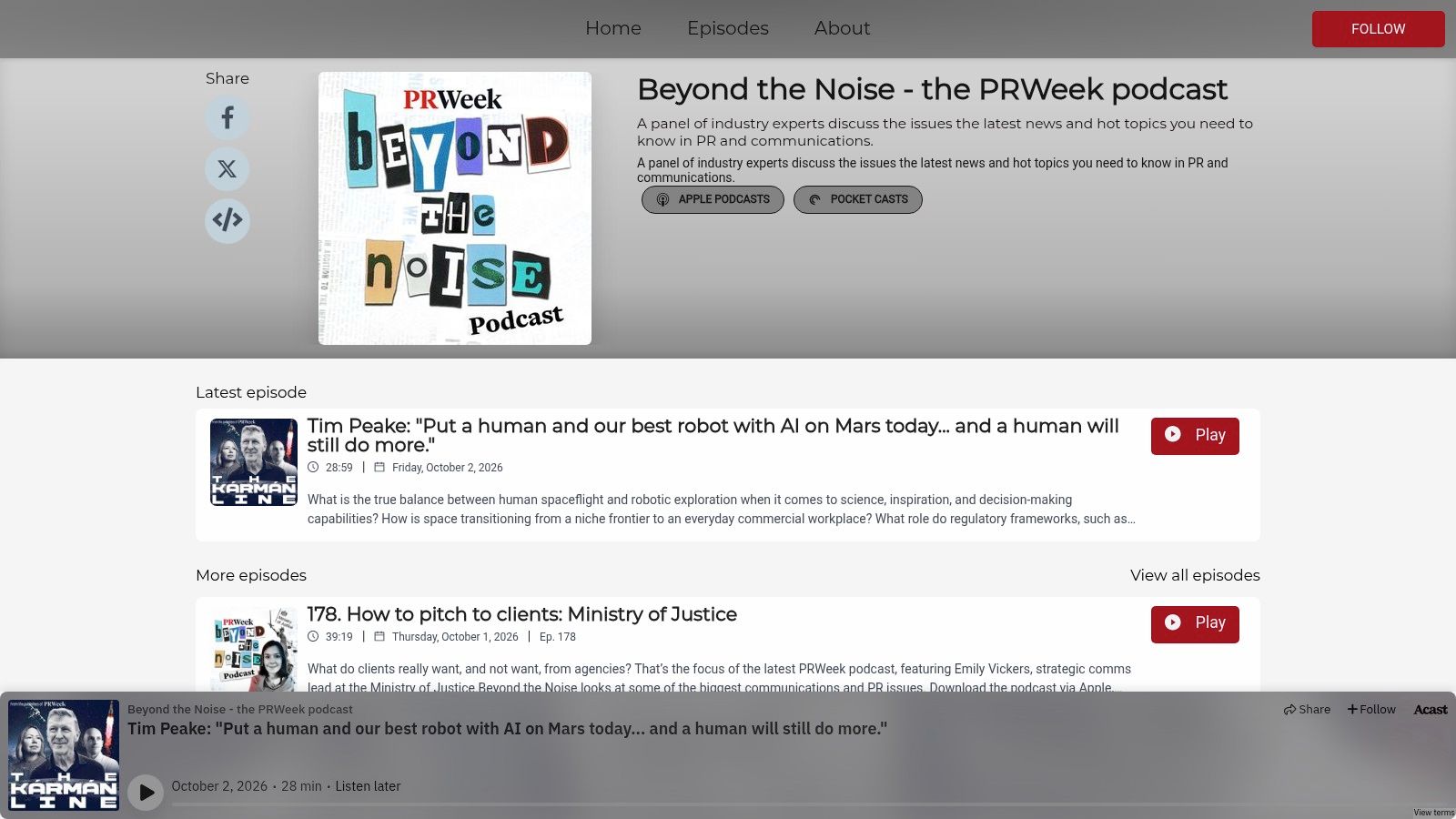
For monitoring the PR industry, Beyond the Noise from PRWeek is the clearest fit in this group. The show uses editorial panels, practitioner conversations, themed episodes, and special coverage to interpret current PR and communications stories. That makes it less of a skills course and more of a news-led briefing with analysis attached.
Its value lies in curation. A busy communications professional doesn't need every development in the media presented as equally important. A weekly panel can help separate a meaningful shift in crisis practice, reputation, or sector communications from a story that will disappear quickly. The format also varies enough to keep the listening experience from becoming a single repeated interview pattern.
Geographic caveat and action
The prominent UK lens matters. U.S. listeners can still use the show to track editorial judgment, agency issues, and broader communications debates, but they shouldn't automatically transfer every regulatory, media, or market assumption to their own work. Pairing it with a regionally relevant news source creates a more reliable monitoring routine.
Use the show in a two-pass workflow. First, listen for the issue and the language practitioners use to describe it. Then turn one topic into a client alert, internal briefing, or media-risk question. The PRWeek podcast page provides direct listening routes, so it can function as a regular news checkpoint rather than an occasional discovery.
For guests, the show is less obviously a placement target than a source of editorial context. Study which themes receive sustained attention, then assess whether your expertise contributes a useful interpretation. A pitch that merely repeats the episode's headline adds little. A pitch that supplies a specific, defensible perspective may be more relevant.
3. For Immediate Release
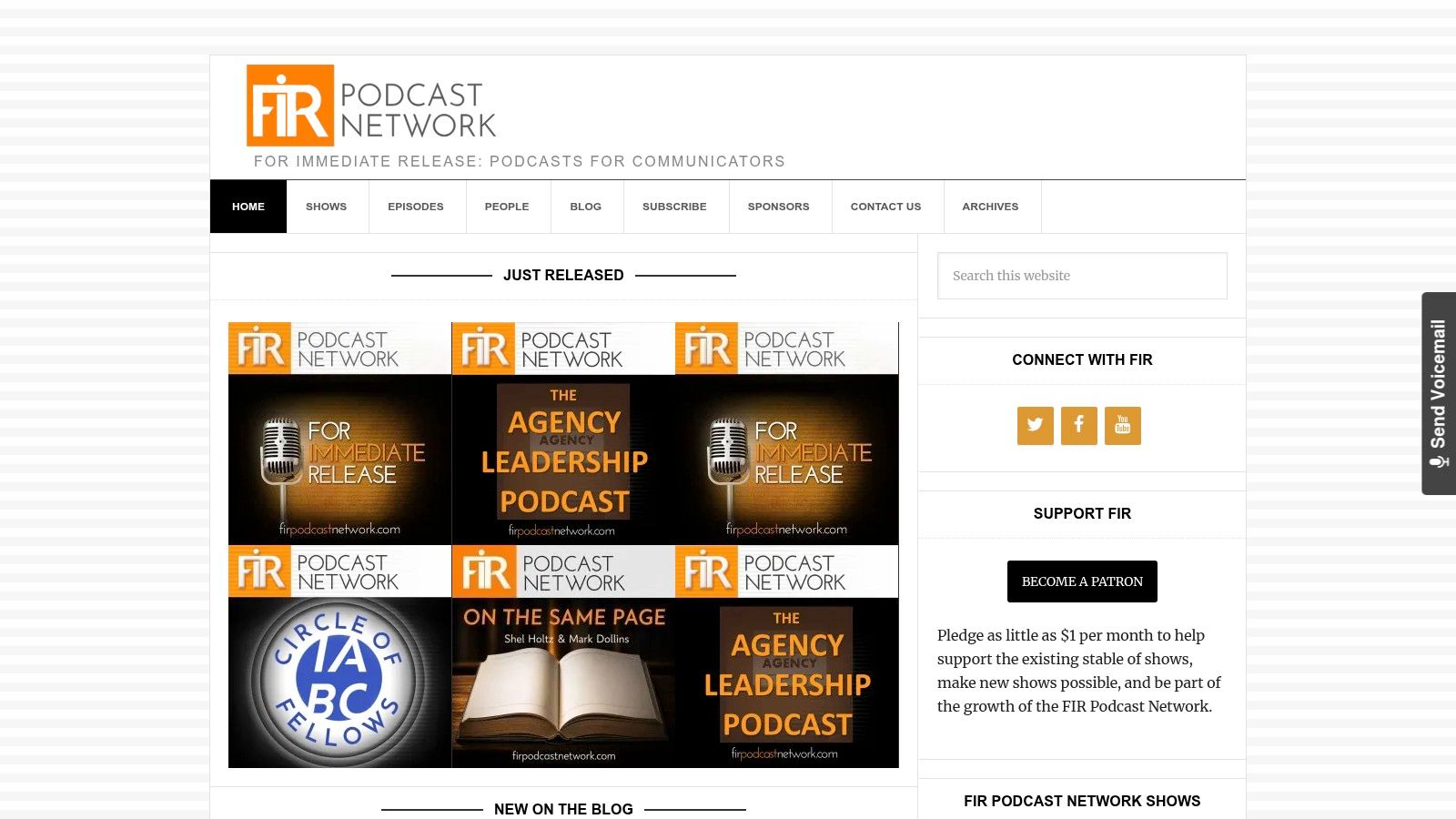
For Immediate Release, known as FIR, is a strong choice for listeners who want communications strategy explained through technology, governance, and practitioner consequences. Shel Holtz and Neville Hobson bring veteran perspectives to discussions about digital change, social communication, and the systems that shape professional practice.
The show's advantage is depth. Its archive and FIR Network create a broader learning environment than a single stream of current interviews. Regular segments, including technology-focused analysis, help listeners connect a development to the work of communicators rather than treating technology news as an isolated trend.
Best fit and limitation
FIR fits communications leaders, digital PR practitioners, and experienced professionals responsible for adapting teams to change. It rewards active listening. Instead of collecting quotable tips, write down the assumption an episode challenges, the governance issue it exposes, and the operational decision it could affect.
The main show's monthly cadence is a limitation for anyone seeking rapid industry updates. It's better treated as a strategy session that complements a faster news-led show. The extensive back catalog can also create choice overload, so start with episodes tied to a current project or a recurring responsibility.
Prospective guests should prepare for a thoughtful conversation rather than a short promotional appearance. A clear thesis, relevant examples, and an understanding of the technology's communications implications will travel further than a broad claim about innovation. Listeners considering a guest appearance can also use this guide to getting booked as a podcast guest to turn subject expertise into a focused pitch.
The FIR Podcast Network is especially useful for building a complementary listening mix. Choose the main show for nuanced analysis, then use related programs when a specific communications or technology question demands more attention.
4. The Spin Sucks Podcast with Gini Dietrich
The Spin Sucks Podcast is designed for the practitioner who needs to improve execution this week. Gini Dietrich's episodes focus on integrated communications, the PESO Model, measurement, agency leadership, and the practical decisions that determine whether a PR program can demonstrate value.
Many episodes use a concise, solo format. That can feel closer to a focused lesson than a long-form conversation, which is an advantage when a team needs a framework it can apply immediately. Interviews add perspective, but the consistent subject focus keeps the show anchored in implementation rather than drifting into general professional storytelling.
Best fit and action
Choose it for PR generalists, agency teams, account leads, and communicators trying to connect channels, messages, and outcomes. After listening, convert the episode into one working document: a measurement brief, a PESO planning grid, a client question set, or a revised reporting agenda. The framework becomes useful only when it changes a decision.
The emphasis on measurement is especially relevant because podcast appearances are often reported through reach or impressions without a clear link to reputation or business outcomes. An earned interview can create value through authority, referral behavior, message pull-through, or later consideration, but those outcomes need separate tracking rather than a single inflated proxy.
Practical rule: Treat each episode as a prompt to improve one operating habit, not as another item in a professional reading list.
The limitation is the lecture-style feel of many solo episodes. Listeners who need debate or newsroom perspective may want to pair the show with an interview-led program. For communications teams arranging podcast placements, find podcasts to pitch after identifying the exact topic and audience the guest can serve. The Spin Sucks website is the natural starting point for the show's broader frameworks and community context.
5. On Top of PR with Jason Mudd
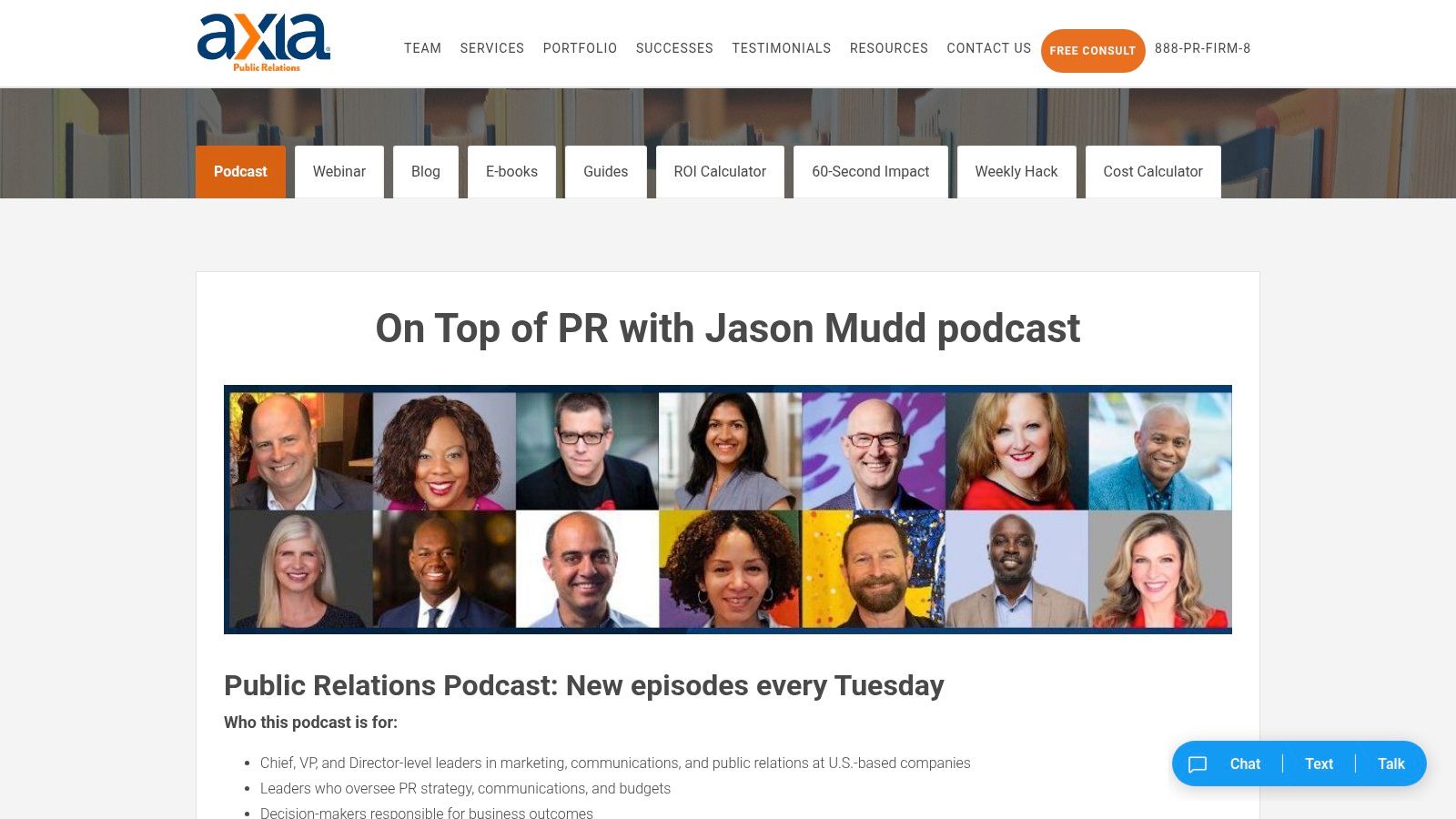
On Top of PR is built for decisions that sit above day-to-day media outreach. Jason Mudd's conversations with brand-side and agency communications leaders address budgets, vendor management, key performance indicators, agency relationships, and the connection between PR activity and business outcomes.
That makes it a better fit for a decision-maker than for someone looking for introductory terminology. The guest mix gives listeners access to perspectives across sectors, while the interview format allows strategic choices to be discussed through operating experience rather than abstract principles.
What to listen for
The most useful question is not “What tactic worked?” It's “What did the leader decide to measure, fund, stop, or delegate?” That framing helps a listener distinguish a repeatable management principle from a story that only makes sense inside one organization.
Use the official Axia Public Relations podcast page for regular listening, then bring one question to a planning or client meeting. For example, ask whether the current PR report shows activity, audience response, or a meaningful business or reputation outcome. The show's outcome-oriented approach makes that distinction difficult to ignore.
The limitation is its executive focus. Early-career practitioners may find some discussions advanced or removed from immediate pitching work. They can still extract value by translating each leadership issue into a frontline process, such as how a team documents objectives before outreach or explains the value of a placement to a client.
Prospective guests should pitch a lesson with organizational relevance. A personal success story may be less compelling than a clear explanation of how a communications team made a difficult trade-off, evaluated a vendor, or connected earned media to a broader business objective.
6. Coffee with a Journalist from OnePitch
Coffee with a Journalist answers a narrower question than most shows on this list: How do working journalists want PR professionals to approach them? Its one-on-one interviews with reporters and editors explore inbox preferences, pitch structure, subject lines, exclusives, embargoes, and the practical details that shape media relations.
That narrowness is the point. The show isn't trying to explain every part of public relations. It gives listeners access to the reasoning behind a journalist's response to outreach, which is more useful than memorizing generic pitching rules.
Best fit for pitch improvement
Media-relations specialists, founders handling their own outreach, and junior PR professionals will get the most immediate benefit. The weekly format and wide range of beats make it possible to compare how preferences differ between reporters rather than assuming one universal newsroom workflow.
Listen with a pitch open on your screen. When an episode reveals a preference about relevance, timing, or context, mark the sentence in your draft that violates it. Then rewrite the pitch around the journalist's stated beat and the actual news value. The transcripts and companion material on the OnePitch website make that exercise easier to revisit.
The show's limitation is equally clear. It is heavily focused on media relations, so it offers less guidance on agency leadership, crisis preparation, or measuring the long-term reputation value of a placement. It also shouldn't be treated as permission to copy every preference into every campaign. A reporter's needs depend on beat, outlet, deadline, and story.
For guest placement, the same discipline applies. Research the host's recent subjects before contacting them, explain why the proposed conversation serves that audience, and avoid presenting a podcast pitch as a disguised press release. If outreach volume becomes difficult to manage, a podcast booking service can be considered, but relevance still has to come before scale.
7. Indestructible PR with Molly McPherson
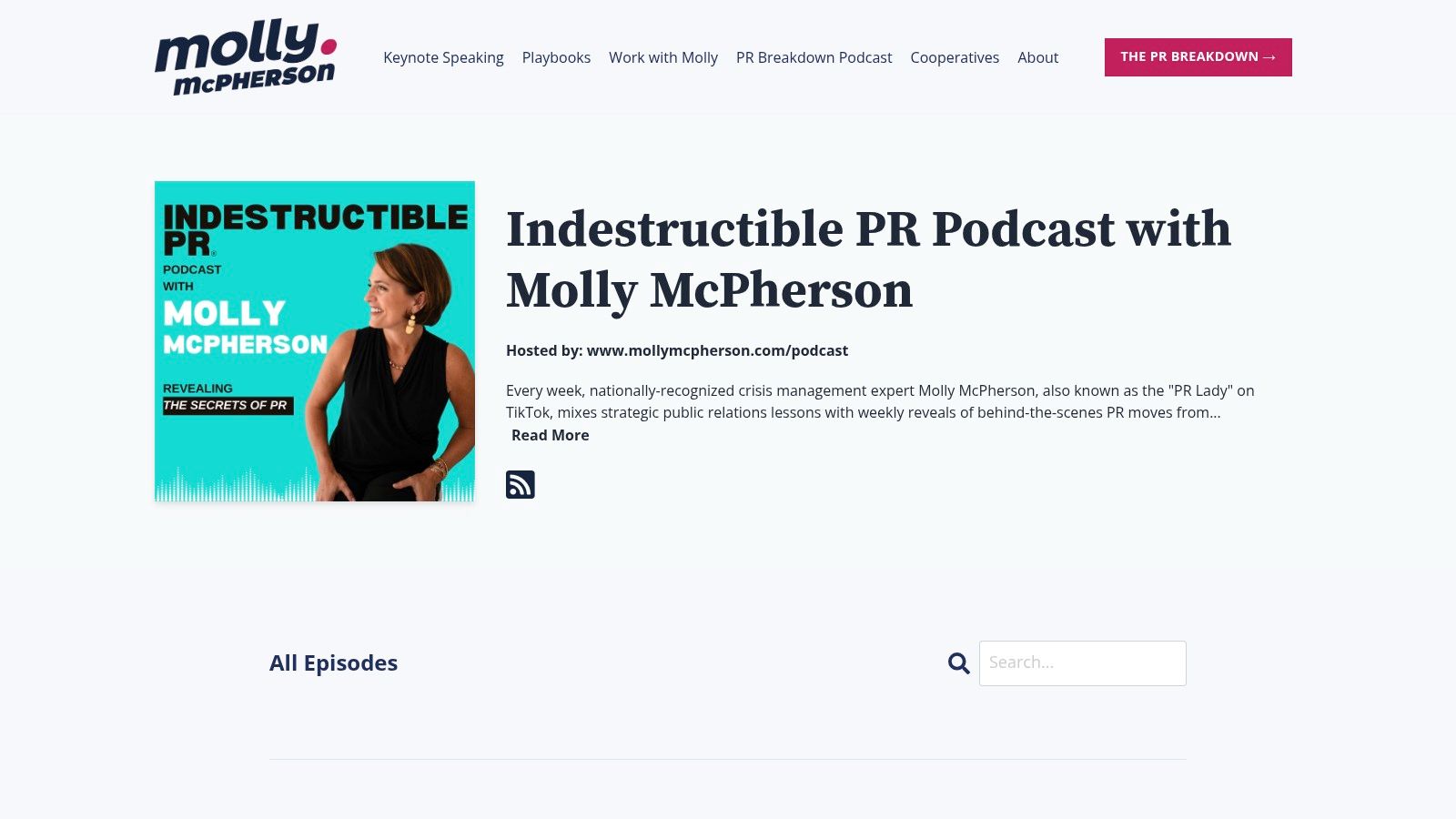
Indestructible PR, also known as The PR Breakdown, is the specialist choice for crisis communications and reputation management. Molly McPherson uses current events and public-facing situations to examine response choices, online issue management, messaging discipline, and the behaviors that make a crisis harder to contain.
The case-led format gives the listener something concrete to analyze. Instead of starting with a communications model in the abstract, an episode can prompt questions about timing, ownership, audience reaction, channel selection, and whether an organization has earned enough trust to be believed when pressure rises.
Crisis preparation workflow
Listen before a crisis, not only after one becomes visible. Build a small scenario file from recurring episode themes, with a decision owner, first-response principle, internal approval risk, and audience that needs the clearest explanation. That converts commentary into preparedness.
A crisis episode is most valuable when it changes what the team does before the next incident.
The Indestructible PR podcast page is a useful entry point for weekly, topical analysis. The show's social-era emphasis also matters for teams whose stakeholders encounter a developing issue through public channels before an official statement is ready.
Its limitation is the same strength. Crisis-heavy content covers less of routine brand PR, including ordinary media planning, campaign development, and reporting. Pair it with a tactical show for day-to-day execution and a measurement show for evaluating what happened afterward.
Prospective guests need a defensible crisis insight, not merely a dramatic story. A strong pitch can explain a repeatable response principle, a common leadership error, or a way to prepare spokespeople for uncertainty. The subject must help the audience handle a real communications problem, not just revisit a headline.
8. The PR Podcast with Jody Fisher
The PR Podcast with Jody Fisher is a practical choice for listeners who want to understand how stories get developed and placed from both the PR and newsroom sides. Interviews with PR professionals, reporters, and communicators create a more accessible view of media relations than a purely executive or news-analysis program.
Its large back catalog, with 250-plus episodes, gives career-minded practitioners and newer professionals room to browse by problem. A listener can move from pitching and newsroom relationships to career development without needing to follow a single narrow theme.
Best fit and limitation
Choose this show when you need a balanced explanation of the work rather than a macro view of the industry. The interview style is friendly and open, which makes it suitable for early-career practitioners, independent consultants, and prospective guests learning how media conversations are structured.
The weekly cadence supports a simple habit. Listen to one episode, identify the moment when a story became newsworthy, and write down the evidence that made the pitch credible. That exercise teaches judgment more effectively than collecting subject-line formulas.
The show also uses an open invitation model for qualified guests seeking exposure. That can make it relevant to experts who can explain a media-relations lesson, a communications career decision, or a useful story-development process. A generic biography won't be enough. The proposed conversation needs to serve the show's practitioner audience.
The limitation is that the program leans toward practitioner stories and offers fewer macro industry analyses. Listeners responsible for agency strategy or global reputation should pair it with PRovoke Media or PRmoment. The Jody Fisher podcast page offers the archive and current listening route.
9. PRmoment Podcast
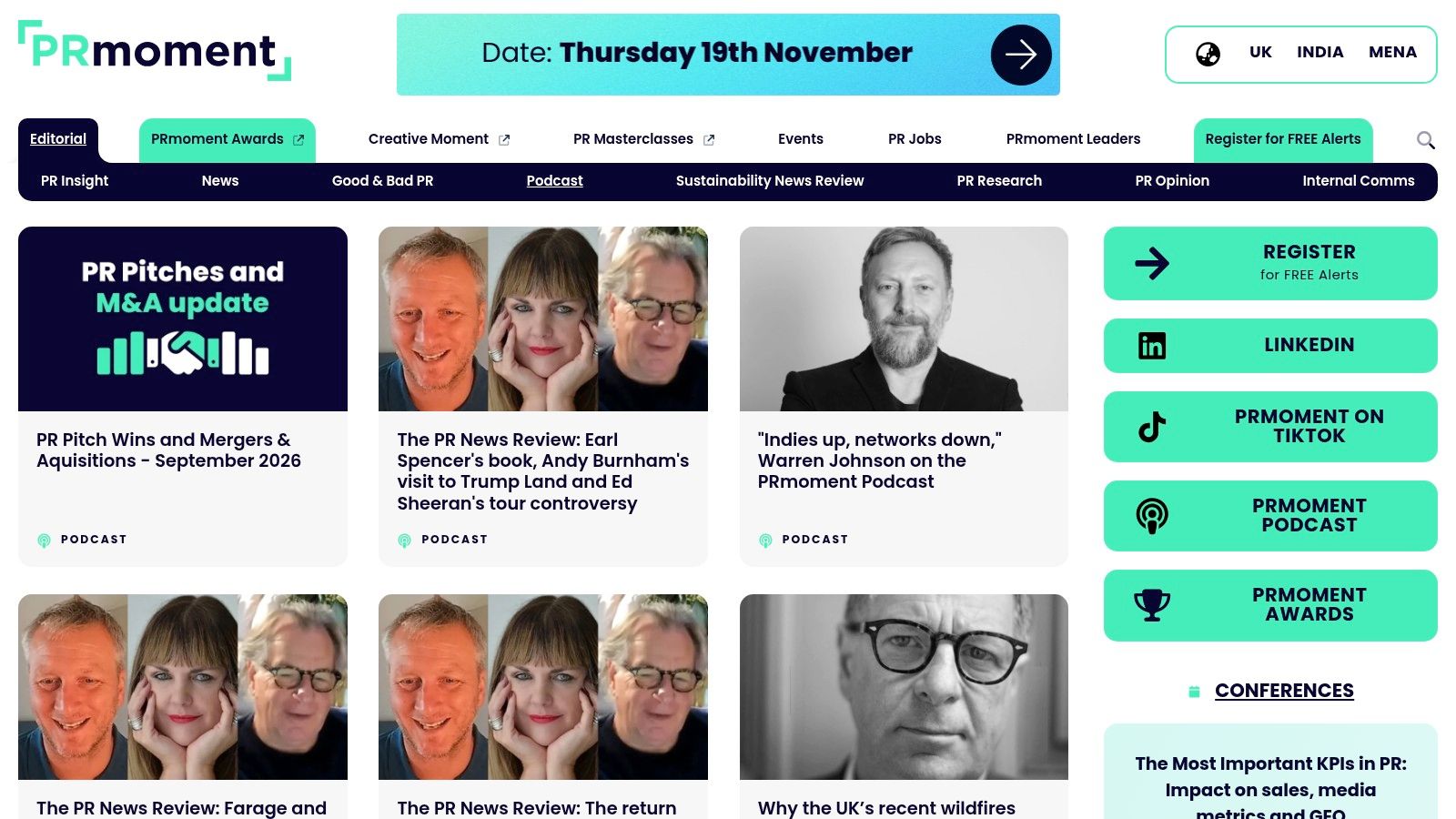
The PRmoment Podcast is a strong option for agency operators and senior practitioners who need to connect communications craft with the business of running a firm. Its UK base shapes the editorial perspective, while interviews and news-review episodes address agency leadership, pitches, mergers and acquisitions, artificial intelligence, readability, creative practice, KPIs, and operational choices.
The combination matters. A creative discussion can be evaluated alongside questions about staffing, client value, or commercial discipline. That helps agency leaders see PR not only as a collection of campaigns but also as a business with pricing, positioning, talent, and accountability decisions.
Geographic and format caveat
The UK emphasis requires translation for U.S. listeners and teams in other markets. Agency economics, media systems, regulation, and client expectations don't always transfer cleanly. That doesn't make the episodes irrelevant. It makes comparison more valuable, especially when a listener separates the underlying management principle from the local example.
Use the regular PR News Review for market awareness, then choose founder or CEO interviews when a leadership question is more urgent. The organized archive on the PRmoment podcast page supports that selective workflow.
For guests, the program is a credible opportunity only when the proposed topic reaches beyond self-promotion. An agency leader could discuss a difficult operational choice, a practitioner could explain how a team improved creative judgment, and a measurement specialist could clarify a KPI dispute. The closer the topic is to the show's business and leadership concerns, the more useful the placement becomes.
Its limitation is scope. Someone seeking granular pitch-writing instruction or crisis playbooks will need another show. PRmoment belongs in a listening mix focused on agency leadership, market interpretation, and the decisions behind sustainable PR work.
10. The PR Resolution Podcast from CoverageBook
The PR Resolution Podcast is the specialist choice for proving PR value. Hosted by Stella Bayles, it focuses on measurement frameworks, digital PR, SEO, trustworthy data, reporting, and AMEC-related thinking. That makes it particularly relevant to teams that need to move beyond counting placements and explain what earned media contributed.
The subject is more important than it may first appear. Podcast appearances can support awareness, authority, stakeholder education, referrals, and later action, but downloads or impressions alone don't establish which outcome occurred. A measurement-focused show helps communicators design reporting around the objective rather than forcing every campaign into one headline number.
Measurement workflow
Before listening, write down the outcome the campaign is supposed to influence. Then use the episode to test whether the planned evidence can show progress, such as referral behavior, branded search activity, message pull-through, qualified inquiries, backlinks, sentiment, or share of voice. Those indicators still need careful interpretation, especially when several channels affect the same result.
The need for defensible reporting is growing alongside the commercial scale of podcasting. U.S. podcast advertising revenue reached approximately $2.862 billion in 2025, up 17.6% from 2024, according to industry reporting summarized by Elite Content Marketer. That figure describes paid advertising, not earned interviews, but it signals why teams increasingly need to distinguish audience reach from PR outcomes.
The CoverageBook PR Resolution podcast page offers subscribe and streaming routes, including RSS, Apple, and Spotify. Its limitation is specialization. It won't replace a broad industry briefing or crisis program, but it can improve the reporting discipline that makes both easier to defend.
For podcast PR specifically, compare unique reach where available, retention or completion, referral traffic, conversions, backlinks, message adoption, and reputation signals. Don't collapse them into a single equivalent-media-value estimate when the objective calls for a more precise explanation.
Top 10 Public Relations Podcasts Comparison
| Podcast | Core focus & format | ✨🏆 Standout | 👥 Target audience | ★ / 💰 Practical value & access |
|---|---|---|---|---|
| The PRovoke Media Podcast | Weekly executive interviews; industry trends & special series | ✨Agency Leaders / CCO series; global scope 🏆 | Senior comms leaders, agency execs 👥 | ★★★★ / 💰 Free, strong visibility for expert guests |
| Beyond the Noise, PRWeek | Weekly news panels & themed episodes | ✨Sharp editorial curation; varied formats 🏆 | PR practitioners tracking current stories 👥 | ★★★★ / 💰 Free, timely slots for topical guests |
| For Immediate Release (FIR) | Long-form analysis; tech × comms; networked shows | ✨Deep archives & expert hosts 🏆 | Strategy-minded communicators, veterans 👥 | ★★★★ / 💰 Free, authoritative platform, lower cadence |
| The Spin Sucks Podcast | Frequent tactical episodes; PESO frameworks | ✨Actionable frameworks & community tie-ins 🏆 | Mid-level practitioners, agency teams 👥 | ★★★★ / 💰 Free, practical exposure; clear takeaways |
| On Top of PR (Jason Mudd) | Weekly exec interviews focused on outcomes & KPIs | ✨Business/measurement-oriented conversations 🏆 | Brand leaders, agency decision-makers 👥 | ★★★★ / 💰 Free, high-value for senior guest appearances |
| Coffee with a Journalist | Weekly 1:1 with reporters on pitching prefs | ✨Direct pitching insights + transcripts 🏆 | Media-relations pros and spokespeople 👥 | ★★★★★ / 💰 Free, must-listen for PR pitching readiness |
| Indestructible PR (Molly McPherson) | Weekly crisis case studies & playbooks | ✨Crisis-focused, social-era tactics 🏆 | Crisis comms teams, reputation leads 👥 | ★★★★ / 💰 Free, excellent for crisis-expert guests |
| The PR Podcast (Jody Fisher) | Weekly interviews; large back catalog | ✨Open-invite model; practical media tactics 🏆 | Emerging PR pros & practitioners 👥 | ★★★★ / 💰 Free, good platform for visibility & career topics |
| PRmoment Podcast | News-review & founder/CEO interviews | ✨Operational/agency leadership angle 🏆 | Agency operators, senior practitioners 👥 | ★★★★ / 💰 Free, useful for agency-focused guests |
| The PR Resolution Podcast (CoverageBook) | Measurement, AMEC themes & digital PR | ✨Metric-driven, trustworthy data focus 🏆 | Measurement specialists, analysts 👥 | ★★★ / 💰 Free, niche but high-value for measurement experts |
Build a Listening and Outreach Routine
A useful listening routine follows recurring work. Use news-led shows such as Beyond the Noise and PRmoment to understand the industry environment. Choose tactical programs such as The Spin Sucks Podcast and Coffee with a Journalist when the immediate need is better execution. Use Indestructible PR for scenario preparation, On Top of PR and PRovoke Media for leadership judgment, and The PR Resolution Podcast when reporting needs stronger evidence.
No single show can cover all of those jobs without becoming either too broad or too shallow. Compare several recent episodes before committing to a regular rotation. Check whether the cadence matches your schedule, whether the geographic perspective fits your market, whether the format helps you learn, and whether the audience resembles the people you need to influence.
The audience context is substantial. Edison Research reporting found that 70% of people aged 12 and older in the United States had ever listened to a podcast, while 73% had consumed podcast content in audio or video form in early 2025, as summarized by Christoph Olivier Consulting. Those figures support podcast outreach as a serious communications channel, but they don't justify treating every show as interchangeable. A specialist program may be more valuable than a large general-interest show when the objective is authority with a defined audience.
For prospective guests, listening should come before outreach. Identify relevant recent episodes, understand the host's recurring themes, define the specific audience problem you can help explain, and prepare a focused one-sheet with your topics, biography, photo, and previous appearances. A pitch should show that you know the show, not merely that you want its audience.
Let's Make A Podcast can support that process with a directory of active shows, topic and fit filters, pitch drafting, follow-up tracking, one-sheet creation, messaging, and scheduling. Use a verified route where the host has stated how guests should make contact, then coordinate follow-up and booking without losing the context gathered during research.
For PR teams, the same workflow can support a placement program, but measurement needs to begin before the interview. Define the target audience, message, expected action, tracking link, and reporting window in advance. The appearance is a communications input. Its value becomes clearer when the team records what happened afterward.
The strongest results come from applying one specific lesson after each episode. Rewrite one pitch, add one crisis scenario, change one reporting field, or identify one better-fit guest opportunity. Subscriptions create a queue. Applied learning changes the quality of PR work.
Let's Make A Podcast offers a directory of active shows, guest one-sheet tools, pitching and follow-up support, and scheduling workflows for podcast outreach. If you're building a public relations podcast placement program or seeking credible guest opportunities, visit Let's Make A Podcast and turn focused listening into a better-matched conversation.