Podcasting for Small Business: A Practical Guide for 2026
Americans aged 13 and older spent approximately 773 million hours per week with podcasts in 2025, compared with 170 million hours per week in 2015, according to Edison Research's 2025 Podcast Consumer study. That's a huge pool of attention, but size alone doesn't make podcasting for small business worthwhile. It works when you pick one business goal, set a baseline before you publish, and judge results by inquiries and relationships rather than downloads. It won't replace sales conversations, fix a weak offer, or produce reliable leads in two weeks.
Table of Contents
- Why Podcasting Works for Small Business Goals
- Choose a Podcast Format That Matches Your Goal
- What a Small Business Podcast Costs in Time and Money
- Define Your Listener, Topics and Episode Cadence
- Record and Master Episodes to a Broadcast Standard
- Publish, Promote and Repurpose Each Episode
- Measure Whether Your Podcast Brings Business Results
- Plan Your First Ninety Days of Episodes
Why Podcasting Works for Small Business Goals
That same Edison Research study found 55% of Americans aged 12 and older consumed a podcast in the past month and 40% listened in the past week. For a small business, the audience profile matters as much as the reach. Among weekly podcast consumers, 18% were business owners. Among monthly consumers, 47% earned at least $75,000 annually, compared with 43% of the general population, and 51% had college degrees, compared with 46% overall.

Three practical uses
- Interview prospects and partners: You get a legitimate reason to start a useful conversation and learn how buyers describe their problems.
- Appear as a guest: You borrow an established show's audience without producing your own series.
- Answer buyer questions: Short expert episodes can support sales calls long after publication.
Podcasting rewards consistency over several months. Before you buy equipment, name your primary goal. Is it awareness, leads, customer research, or authority? Then ask whether you can keep a fixed schedule for at least three months. If you can't answer both questions clearly, guest appearances are usually the safer first step.
Choose a Podcast Format That Matches Your Goal
These time ranges are planning estimates for a small team, not guarantees. Use them to compare workload before you commit.
| Format | Best goal | Time per episode | Commitment |
|---|---|---|---|
| Solo expert show | Authority and thought leadership | 2-4 hours | Weekly for at least 12 episodes |
| Interview show | Customer research and relationships | 3-5 hours | Biweekly for at least 8 episodes |
| Guest appearances on other shows | Reach and lead generation | 1-2 hours per appearance | 2-4 bookings per month |
| Branded narrative series | Brand awareness | 10+ hours | One season of 6-8 episodes |
| Customer story show | Sales support | 4-6 hours | Monthly for at least 6 episodes |
Match the format to the job
A solo expert show gives you full control over topics and timing. It works when you can turn recurring customer questions into clear, specific answers. It fails when every episode requires hours of fresh research or when you don't enjoy speaking without a partner.
An interview show lets you build relationships while gathering market research. Ask prospects what triggered a purchase, what alternatives they considered, and what nearly stopped them. You'll get episode content and better sales language from the same conversation. The tradeoff is scheduling, preparation, and follow-up.
Guest appearances require no studio or publishing routine. You prepare, record, and promote the episode, while the host handles production. You don't own that audience, though, and you can't control editing or release timing.
Higher effort formats
A branded narrative series can tell a bigger story across a season, but scripting, sound design, and revisions make it the most expensive option in time. Choose it only when brand awareness matters more than near-term inquiries and the story needs multiple episodes.
A customer story show supports sales because buyers explain problems and results in their own words. It needs customer permission, careful preparation, and enough willing customers to sustain the schedule.
Practical rule: Pick one format, one goal, and one fixed publishing slot. Don't switch formats before you've completed the first eight to twelve episodes.
What a Small Business Podcast Costs in Time and Money
Time is the cost owners underestimate most. A weekly solo show at two to four hours per episode needs roughly nine to seventeen hours a month before promotion. A biweekly interview show at three to five hours per episode needs about seven to eleven hours. Add time for a guest share request, a short highlight clip, show notes, and a transcript post.
Cash costs to plan for
- Microphone and headphones: A USB microphone suits many beginners, while XLR can offer more upgrade flexibility.
- Recording space: A quiet room with soft furnishings often costs nothing extra.
- Editing software: Start with a free editor that can measure loudness if it meets your needs.
- Hosting: Compare current plans and confirm pricing before committing by reviewing what podcast hosting costs.
Paid editing and guest travel are optional. Many interviews record remotely, so travel may never enter the budget.
Finally, compare your total monthly hours with the number and value of leads you realistically need. That ratio is your first business test. If the arithmetic only works with a large audience you don't have, choose guest appearances or a slower cadence.
Define Your Listener, Topics and Episode Cadence
The flow below turns a broad idea into a publishable plan.
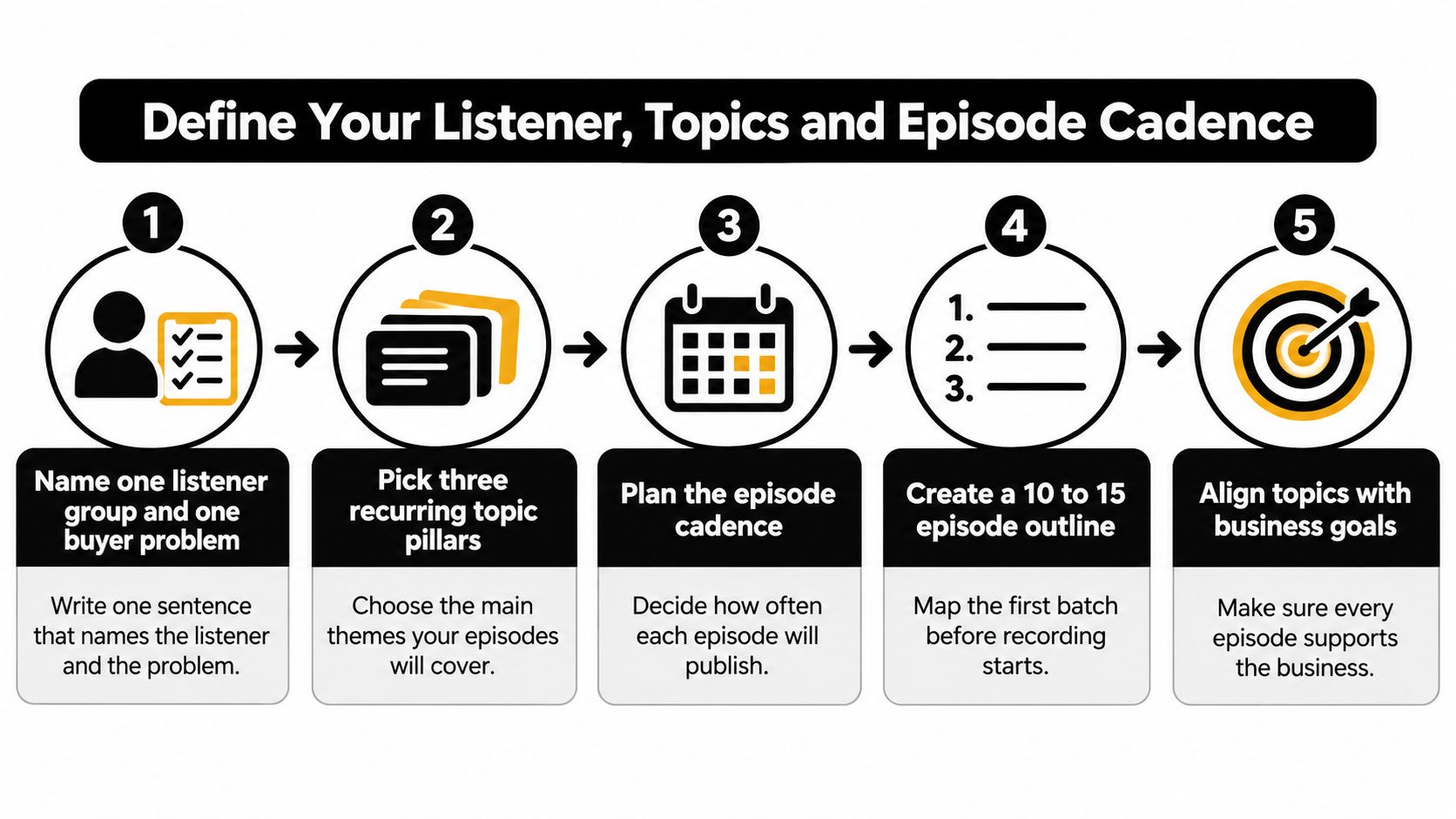
Five decisions before recording
- Name one listener and one problem. Write a single sentence, such as owners of two-person accounting firms who need to hire their first employee. A narrow definition makes topic and guest choices easier because you can ask whether each episode helps that person.
- Test your audience assumption. A cross-market advertising analysis found 43.5% of age-targeted podcast impressions were directed at 25-34-year-olds, while only 2.6% combined went to listeners aged 55 and older. If your buyers are older professionals, a language community, or customers outside your home country, that overlooked audience may be your opening.
- Collect topics from real questions. Pull ten questions from sales calls, support tickets, consultations, and reviews. Turn each question into a working episode title. If you can't find ten, interview customers before inventing a content calendar.
- Choose a sustainable length. Twenty to forty minutes is a practical planning range for many interviews. Shorter episodes are easier to produce, but they still need a clear beginning, useful middle, and specific next step.
- Set a cadence you can keep. Commit to twelve weeks, not forever. Then write a one-sentence show promise that names the listener, the problem, and the outcome.
This short video walkthrough can help you compare your draft promise with the decisions above before you lock the schedule.
Make the show usable for the audience you chose
Plain-language descriptions, chapters, and transcripts help listeners find the part they need. If you serve another region, consider regional examples, translated show notes or subtitles, time-zone-aware promotion, and local privacy and consent expectations. Measure results by geography and audience segment so you know whether the intended listeners are arriving.
Guest selection should follow the same listener definition. Our guide on how to find guests for your podcast can help you build a shortlist around buyer problems rather than celebrity value.
Finish with two checks. Could a stranger read your promise and know who should listen? Can you name the next six episodes without struggling? If either answer is no, tighten the audience or collect more customer questions before recording.
Record and Master Episodes to a Broadcast Standard
Good mastering makes speech easier to follow across headphones, car speakers, and smart speakers. Set a clear target, then use it consistently.
| Episode type | Loudness target | Tolerance | True peak ceiling |
|---|---|---|---|
| Stereo spoken-word episode | -16 LUFS | ±1 dB | -1 dBFS |
Apple Podcasts audio requirements recommend approximately -16 dB LKFS/LUFS for stereo audio, with a tolerance of ±1 dB and a true-peak ceiling no higher than -1 dB FS, measured under ITU-R BS.1770-5.
What the two main numbers mean
Loudness describes how loud the episode sounds on average. If one episode is much quieter than the last, listeners may need to adjust their volume. True peak is the highest instantaneous level in the file. Staying below the ceiling leaves headroom and reduces the risk of distortion after encoding.
Integrated loudness averages the level across the finished episode. Measure it after editing, rather than judging it from one loud passage. A limiter can control peaks, but heavy limiting can make voices sound flat or harsh. Use only as much as needed.
A simple mastering workflow
- Record each speaker separately. Separate tracks let you adjust one voice without changing the other.
- Check microphone position. Keep each speaker close to the microphone, and listen for the quietest voice before editing.
- Clean obvious problems. Remove long silences, clicks, and distracting background noise without making speech sound artificial.
- Balance the voices. Bring speakers to a similar perceived level before mastering the full episode.
- Measure integrated loudness. Compare the finished edit with the target.
- Apply limiting only where needed. Recheck loudness after making changes.
- Verify true peak after encoding. Export settings can change peaks, so check the file you plan to upload.
- Keep loudness metadata when supported. Compatible platforms can use it to handle playback consistently.
Normalization can correct average level. It cannot repair clipping, room echo, traffic noise, or a guest speaking far from the microphone.
Prevent those problems at the recording stage. Ask guests to use headphones, silence notifications, sit in a furnished room, and keep a steady distance from the microphone. Record a short test and listen before the interview. Remote calls can also produce dropouts, robotic compression, and overlapping speech when there is a delay.
A modest kit is enough: a decent USB or XLR microphone, headphones for monitoring, a quiet room, and editing software that measures loudness. Technique matters more than an expensive upgrade. If you cannot understand every word on laptop speakers at a normal volume, improve the recording rather than trying to hide the problem during mastering.
Publish, Promote and Repurpose Each Episode
Choose a podcast host that provides a public RSS feed. Directories such as Apple Podcasts and Spotify read that feed, so one hosting account can distribute each episode everywhere. You publish once, then verify that directories picked it up.
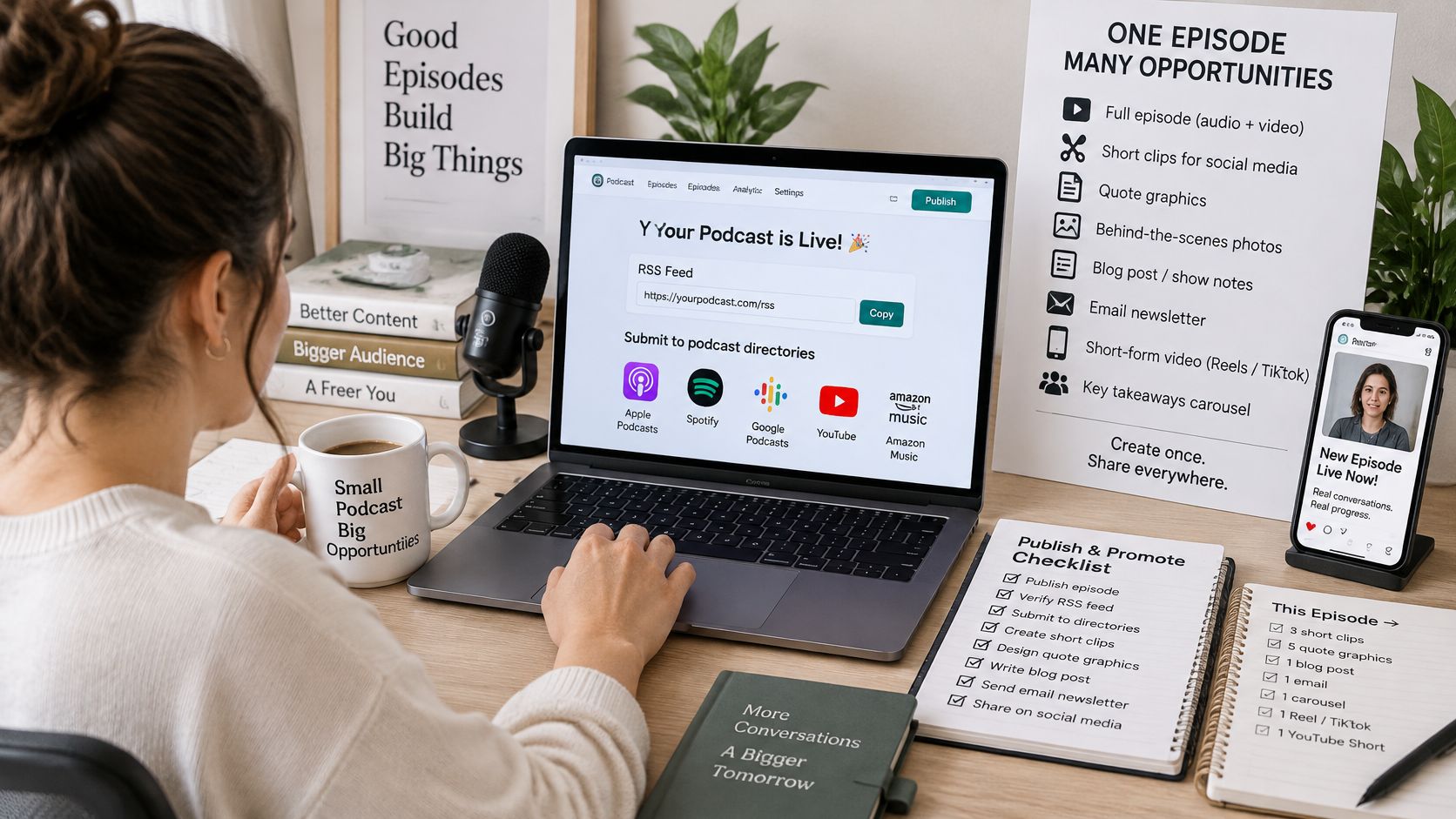
Publishing checklist
- Upload the final file. Add a clear title, description, and square cover art of at least 1400 by 1400 pixels.
- Write focused show notes. Name the guest, state the problem solved, summarize the main points, and include one relevant link.
- Add a full transcript. Transcripts support accessibility and give search engines text they can read.
- Publish on a consistent weekday. A predictable slot helps listeners and your production team plan.
- Submit and confirm. Submit the feed to your chosen directories and check that the episode appears with the right audio and description.
Your title should say what the listener will learn, not merely announce a conversation. For example, "How a Two-Person Firm Hires Its First Employee" gives a prospective listener more reason to press play than "Episode 8, Interview With Alex." Keep the guest's name in the description if it doesn't fit naturally in the title.
Three low-cost promotion actions
Ask each guest to share the episode with their own audience. Give them the link, a short summary, and one quote or clip they can use without extra work. Guest promotion is often a strong reach lever because their network already trusts them.
Cut one 60-second highlight for social media. Choose a complete, useful idea rather than a dramatic fragment that needs missing context. Add captions so people can follow it with the sound off.
Turn the transcript into a blog post or newsletter section. Don't paste an unedited transcript and call it finished. Add headings, remove repetition, link to the episode, and highlight the decision or example readers can apply. For a deeper promotion routine, see how to promote a podcast.
Avoid pushing the same episode repeatedly on every platform. One thoughtful share per platform is usually enough for a small audience. More promotion won't compensate for a vague topic, weak audio, or an episode that doesn't solve the promised problem.
Measure Whether Your Podcast Brings Business Results
A download count is not a listener count. Edison Research's podcast metrics methodology measures listening rather than downloads, using 5,044 online interviews with weekly podcast consumers aged 13 and older in its cited U.S. study. Treat hosting numbers as a reach indicator, not proof that unique people heard an episode from start to finish.
| Metric | What it proves | What it cannot prove | Where to find it |
|---|---|---|---|
| Episode downloads | Reach indicator over a set period | Unique listeners or completed listens | Hosting dashboard |
| Average consumption | How much of each episode listeners hear | Whether listeners take any action | Hosting or podcast platform analytics |
| Branded search and website sessions | Interest that rises after an appearance | Which episode caused the interest | Website analytics |
| Episode-specific UTM link visits | Clicks from a specific episode or guest | Sales from people who never clicked | Analytics tool |
| Qualified inquiries logged in CRM | Business demand tied to a source | Word-of-mouth influence not recorded | CRM |
Build measurement before launch
- Record a 30-day baseline. Capture website sessions, branded search, follower changes, inquiries, and sales conversations before the first episode appears.
- Give each episode its own route. Use a unique UTM link or dedicated landing page for each episode, guest, or appearance.
- Ask every new lead one question. Ask how they heard about you and log the exact answer in your CRM.
- Review after 90 days. Compare inquiry volume and conversion rates with the baseline using a consistent reporting period.
- Judge guests by lead quality. A guest who brings two qualified buyers may be more valuable than one who brings a larger but irrelevant audience.
Use consistent definitions. A download during the first seven days isn't comparable with a download total accumulated over six months. Record the reporting window beside every number so future comparisons mean something.
Understand attribution without overstating it
Last-click attribution gives credit to the final tracked action before an inquiry or purchase. It undercounts podcast influence because someone may hear you on Monday, search your business name on Friday, and contact you the following week. Your analytics may credit search even though the episode created the initial interest.
Self-reported answers help fill that gap, but they're imperfect too. People forget, name the most recent touchpoint, or mention a person rather than the show. Use UTMs, branded search movement, average consumption, and CRM notes together. Look for agreement across several signals instead of demanding one perfect source of proof.
Say a consultant records interviews with three owners who match her ideal client profile. The episodes produce modest downloads, but two guests request proposals and one introduces her to a partner. That can be a strong business result. Another episode may receive far more downloads from people who can't buy her service. Bigger reach didn't create bigger value.
Report what each metric shows and what it can't prove. Never present downloads as listeners, listeners as leads, or leads as sales unless your records support that chain.
Plan Your First Ninety Days of Episodes
Weeks 1 to 2
Choose the format that matches your goal, write the show promise, and record your thirty-day measurement baseline. Decide your publishing weekday and create the tracking fields you'll use in your CRM. Don't record a trailer until you can explain who the show serves and what action a listener should take next.
Weeks 3 to 6
Record and master three episodes. Publish them through your RSS feed, add transcripts and show notes, and create one unique link or landing page for each episode. Send every guest a ready-to-share summary and clip. Note production time, including scheduling and promotion, so the next phase uses real numbers.
Weeks 7 to 12
Publish in your fixed slot, log every inquiry, and record how each lead says they found you. At week twelve, compare inquiries, conversion rates, production hours, and useful relationships with your baseline. Then make the decision your evidence supports. Keep the format, change the audience or cadence, shift to guest appearances, or stop.
If interviews are central to your plan, finding suitable guests or shows is often the hardest operational step. At Let's Make A Podcast, we offer a free search tool, with no account needed, that searches real podcasts by topic and shows which are still publishing, which publish a contact route, and which show evidence they book outside guests. Joining is free, and creating a profile, browsing, pitching, inviting, messaging, and scheduling cost nothing.
Book the first recording date on your calendar today. A confirmed date forces the remaining decisions into the open and turns a loose podcast idea into a testable business channel.
Ready to turn your first ninety days into booked conversations instead of a list of cold outreach guesses? Visit Let's Make A Podcast to find active shows or qualified guests, publish a profile, and move from discovery to a scheduled recording in one place.