10 Podcast for Leadership Picks for 2026
One leadership podcast rarely serves every manager, executive, or founder well. A new manager needs a repeatable one-on-one structure, while a chief executive may need better judgment under uncertainty. A team lead working on conflict has a different problem from a founder building culture during rapid growth.
That distinction matters because senior executives are unusually active podcast listeners. A March 2024 Signal Hill Insights study of 24,505 surveys found that 83% of senior executives had listened to a podcast in the previous week. The strongest show for leadership development, however, may be a poor source of day-to-day management tactics, and a tactical show may not offer the strategic thinking a prospective guest wants to demonstrate.
This list compares 10 resources by format, audience, practical workplace application, limitations, and guest-pitch fit. Use it to build a focused listening rotation, or to decide which shows deserve targeted outreach. Let's Make A Podcast is relevant if you want to identify active, topic-aligned shows and organize guest pitching, but its presence in this article isn't an endorsement of every podcast listed.
Table of Contents
- 1. HBR IdeaCast
- 2. Masters of Scale
- 3. The Learning Leader Show With Ryan Hawk
- 4. Coaching for Leaders
- 5. Manager Tools
- 6. The Look & Sound of Leadership
- 7. The Knowledge Project
- 8. At The Table With Patrick Lencioni
- 9. How Leaders Lead With David Novak
- 10. The Modern Manager
- Top 10 Leadership Podcasts, Comparison Matrix
- Build a Leadership Listening and Pitching Plan
1. HBR IdeaCast
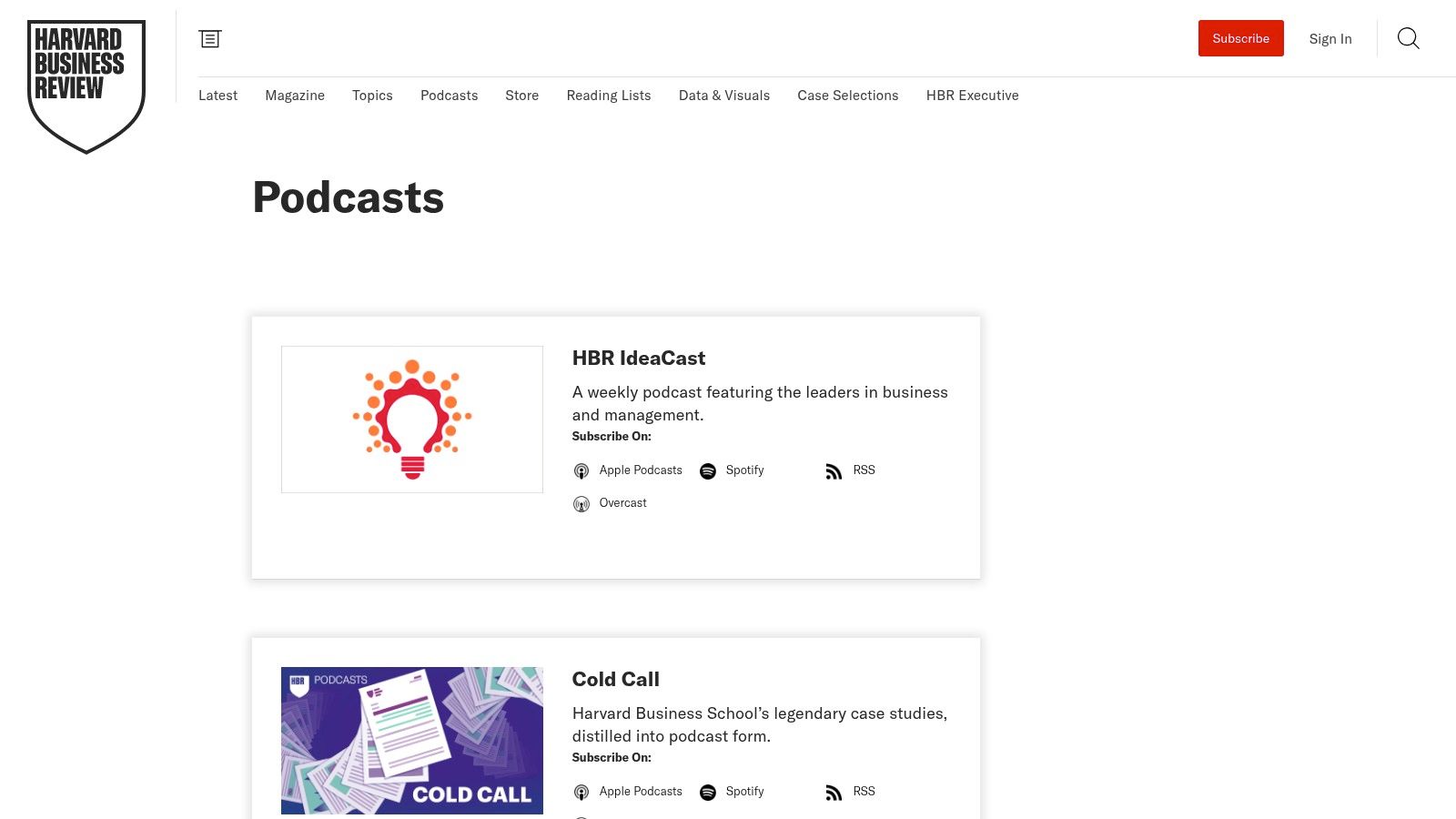
HBR IdeaCast is a strong starting point for leaders who want research-led thinking without reading an entire management article before work. Its interviews and explainers bring together researchers, CEOs, and practitioners around culture, strategy, team dynamics, communication, change, and the future of work.
The editorial approach is its main advantage. Episodes are focused and accessible, making the show suitable for a busy executive who wants one clearly framed management question rather than an extended personal conversation. The archive also gives listeners a useful way to explore a leadership problem over time, while transcripts make it easier to revisit a framework or share a relevant passage with a team.
Best workplace application
HBR IdeaCast is better for diagnosing a leadership problem than for prescribing an exact script. A listener might use an episode to reconsider how a team handles change, why a culture initiative isn't gaining traction, or which assumptions are shaping a strategic decision. The next step still belongs to the listener, who must translate the idea into a meeting agenda, decision rule, or experiment.
Its formal, academic tone won't suit everyone. Leaders looking for step-by-step instructions on giving feedback or running a one-on-one may find tactical shows more immediately useful.
For a guest, the fit is strongest when the proposed topic has a clear management question, evidence, and relevance beyond one personal story. A narrow idea about implementing a workplace change is more credible than a general pitch about being an inspiring leader. Prospective guests can review the HBR IdeaCast guest opportunity before preparing outreach.
2. Masters of Scale
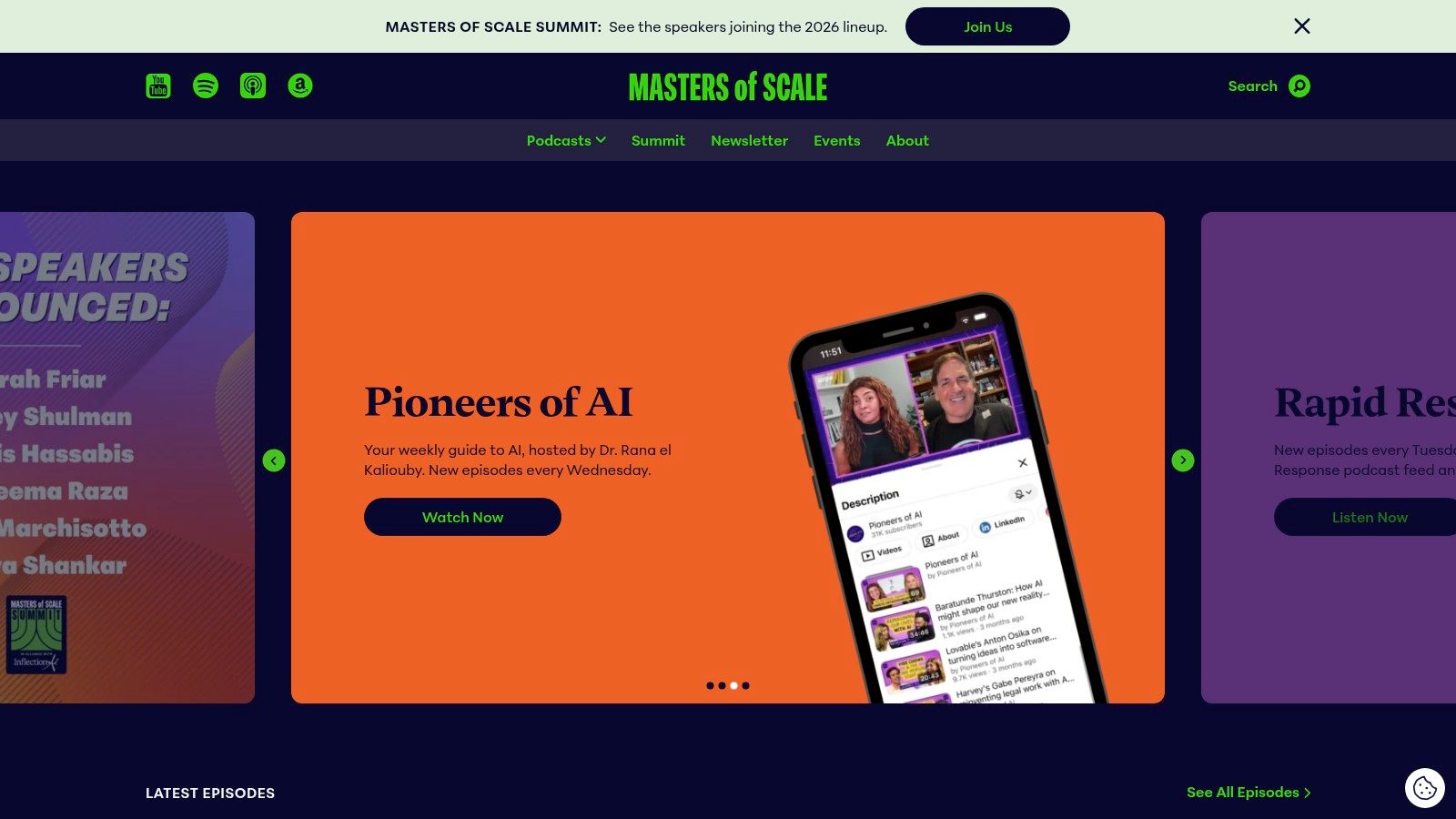
Masters of Scale turns leadership lessons into stories about building and scaling organizations. Its narrative production, founder and CEO interviews, Rapid Response episodes, and live events create a wider ecosystem than a conventional interview feed.
The show works particularly well for listeners who remember a leadership principle when it is attached to a decision, conflict, launch, or crisis. Rather than presenting management as a collection of isolated techniques, episodes often connect a theory to the choices leaders made while organizations were growing. That makes the lessons memorable, though it can also make them harder to transfer directly to a small team, public-sector organization, or mature institution.
Best workplace application
Choose this show when your question is how leadership changes as an organization becomes more complex. A listener can extract ideas about delegation, culture, crisis communication, or scaling a decision process, then test whether the principle still works in their own context. The application is interpretive rather than procedural, so it suits experienced leaders who can adapt a framework without copying a founder's playbook.
The main limitation is its emphasis on hypergrowth and startup environments. Those stories may offer useful contrasts, but they won't automatically solve the constraints faced by a nonprofit, government department, or established enterprise. Frequent sponsorship segments may also interrupt the flow for listeners who prefer a tighter editorial experience.
For a guest pitch, the show favors a distinctive scale-related tension. A credible guest might bring an unusual approach to growth, a clear lesson from a crisis, or a leadership theory tested across changing organizational stages. A generic founder biography is unlikely to create the same editorial hook as a specific decision with broader implications.
3. The Learning Leader Show With Ryan Hawk
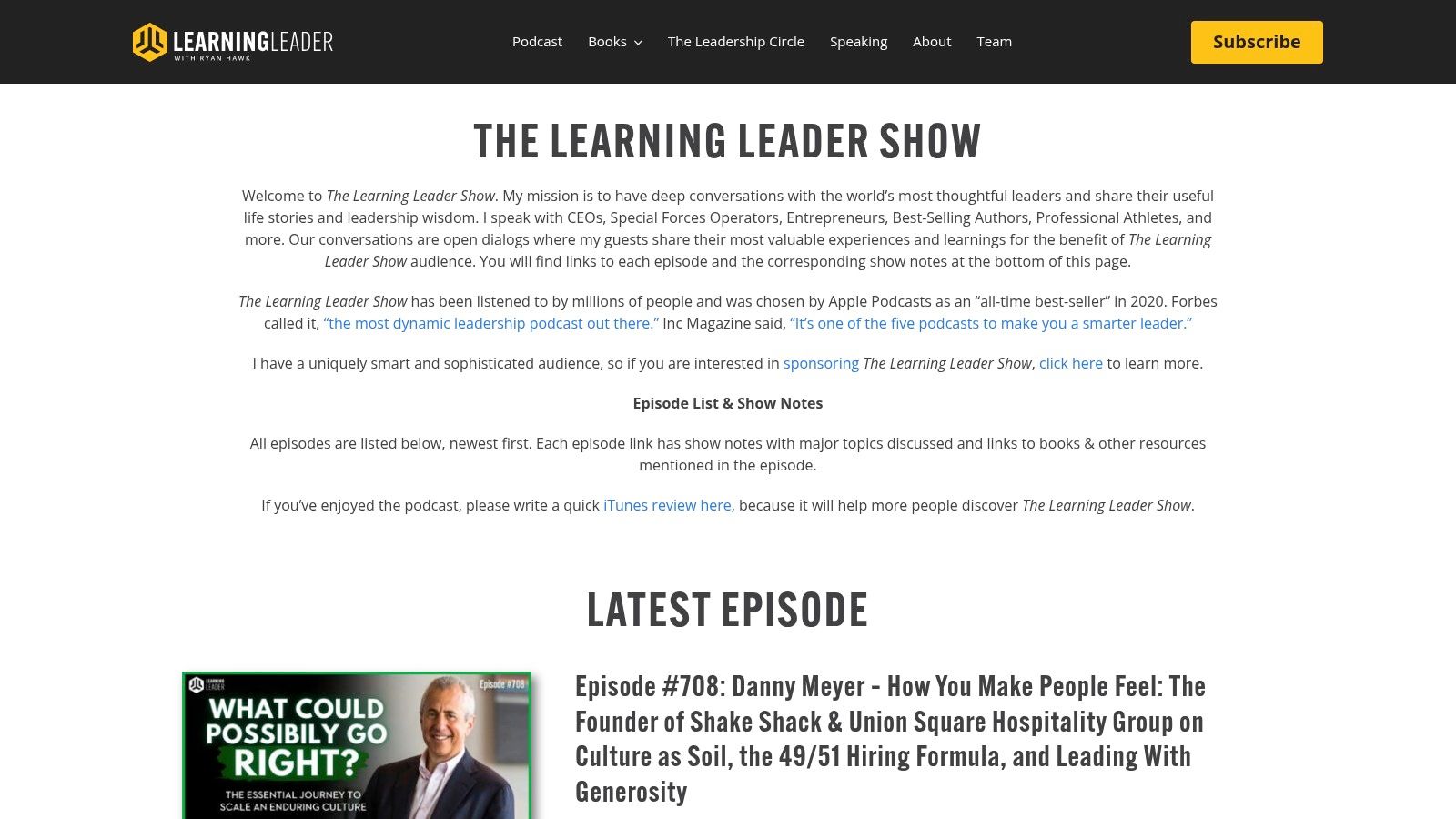
The Learning Leader Show is built around long-form conversations with CEOs, athletes, authors, and military leaders. Its central subject isn't merely management technique. It's the craft of becoming a better leader through curiosity, deliberate practice, habits, and reflection.
The extended format gives guests room to explain how they think, not just what they achieved. That benefits listeners who want context, stories, and practical takeaways woven into a substantial conversation. The searchable archive and detailed show notes also make it easier to find episodes by guest or topic instead of relying on the latest release.
Best workplace application
This is a good choice when the workplace problem involves personal leadership practice, such as building better habits, asking more useful questions, or learning from failure. A listener can keep a short reflection log after each episode, identifying one behavior to test during the following week. The show is less suitable when the listener needs an immediate script for a difficult conversation.
The time commitment is significant because interviews often run from 60 to 90 minutes. That length creates depth, but it also requires deliberate listening. Episode quality can vary with guest fit, as happens with any personality-driven interview format, so listeners may benefit from selecting episodes by problem rather than playing the feed in order.
For a prospective guest, the strongest pitch combines a compelling leadership journey with a transferable practice. A guest should explain the lesson in a way that serves listeners beyond their own industry. Stories about deliberate practice, recovery from a leadership mistake, or an unexpected mentor can work well when they lead to concrete reflection questions.
4. Coaching for Leaders
Coaching for Leaders is aimed at the manager facing a problem this week. Its subjects include feedback, influence, conflict, hiring, career conversations, and other recurring responsibilities that make leadership feel less like a grand theory and more like a sequence of difficult interactions.
The show's topic-indexed archive and detailed book notes make it practical for targeted research. A manager doesn't need to consume the full catalog to find relevant material. The free membership and searchable library support a more intentional approach, while companion courses, community options, and Academy resources extend the learning beyond the audio feed.
Best workplace application
The show is especially useful for turning leadership knowledge into a conversation or behavior. Before pressing play, a listener can define the situation, such as an underperforming employee, a stalled hiring process, or a peer who resists influence. Afterward, they can write the opening question, desired outcome, and next action they'll use at work.
Practical rule: Don't finish an episode with only a highlighted idea. Convert the idea into a sentence you'll say, a question you'll ask, or a process you'll change.
Its tactical strength is also its boundary. Leaders searching for broad theories of organizational design or long-form strategic debate may find the format less expansive than a research or executive show. Some deeper resources sit behind free-account or paid access, and the straightforward production style prioritizes utility over narrative polish.
Guest pitches should focus on a specific management challenge and a useful framework. Researchers, authors, and practitioners with a teachable model can fit well, especially when they can explain how a concept changes a manager's next conversation.
5. Manager Tools
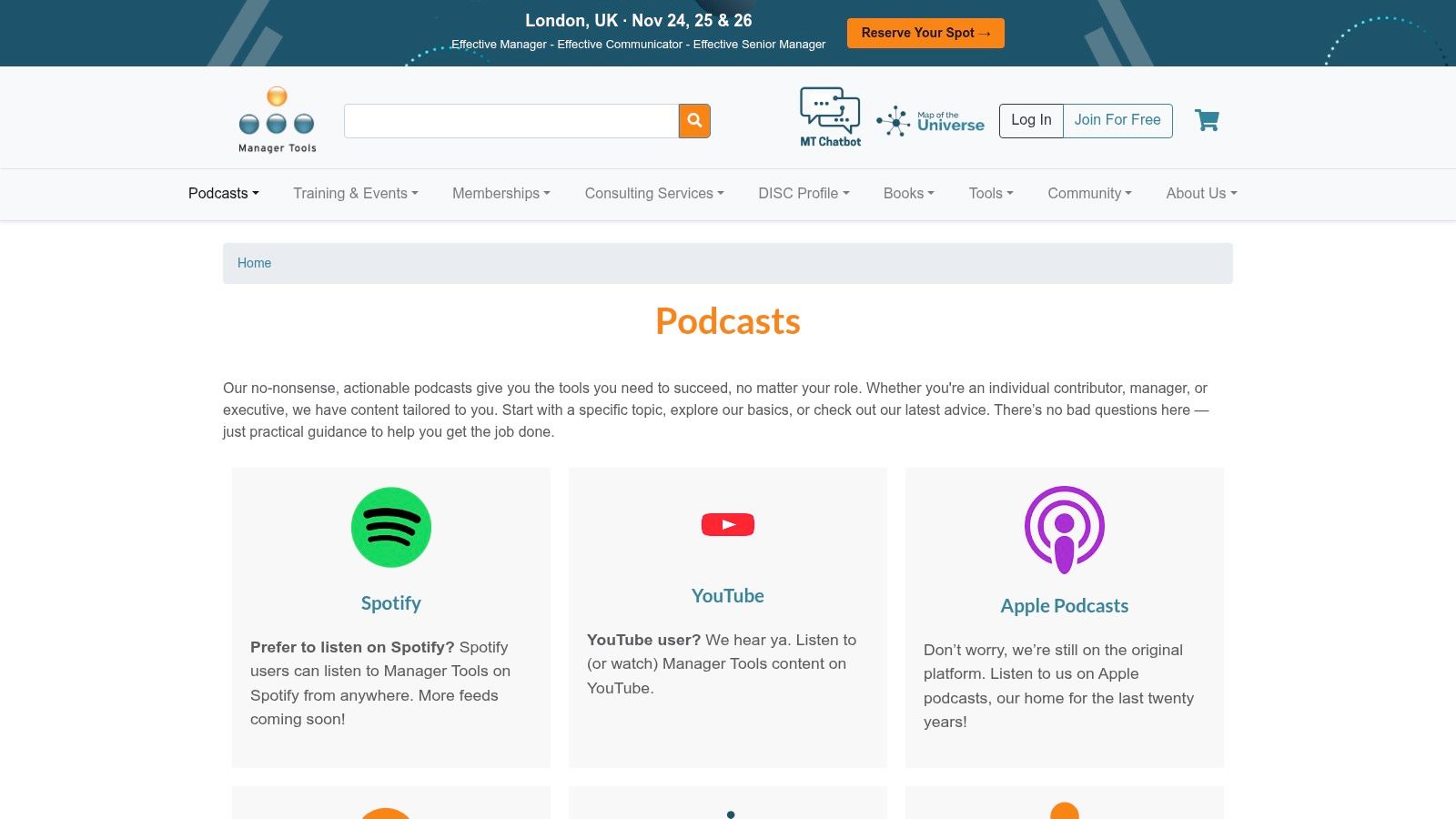
Manager Tools takes a process-first view of leadership. Its feeds for Manager Tools, Career Tools, and Executive Tools separate different professional needs, while indexed libraries and Basics series help new managers find foundational guidance without navigating an undifferentiated archive.
The delivery is direct and utilitarian. That can feel dry beside highly produced narrative shows, but it supports the central promise: give managers a repeatable way to handle a recurring responsibility. One-on-ones, feedback, delegation, and coaching are treated as behaviors and processes, not abstract virtues.
Best workplace application
Manager Tools is the clearest pick for a newly promoted manager who needs structure. A listener can choose one process, use it consistently, and observe how employees respond. That makes it more actionable than a show that only describes the importance of trust or communication.
The risk is over-application. A process can provide discipline, but managers still need judgment about personality, power, culture, and context. The private license offers ad-free feeds and full shownotes, while some resources require payment, so listeners should decide whether the additional materials justify the commitment.
For a guest pitch, fit is narrower but clear. The strongest proposal offers a specific, repeatable management tool that listeners can understand and try. A guest should avoid presenting a broad leadership philosophy unless it resolves a recognizable management problem. The show's practical audience will want to know what to do, when to do it, and what common mistake to avoid.
6. The Look & Sound of Leadership
The Look & Sound of Leadership concentrates on executive presence, communication, influence, perception, and the politics of senior leadership. Tom Henschel's solo coaching format uses scenario-based lessons rather than a rotating line-up of external guests.
Episodes typically run 15 to 30 minutes, which makes the show useful when a leader needs a focused intervention before a presentation, difficult meeting, or high-stakes conversation. The curated library organizes lessons by leadership theme, and the free Essential Tools downloads give listeners something concrete to use alongside the audio.
Best workplace application
This is less about redesigning an organization and more about how a leader is perceived in a specific moment. A listener might apply an episode by changing how they open a meeting, frame disagreement, or communicate confidence without becoming performative. The emphasis on self-awareness is valuable because leaders often focus on their intention while colleagues experience their tone, timing, or behavior differently.
The solo format limits the range of outside perspectives. It also means the show isn't a natural fit for founders seeking advice on scaling strategy or organizational architecture. However, that narrow focus is useful for executives who already understand the business problem and need to improve how they communicate through it.
Prospective guests should pitch an expertise that complements executive presence, such as difficult conversations, public speaking, stakeholder influence, or leadership communication. A guest can use the podcasts on public speaking resource to refine a topic that is practical rather than broadly motivational.
7. The Knowledge Project
The Knowledge Project is designed for leaders who want to improve decision quality, mental models, clarity of thought, and long-term judgment. Farnam Street's long-form interviews draw on business, psychology, science, sports, strategy, and performance, which gives the show a broader intellectual range than a conventional management podcast.
This is leadership development at the level beneath a particular tactic. A listener may not hear a ready-made agenda for a one-on-one, but they may become better at identifying assumptions, evaluating trade-offs, or noticing the cognitive patterns that distort a decision. Optional paid membership provides extended, ad-free episodes for people who want a more focused listening experience.
Best workplace application
Use the show when the problem is not knowing what to think, rather than not knowing what to say. After listening, a leader might separate facts from interpretations, write down competing explanations, or ask which incentives are shaping a team's recommendation. Those practices can improve strategic decisions, but they require time and deliberate reflection.
Long episodes demand focused attention. This isn't the best choice for someone who wants a quick fix before a performance review. Its value increases for senior leaders handling ambiguous decisions, because the subject matter develops meta-skills that remain useful across different roles and industries.
A guest pitch should bring a clear intellectual contribution, not merely a résumé. The strongest guests can explain a mental model, decision mistake, or research-backed method in plain language, then show how it changes behavior. A narrow question about judgment is likely to fit better than a broad claim about leadership success.
8. At The Table With Patrick Lencioni
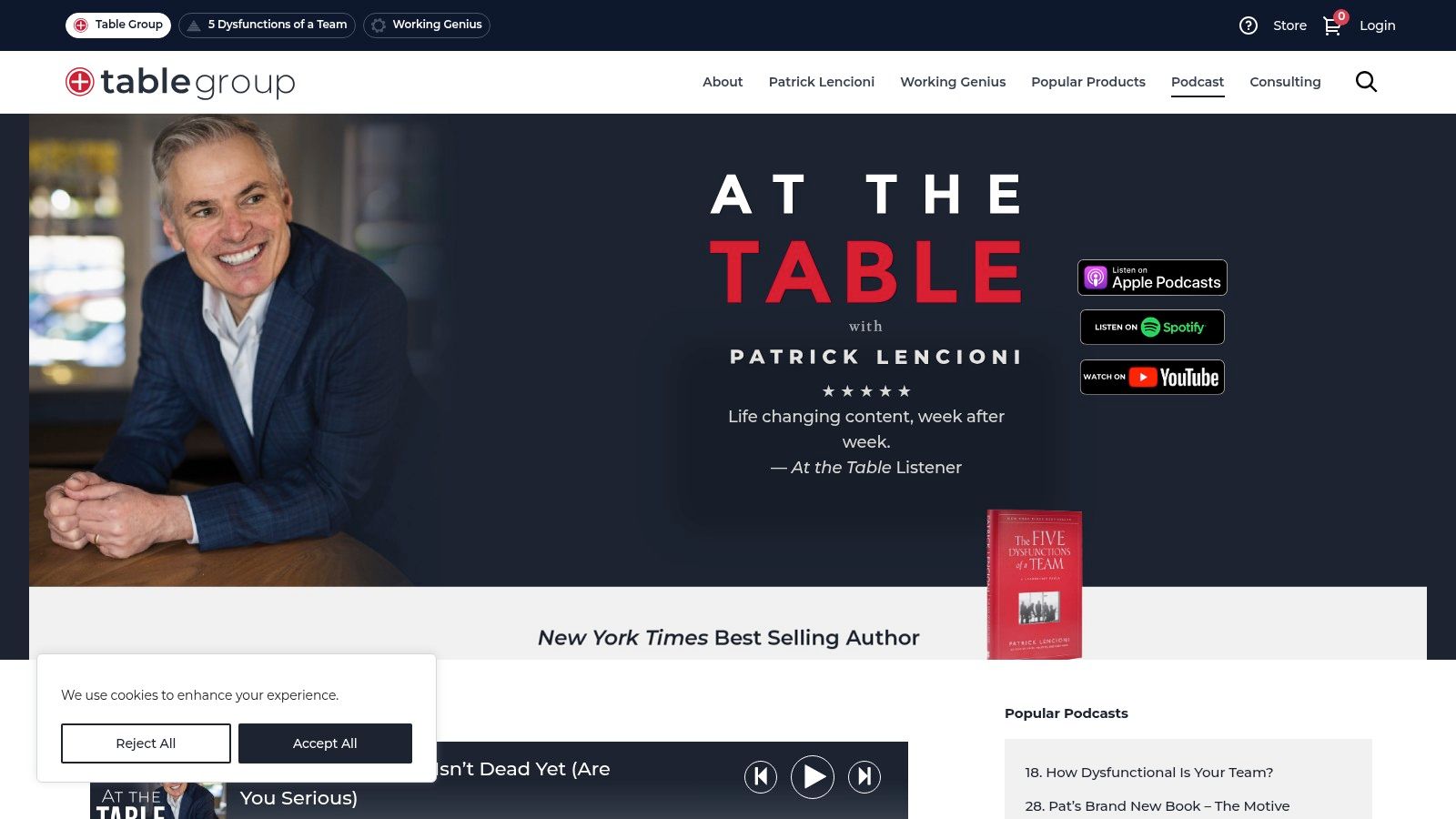
At The Table focuses on team health, trust, meetings, hiring, and organizational clarity. Patrick Lencioni's conversational, fast-paced episodes connect leadership problems to the Table Group's models and tools, giving listeners frameworks they can remember and teach.
That teachability is the show's biggest strength. A leader can use an episode as the starting point for a team discussion, a meeting redesign, or a conversation about trust. Short episodes also fit commutes and staff-development routines better than long interviews, particularly when a leadership team wants a shared vocabulary.
Best workplace application
Choose this show when the team problem is collective rather than individual. It can help leaders examine whether meetings create clarity, whether team members engage in productive conflict, and whether organizational priorities are understood. The practical move is to select one framework and discuss how it appears in the team's current behavior, rather than treating the episode as a motivational broadcast.
The limitation is methodological. Content is centered on Lencioni's approach and includes less outside research than a publication-led show. Some analogies involving churches or nonprofits may also require adaptation for listeners in commercial or highly regulated settings.
For a guest, the fit depends on offering a useful perspective on team health without competing with the show's established methodology. A pitch might address a specific trust problem, meeting failure, or clarity challenge, especially if the guest can provide a concrete example and a tool leaders can teach internally.
9. How Leaders Lead With David Novak
How Leaders Lead features C-suite leaders discussing recognition, culture, decision-making, and leadership at scale. David Novak's background as a former Yum! Brands CEO gives the show an enterprise orientation, with conversations that often focus on how large organizations shape behavior through people practices and culture.
This makes the podcast most useful for executives responsible for leading through organizational scale. The site's transcripts, summaries, and companion leadership content help listeners revisit a decision or share a principle with colleagues. The format also gives guests space to explain the decisions behind a result rather than merely describing the result itself.
Best workplace application
Listeners can apply the show by examining how recognition, culture, and leadership habits operate across layers of an organization. An executive might ask whether the behaviors praised at the top are visible in frontline management, or whether a stated value influences hiring and promotion decisions. That is a system-level exercise, not a quick conversation script.
The enterprise lens limits relevance for early-stage teams or first-time managers. A leader in a small organization may need to translate large-company examples into simpler routines, such as clarifying expected behaviors or recognizing contributions consistently.
Guest pitches should suit a C-suite audience. A prospective guest needs a strong decision story, a people-first leadership practice, or a lesson about shaping culture across a complex organization. The pitch should explain why the subject matters to leaders beyond the guest's company, and it should avoid presenting corporate scale as proof by itself.
10. The Modern Manager
The Modern Manager translates leadership principles into daily management behaviors. Its topics include one-on-ones, feedback, facilitation, team dynamics, meeting design, and operating systems for distributed teams. Action-oriented episodes and one-page implementation guides help close the gap between understanding a practice and using it.
The show is particularly well suited to new and mid-level managers who need something they can try the next day. Rather than asking listeners to absorb a broad theory of leadership, it narrows attention to a behavior, a meeting pattern, or a team process that can be changed directly.
Best workplace application
The show works best when a manager chooses one implementation guide and uses it to prepare for a real event. That might mean redesigning a recurring meeting, changing the questions used in a one-on-one, or creating a clearer feedback loop for a distributed team. The practical focus helps listeners measure progress through behavior rather than inspiration.
Its scope is narrower than broad leadership thought shows, and its practical production style won't provide the same narrative experience as a heavily produced interview. That trade-off is sensible for managers who value implementation over entertainment.
For guest outreach, the ideal topic has a clear audience, a recognizable management problem, and an implementable solution. A prospective guest can review the leadership podcast listing to identify a topic-aligned show and shape the pitch around the listener's next action.
Top 10 Leadership Podcasts, Comparison Matrix
| Podcast | ✨ Core / Unique Features | 👥 Best For | ★ Quality / USP | 💰 Access |
|---|---|---|---|---|
| HBR IdeaCast (Harvard Business Review) | Research-backed, editor-curated interviews; transcripts | 👥 Busy leaders, executives | ★★★★☆ 🏆 Trusted, evidence-led insights | 💰 Free |
| Masters of Scale | Narrative frameworks, top founder/CEO guests, live events | 👥 Founders & growth leaders | ★★★★★ 🏆 Polished storytelling & memorable frameworks | 💰 Free |
| The Learning Leader Show (Ryan Hawk) | Long-form 60-90m interviews; large archive | 👥 Listeners wanting deep story-driven lessons | ★★★★ Practical, in-depth conversations | 💰 Free |
| Coaching for Leaders (Dave Stachowiak) | Topic-indexed archive, book notes, companion courses | 👥 Managers seeking tactical guidance | ★★★★ Proven, manager-friendly tactics | 💰 Free (some paid tiers) |
| Manager Tools | Step-by-step processes; separate indexed feeds | 👥 New or frontline managers | ★★★★★ 🏆 Extremely actionable, decades of practice | 💰 Free (paid license for extras) |
| The Look & Sound of Leadership (Tom Henschel) | 15-30m scenario-based coaching lessons | 👥 Leaders wanting executive presence tips | ★★★★ Tight, practical coaching | 💰 Free |
| The Knowledge Project (Farnam Street) | Deep dives on decision-making & mental models | 👥 Senior leaders & thinkers | ★★★★ Insightful, evergreen meta-skills | 💰 Free (optional membership) |
| At The Table (Patrick Lencioni) | Short, teachable frameworks on team health | 👥 Team builders & people leaders | ★★★★ Clear, repeatable organizational tools | 💰 Free |
| How Leaders Lead (David Novak) | CEO-centric play-by-play on recognition & culture | 👥 Enterprise leaders & C-suite | ★★★★ Strong enterprise focus, people-first lessons | 💰 Free |
| The Modern Manager (Mamie Kanfer Stewart) | One-page guides, programs to close knowing, doing gap | 👥 New & mid-level managers | ★★★★ Highly tactical, easy to implement | 💰 Free (paid programs) |
Build a Leadership Listening and Pitching Plan
The strongest choice depends on the capability you need to build, not on which show has the most recognizable name. For research and strategic perspective, start with HBR IdeaCast. Its editorial framing can help you understand a management problem before you rush toward a solution. Masters of Scale is better for leadership under growth, disruption, or organizational expansion, while The Learning Leader Show suits listeners who learn through stories, reflection, and examples of deliberate practice.
For tactical management, Coaching for Leaders, Manager Tools, and The Modern Manager are the most direct options. Coaching for Leaders helps you investigate a specific challenge and find supporting resources. Manager Tools offers repeatable processes for recurring responsibilities. The Modern Manager turns management ideas into next-day behaviors and meeting practices. These shows are more useful when you need to change what you do this week than when you're looking for a broad philosophy of leadership.
Choose The Look & Sound of Leadership for executive presence and communication. Choose The Knowledge Project for decision quality and judgment, particularly when the issue involves ambiguity, assumptions, or competing incentives. At The Table is the natural fit for team health, shared language, trust, meetings, and organizational clarity. How Leaders Lead is most relevant to enterprise culture, recognition, and people leadership across a large organization.
A simple listening system prevents passive consumption:
- Choose one primary show: Match it to the leadership capability you need most, rather than subscribing to every promising feed.
- Apply one idea at work: Write down the behavior, question, or process you'll test after the episode.
- Review the result: Note what changed, what failed, and what requires adaptation in your context.
- Add a secondary show carefully: Use a research-led show for perspective and a tactical show for implementation, or reverse that combination if you already understand the theory.
Prospective guests should use a similarly focused process. Define one leadership angle before contacting a host. Study relevant recent episodes, identify the show's audience and format, and explain why your topic belongs in that conversation. Prepare a concise one-sheet with your bio, proposed topics, relevant experience, and links to past appearances. Then use the show's stated pitch route instead of sending the same generic message everywhere.
Let's Make A Podcast can support that workflow by helping users search topic-aligned active shows, prepare a guest profile, generate context-aware pitches, and coordinate scheduling. Its directory, one-sheet builder, pitch tools, messaging, and scheduling features are designed to move outreach from discovery toward a booked conversation. Track follow-ups so you can distinguish a thoughtful second message from repeated, unfocused outreach.
The best podcast for leadership is the one that matches the problem in front of you and changes what you do afterward. Pick one episode, identify one behavior, test it with your team, and use the result to decide what deserves your next hour of listening.
Let's Make A Podcast offers a directory of active shows, leadership-focused discovery, guest one-sheet tools, context-aware pitch support, and scheduling workflows. Use it to find a podcast that matches your leadership expertise, prepare a focused guest pitch, and visit Let's Make A Podcast to start exploring.