Interview Question How Do You Stay Organized: STAR Answers

You're preparing for an interview, and your answer sounds reasonable: you use a calendar, make lists, and keep track of deadlines. Then you try saying it aloud and realize it could describe almost anyone. Nothing tells the interviewer what happens when a client changes the brief or your manager adds urgent work.
The interview question “How do you stay organized?” calls for more than productivity preferences. Describe a control system, then prove that it worked under pressure. Your answer should make your decisions visible, not just name the apps on your laptop.
Table of Contents
- What Interviewers Are Really Testing
- How to Build Your Answer with the STAR Method
- Sample Answers for Different Roles
- Mistakes That Make an Organized Answer Sound Hollow
- Follow-Up Questions Interviewers Ask Next
- Adapting Your Answer for Flexible and Neuroinclusive Workplaces
- A Host Playbook for Questions About Productivity
- Rehearse Your Answer Before the Interview
What Interviewers Are Really Testing
The question behind the question is simple: Can your commitments survive busy weeks? An interviewer wants to know whether other people can rely on you without chasing updates.
There's evidence behind that concern. A 2021 PLOS ONE meta-analysis of 158 studies involving 53,957 participants found a moderate positive relationship between time-management behavior and job performance, around r = 0.25, and identified conscientiousness as its strongest personality correlate. That's an association, not proof that a particular planning method causes better performance.
The workplace gap is also revealing. In a 2022 Timewatch survey of 300 employees across the United States and United Kingdom, 12% used a dedicated time-management system, while 88% relied on informal methods, including calendars, inboxes, to-do lists, or memory. A calendar isn't inherently inadequate. The question is whether you use it within a repeatable process.
Signals interviewers listen for
The examples below show the difference between describing a behavior and claiming a virtue. The result figures are illustrative, not achievements to borrow.
| Signal | Strong version | Weak version |
|---|---|---|
| Repeatable system | Names one task list and one calendar, used daily | Says they're very organized |
| Review rhythm | Reviews open commitments every Friday | Keeps everything in their head |
| Handling change | Logs a moved deadline and re-plans the week the same day | Says they adapt to whatever comes up |
| Measurable result | Illustrative result: missed deadlines fell from several a quarter to none over six months | Claims nothing ever slips |
The infographic highlights the distinction between evidence and good intentions.
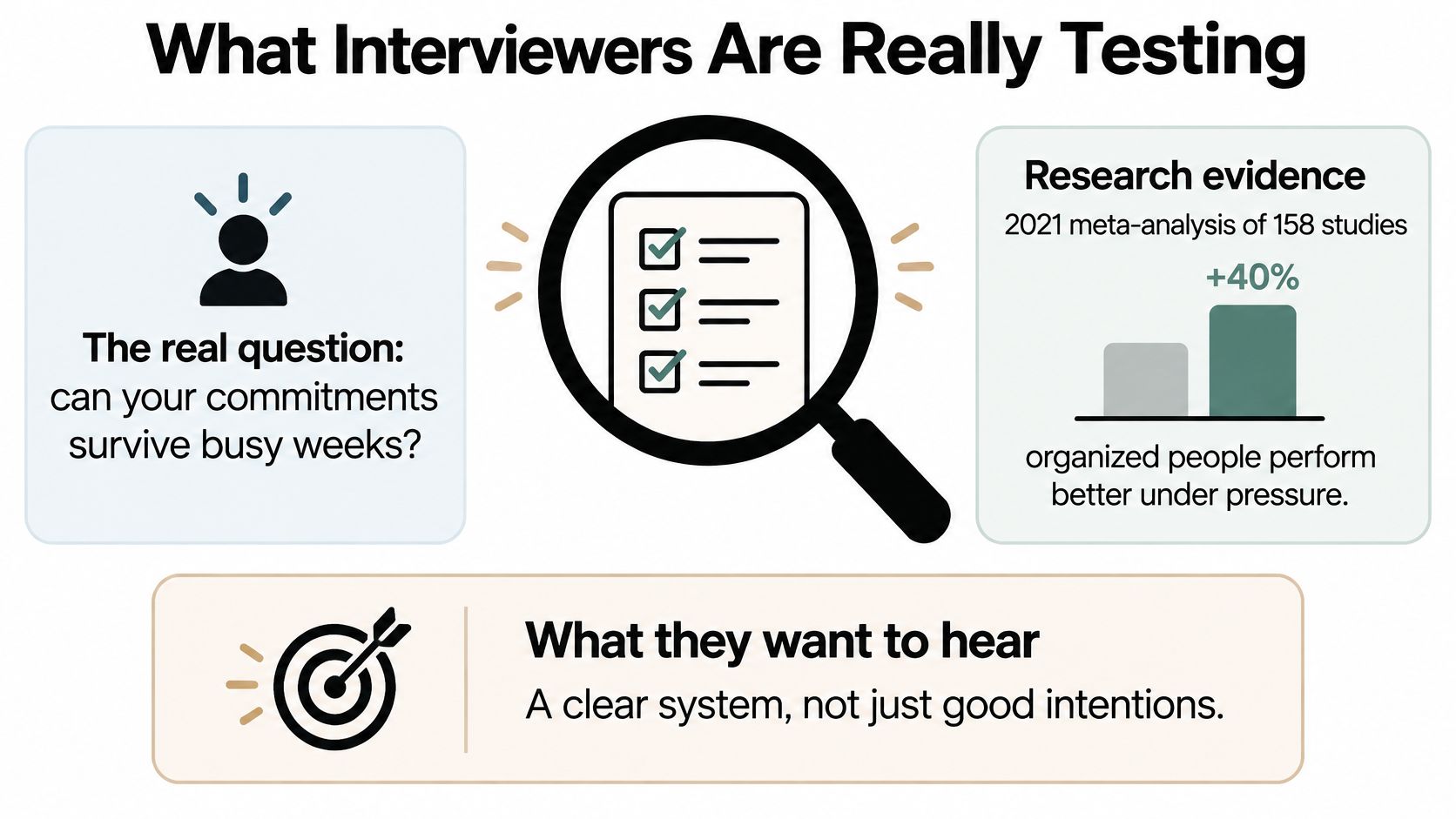
Don't turn a personality description into your entire answer. Being dependable matters, but observable behaviors give the interviewer something concrete to evaluate.
Here's a compact model to adapt. Replace the result with evidence you can defend:
I keep commitments in a prioritized task list and reserve execution time in my calendar. I check deadlines each morning and review open work on Fridays. When priorities change, I confirm the trade-off and update affected owners. On my last project, that helped me complete every agreed handoff by its deadline.
How to Build Your Answer with the STAR Method
Use STAR, Situation, Task, Action, Result, to show your system working in a real situation. Start with a brief summary of your method, then tell the story. Don't make the interviewer wait through your employment history.
The diagram gives you the sequence to rehearse.
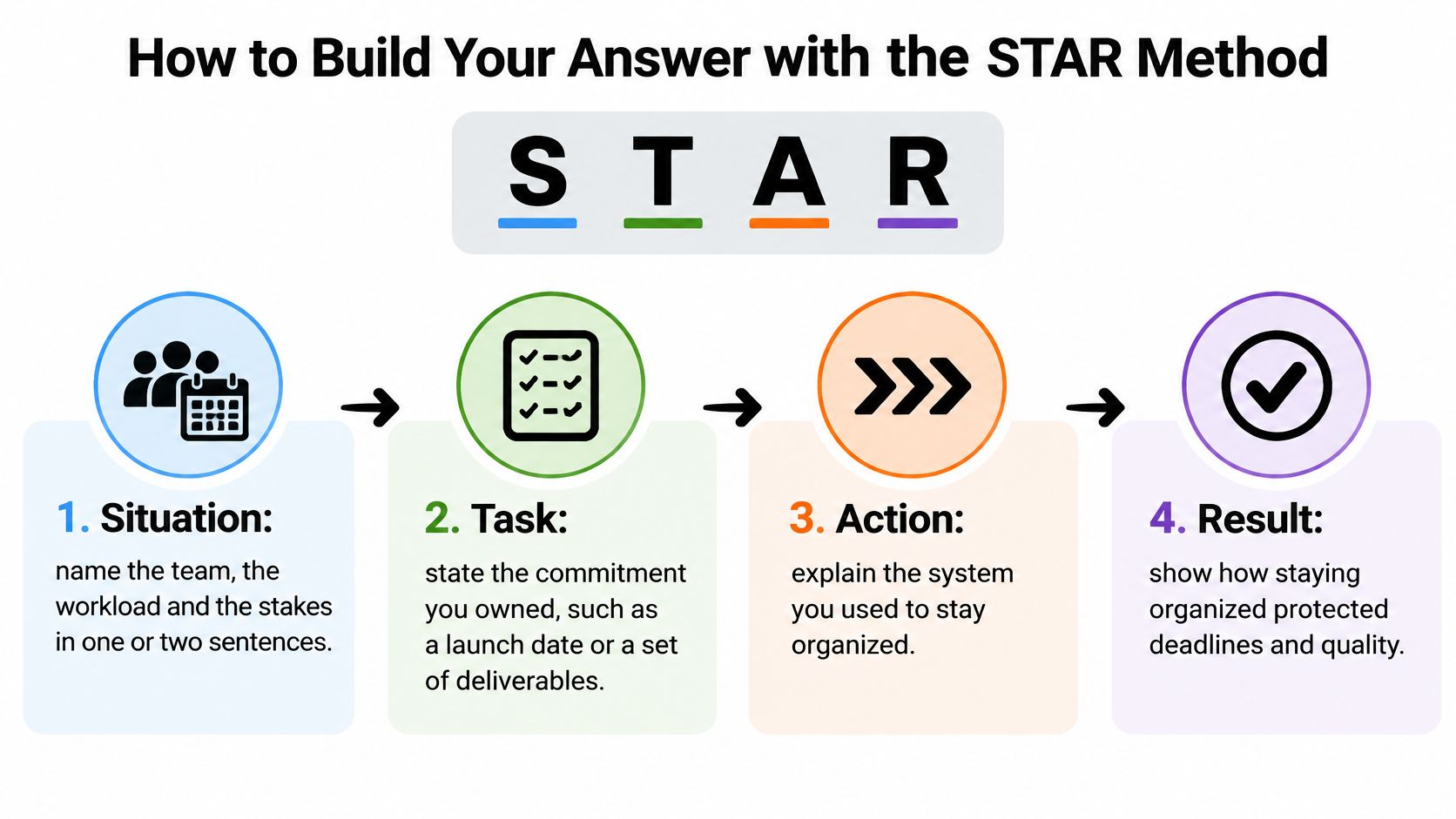
Situation. Name the team, workload, and stakes in a brief setup, such as coordinating a launch while supporting existing clients. This establishes difficulty; the common mistake is spending most of the answer explaining background.
Task. State the commitment you personally owned, such as delivering approved materials before launch. Clear ownership separates your contribution from the team's work; avoid hiding behind we throughout.
Action. Explain how you ranked work, reserved focus time, checked dependencies, and recorded changes. This is the substance of the answer, so don't substitute a list of software names.
Result. Give an outcome you can substantiate through delivery records, handoff dates, or a before-and-after comparison. Don't end with a vague statement that everything went well.
Make the decision rules visible
ResumeMate's guide to answering organization questions recommends combining a practical method with a concrete example. Make yours stronger by explaining the decisions behind the method: what ranks first, who confirms a changed priority, and how you spot delivery risk.
For example, describe a task list with fields for owner, due date, dependency, and next action. Explain that you check dependency dates before committing to a delivery date. That tells the interviewer more than naming Asana, Trello, or Notion without explaining how you use it.
When a manager brings a deadline forward, don't suggest you work faster. Explain what you reassess:
- Scope: Can the deliverable be reduced without undermining its purpose?
- Capacity: Which existing commitment would lose execution time?
- Authority: Who can approve that trade-off?
- Visibility: Where will the revised agreement be recorded?
An urgent request should produce an explicit decision, not an invisible promise to do everything. If stakeholders disagree, explain how you present the consequences and ask the accountable manager to choose.
Use the video as an additional rehearsal aid, then practice your own example rather than memorizing somebody else's phrasing.
Aim for a spoken answer of about a minute to a minute and a half. Give the most airtime to your actions and result, and finish with this test: Could a colleague repeat your system after hearing it once?
Sample Answers for Different Roles
A software engineer's answer should connect organization to engineering decisions, not just a tidy sprint board. Here's an illustrative sample, not a claim about an actual employee:
I use the sprint board as my commitment record and write a daily plan around the highest-priority blocker. When older bugs were repeatedly getting pushed aside, I reviewed their age and impact with the product owner, agreed which belonged in the sprint, and recorded a next action for each. We reduced the age of the bug backlog by half over a quarter while keeping release commitments visible.
The opening names the method. The middle shows prioritization and ownership. The ending gives a result the candidate would need to verify from actual records before using.
Role-based sample answers
Every outcome below is hypothetical. Use the structure, but substitute your own evidence.
| Role | System to name | Result to quote |
|---|---|---|
| Software engineer | Sprint board plus a written daily plan | Illustrative: bug backlog age cut by half in one quarter |
| Executive assistant | Shared calendar with a weekly handoff note | Illustrative: zero double-booked meetings across two executives in a year |
| Project manager | Risk log reviewed in each stand-up | Illustrative: two major risks escalated a sprint before they blocked delivery |
| Clinic coordinator | Shift handover checklist | Illustrative: handover errors cut from weekly to none over a quarter |
| Marketing lead | Weekly pipeline review with owner names | Illustrative: campaign briefs delivered three days earlier on average |
| Teacher | Term calendar with a parent communication log | Illustrative: all report deadlines met across three terms |
Choose the word that makes your answer credible
For an executive or operations assistant, that word is handoff. Explain how another person knows what's confirmed, what's pending, and what needs a decision. Calendar maintenance alone doesn't demonstrate coordination.
For a project manager, emphasize dependency. Show how you identify work that cannot start until somebody else finishes, then make that dependency visible before the schedule becomes unrealistic.
A clinic coordinator should emphasize handover: how outstanding actions pass to the next shift through the approved process. Keep patient information out of your interview example and don't imply that a checklist replaces clinical protocols.
For a marketing or sales lead, use owner. A pipeline review becomes useful when each brief, approval, or opportunity has someone accountable for the next action. A teacher can emphasize cadence, explaining how recurring preparation and communication fit around fixed term deadlines.
If you're entry-level, use a university project, volunteer responsibility, or part-time job. Describe the task list you maintained, the deadline you owned, and the actual evidence of completion. You don't need an impressive job title to demonstrate reliable follow-through.
Choose an example that also supports interview questions about problem-solving, particularly one involving a blocked dependency. Name your tool only after the interviewer understands the method.
Mistakes That Make an Organized Answer Sound Hollow
Presenting multitasking as efficiency is the most damaging mistake. It suggests you judge productivity by how much you touch rather than what you finish.
In a study of task switching in software-development work, developers failed to resume 29% of interrupted or switched tasks. That finding concerns a specific work setting, but it gives candidates a concrete reason to explain how they preserve unfinished work.
Your replacement answer should describe deliberate switching: assess the incoming request, decide whether it outranks the current deliverable, and leave a written next action before moving.
Replace claims with operating details
- Drop the app inventory. Instead of listing Notion, Slack, and Google Calendar, explain where commitments live and how you check them.
- Drop universal urgency. If every request is urgent, you haven't explained prioritization. Name the consequences you compare, such as an external deadline or a blocked colleague.
- Drop reliance on memory. Describe how you record requests received in meetings, messages, or informal conversations.
- Drop perfection claims. Explain your recovery process rather than claiming you never miss anything.
Keep a single prioritized queue and limit active work to what you can realistically advance. Batch routine communications where the role allows it, while preserving an agreed route for genuine emergencies.
Before switching, write down the deliverable's current state, blocker, and next action. A note such as Draft complete, waiting for finance approval, send reminder tomorrow makes resumption easier than an unexplained task title.
Practical rule: An interruption doesn't erase the original commitment. Someone must complete it, renegotiate it, or explicitly cancel it.
Give yourself evidence to discuss
An interviewer may ask what happens when a deadline moves. A convincing response includes the displaced work and its revised agreement, not just the new priority.
Replace I just get it done with an explanation of the decision you made. Replace I'm always available with how colleagues can reach you for an urgent issue without interrupting every focused task.
Track planned versus completed commitments and unplanned switches per day. Note why commitments changed, too: an approved reprioritization isn't the same as forgetting a promise. These records help you discuss your performance candidly without manufacturing a flawless history.
Follow-Up Questions Interviewers Ask Next
Prepare for the interviewer to test the mechanics behind your first answer. Use these response structures, then add a real outcome.
What happens when a deadline moves? Describe updating the agreement, notifying affected owners, and assigning the displaced task a revised date. Finish with evidence that the revised handoff happened.
How do you handle conflicting priorities? Name your decision rule, explain who confirmed the trade-off, and state what you delivered. Don't pretend you can resolve conflicting managerial instructions through personal effort alone.
What do you do when you miss a commitment? Acknowledge the miss, describe the warning you gave and recovery agreement, then explain the process change. Use the next comparable commitment to demonstrate improvement.
How do you decide what not to do? Give an actual request you deferred or declined, who agreed, and which higher-priority deliverable you protected.
How do you manage too many tools? Identify the authoritative record for each commitment type and the channel you don't treat as an assignment queue. Explain how that prevented conflicting instructions.
Practice the difficult conversation
Keep each response focused on a decision and an outcome, rather than repeating your opening answer. Prepare your wording for renegotiating expectations with interview questions about communication. The strongest follow-up answers show that you can tell another person what won't happen, not merely promise what will.
Adapting Your Answer for Flexible and Neuroinclusive Workplaces
You don't have to present constant availability as proof of competence. For flexible or remote work, explain how colleagues can understand your priorities and receive dependable handoffs without needing you online continuously.
A 2025 literature review on neurodivergence in the workplace identifies executive dysfunction, sensory overload, working-memory limitations, and planning difficulties as recurring workplace barriers. Its discussion includes a sample of 171 neurodivergent people, in which weak time-management and organizational skills were associated with burnout among employees with ADHD.
That's a reason to discuss effective working practices, not to make assumptions about any candidate's abilities. You can describe your workflow without volunteering a diagnosis.
Tie working practices to observable outcomes
- Written priorities: A shared brief lets you check scope and resolve conflicting instructions before execution.
- Protected focus periods: Agreed interruption rules help you complete work requiring sustained attention.
- Clear handoffs: Named recipients and acceptance criteria prevent ambiguity about who acts next.
- Recurring check-ins: A predictable opportunity to clarify decisions helps you address blockers.
- Deadline reminders: External prompts keep future commitments visible without relying on recall.
Here's sample wording focused on performance:
I work best from written priorities and a clear definition of done. I confirm those at the start, publish progress asynchronously, and flag blockers before the handoff date. That gives colleagues a reliable update without requiring another meeting.
A second option makes the support need explicit:
For detailed preparation, I use a protected focus period with an agreed route for urgent requests. I then share a completion update and outstanding decisions so the next person can continue without waiting for me.
Separate your process from workplace support
Your personal system describes what you do. Workplace support describes the conditions, access, or adjustments you may need to perform the role. Don't imply that buying a planner removes the need for appropriate support.
If you want to discuss an accommodation, describe the functional need and use the employer's relevant process. Legal duties and procedures depend on the jurisdiction; an interview answer isn't a substitute for that discussion.
Never speculate about a colleague's condition. Keep your examples about agreed working practices and outcomes. This framing gives interviewers a fairer basis for judging reliability, self-awareness, and delivery, rather than resemblance to a particular working style.
A Host Playbook for Questions About Productivity
A podcast conversation about organization can quickly become a tour of somebody's favorite apps. Keep the guest focused on decisions, mistakes, and evidence instead. Ask for a particular working day or project, not their philosophy of productivity.
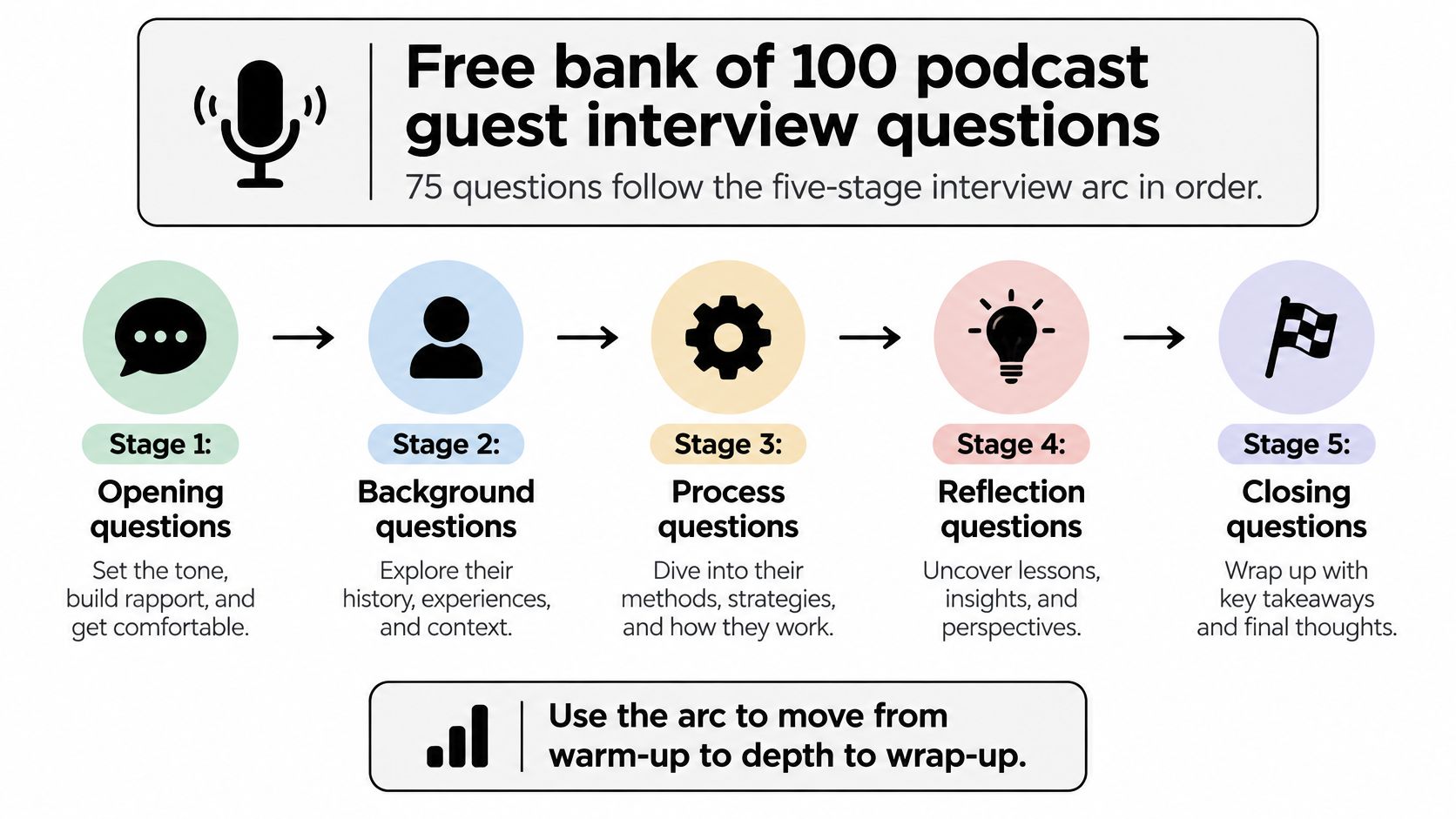
Our free bank of 100 podcast guest interview questions can be copied into a prep document: 75 follow the five-stage interview arc in order, and the final 25 are swap-ins for particular kinds of guest. Use that progression to move from an accessible opening toward a candid account of how the guest works.
The visual gives you the overall interview arc.
Interview stages and sample questions
| Stage | Sample question | Follow-up to ask |
|---|---|---|
| 1. Daily routine | What does a normal Monday look like for you? | What do you refuse to schedule on a Monday, and why? |
| 2. System | How do you decide what gets done today? | Show me the list or calendar you used last week. |
| 3. Missed deadline | Tell me about a deadline you missed and how you recovered. | What did you change afterwards, and how do you know it worked? |
| 4. Tools | Which tool do you rely on, and where does it fail? | What breaks when the team changes its process? |
| 5. Advice | What would you tell a listener to stop doing this week? | Give one example of that working in your own work. |
Treat the request to show a calendar as optional. A guest can describe a redacted example rather than expose confidential appointments, client names, or internal records.
Follow the decision, not the software
For guests who run teams, ask: What does your system do when a client changes the brief? Listen for who approves the scope change, who receives the update, and what happens to work already underway.
For solo creators, ask: What did you stop doing that made the biggest difference? Push for the specific obligation they removed and the work they completed instead. That's more useful than a broad recommendation to eliminate distractions.
Keep your follow-ups short. If the guest names a tool, ask what they record in it; if they claim an improvement, ask what changed in their work.
Don't ask every prepared question regardless of the answer. Stay with a concrete example long enough for listeners to understand the guest's method, then move on when the decision and consequence are clear.
Rehearse Your Answer Before the Interview
Write an answer you can deliver in under a minute and a half, using a real example. Open with a sentence describing your system, then spend most of your time on the difficult decision and the result.
Practice aloud with a colleague. Ask them to mark anything vague, especially claims about improved efficiency or better communication.
Check what you can defend
- Verify the outcome: Use an actual date, count, or before-and-after comparison.
- Test the follow-ups: Rehearse a moved deadline, conflicting requests, and a missed commitment.
- Remove borrowed achievements: Keep sample phrasing only where it matches what you did.
For podcast guests, the same drill helps keep an answer focused. Use the podcast interview preparation guide to prepare the story without scripting every word.
This week, rehearse the project where a changed deadline forced you to renegotiate a handoff. Write down the result you'll quote and the record that supports it.
Let's Make A Podcast helps hosts and guests organize interview preparation, with an Interview question generator that creates a timed plan sized to the episode. Visit Let's Make A Podcast to prepare questions that uncover a guest's working method, then choose a concrete story to bring to the recording.