7 Good Weight Loss Podcasts for Smarter Listening
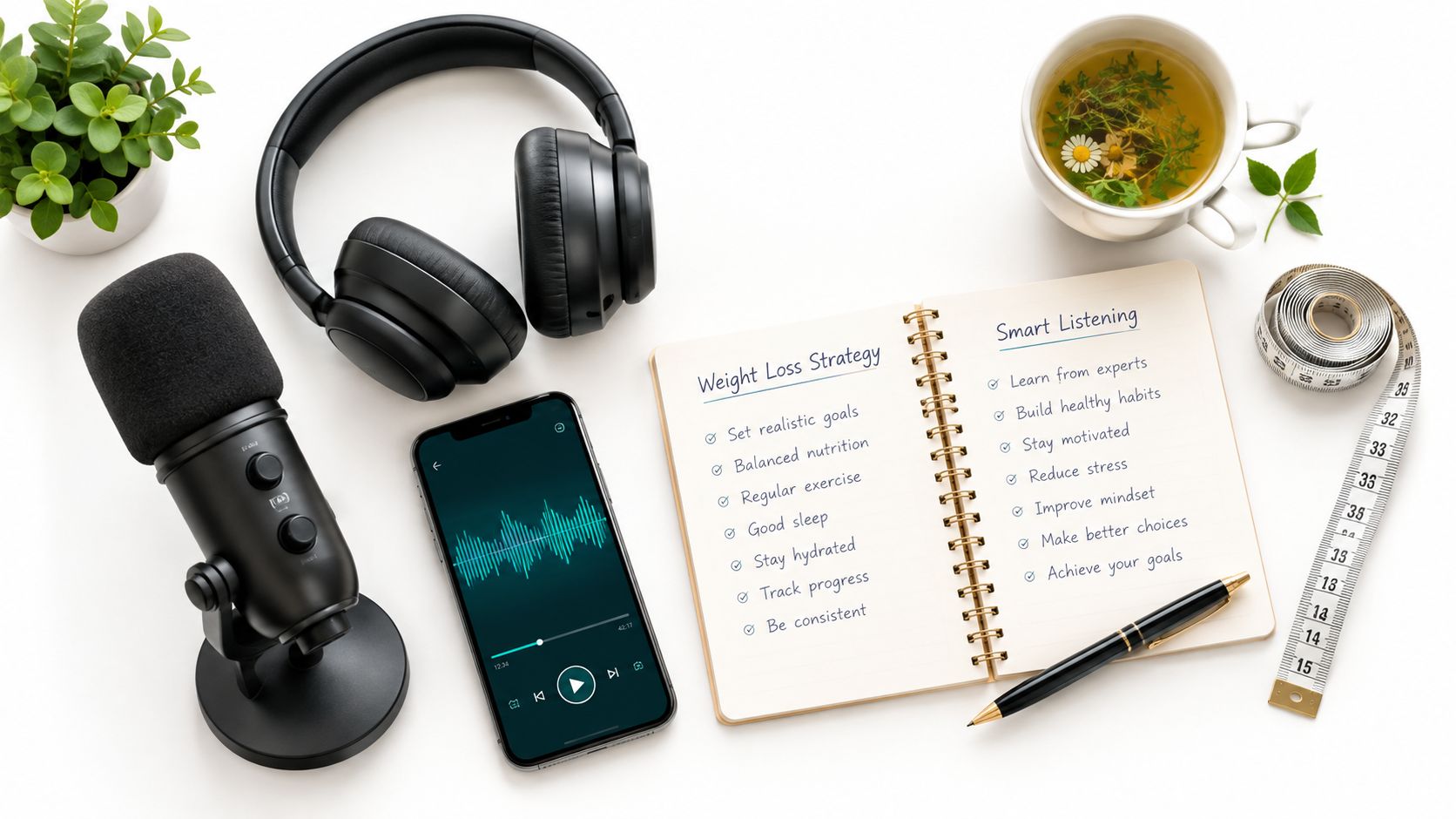
The best weight-loss podcasts aren't necessarily the most popular or the most motivating. A useful show helps you understand nutrition and metabolism, assess claims, build habits you can maintain, or make informed decisions about treatment. The right choice depends on what you need: concise tips, detailed research, critical analysis, clinical context, or support with long-term behavior change.
This roundup compares seven shows by listening style, evidence depth, practical value, and audience fit. It also offers prospective guests a clearer way to approach each show: pitch a focused idea that serves its listeners, not another generic conversation about losing weight.
Table of Contents
- 1. Docs Who Lift
- 2. Sigma Nutrition Radio
- 3. Nutrition Diva
- 4. Maintenance Phase
- 5. ZOE Science & Nutrition
- 6. Fat Science
- 7. Half Size Me
- Top 7 Weight Loss Podcasts Compared
- Build a Listening and Guest-Pitching Strategy
1. Docs Who Lift
For listeners who want clinical context without leaving practical training behind, Docs Who Lift is a strong starting point. Obesity-medicine physicians Spencer and Karl Nadolsky discuss nutrition, exercise, hormones, metabolic health, and weight-loss medications. Their physician-led approach is especially relevant for people trying to understand how strength training and lifestyle habits fit alongside medication.
The show's topics include GLP-1 treatments, resistance training, weight-loss plateaus, and emerging medication research. That combination makes it useful for listeners who want to follow treatment developments while still asking what to do in the gym and at the dinner table.
What to expect from the format
Expect expert explanation and actionable takeaways, not a personal transformation diary. The hosts' physician and lifting backgrounds give the discussion a distinctly clinical and exercise-aware perspective. Episodes about medications and research controversies can help listeners prepare better questions for a healthcare professional, but the terminology may take some getting used to if you're new to obesity medicine.
The main drawback is that medication-heavy discussions can feel technical or dominate the conversation. Beginners may prefer to start with episodes about practical lifestyle topics, then move into treatment details as their questions become more specific.
Best fit: Listeners who want a clinician's view of weight management that includes medication, nutrition, and resistance training.
Prospective guests should bring a concrete subject that fits the show's medical and practical focus, such as how to interpret a treatment development or how to train while managing appetite changes. A pitch works better when it offers a clear lesson for listeners than when it promotes a personal brand or product.
2. Sigma Nutrition Radio
Sigma Nutrition Radio is best for listeners who want to examine the reasoning behind nutrition advice. Hosted by Danny Lennon, the show features research-focused interviews with scientists, registered dietitians, and other specialists. Discussions cover energy balance, appetite, behavior change, long-term weight maintenance, protein utilization, and metabolic adaptation.
The show's defining strength is its attention to evidence. Research-oriented show notes and references give curious listeners a route to investigate claims beyond the episode itself. That makes it useful for coaches, nutrition professionals, and listeners who prefer detailed explanations to short motivational takeaways.
A good match for evidence-minded listeners
Sigma Nutrition Radio can be dense. Some conversations assume a working familiarity with nutrition concepts, and the interview format often prioritizes detail over storytelling. If you want a quick answer to a simple food question, a shorter show may suit you better. If you want to understand why experts disagree, or how a claim holds up against research, this is a better fit.
For prospective guests, a sharply defined research question is more compelling than a broad pitch about healthy eating. Explain what listeners will learn, what evidence or professional experience supports the discussion, and how the topic connects to an existing area of the show.
Guests planning outreach can use a podcast guest-booking resource to prepare a focused pitch and connect the proposed conversation to the show's audience.
3. Nutrition Diva
Need an answer you can use on a walk or between errands? Nutrition Diva, hosted by Monica Reinagel, offers accessible discussions of nutrition and weight management. Episodes address questions about cravings, calories, food quality, and body recomposition, with practical guidance and listener Q&As.
Its shorter format makes it easier to fit into a busy routine than a long expert interview. Rather than asking listeners to follow an extended research discussion, the show breaks down everyday nutrition questions in plain language. That's useful when you want a clear starting point or a quick explanation of a claim you've encountered.
Short answers, broad coverage
Nutrition Diva's strength is accessibility, not exhaustive treatment of every subject. Listeners who want a deep dive into a research debate may need to follow up with a more technical show or consult the references and professionals relevant to their situation. The podcast also covers nutrition broadly, so it isn't exclusively about weight loss.
That range is an advantage if you want advice connected to the wider context of food and health. It's a less direct fit if you're looking for a dedicated weight-loss program with a sequence of lessons and a structured plan.
Best fit: Listeners who prefer concise explanations and practical answers to common nutrition questions.
A prospective guest should propose a question with an everyday payoff, such as how to distinguish a nutrition myth from a useful guideline. Keep the idea narrow enough to answer clearly in a short episode, and avoid turning an educational conversation into a sales pitch.
4. Maintenance Phase
Maintenance Phase, hosted by Aubrey Gordon and Michael Hobbes, takes a different route from clinician-led advice shows. The hosts investigate diet culture, fad programs, supplements, and weight-loss claims, combining evidence-focused myth-busting with cultural discussion of weight stigma. Transcripts and references help listeners explore the material beyond the episode.
This is a show for people who want to become more discerning consumers of weight-loss content. It can help listeners question how diet trends are framed, what evidence supports a claim, and what gets left out of public conversations about weight. The show's mix of analysis and satire also gives it a distinctive, less clinical listening experience.
Critical listening, not a prescriptive plan
Maintenance Phase isn't a step-by-step weight-loss program. It won't provide the same kind of routine-building structure as a show centered on behavior change, or the medication guidance of an obesity-medicine podcast. Its value lies in helping listeners scrutinize claims and understand the wider context around them.
The satirical tone won't suit everyone, especially listeners who prefer a neutral, clinical presentation. But for anyone tired of confident promises about supplements, diets, or quick fixes, the show offers a useful counterweight to motivational storytelling.
“Treat a compelling weight-loss claim as a question to investigate, not an instruction to follow.”
Prospective guests should pitch a specific claim, trend, or cultural assumption that can support a substantive conversation. A guest who can explain the evidence and its limitations will be a better fit than someone offering a broad endorsement of a diet or product.
5. ZOE Science & Nutrition
ZOE Science & Nutrition connects academic research with practical food choices. Hosted by Jonathan Wolf with Tim Spector and guests, the show explores appetite, blood sugar, the microbiome, protein, and fiber. Those topics can help listeners think about satiety and weight management through the wider lens of nutrition science.
Episodes bring researchers into conversations about how findings might relate to everyday eating. The format is useful for listeners who enjoy hearing experts unpack mechanisms and translate research into possible food choices. Episode pages also provide links and visual materials for people who want to continue exploring a topic after listening.
Research with a commercial context
Some content refers to ZOE's commercial program, and the show's personalized-nutrition framing won't appeal to every listener. Keep that context in mind as you evaluate recommendations. The podcast can still be a useful way to hear researchers discuss nutrition, but listeners should distinguish general education from content connected to a company's offering.
ZOE works best for people curious about food, appetite, and nutrition research, rather than those seeking a narrowly focused weight-loss plan. If you prefer concise practical advice, the discussions may feel more expansive than necessary.
Experts pitching the show should bring a clear research-based topic that links scientific findings to a listener's everyday choices. A relevant guest-booking tool can help develop that angle and connect it to a show's topic focus: a podcast guest-pitching resource.
6. Fat Science
Fat Science, hosted by Emily Cooper, MD, takes a clinically oriented approach to metabolic health and weight management. Episodes address topics such as plateaus, weight-regain biology, hypoglycemia, and guidance for people using GLP-1 medication. The show aims to move past simplistic advice while taking weight stigma seriously.
Listener Q&As and clinic-inspired discussion give the podcast a practical dimension. Scientific references offer a starting point for listeners who want to check the background to an episode. That combination makes Fat Science a good choice for people seeking clinical context in accessible language, especially when their questions involve treatment or complex metabolic topics.
Clinical detail with a stigma-aware lens
Fat Science can help listeners find explanations that take individual circumstances seriously rather than reducing weight management to willpower. Its attention to GLP-1 therapy and fueling may be particularly useful for people trying to understand how medication and nutrition intersect. As with any health podcast, use the discussion to inform questions for your own care team rather than treating an episode as personal medical advice.
Some recommendations in this field are debated, so listeners should notice where an episode distinguishes established guidance from questions that remain unsettled. Community and Patreon content may also include promotions, a consideration for people who prefer strictly editorial programming.
Prospective guests should bring clinical expertise and a clear explanation of what listeners can apply or ask their healthcare professional. A focused conversation about medication-related nutrition, weight stigma, or a specific metabolic issue is more useful than a general pitch about weight loss.
7. Half Size Me
Half Size Me, hosted by Heather Robertson, is the show I'd point to first for anyone who has already lost weight and wants to keep it off. Episodes cover sustainable weight loss and maintenance through interviews and real-world experience: behavior change, mindset, relapse recovery, binge eating, tracking, plateaus, and motivation. The show cares less about the latest research finding and more about how people handle the unglamorous daily work of keeping change in place.
That focus makes Half Size Me a strong pick for listeners who want encouragement grounded in ordinary life. Stories and strategies give people a way to think about setbacks and routines without demanding a perfect record. Optional coaching resources add a layer of support for listeners who want more than the episodes alone.
A maintenance-first perspective
The show's core strength is sustainability, and that's also its limit. Listeners who want technical interviews with researchers will get more from Sigma Nutrition Radio or a clinically oriented show. Listeners who want to hear how real people build and hold habits will find Half Size Me more relatable than most expert-driven podcasts.
Two cautions apply. Coaching offers come up periodically, which won't suit listeners who want an entirely non-commercial feed. The show also spends less time on emerging research than expert-interview podcasts, so pair it with an evidence-focused show if you want scientific depth alongside practical perspective.
For pitching, guests should bring a specific story or strategy that helps listeners think differently about behavior change, maintenance, or recovery after a setback. Guests planning outreach can use a podcast guest-booking resource to shape a maintenance-focused pitch, and a clear description of the audience benefit will always beat a generic personal success story.
Top 7 Weight Loss Podcasts Compared
| Podcast | Main Focus | 🔄 Listening Effort | 📊 Expected Value | 💡 Ideal Use Case |
|---|---|---|---|---|
| Docs Who Lift | Obesity medicine, medications, exercise, and metabolic health | Moderate; some clinical terminology | ⭐ Practical, physician-led guidance on treatments and lifestyle | Understanding GLP-1s or combining medication with strength training |
| Sigma Nutrition Radio | Nutrition research, appetite, behavior, and weight maintenance | High; detailed, research-heavy episodes | ⭐ In-depth evidence evaluation with references | Coaches and listeners seeking rigorous nutrition discussions |
| Nutrition Diva | Brief nutrition and weight-management tips, myths, and Q&A | Low; typically 10-15 minutes | ⚡ Quick, accessible ideas for everyday choices | Busy listeners who want short, actionable guidance |
| Maintenance Phase | Diet culture, weight-loss claims, fads, and weight stigma | Moderate; extended, conversational deep dives | 📊 Builds media literacy and helps identify weak claims | Evaluating popular diets, supplements, and weight-loss headlines |
| ZOE Science & Nutrition | Nutrition science, appetite, blood sugar, microbiome, and food choices | Moderate; research interviews with practical framing | ⭐ Connects scientific concepts with everyday eating | Exploring nutrition research and its possible practical relevance |
| Fat Science | Metabolism, plateaus, weight regain, and GLP-1 guidance | Moderate; clinical topics explained accessibly | 📊 Offers stigma-aware context and practical clinical insights | Learning about metabolic topics and weight-loss medication |
| Half Size Me | Sustainable weight loss, behavior change, and maintenance | Moderate; interview- and experience-driven | ⭐ Emphasizes realistic strategies and long-term support | Building habits, navigating setbacks, and maintaining weight loss |
Build a Listening and Guest-Pitching Strategy
Choose a podcast based on the job you need it to do. For brief, plain-language guidance, start with Nutrition Diva. For research-heavy discussion, choose Sigma Nutrition Radio or ZOE Science & Nutrition. If you want to examine diet claims and weight stigma, try Maintenance Phase. For clinical context, listen to Docs Who Lift or Fat Science, and turn to Half Size Me for conversations about routines, setbacks, and long-term maintenance.
Don't expect motivation alone to tell you whether a show is useful. A foundational randomized trial of a theory-informed weight-loss podcast found stronger weight-loss outcomes and gains in knowledge and perceived control than a conventional podcast, illustrating why structured guidance and practical prompts matter alongside inspirational content (trial report). The study doesn't mean any podcast will produce the same result. It does support judging a show by whether it offers credible explanations and actions you can apply, then paying attention to whether those actions help you.
Prospective guests should pitch one specific, audience-centered idea. That might mean translating GLP-1 research into practical questions for clinicians, examining a popular diet claim, or explaining how people can approach weight maintenance after a setback. Show that you understand the program by referencing a relevant episode and explaining why your expertise adds something to that conversation.
Keep the pitch focused. State the subject, the listener takeaway, and why you're qualified to discuss it. A personal story can be compelling when it illustrates a useful lesson, but a story without a clear audience benefit is harder for a host to place.
Let's Make A Podcast can help guests find relevant shows, prepare a one-sheet, and organize outreach and scheduling. Its directory and pitching tools are useful for experts and creators who want to identify a better-fit show rather than send the same weight-loss pitch everywhere.
If you're an expert or creator with a practical perspective on nutrition, treatment, or sustainable weight management, use Let's Make A Podcast to find relevant shows and prepare a focused guest pitch. Build a one-sheet that explains your expertise, shape an angle for each audience, and keep booking conversations organized in one workflow.