The 7 Best Podcasts for Entrepreneurs in 2026

Of 383 public podcast feeds read across a 408-show directory at Let's Make A Podcast, 246 of them (60%) had published an episode in the previous six months and printed a contact route a stranger can use. The other 40% explain why so much podcast advice wastes your time. Dormant feeds, dead contact pages, and shows that never booked outside guests in the first place.
Audience supply isn't the constraint. The Infinite Dial 2025 from Edison Research and SSRS found that 73% of Americans aged 12 and older, an estimated 210 million people, had consumed a podcast in audio or video form. Picking where to spend your listening hours is the constraint.
So this list ranks seven shows by listener fit, tactical versus narrative value, archive depth, and format practicality. Each entry names one job the show does well, where it fails, and how a founder can use the same beat to get booked as a guest instead of staying a listener forever.
Table of Contents
- 1. How I Built This with Guy Raz
- 2. Masters of Scale
- 3. My First Million
- 4. Acquired
- 5. Founders
- 6. The Pitch
- 7. The Tim Ferriss Show
- The 7 Best Podcasts for Entrepreneurs at a Glance
- From Listener to Guest and How to Turn These Shows Into a Growth Channel
1. How I Built This with Guy Raz
Guy Raz builds episodes as stories rather than interviews. Founders rewind to the awkward years, the prototype nobody wanted, the payroll they nearly missed, the pivot that looked reckless until it worked. That structure is the show's value and its limit. You finish understanding how a founder thought, not how to price a second product line.
The franchise now runs under Raz himself, with Vox Media handling publishing and expanded video output, which is why new episodes increasingly reach people as clips before they reach a podcast app. The official How I Built This archive is built for searching by company rather than scrolling chronologically.
Founder narrative travels well because it doesn't depend on local tax law. Global podcast listenership reached an estimated 584.1 million people in 2025, growing 6.8% year over year, according to Omniscient Digital's compilation of podcast-industry data.
What It's Actually Best For
- Pattern recognition. A dozen episodes give you the shape of early-stage chaos: hiring before revenue, partners who disappear, distributors who gatekeep.
- Competitive texture. If you sell into a category this show has covered, you'll hear how incumbents won distribution before you pitch against them.
- Skip it for mechanics. There's little on unit economics, contracts, or the week-to-week operating rhythm of a small team.
Practical rule: put How I Built This on when you're stuck on a decision, not when you need a template. It changes how you think, not what you do Monday.
Where the show won't help is getting booked. The slate is edited narrative built around recognizable founders, so a cold pitch from an unknown operator rarely converts. The winnable version of the same beat lives on smaller founder-story shows. Filter the entrepreneurship podcast directory for hosts who interview operators at your stage, then lead with one specific decision you got wrong and what it cost.
2. Masters of Scale
Reid Hoffman's show is about the second act. Most episodes assume something already works and ask what breaks when you add people, markets, or a second product. That focus makes it the wrong listen before launch and the right one when your calendar fills with hiring loops and pricing debates.
The network format is both the draw and the friction. Interviews, narrative seasons, and shorter explainers sit alongside material the Masters of Scale site gates behind membership, so check what you're getting before you commit a commute to it.
Platform spread now shapes whether a show is worth your time at all. Edison Research's 2025 consumption report identified YouTube as the service used most often by 32% of U.S. weekly podcast consumers, ahead of Spotify at 25% and Apple Podcasts at 15%, published in Edison Research's Evolving Ear report. A show that publishes video next to audio is easier to sample in ten spare minutes.
- Strongest episodes. The ones where a founder admits a scaling decision failed and explains the signal they ignored.
- Weakest episodes. A company with 900 employees and unlimited runway explaining a tactic that assumes a recruiting team you don't have.
- Best stage. Post-product-market-fit, pre-management-layer. If you're the whole management layer, wait.
If a scaling tactic needs a VP of People to execute, it isn't a tactic yet. It's a hiring plan.
When the guest list feels narrow, the guide to women entrepreneur podcasts widens the sample with operators who scaled under different constraints. As a guest target, Hoffman's format favors people who've already shipped a growth story, so pitch the smaller shows that copy this structure and are still building their guest roster.
3. My First Million
Most business shows explain success after the fact. Sam Parr and Shaan Puri stay in the present tense, trading ideas about businesses working right now: a niche newsletter, a service company with ugly margins and no competitors, a product that would never appear in a pitch deck. I treat it as a brainstorming session I'm allowed to sit in on.
Popularity isn't the reason to listen. Total weekly podcast time among Americans aged 13 and older reached 773 million hours, up 355% since 2015, according to Edison Research's Infinite Dial 2025. There's more audio competing for your commute than any founder can absorb, so each show has to earn the slot with a specific job. This one's job is generating candidate ideas, not validating them.
- Take the arithmetic. When they break down how an unglamorous business makes money, write the numbers down and stress-test them later.
- Discount the confidence. A fifteen-minute riff is a hypothesis. It's not diligence.
- Use the show notes. The My First Million archive keeps episode pages that make it easy to chase one industry instead of hopping between trends.
What it won't give you is a sequence. There's no curriculum, no homework, and the hosts' opinions are commentary rather than advice about your business. Listeners who want step-by-step operating guidance consistently overrate this show and then wonder why nothing changed.
Its beat is a question worth stealing for your own pitch: how does this odd business make money? Shows in this format book guests who arrive with real numbers and an unusual distribution trick, not guests with a personal journey and no revenue.
4. Acquired
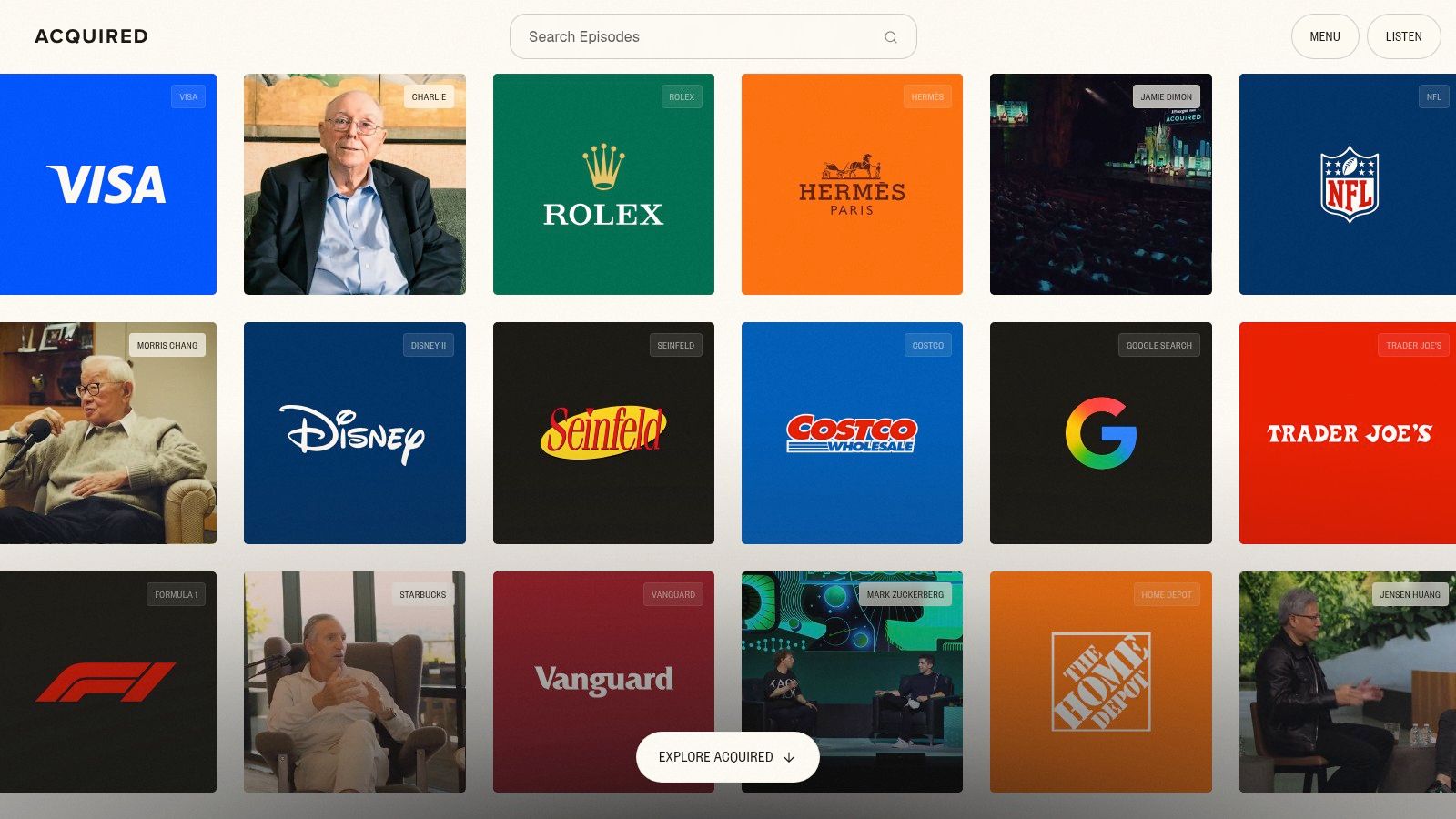
Acquired is the most expensive listen on this list, and I mean that as a warning and a compliment. Episodes are researched case studies built from company documents, financial filings, and interviews, and they run for hours. You don't dip into Acquired during a jog. You schedule it.
The audience shape explains the format. In a nationwide survey of 5,071 adults by Sounds Profitable and American Public Media, the business-podcast audience included 389 respondents who had listened to a business podcast in the previous month, according to Sounds Profitable's listener research. Deep business analysis is a committed minority rather than a mass format, which is exactly why three-hour episodes survive.
When a Long Case Study Is the Right Tool
Use it before a decision you'll live with for years: repricing, choosing a channel, building versus partnering. The Acquired episode archive lets you pick a company adjacent to your own market instead of the famous ones everyone discusses.
- Study incentives, not outcomes. The useful material is why a board, a founder, and a distributor each wanted something different.
- Ignore the scale. A strategy that needed a decade of cheap capital doesn't transfer to a five-person team with one quarter of runway.
- Skip it when you're pre-revenue. You need customers, not capital structure.
Acquired doesn't take outside guests, so the lesson is the method rather than the booking. Write one page of primary-source research on your own market, with numbers and sources, and use it as pitch material for interview shows that want analysis. Operators who arrive with a fact sheet get booked. Operators who send a paragraph about their journey don't.
5. Founders
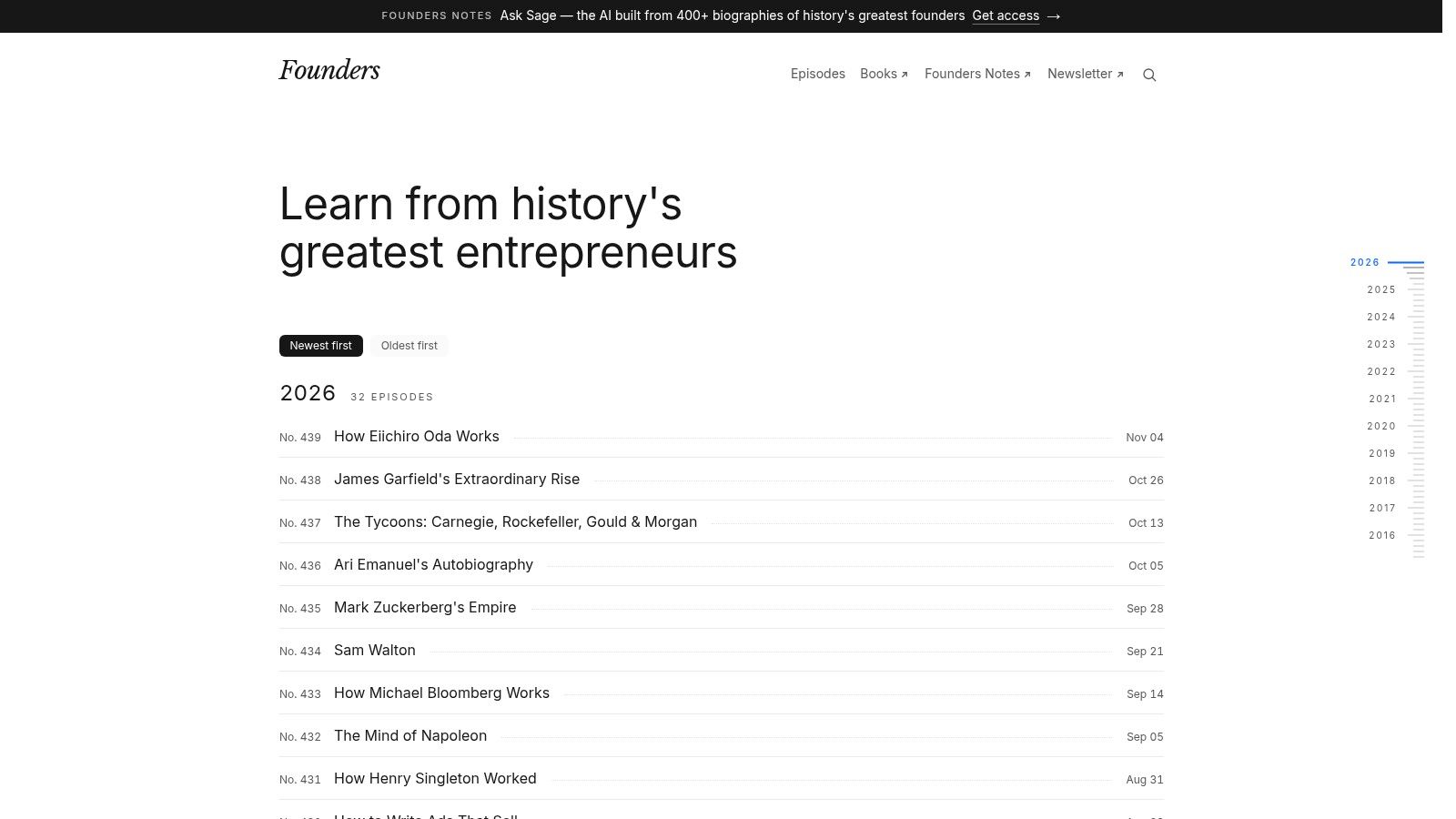
No guests. No news hook. David Senra reads biographies of company builders and pulls out what they did, how they decided, and what it cost. The format shouldn't work in a medium built on interviews, yet the archive has become one of the most quoted shows among founders for a plain reason: repetition beats novelty when you're trying to change your own behavior.
Choice is the argument for a narrow lens. Around 4.5 million podcasts were available worldwide in 2025, according to TVEyes' podcast-statistics report, and most of them sound interchangeable within thirty seconds. A show defined by one host's specific obsession survives that crowd. A general business interview show doesn't.
A biography won't tell you what to charge. It will tell you what kind of person keeps going after the third rejection, which is the more useful thing to know on a bad Tuesday.
- Best use. One episode a week, with a single note on one decision you'd have made differently in the founder's position.
- Worst use. Copying a playbook from a different era of distribution and wondering why the market doesn't respond.
- Its honest limit. You're hearing the host's interpretation of a secondary source, and a 1970s retailer's constraints aren't yours.
There's no guest slot to chase here, and that's the transferable lesson. The Founders podcast site shows how far one clear angle carries a show. Build the same clarity about your own operating story, one sentence you'd repeat in every interview, before you pitch anyone.
6. The Pitch
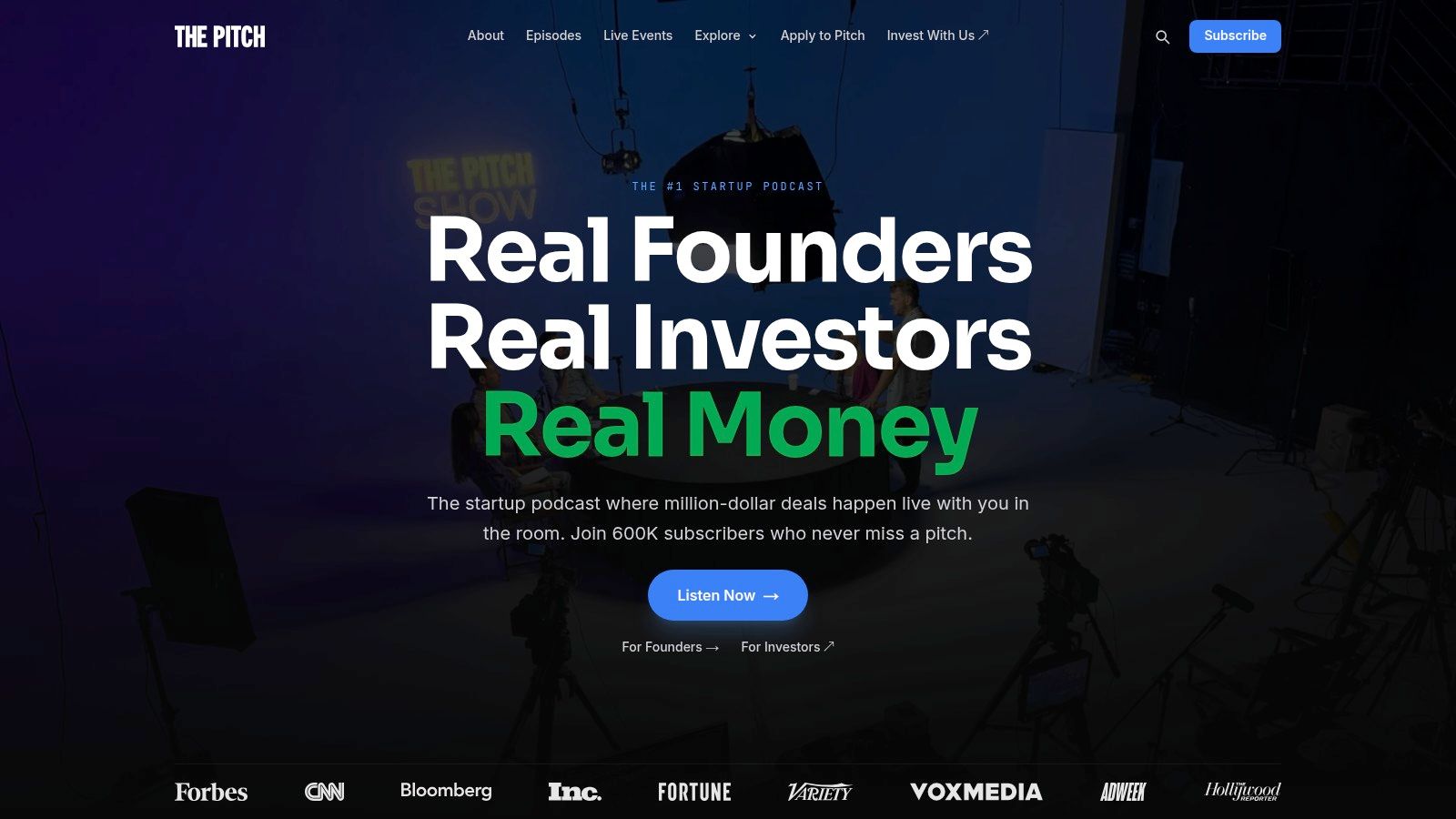
Three weeks before a first investor meeting, the expensive mistake is walking in with a story that collapses on the first valuation question. The Pitch records founders presenting to investors, and the useful part is the interrogation: where they hesitate, which metric they reach for, and how fast a confident claim gets qualified.
Video gives this format its edge. In 2025, 51% of the U.S. population aged 12 and older had ever watched a video podcast, 37% had watched one in the past month, and 26% in the past week, per Edison Research's podcast research library. A founder's face during valuation pushback is the tell audio loses.
- Best use. Rehearse answers to the questions investors repeat: market size, margin, churn, and why now.
- Real cost. Your pitch, your numbers, and the reaction become public. Decide that before you apply.
- Honest limit. A clean story cannot compensate for customers who refuse to pay.
Pair it with podcasts on sales when revenue is the bottleneck, since buyer objections and investor objections need separate preparation. The Pitch show site carries the archive and the application route.
Among these seven, it is the closest thing to a direct application. Treat a guest slot as investor-grade scrutiny of your numbers, then borrow the discipline for every other pitch you make.
7. The Tim Ferriss Show
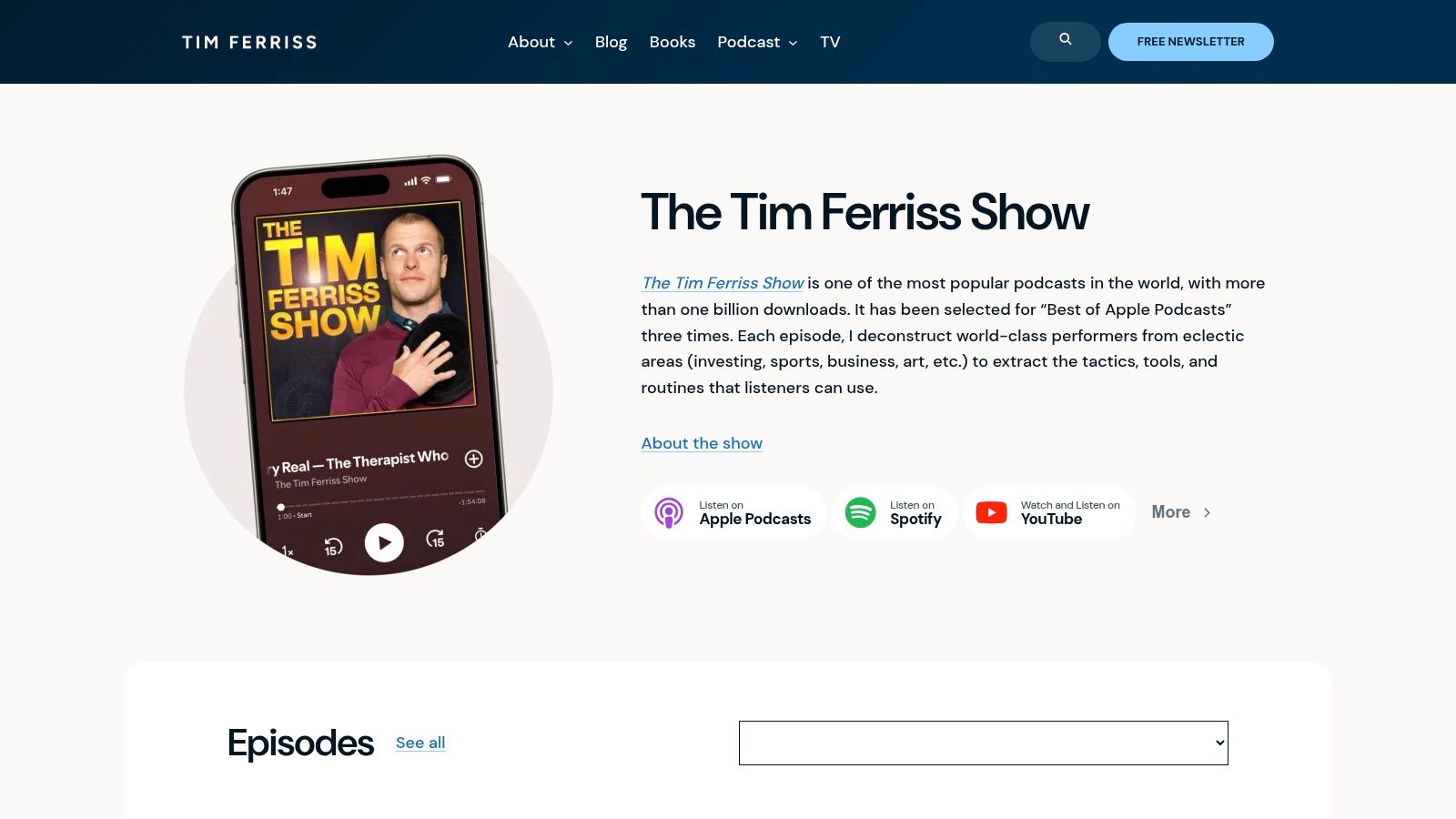
The episodes that pay off usually aren't the famous-founder ones. They're the ones where a guest describes a specific morning, a specific notebook, a specific way of saying no. Ferriss interviews at length and keeps pushing for method, which is why the show still sits in founders' queues years after they stopped listening to hype-driven business media.
Habit beats scale. 55% of Americans aged 12 and older consumed podcasts monthly in 2025 and 40% consumed them weekly, according to SSRS's summary of The Podcast Consumer 2025. Listening is routine behavior, and routines reward the show you return to weekly rather than the bigger one you sample twice a year.
Read the Transcript Before You Commit Three Hours
Pull the transcript and skim for the routine or the tool. Most long interviews contain ten usable minutes and ninety minutes of context, and knowing which is which is the whole skill of listening efficiently. The Tim Ferriss podcast archive labels episodes by guest so you can go straight at operators rather than athletes.
- Use it for process. Decision rules, focus habits, how guests handle email, travel, and bad weeks.
- Expect variance. Not every episode is business, and a guest's routine may assume a staff you don't have.
- Watch for the tell. When a guest can describe the mechanism in plain words, the tactic usually transfers.
Its guest list rewards a narrow method rather than a company story. The pitch that fits: one experiment you ran, what it changed, and the number that proves it. If you can't describe the mechanism in two sentences, the show isn't the problem.
The 7 Best Podcasts for Entrepreneurs at a Glance
Match the show to the job first, then check whether a guest route exists before you commit listening time.
| Podcast | Best use | Format | Guest route |
|---|---|---|---|
| How I Built This with Guy Raz | Learning from founder stories | Narrative founder interviews | Guests are pitched |
| Masters of Scale | Exploring business growth and scaling | Interviews and business stories | Guests are pitched |
| My First Million | Discovering and evaluating business ideas | Conversational brainstorming and interviews | Guests are pitched |
| Acquired | In-depth company and strategy case studies | Long-form researched analysis | No outside guests |
| Founders | Learning from business biographies and history | Host-led biographical analysis | No guests |
| The Pitch | Preparing for venture fundraising | Startup pitches and investor questions | Founders can apply to pitch |
| The Tim Ferriss Show | Exploring methods and decision-making | Long-form interviews and Q&A | Guests are pitched |
Treat Acquired and Founders as study material only. Put pitching effort into the shows and similar mid-sized shows that book outside guests.
From Listener to Guest and How to Turn These Shows Into a Growth Channel
The fastest return on these seven shows isn't the note you take. It's becoming the guest that the smaller, hungrier versions of these shows book every week. Seven shows can't absorb your pitch, but a few hundred mid-sized podcasts with active feeds absolutely can, and most founders never send the email.
Pitch discipline is what separates a reply from silence. Reference a recent episode by name and roughly when it aired, state one topic that matches the show's beat, and keep the ask short enough to read on a phone.
The pitch shape that works: one line on who you are, one line on the episode you're responding to, three bullet topics you can actually defend, and one link to a one-sheet.
Let's Make A Podcast's directory holds the public feeds behind 408 podcasts, and its shortlist tool narrows them to shows that are still publishing, reachable, and showing evidence they book outside guests. The free tools help you find podcasts by niche, draft a cold pitch, grade the draft against that specific show, and build a guest one-sheet you can send as a link or a PDF. Joining, browsing, pitching, and scheduling are free during early access.
- Pick two shows from this list and follow them weekly, with a single note per episode on what you'd apply.
- Shortlist five smaller shows in your niche that book guests and publish a contact route, then read their last three episodes.
- Send one personalized pitch this week. One. Written for that host, not copied across five inboxes.
The shows above prove the demand exists, and the guest side is where that demand becomes your distribution. Let's Make A Podcast gives you a directory of 408 podcasts with status signals pulled from each public feed, free pitching and one-sheet tools, and scheduling in one thread, all free during early access. Visit Let's Make A Podcast, shortlist the shows that fit your niche, and send the first pitch this week.
Pitch this show as a guest
One show from this article is in our directory, each with a page on how it books guests and what to send.
More shows that book guests: Business podcasts