10 Women Entrepreneurs Podcast Picks for Smart Growth
The most popular advice about a women entrepreneurs podcast is often too broad: listen for inspiration, stay motivated, and learn from successful founders. That's a weak listening strategy when your actual problem is more specific. You may need a better offer, a financing model, stronger operating systems, a clearer personal brand, or a way to build a business around caregiving and limited capacity.
The right show depends on the question in front of you. This directory matches ten podcasts with the business problems they address, then weighs audience, subject focus, business stage, useful formats, limitations, and likely guest fit. The aim isn't to rank interchangeable brands. It's to help you choose an episode that can change your next decision, and identify where your own expertise might belong in the conversation.
Let's Make A Podcast can serve as an optional discovery and outreach resource. You can use it to check active shows, review stated guest topics, build a one-sheet, and coordinate pitches without making podcast promotion the center of your research.
Table of Contents
- 1. Goal Digger Podcast
- 2. Side Hustle Pro
- 3. Girlboss Radio
- 4. The Bossbabe Podcast
- 5. Female Startup Club and Imagine If
- 6. So Money
- 7. Brown Ambition
- 8. Being Boss
- 9. The Strategy Hour
- 10. Women in Tech Podcast
- Top 10 Women Entrepreneurs Podcasts Comparison
- Turn Listening Into Better Podcast Opportunities
1. Goal Digger Podcast
If your immediate problem is getting attention for a business, Goal Digger is the most direct match in this group. Hosted by Jenna Kutcher, the show focuses on marketing, content creation, audience growth, email, funnels, and personal brand development. Its format moves between short marketing trainings and longer founder or expert interviews, so it works for both a quick tactical question and a deeper strategic reset.
The archive is especially useful for early- and mid-stage entrepreneurs who need to turn expertise into discoverable content. A service provider refining an Instagram strategy will likely get more from this show than a founder trying to solve manufacturing capacity or complex enterprise sales. That focus is a strength, because the advice tends to stay close to visible customer acquisition work. It's also the main limitation.

Best fit and guest angle
Use Goal Digger when you need to answer questions such as:
- Content decisions: Which ideas deserve a post, email, lead magnet, or episode?
- Audience growth: How can a founder explain a useful offer clearly enough to attract the right people?
- Monetization: How should a personal brand connect attention to products, services, or digital offers?
The extensive back catalogue makes topic-led research easier, but production timing matters. Check the show's current publishing status before treating it as an immediate guest target. If you pitch, bring a specific marketing lesson, an audience-relevant experiment, or a clear framework rather than a general founder biography. For broader discovery, browse entrepreneurship podcasts for potential guest opportunities.
2. Side Hustle Pro
A side hustle rarely becomes a company through motivation alone. It needs a viable offer, repeatable demand, and decisions that make full-time work financially possible. Side Hustle Pro, hosted by Nicaila Matthews Okome, examines that transition through interviews with Black women entrepreneurs who have built side businesses into primary ventures.
Its strongest use case is practical comparison. Episodes address marketing, funding, team building, pivots, systems, and the personal costs that arise as a project becomes an operating business. Listeners can compare how consumer brands and direct-to-consumer companies tested demand, reinvested revenue, or changed direction. The show is less useful for software architecture, technical B2B sales, or specialized enterprise operations. Its U.S. context may also require adaptation for founders facing different employment, banking, and market conditions.
The clearest audience is aspiring founders, early-stage operators, and entrepreneurs deciding whether informal traction can support a durable company. A listener still validating an offer may gain more here than from a show focused on scaling an established venture.
For potential guests, the fit depends on a specific transition rather than a broad founder story:
- Side project to company: Explain the decision that made full-time operation possible.
- Money and trade-offs: Discuss pricing, reinvestment, funding, or the cost of staying small.
- Systems and delegation: Show how you stopped handling every task personally.
Lead with the decision, evidence, and listener benefit. “I'm a founder” supplies context, not a compelling pitch.
3. Girlboss Radio
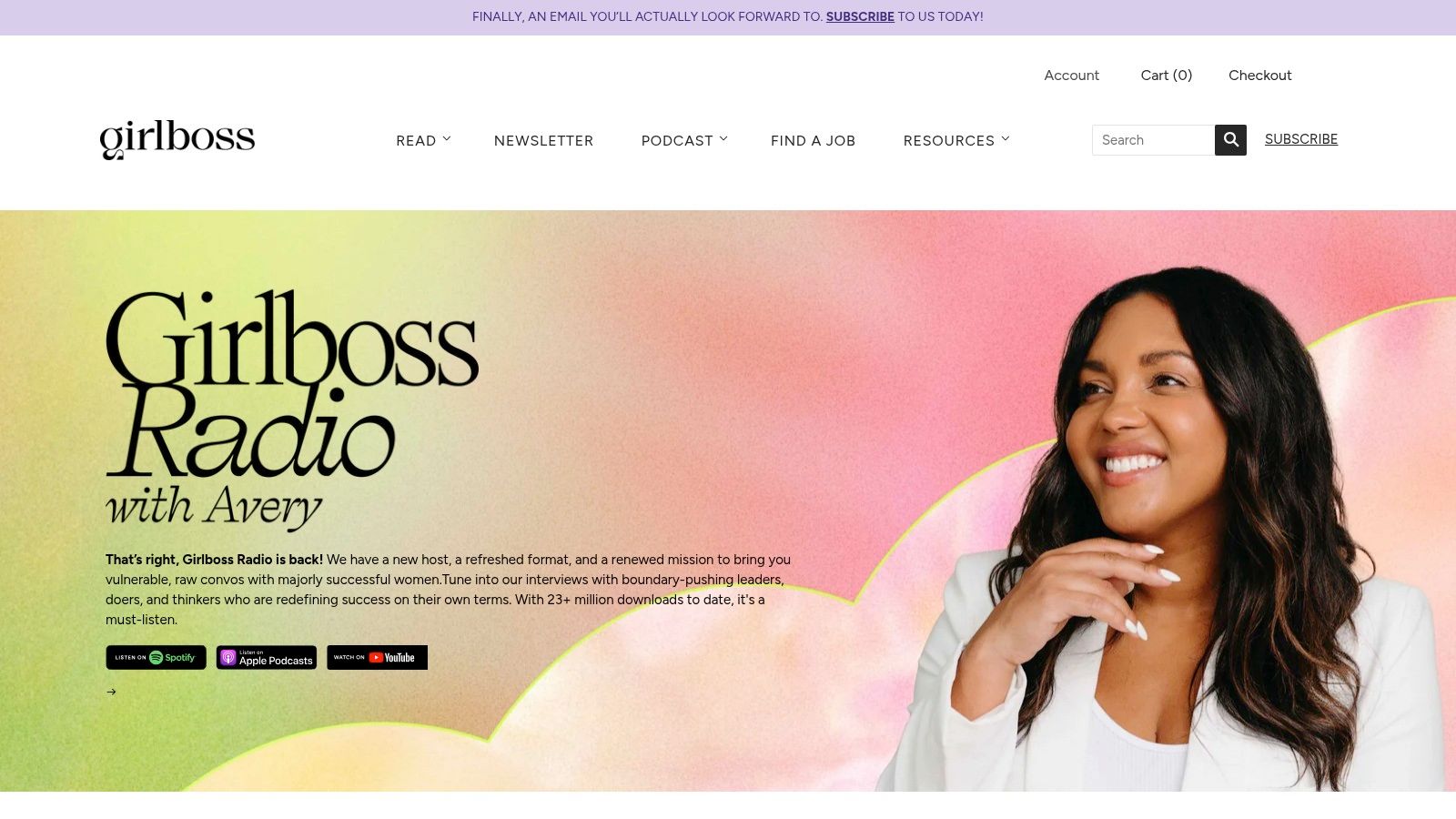
Revenue is only one part of the founder's problem. Girlboss Radio, hosted by Avery Francis, focuses on the people and power issues that shape a company: leadership, workplace culture, negotiation, careers, wellbeing, and entrepreneurship. That makes it a practical listen for women deciding how to lead, hire, raise capital, or build work that does not consume their entire identity.
Its broad editorial focus suits founders moving beyond individual execution. Someone becoming a manager, developing a team, or turning professional expertise into a company may gain more here than from a narrowly tactical marketing show. Episodes can inform conversations about compensation, fundraising, leadership expectations, workload, and personal sustainability, though the format is less suited to a detailed operational playbook.
Choose this show according to the decision you need to make:
- Leading a growing team: Hear perspectives on management, company culture, and expectations as hiring increases.
- Turning expertise into a company: Follow career-to-business transitions, especially when independence changes how work and identity intersect.
- Handling negotiation or capital conversations: Look for guests who make difficult discussions concrete.
- Protecting sustainable performance: Use founder wellbeing episodes to examine workload and boundaries.
The show's breadth may frustrate listeners seeking a narrow process for specialized businesses. Its branded tone may also feel general to highly technical operators. For guest outreach, pitch a timely leadership question supported by one concrete operating example. Explain the relevance to women redefining work, and review this guest route for a women-focused career and entrepreneurship show before contacting the team.
4. The Bossbabe Podcast
A polished brand does not solve an unclear offer. The Bossbabe Podcast, hosted by Natalie Ellis, addresses that problem through practical discussions of funnels, launches, offers, audience growth, and mindset. Its primary audience is solo founders and micro-teams selling services, education, memberships, or digital products.
The show is most useful after a business has attracted attention but has not yet built a reliable path from audience to customer. Episodes can help listeners assess how an offer is packaged, how a launch is organized, and which promotional or delivery tasks still rely too heavily on the founder. That makes it a better fit for execution questions than for market validation, manufacturing, or fundraising.
Use it selectively according to the operating problem:
- Unclear positioning: Study how a defined customer problem becomes a product or service people can understand.
- Weak conversion: Trace the relationship between content, email, launches, and sales.
- Founder bottlenecks: Look for repeatable processes that support delivery and promotion.
The boundaries are clear. Advice developed for online education or information products may transfer poorly to a local shop, capital-intensive company, or complex product operation. Promotional ties to the wider Bossbabe ecosystem may also make the listening experience feel commercial.
A guest pitch should offer a specific operating lesson, not a general success story. Strong topics include rebuilding an offer after poor customer fit, creating a launch process, or preserving delivery quality during growth. Frame the episode around one decision, the method used, and the practical relevance for online business owners. That fit-and-pitch approach also helps experts judge whether their experience belongs on the show before contacting its team.
5. Female Startup Club and Imagine If
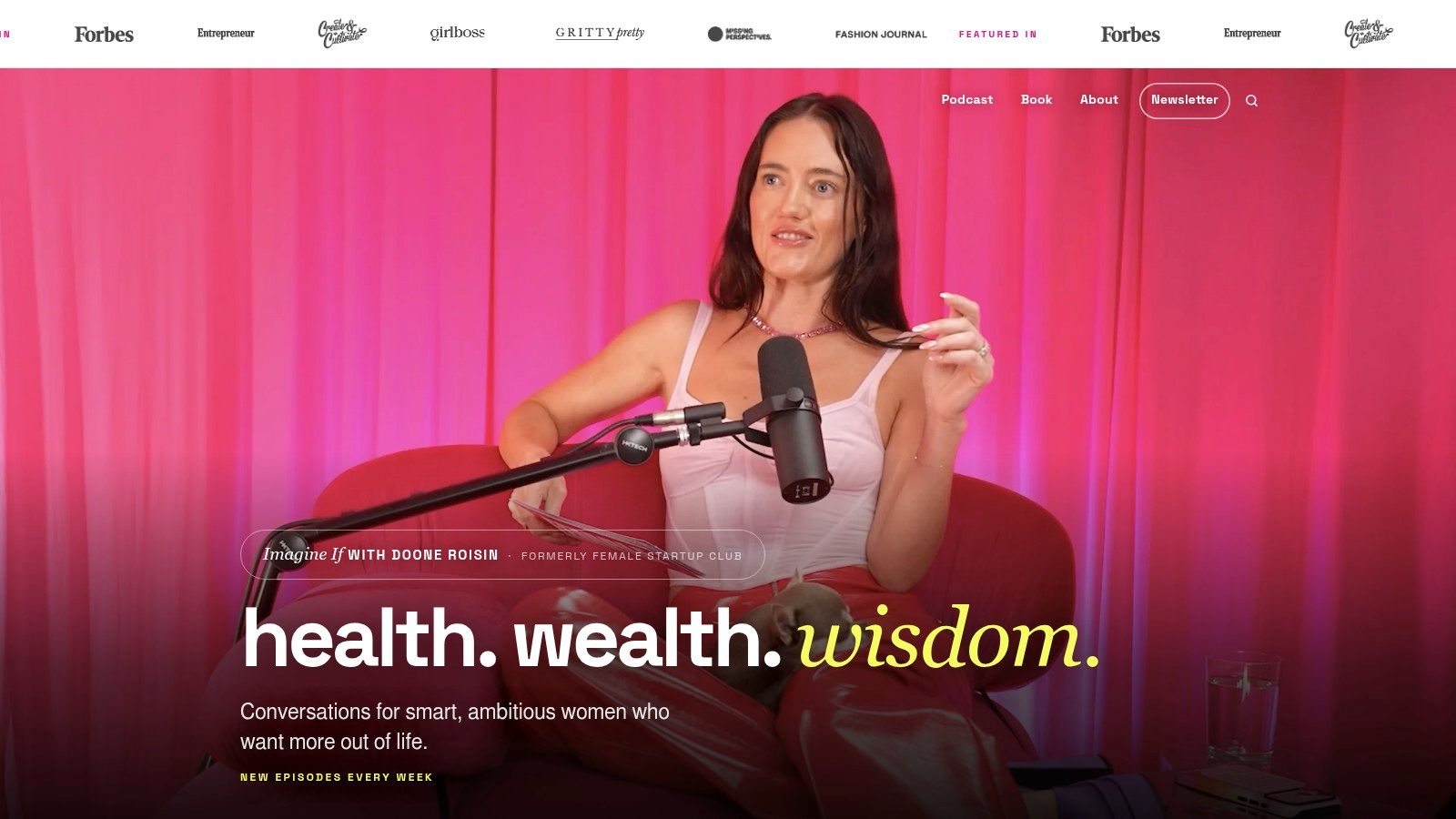
The main value of Female Startup Club, now operating under the Imagine If branding with Doone Roisin, is decision comparison rather than motivation. Founder interviews examine product development, consumer positioning, funding, partnerships, and growth, while the wider ecosystem includes community, courses, and investment-focused resources. That combination suits ambitious women who want to study how businesses were built and identify choices that may transfer to their own stage.
The audience fit is strongest for consumer packaged goods, direct-to-consumer, retail, and some technology businesses. Founders selling complex B2B solutions may find fewer directly applicable examples, but can still compare how guests tested demand, communicated value, or expanded distribution. The useful question is not whether a guest's industry matches yours. It is whether the decision process applies.
Use the show according to the business problem:
- Product or market uncertainty: Compare how founders developed an offer and identified a customer.
- Consumer positioning: Examine language, community building, retail strategy, and direct sales.
- Growth planning: Study choices around funding, partnerships, distribution, and expansion.
- Learning beyond audio: Use the newsletters, courses, community, or investment resources when a broader path is useful.
The branding change creates a practical research task. Check the current show identity, guest route, and publishing pattern before pitching, since older pages may point to the former name or an outdated team.
A guest pitch should present one specific blueprint, not a general success story. Name the founder stage it serves, explain the decision being examined, and state what listeners can apply afterward. Experts from B2B, technology, or less represented regions should make the contrast explicit, showing why their experience adds a useful comparison rather than assuming the fit.
6. So Money
So Money, hosted by financial journalist Farnoosh Torabi, addresses a business problem that productivity advice often misses: how money decisions shape entrepreneurial risk. Its strongest territory includes pricing, negotiation, personal finance, financial confidence, and the connection between household finances and business choices.
The format alternates between founder interviews and “Ask Farnoosh” audience questions. That combination serves two listening modes: longer conversations for examining judgment and direct answers for a defined financial dilemma. Because the feed also covers personal finance and careers, it is broader than a founder-operations show. That breadth suits entrepreneurs whose company decisions affect income, savings, family obligations, or personal security.
Choose episodes based on the decision you need to make:
- Pricing: Study how founders communicate value without apologizing for their rates.
- Negotiation: Look for preparation around clients, investors, salaries, or partnerships.
- Financial boundaries: Examine ways operators separate household stability from business risk.
- Audience questions: Follow experts who answer one concrete money problem in accessible language.
The trade-off is scope. Listeners seeking a detailed content calendar, funnel build, or operations manual will need another resource. So Money offers financial framing and judgment rather than a complete marketing curriculum, making it more useful for clarifying a decision than documenting every execution step.
For a guest pitch, lead with the audience's money dilemma. Define the decision, provide a focused method or example, and explain what listeners could apply afterward. A guide to getting booked as a podcast guest can help shape that idea into a concise, evidence-led pitch.
7. Brown Ambition
Brown Ambition, hosted by Mandi Woodruff-Santos and Tiffany “The Budgetnista” Aliche, addresses a business problem that founder-only shows often miss: making commercial decisions while identity, wealth, career changes, family responsibilities, and mental health remain connected. Its primary audience is women of color building careers, side businesses, or companies, especially those who want practical guidance grounded in real constraints.
The show is most useful for context-rich decisions rather than a single operating system. Conversations about pricing, quitting, scaling, and mental health treat those subjects as related choices. Q&A segments, toolkits, and timely news add formats beyond founder profiles, while the conversational tone creates room for recognition alongside instruction.
A listener deciding whether the show fits should start with the problem, not the episode title:
- Pricing and value: Examine how identity, confidence, and perceived authority affect the amount a founder requests.
- Career transition: Follow discussions of leaving employment and making a business the primary professional platform.
- Sustainable growth: Look for guidance on matching ambition with health, relationships, and available capacity.
- Financial agency: Use episodes that connect business and wealth decisions to the broader circumstances of women of color.
Its breadth is also the main limitation. Some episodes address career and personal finance more than founder operations, so listeners seeking detailed systems for sales, hiring, or delivery may need a more specialized show. The informal presentation will also feel less suitable for someone seeking formal business-school instruction.
For a guest pitch, connect a specific business decision to the lived conditions shaping it. Explain the method, show the commercial consequence, and give listeners an action they can apply. Identity should provide relevant context, not serve as a branding shortcut. That combination gives the hosts a clear editorial reason to invite you and the audience a practical reason to listen.
8. Being Boss
Creative entrepreneurs face operating decisions that differ from those of venture-backed founders. Being Boss, hosted by Emily Thompson, addresses creative businesses and small companies through planning, pricing, processes, boundaries, money, and work-life design. Designers, writers, coaches, photographers, and other online service providers will find the strongest fit when they want business choices to support a defined life rather than an abstract growth target.
The show's format creates two listening routes. Interviews provide room to reconsider a difficult business problem, while the short “10 Minutes to Being Boss” episodes suit a decision that needs attention this week. Website resources, downloads, workshops, and community extensions add implementation support beyond the audio feed.
Use the show to solve four recurring operating problems:
- Unclear pricing: Shift from effort-based rates toward clearer value, scope, and client expectations.
- Founder-dependent delivery: Build processes that reduce reliance on memory for administration and client work.
- Blurry boundaries: Set availability, communication rules, and expectations before they create avoidable strain.
- Limited capacity: Shape workload and growth around the life the business is intended to fund.
The creative-business focus defines both its usefulness and its boundary. A founder pursuing hypergrowth, complex logistics, or institutional financing may need more specialized guidance. Switching between minisodes and main episodes can also make the archive harder to assess quickly.
A credible guest pitch should connect a creative operating decision with a specific commercial consequence. Scope control, sustainable capacity, client selection, and the economics of specialist services offer stronger editorial angles than a broad account of company-building. State the method and leave listeners with an action they can apply.
9. The Strategy Hour
The Strategy Hour, from Boss Project and hosted by Abagail Pumphrey, addresses a problem that broad entrepreneurship shows often leave vague: how to make a small service business operate consistently. Its focus spans marketing, offers, client experience, processes, leadership, and sustainable growth. The category structure helps listeners select episodes around a specific operating issue rather than follow the archive by popularity.
The twice-weekly format favors practical implementation. Behind-the-scenes discussions and tactical frameworks can help a service-business owner trace how leads enter the company, how work moves through delivery, and where the founder still creates avoidable complexity. It therefore fits listeners who have collected ideas from other shows but need to convert them into routines, standards, and clearer decisions.
The show is especially useful when the business problem is operational:
- Marketing execution: Connect channels and messaging to a defined offer.
- Client experience: Improve handoffs, delivery expectations, and retention.
- Service operations: Build repeatable workflows for a solo practice or small team.
- Sustainable growth: Add capacity without increasing complexity faster than the business can manage.
Sector fit remains the main limitation. Physical-product operators and technology founders may need to translate advice because the show centers online service and education businesses. Earlier episodes may also reflect different co-host or format arrangements, so listeners should check context before applying a recommendation.
For guests, a specific operating method will fit better than a broad success story. Strong pitches could examine simplifying delivery, redesigning a client journey, or replacing founder-dependent work with a documented process. State the business problem, explain the method, and identify the decision listeners can apply.
10. Women in Tech Podcast
Technology founders often need a narrower filter than a general entrepreneurship show provides. Women in Tech Podcast, hosted by Espree Devora, centers women founders, builders, operators, and investors across software, startups, engineering, product, and venture. Its international range gives listeners examples from the United States, Europe, Latin America, and other markets rather than a single startup environment.
The strongest use case is context selection. An aspiring founder can learn how technology entrepreneurs discuss products, markets, funding, and company formation. Product and operations leaders can compare decisions about building, testing, hiring, and leading. Investors and ecosystem participants can listen for how founders frame traction, opportunity, and barriers to access.
Choose episodes according to the business problem:
- Product development: Find discussions related to testing ideas, building software, and scaling technology.
- Startup formation: Hear how founders and operators describe early-stage decisions and company building.
- Venture and investment: Compare founder, investor, and ecosystem perspectives on opportunity and traction.
- Global market context: Examine how technology businesses operate across different regions.
- Community access: Use the show as an entry point to technology communities connected with WeAreLATech.
Its boundaries are clear. A purely offline local business or non-technical service practice may need to translate much of the discussion. Episode depth also depends on the guest's stage and subject, so selective listening will produce more value than treating every interview as equally relevant.
For a guest pitch, lead with a defined technology problem and a specific founder stage. A useful proposal could cover a product decision, an operating responsibility, or a customer problem you handled. Name the market, explain the practical lesson, and show why the audience can apply it. Broad claims about helping entrepreneurs will blend into the category.
Top 10 Women Entrepreneurs Podcasts Comparison
| Podcast | Core focus & format | Target audience 👥 | Reach & quality ★🏆 | Unique selling points ✨ | Guest-fit & booking accessibility 💰 |
|---|---|---|---|---|---|
| Goal Digger Podcast | Marketing-forward; solo mini trainings + deep interviews | Early, mid women entrepreneurs | ★★★★★ · 900+ eps · 115M+ downloads 🏆 | Mini trainings + deep-dive playbooks | 💰 Clear guest criteria; medium availability (periodic breaks) |
| Side Hustle Pro | Founder case studies + solo how‑tos | Black women scaling side hustles to business | ★★★★ · 10M+ downloads · weekly cadence | High DTC/consumer representation; candid money talk | 💰 Intake forms + consistent schedule, good consumer-brand fit |
| Girlboss Radio | Career × leadership interviews | Women founders & leaders re: work, negotiation | ★★★★ · 23M+ downloads · polished production 🏆 | Recognizable guests; leadership & capital focus | 💰 Branded reach; broad tone, moderate guest fit |
| The Bossbabe Podcast | Strategy-heavy: funnels, offers, launches | Solo founders & micro-teams in online biz | ★★★★ · weekly tactical episodes | Integration with Bossbabe courses; playbook transparency | 💰 Strong for infoproduct operators; frequent promo tie-ins |
| Female Startup Club (Imagine If) | Founder blueprints + investor conversations | Ambitious women founders (global) | ★★★★ · 550+ eps; investor & founder focus | Ecosystem: community, courses, investing resources | 💰 Onboarding & pitch guidance, solid pathways for guests |
| So Money | Personal & business finance; audience Q&A | Founders needing practical finance & career advice | ★★★★ · Webby-winning; long catalog | Trusted finance lens; pragmatic Q&A segments | 💰 Mixed episode types; moderate founder relevance |
| Brown Ambition | Wealth, career, entrepreneurship & identity | Women of color building businesses & careers | ★★★★ · award-recognized; loyal audience | Relatable voice; practical toolkits & timely segments | 💰 Strong community fit; broader scope than pure startups |
| Being Boss | Planning, pricing, processes for creatives | Creative entrepreneurs & small business owners | ★★★★ · long-running; community extensions | “10 Minutes” minis + workshops/resources | 💰 Ideal for creative/service founders; less for VC startups |
| The Strategy Hour | Twice‑weekly tactics: marketing, offers, systems | Women-led online service & education businesses | ★★★★ · 4M+ downloads · 900+ eps | Clear topical categories; actionable frameworks | 💰 Highly tactical; excellent fit for ops-focused guests |
| Women in Tech Podcast | Tech founders, builders, investors (global) | Women in software, product, venture paths | ★★★★ · 700+ eps · global scope | Tech-specific depth; global founder roster | 💰 Strong fit for tech/VC guests; consistent cadence |
Turn Listening Into Better Podcast Opportunities
Listening becomes more valuable when you choose a show for a current business problem rather than subscribing to every founder feed that sounds encouraging. If marketing and audience growth are the priority, start with Goal Digger, The Bossbabe Podcast, or The Strategy Hour. If you're moving from side hustle to company, Side Hustle Pro offers the closest narrative fit. If money is the constraint, begin with So Money or Brown Ambition. Creative service founders should test Being Boss, while software and venture-oriented founders are more likely to benefit from Women in Tech Podcast.
Choose one primary show for the next decision you need to make. Save episodes that match your expertise, not just episodes that motivate you. Then check the program's current cadence, audience, guest topics, and stated submission route before you pitch, because a useful show can still be inactive, repositioned, or unsuitable for your business stage.
Your pitch can stay short if the thinking is specific. Reference one relevant episode, identify a clear audience benefit, propose one focused conversation idea, and add one credibility signal that proves you can deliver the promised insight. A founder bio without a useful episode angle gives the host more work and gives the audience no clear reason to listen.
Pitch test: If the host can't tell which listener problem you solve after reading your opening lines, the topic is still too broad.
Let's Make A Podcast can support that workflow as an optional research and outreach tool. Its directory lets guests search by niche and fit, while show pages can provide stated guest topics and active-status signals based on public feeds. The platform also offers context-aware pitch drafts when a target feed lists a recent episode, a shareable one-sheet builder, pitch tracking, messaging, and scheduling. Those features are useful when you're comparing several potential shows and want discovery, preparation, outreach, and follow-up in one process.
The final filter is simple. Don't pitch “entrepreneurship” as a category. Pitch the decision you've made, the problem you understand, and the specific audience that can use the lesson. A precise, show-specific conversation is more useful than a generic entrepreneur introduction.
Use Let's Make A Podcast to find women-focused entrepreneurship shows, check active guest opportunities, build a shareable one-sheet, and manage personalized pitches through scheduling. Start with the business problem you can explain best, then match that expertise to a show whose audience will benefit from it.