When Did Podcasting Start? the Full Origin Story
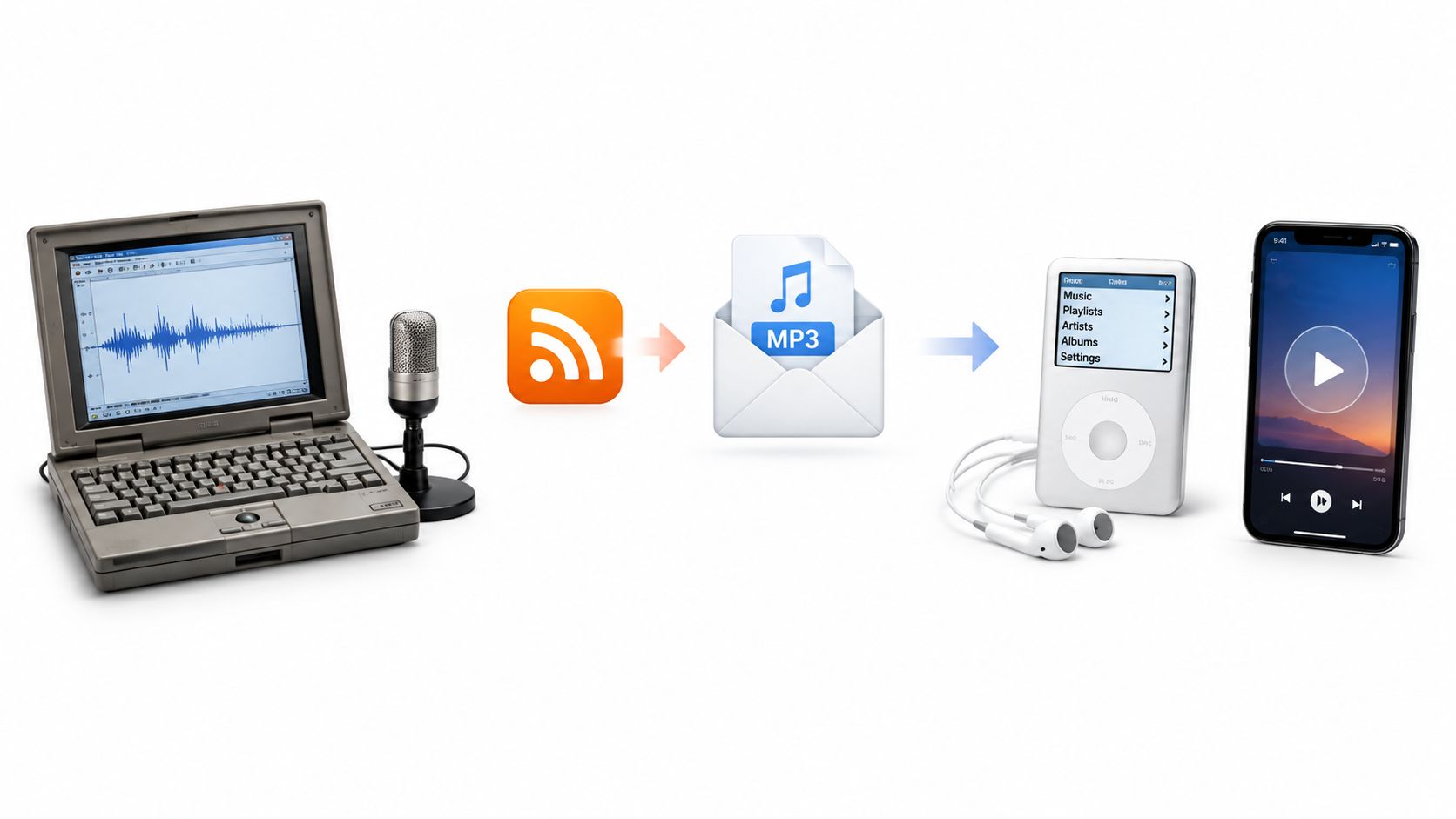
Podcasting began between 2003 and 2004, when RSS-enclosed audio became a workable distribution method and Ben Hammersley gave the format its name in February 2004. If you're asking when did podcasting start, that's the anchor, but the fuller story is how a technical workaround turned into a media category, then into a mainstream habit, and now into a cross-format audio-and-video medium.
The easy mistake is to treat podcasting as if it appeared fully formed. It didn't. First came the plumbing, then the first experiments, then the label, then the software support that made it easy enough for everyday listeners. By the time podcasting felt familiar, the foundations were already years old.
Table of Contents
- The Short Answer to When Podcasting Started
- The Technical Foundation That Made Podcasting Possible
- The First Podcast and the 2003 Harvard Experiment
- The 2004 Moment Podcasting Got Its Name
- How iTunes 4.9 Turned Podcasting Into a Mass Medium in 2005
- From Audio-Only Origins to Video-First in 2026
- Common Misconceptions and the Road Ahead
The Short Answer to When Podcasting Started
Podcasting started in the early 2000s, especially 2003 and 2004. In practice, that means two things happened close together, RSS-enclosed audio distribution became usable, and the word “podcasting” was coined in February 2004 in The Guardian.
That timing matters because podcasting wasn't born as a finished consumer product. It began as a workflow, one that let creators attach audio to a feed and let listeners receive new files automatically. The name came later, after the method already existed.
The timeline in plain terms
First, the distribution method had to work. Then people had to recognize it as something distinct enough to name. Then software platforms had to make it easy enough to use without technical effort.
That's why the history of podcasting is best read as a sequence:
- RSS enclosures made audio subscription possible.
- The 2003 Harvard experiment showed the method in real use.
- Ben Hammersley's 2004 naming moment gave the format a shared word.
- iTunes 4.9 in 2005 pushed it into mainstream software.
- 2026 shows how far the medium has moved, with video now sharing the stage with audio.
The question isn't just “when did podcasting start?” It's also “when did enough of the internet finally catch up to the idea?”
If you keep that sequence in mind, the rest of the origin story is easier to follow. A medium doesn't become a medium the moment someone has the idea. It becomes one when the technology, the language, and the listening habits line up.
The Technical Foundation That Made Podcasting Possible
Podcasting needed two building blocks before anyone could call it a podcast, RSS and the enclosure. Think of RSS as a subscription mailbox. Instead of visiting a site again and again to check for updates, you subscribed once and the feed asked, on your behalf, whether anything new had arrived.
The enclosure made that feed useful for media. It let a post carry a file, so an update could include audio the way an envelope can carry a small package. That turned RSS from a text-update tool into a delivery system for downloadable media. The shift sounds small, but it changed what creators could publish and how listeners could receive it.
Why the plumbing mattered first
Before podcasting had a name, it had a mechanism. Dave Winer's enclosure work around RSS gave publishers a way to attach media files to feed items, which meant a blog post could arrive with audio already packaged inside it. That was the missing piece.
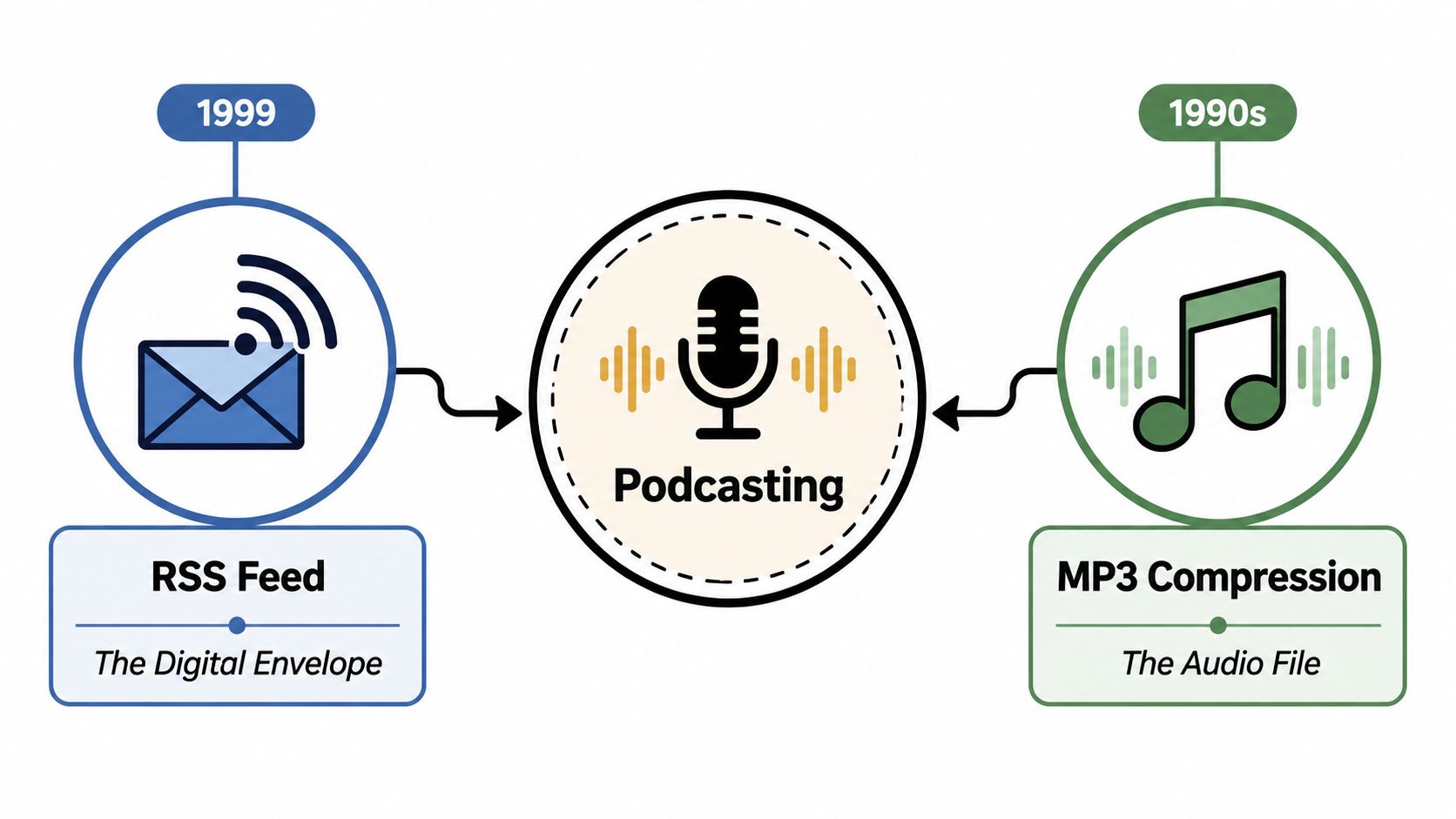
The important part is not just that the file existed, but that it could arrive automatically. That's what separated podcasting from a static download page or a manually shared MP3. It created a subscription model for audio, and that model is still the core of the medium.
Practical rule: if a media format depends on a platform logging in, pressing play, and staying on the site, it's not yet podcasting in the historical sense.
For readers who want the hands-on version of this workflow, a basic guide to how to make a podcast shows how much of today's production still rests on the same simple idea, create once, distribute through a feed, let people subscribe.
The First Podcast and the 2003 Harvard Experiment
When did podcasting start? The clearest early marker is July 9, 2003, when Christopher Lydon and Dave Winer recorded audio at Harvard and distributed it through an RSS enclosure. The moment was modest, but the mechanism was new enough to matter. Audio could now sit inside a feed and reach listeners without a separate streaming system.
The 2003 recording shows the medium before the branding. Lydon brought the journalistic habit of asking questions in public, Winer brought the feed architecture, and the two ideas met in one practical experiment. That combination is why historians later treat the session as a starting point rather than a curiosity.
An experiment that looked ordinary at the time
The setup did not announce itself as a media revolution. A recording was made, the file was attached to a feed, and readers who already knew blogs could also retrieve audio. By late 2003 the enclosure pattern was circulating among bloggers and audio experimenters, still awkward but already repeatable.
That matters because the workflow already contained the logic of podcasting. There was no broadcast tower, no fixed schedule, and no need to wait for a station to decide when to air something. First came the file, then the feed, then the listener who subscribed.
The first podcast was not a show in the modern sense. It was evidence that distributed audio could behave like a subscription.
A few months later, the practice would get an easier name, but the underlying method was already in place. The medium existed before the word did.
New media often looks messy before it looks inevitable. The Harvard experiment shows that stage clearly, because the parts were simple and the result was larger than the sum of them.
The 2004 Moment Podcasting Got Its Name
Once the workflow existed, it still needed a name that people could use consistently. That happened in February 2004, when Ben Hammersley used “podcasting” in The Guardian. The word stuck because it solved a simple problem, people needed one label for a format that had been described in scattered ways.
Before that, the same thing might be called an audioblog, RSS radio, or an internet show. Those phrases hinted at the idea, but none of them settled it. Once podcasting entered circulation, developers, writers, and listeners could point to the same thing without translating from one term to another.
Why a label changes a medium
Naming does more than decorate a technology. It lets software builders code for it, directory curators categorize it, and audiences recommend it without explaining the backstory every time. A shared name gives a workflow social visibility.
That's exactly what happened here. The audioblogging community was already refining the enclosure-based method, and Hammersley's wording gave the emerging practice a public handle. The name didn't invent the medium, but it made the medium easier to find.
The shift was also psychological. Once a practice has a name, it starts to feel like a category instead of a workaround. That's when tools, communities, and habits begin to form around it.
A medium often becomes mainstream only after it becomes easy to say out loud.
This is why 2004 matters so much in the origin story. The technical base was already in place, but the label gave the format an identity. That identity helped podcasting move from a niche experiment to a recognizable media type.
How iTunes 4.9 Turned Podcasting Into a Mass Medium in 2005
The next turning point came in June 2005, when Apple added native podcast support in iTunes 4.9. That step mattered because it reduced friction. Listeners no longer needed to understand RSS, hunt for feed readers, or manually manage files. They could subscribe inside software they already used.
That's what turned podcasting from a technically elegant idea into something ordinary people could adopt. The same feed logic was still underneath, but Apple wrapped it in a familiar interface. Once that happened, the medium became much easier to discover and much easier to keep using.
Platform support changed the experience
Apple's move did three things at once. It gave podcasting a directory, it made subscription handling easier, and it tied episodes to the iPod ecosystem. That combination mattered more than any single feature, because it collapsed a multi-step workflow into a simple one.
The effect on adoption was slow at first, then clearly visible over time. Edison Research data summarized by Pew Research Center shows podcast listening among Americans ages 12 and older rising from 12% in 2013 to 37% in 2020 and 42% in 2023. Another Edison-linked fact sheet says 54% of U.S. adults listened to a podcast in the prior 12 months in 2025, up from 42% in 2023 and 9% in 2008. That long arc shows how long it took podcasting to move from niche habit to mainstream behavior. Pew's audio and podcasting fact sheet captures that long-run rise.
| Year | Source | Weekly U.S. Listeners | Notable Trigger |
|---|---|---|---|
| 2005 | Apple iTunes 4.9 launch, as summarized in the historical record | Not stated in the verified data | Native podcast support in mainstream software |
| 2013 | Pew Research Center summary of Edison Research data | Not stated in the verified data | Early measured U.S. adoption |
| 2020 | Pew Research Center summary of Edison Research data | Not stated in the verified data | Wider consumer familiarity |
| 2023 | Pew Research Center summary of Edison Research data | Not stated in the verified data | Continued mainstream growth |
| 2025 | Edison-linked fact sheet summarized by Pew Research Center | Not stated in the verified data | Higher overall adult listening |
The table shows the important pattern, the technical idea from 2003 only became mass-friendly after a major platform normalized it. Podcasting didn't change its core mechanism. It changed its packaging.
From Audio-Only Origins to Video-First in 2026
Podcasting began as downloadable audio delivered through RSS enclosures. That audio-first foundation stayed intact for years, which is why the medium still feels familiar even as the surface has changed. Today, the more useful question isn't only where podcasting started, it's how far the format has stretched.
By 2026, the shift is clear enough that weekly podcast consumers are watching as much as they're listening for the first time in the available data. SSRS reported in 2026 that, for the first time, as many weekly podcast consumers are watching as listening, and Acast's 2026 Podcast Pulse found 88% of monthly audio and video podcast consumers use both formats, up from 78% a year earlier. Edison Research also reported 167 million monthly U.S. podcast consumers in 2026, up from 158 million in 2025. SSRS's 2026 consumer insights make the point plainly. The medium is no longer audio-only in practice.
What changed, and what didn't
The distribution logic is still recognizable. Creators publish a file, audiences subscribe, and platforms help surface the content. What changed is the file type and the way people consume it. Video podcasts now sit beside audio podcasts instead of replacing them.
That's why this moment is best understood as an extension of the original model, not a break from it. The same subscription logic that made audio scalable can also carry video, and creators now choose the format mix that fits their audience and production style.
If you're organizing a show today, category choices, guest-fit, and format planning matter more than ever, which is why a practical directory and workflow tool can be useful. For example, podcast categories and show discovery are now part of how creators think about reach, format, and audience expectations.
Podcasting started as a way to move audio through feeds. In 2026, it looks more like a parallel audio and screen experience. The medium hasn't abandoned its roots, it has expanded them.
Common Misconceptions and the Road Ahead
A lot of people get the origin story slightly wrong because they confuse podcasting with earlier internet audio. Live-streaming projects like AudioNet and RadioMotive in the 1990s came before podcasting, but they were not the same thing. They were broadcasts, not downloadable feed-based subscriptions.
That distinction is the key. Podcasting is defined by RSS-enclosed, on-demand distribution, not just by putting sound on the internet. Earlier audioblogging experiments and speculation were important, but without the enclosure workflow they weren't yet the full medium.
What podcasting is not
It helps to separate three things:
- Live streaming is not podcasting, because the audience is tuned to a live feed rather than subscribing to a downloadable file.
- Audioblogging is related, but it becomes podcasting only when the feed and enclosure mechanism make automatic delivery possible.
- Apple popularized podcasting, but it didn't invent the medium itself. The workflow was already underway before the brand arrived.
That clean distinction matters because the history gets blurry when people focus on a famous platform instead of the underlying technique. Podcasting is a protocol story first, and a consumer-platform story second.
What comes next is already visible. Major networks are consolidating, creator-funding models like subscriptions and tipping are getting more common, and AI-assisted production tools are lowering the barrier to entry for new shows. Short-form vertical video and more interactive podcast formats are likely to shape the next phase.
The origin story still matters because it explains why the medium keeps adapting. Podcasting started as a way to subscribe to audio. It's now becoming a broader publishing format, but the logic of direct distribution still sits underneath everything.
If you want to move from podcast history to actual podcast action, visit Let's Make A Podcast. It helps hosts find guests, organize outreach, and manage the booking workflow in one place. If you're planning a show or trying to get booked on one, it's a practical next step.