Podcast Name Generator: How to Find a Name That Sticks

You've settled on a topic, sketched some episodes, and opened a document to name your podcast. Every sensible option sounds ordinary. Every clever option needs an explanation. Meanwhile, you're itching to record.
A podcast name generator can break that stalemate, but its suggestions are drafts, not launch-ready decisions. Treat naming as a production task: write a useful brief, compare different directions, screen for conflicts, and test what listeners hear. That way, you don't fall in love with a title before discovering that people can't spell it or already associate it with another show.
Table of Contents
- How to Generate Podcast Name Ideas in Five Steps
- Four Podcast Name Styles and When Each Works
- Scoring Podcast Name Candidates on Five Criteria
- Clearance Checks Before You Lock In a Name
- Testing Finalists by Saying, Spelling and Searching Them
- Choose Your Podcast Name and Launch With It
How to Generate Podcast Name Ideas in Five Steps
Say you're starting a sourdough podcast for first-time bakers. You know how to explain starter care without intimidating people, but you haven't found a name that feels right. Start with those useful details rather than asking a generator for something creative about bread.
Spotify's podcast SEO guidance recommends a short, unique title, roughly three to four words, containing a keyword that reflects the content, and warns against generic or highly similar names. Treat that as a design target, not a promise of downloads.
Give the Generator Useful Boundaries
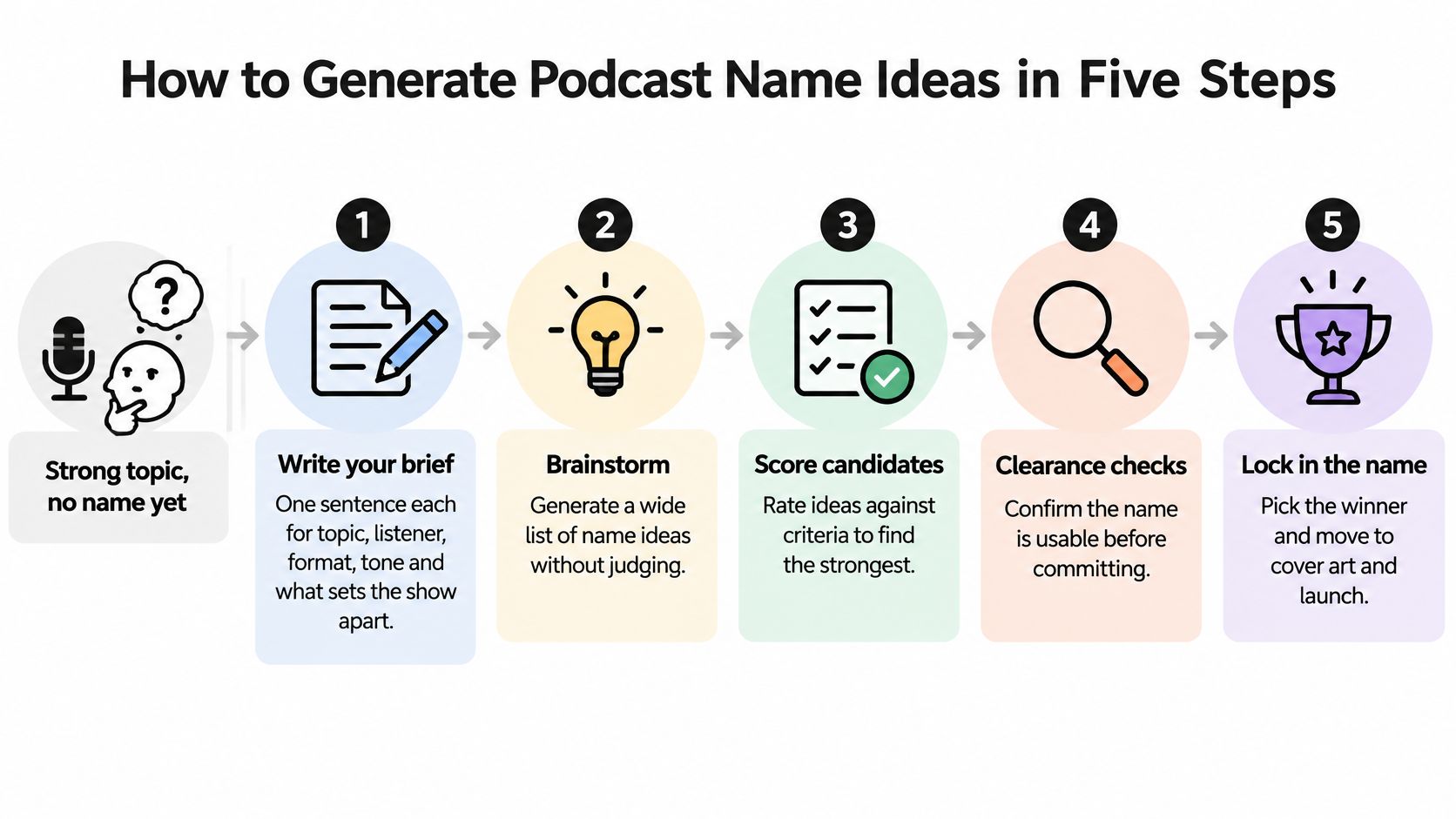
Write your brief. Give the generator a sentence each about your topic, listener, format, tone, and differentiator. For example: the topic is sourdough troubleshooting; the listener is a nervous beginner; the format is solo instruction; the tone is reassuring; the differentiator is your experience teaching home bakers. If your audience description is still everyone who likes food, narrow it using the guide to podcast niches.
Choose a listener's search phrase. Beginner sourdough baking is more useful than bread inspiration because it describes a specific need. Keep that phrase, or a natural variation such as sourdough for beginners, in your initial search-led candidates. You're identifying the language listeners recognize, not writing a search query as a title.
Add a differentiator. Try an audience, outcome, format, or host-persona cue. Sourdough Starter Clinic suggests troubleshooting; Sourdough for Nervous Bakers identifies the listener's concern. Choose a distinction your episodes can consistently deliver, rather than an adjective such as ultimate that adds little meaning.
Create Variety Before You Edit
Generate contrasting directions. Ask for literal, audience-focused, topical, and brandable suggestions, with a short explanation of each. For this exercise, you could request thirty raw candidates so you have room to discard weak ideas. Start with topic-led wording, then allow topical and brandable alternatives to move the explanation into supporting copy. Otherwise, every result becomes a rearrangement of the same phrase.
Trim and clean the list. Remove unnecessary punctuation, awkward abbreviations, deliberate misspellings, and words that contribute nothing. Beginner Sourdough Baking Tips and Advice Podcast becomes Beginner Sourdough Clinic. Check each remaining title in a narrow phone-sized mockup before keeping it.
Avoid the opposite mistakes of keyword stuffing and metaphor-only naming. A string of search terms doesn't sound like a show, while an unexplained metaphor leaves the listener guessing.
Practical rule: Keep an idea because it communicates a useful direction, not because the generator supplied a persuasive explanation.
For a manageable working shortlist, aim for ten to fifteen clean candidates. That's an exercise target, not a required batch size.
Four Podcast Name Styles and When Each Works
| Style | Pattern | Example for a sourdough show | Works best when | Main risk |
|---|---|---|---|---|
| Literal | Subject plus format | Beginner Sourdough Podcast | Listeners search by topic name | Crowded and hard to own |
| Audience-focused | Subject plus who it serves | Bread Night for New Bakers | The niche audience is clear and specific | Narrows the show if the audience changes |
| Topical | Image or concept from the subject | Flour, Heat and Time | The show needs an evocative, memorable identity | Vague without supporting explanation |
| Brandable | Invented or unusual word | Proofline | You want a potentially distinctive series identity | Needs explanation, and protectability still requires review |
These are illustrative names, not cleared recommendations. Use them to compare naming approaches rather than as a list of available titles.
The literal option makes the smallest demand on an unfamiliar listener. Someone looking for sourdough instruction can understand it immediately, but you'll need to inspect the surrounding results carefully before deciding it stands apart.
The audience-focused option emphasizes belonging. Bread Night for New Bakers suggests an approachable experience, although bread is broader than sourdough. Keep that distinction deliberate: a welcoming name shouldn't promise a different subject.
Keep the Series Identity Separate From Episode Details
The topical and brandable options leave more room for interpretation. Flour, Heat and Time evokes baking without explicitly promising instruction. Proofline could support a recognizable series identity, but an unfamiliar listener won't necessarily know whether it concerns bread, mathematics, or editing.
Format matters too. A title built around a clinic suggests practical diagnosis; a title built around conversations suggests discussion. If you're planning guest-led episodes, the guide to starting an interview podcast can help you check whether that implied experience matches your production plan.
Apple's podcast publishing guidance calls for a clear, concise show name and separates episode and season numbers into dedicated metadata fields. Beginner Sourdough Talk Episode 12 therefore mixes the permanent series identity with information belonging to an individual installment.
The show title identifies the series. The episode title identifies the conversation or lesson.
Keep both search-led and identity-led options in your shortlist. Comparing a literal or audience-focused name against a topical or brandable alternative makes the trade-off visible: immediate comprehension versus a more distinctive identity.
Scoring Podcast Name Candidates on Five Criteria
| Criterion | Weight | What to check | Red flag |
|---|---|---|---|
| Semantic relevance | 40% | Does the name signal the main topic in plain words? | Could describe almost any show in the category |
| Distinctiveness | 25% | Does it stand apart from the top results for the topic? | Shares most of its words with an established show |
| Brevity and display length | 15% | Is it concise, pronounceable, and readable in a phone list? | Gets cut off before the meaningful distinction |
| Audience promise | 10% | Does it tell listeners who the show is for? | Promises something the episodes don't deliver |
| Collision and trademark risk | 10% | Does a similar name appear in directories or registries? | A near-identical name exists in the same category |
These weights are a proposed working model, not a validated success benchmark. The podcast metadata topic-modeling study found that incorporating named entities improved topic coherence in its experiments, but it didn't test whether this scoring formula predicts listener clicks or follows.
Read the Total Without Hiding Weaknesses
For a hypothetical scoring exercise, rate each criterion from zero to five, multiply each rating by its decimal weight, and add the results. The total will be out of five. Use the red flags first: an observed warning should pull that criterion toward the bottom of the scale.
Consider only the relevance and distinctiveness contributions in this worked example:
- Candidate A: Relevance of 4 multiplied by 0.40, plus distinctiveness of 2 multiplied by 0.25, contributes 2.1 points.
- Candidate B: Relevance of 3 multiplied by 0.40, plus distinctiveness of 4 multiplied by 0.25, contributes 2.2 points.
Candidate B leads on those contributions, but you still need the remaining criteria before declaring an overall winner.
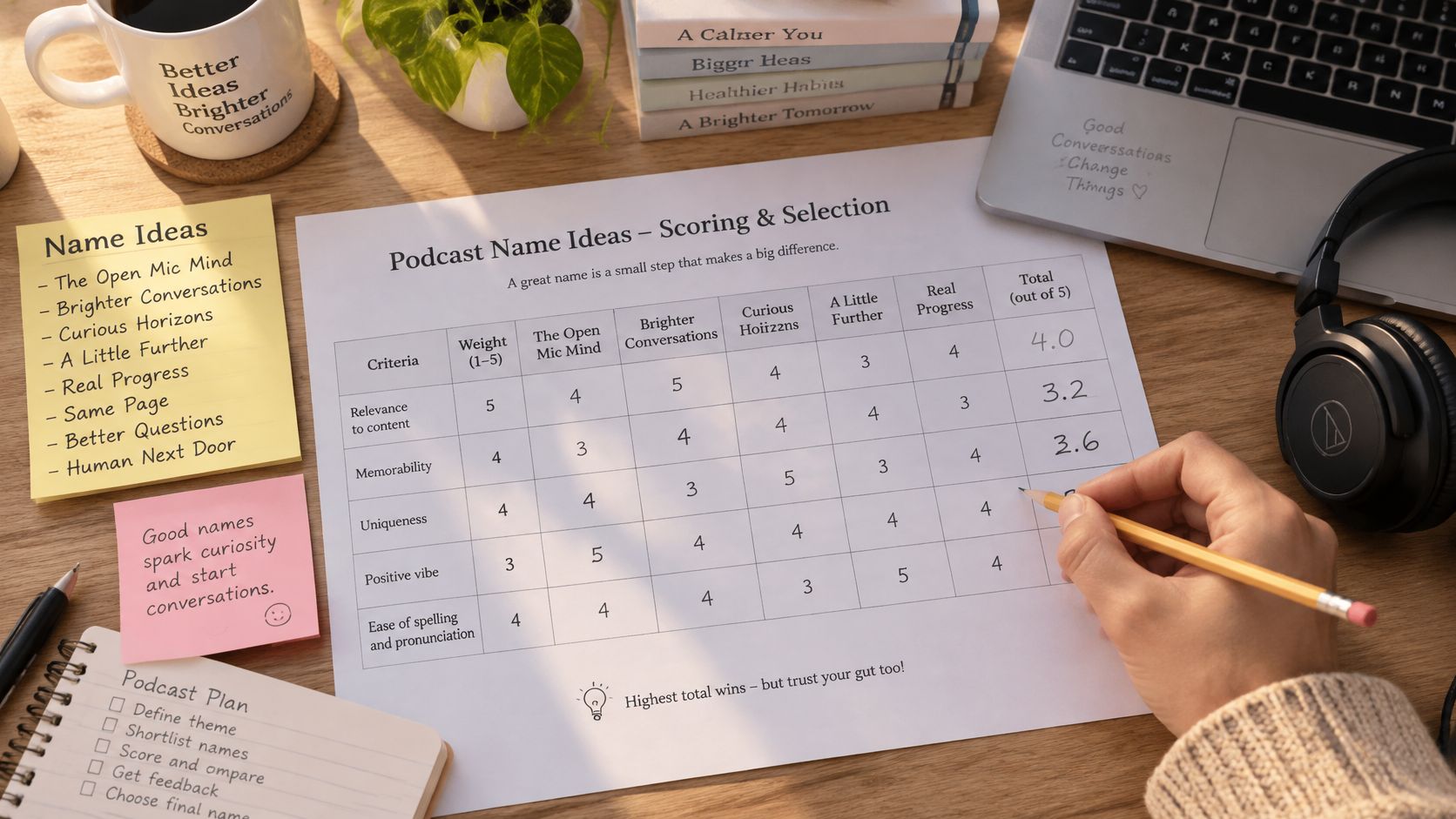
Beginner Sourdough Podcast earns strong relevance and audience-promise marks on its wording alone. Its distinctiveness score should remain provisional until you inspect actual search results. Don't assume a collision merely because the words are common.
Proofline has a different problem. It offers an unusual identity, but the bare word doesn't explain the subject. Score the title, then assess how a supporting description changes the complete listener-facing presentation.
A high total isn't clearance. A serious conflict can disqualify a candidate even when its other scores are strong.
Keep a small finalist group, with written reasons for each score. After launch, compare those expectations with actual search impressions, qualified visits, and follows rather than changing the weights to justify your favorite.
Clearance Checks Before You Lock In a Name
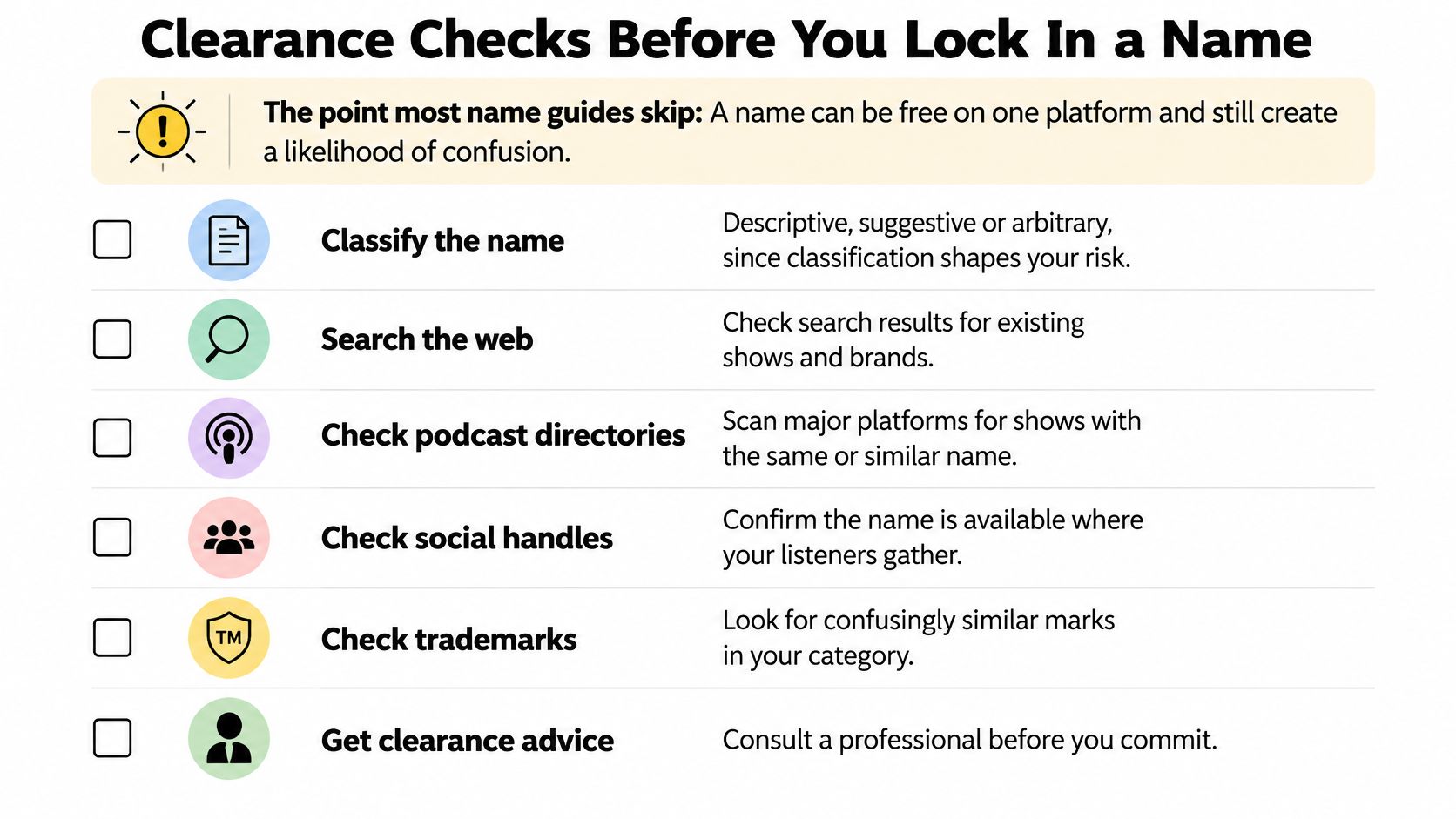
An unused platform listing doesn't make a name safe to use. The important question is whether listeners could confuse your show with another series or related brand, not whether the exact text appears in an app.
Legal 500's guidance on podcast trademarks explains that conflicts can involve similar sounds, spellings, related categories, and unregistered use. A name missing from a government database isn't automatically cleared, and ownership rules vary by jurisdiction.
Search for Confusion, Not Just Matches
- Classify the wording. Record whether the name describes the content, suggests it indirectly, or uses a distinctive identifier. The Podcast About Sourdough plainly describes its subject; an unusual invented term presents a different branding question. Don't mistake an unusual spelling for automatic legal protection.
- List sound-alikes and lookalikes. For a hypothetical name such as Dough School, also search Doe School and other plausible hearing errors. Note spacing, plurals, and spelling variants that could send listeners elsewhere.
- Inspect podcast directories. Search exact and near versions across major podcast platforms. Open the results and examine their subjects, artwork, and descriptions rather than relying on the search-results snippet.
- Check wider commercial use. Search the web, business directories, domain registrations, and relevant social platforms. A similarly named baking course may deserve attention even if its owner doesn't publish a podcast.
Document the Decision Before Spending on It
- Search relevant trademark records and unregistered use. Consider the markets where you intend to build an audience or business. A government database search and an open-web search answer different questions; neither substitutes for interpreting a potential conflict.
- Write down ownership. Record who owns the title, when you selected it, and where you searched. If cohosts or a production company are involved, resolve ownership before commissioning artwork.
- Escalate commercial plans. Get professional trademark review before committing when sponsorships, merchandise, or a wider media brand are central to the project. Bring your shortlist and search notes so the adviser can assess concrete candidates.
An automated name checker is initial screening, not legal advice. If a candidate raises a serious concern, return to the shortlist instead of assuming that adding The or changing a letter solves it.
Testing Finalists by Saying, Spelling and Searching Them
You read Proofline aloud, and your listener writes Proof Line. That doesn't establish a legal problem, but it exposes a practical one: the spelling you pictured isn't necessarily the spelling someone hears.
The Cohn Legal publishing and media trademark resource center explains the role of titles in identifying a recurring series. To test whether your proposed identifier works in conversation, use a small rehearsal with explicit pass and fail signals.
Rehearse a Listener's Route to the Show
Say it without showing it. Ask unfamiliar listeners to write the name after hearing it, without coaching them. Pass: their spelling matches your intended version. Fail: they disagree or need an explanation. For a simple rehearsal, you could use three listeners, but don't treat that small group as representative audience research.
Search at phone width. Type the finalist into podcast searches and inspect competing results. Before publication, pass means no obvious competing result overwhelms the intended identity and the title reads clearly in a mockup. Fail means confusing competition or truncation. Once indexed, check whether someone can retrieve your actual show.
Check intended languages. Ask fluent speakers to read the name and any relevant transliteration. Pass: the meaning and pronunciation fit your intention. Fail: a pun disappears, an idiom becomes awkward, or the wording suggests something unintended.
Separate the dimensions. Assess topic clarity, memorability, pronunciation and spelling across accents, and collision risk independently. Pass: none remains an unresolved weakness. Fail: enthusiasm for memorability hides a pronunciation problem. Set your acceptance threshold before comparing finalists.
Try voice search. Have a colleague speak the name into their usual search tool without supplying its spelling. Pass: the transcription is correct and, after indexing, they can find the show directly. Fail: they must correct the transcription or ask you for letters.
A distinctive title doesn't have to explain everything by itself. Add a short descriptive line to artwork, the show description, or promotional copy, or use a consistent subject-led episode-title convention. Don't rely on a separate subtitle field appearing identically across apps.
Choose Your Podcast Name and Launch With It
Choose the highest-scoring candidate that passes your clearance process and works when spoken, spelled, and searched. If finalists remain tied, favor the one listeners can spell without help.
The decision should be explainable without a speech about your personal taste. You should be able to state who the name serves, what expectation it creates, and why you're comfortable using it.
Make the Name Consistent Across Your Launch
- Enter the plain series title. Put the chosen name into your hosting platform's show-title field, keeping installment details in their appropriate places.
- Attach the necessary context. If the title is intentionally distinctive, prepare a short explanatory line and a description that identifies the listener and recurring promise.
- Save the ownership record. Keep the final wording, selection date, ownership agreement, and clearance notes together.
- Reserve your launch identities. Secure suitable social handles and a domain before announcing the name, then use consistent spelling across artwork and profiles.
If you want more options before committing, our free podcast name generator can help you develop another shortlist. When the wording is settled, use the podcast description generator to draft supporting copy, then edit it against the actual episodes you plan to make.
Don't keep generating names after you've found one that meets your requirements. Your next production decision is to confirm the episode format and release schedule, then prepare a pilot that delivers what the name promises.
Let's Make A Podcast connects hosts and prospective guests, with free tools including a pitch generator, show readiness check, and podcast guest finder. Visit Let's Make A Podcast to check your launch readiness and plan the conversations behind your newly named show. The marketplace is free in both directions during early access.