Brand Building Podcast: What It Is and How to Use One

A busy operations director hears the same founder explain supply chain problems on three different shows over several months. By the next time she needs help, the founder's name feels familiar, and she remembers what the company knows how to do. That recognition is the point of a brand building podcast: not just to get heard, but to become memorable and trusted through relevant conversations.
For a business choosing between starting a show, booking interviews, or paying for sponsorships, the important question isn't just how many people might listen. It's which format can consistently connect the right expertise with the right audience, without making every episode feel like a pitch.
Table of Contents
- What a Brand Building Podcast Is and Why It Differs
- Four Formats Compared and Which One Fits
- Why Brand Building Podcasts Pay Off
- Content Pillars That Build Recall
- Distribution Channels That Multiply Each Episode
- Brand-Focused Shows and the Trust Rules They Follow
- Measure Brand Impact and Run a 90-Day Test
What a Brand Building Podcast Is and Why It Differs
A brand building podcast is a recurring conversation designed to make a particular company, person, or expertise memorable and credible. Its primary job isn't maximizing listens for their own sake. It's helping the right people remember who you are, what you know, and when your expertise might be useful.
Think of the difference between a roadside billboard and a trusted radio presenter. A billboard can reach passing drivers, but most see it briefly and move on. A presenter earns attention through a familiar voice, relevant context, and repeated appearances. A podcast can build recognition in that more personal way when the content consistently connects a name with a useful topic.

Three signals make that connection stronger:
- Repetition: Listeners encounter the same name, company, or point of view in more than one relevant conversation.
- Context: The conversation links that name to a recognizable subject, such as solving supply chain bottlenecks or helping first-time managers.
- Trust: The host's voice, preparation, and relationship with the audience provide a setting where listeners may be more open to an idea.
A download-driven show is often judged by audience size and listening activity. A brand-building show asks a different question: after listening, do the people you want to reach remember the guest, trust their expertise, or look them up? Reach still matters, but it's only useful if the right audience makes a meaningful connection.
Businesses can participate in three ways. Own a show to set the format and publish ongoing conversations. Appear as a guest to bring your expertise into an established show's audience. Or sponsor another show to put a brand message alongside a host and topic listeners already know.
The show is the vehicle; the memory of one clear expertise is the cargo.
Which role fits your goal: building a platform, earning authority as a guest, or reaching listeners through sponsorship?
Four Formats Compared and Which One Fits
| Format | What the Brand Controls | Time to First Signal | Main Risk | Best For |
|---|---|---|---|---|
| Owned show | Topic, guests, schedule, editing | Slow, typically months | Production cost and inconsistent publishing | Companies or founders with a clear point of view |
| Guest appearances | Pitch, talking points, choice of show | Faster, often weeks to first booking | Weak audience fit lowers recall | Experts and founders building personal authority |
| Host-read sponsorship | Script and placement only | Quick to book; results depend on campaign length | Listener fatigue and weak host fit | Brands with an awareness or direct-response budget |
| Co-produced series | Shared with the partner | Moderate, usually a few months | Coordination overhead and shared control | Companies wanting access to a partner's audience |
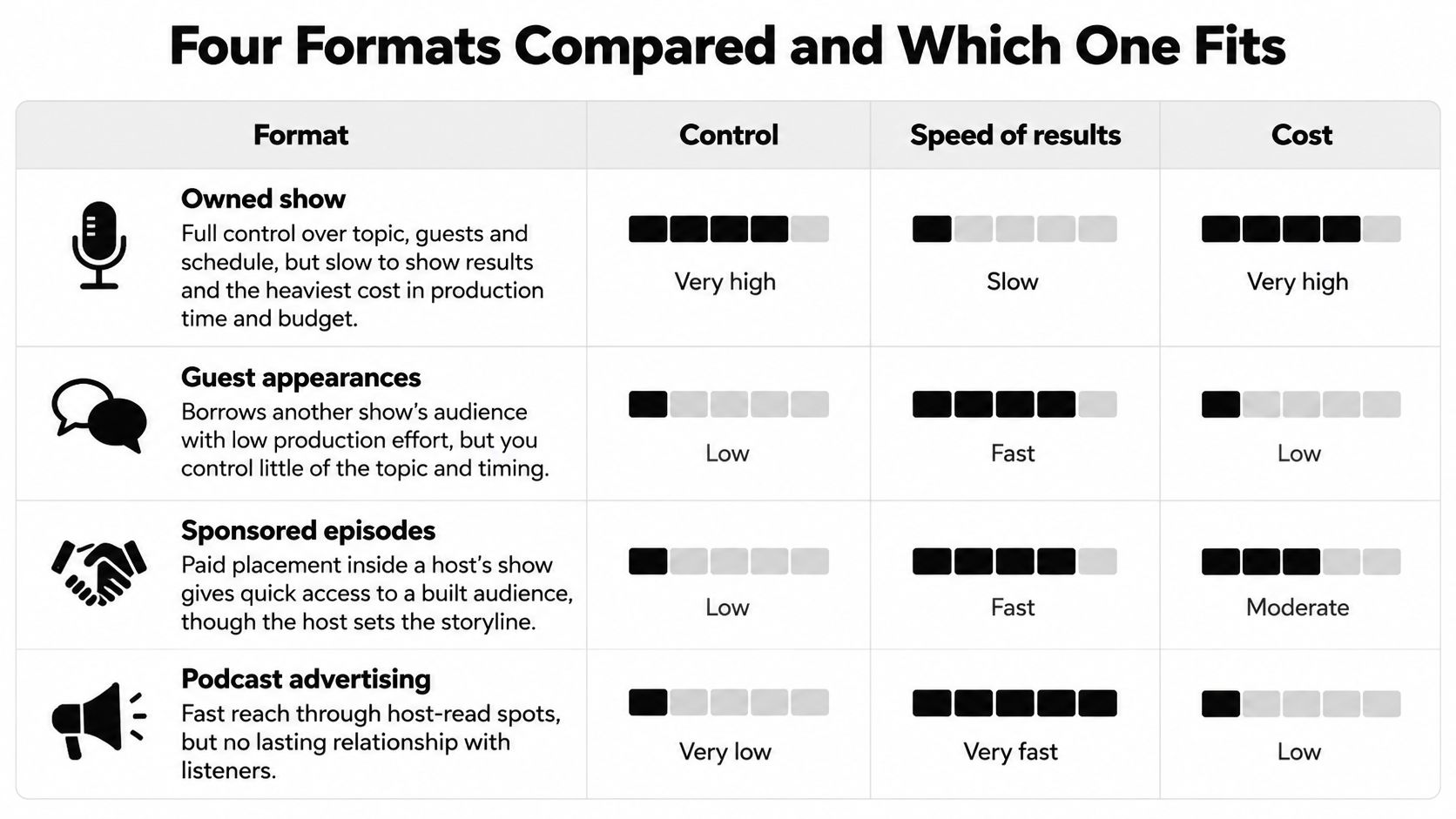
An owned show gives you the most editorial control. You choose the subject, guests, publishing schedule, and editing approach. That control is valuable when you have a strong perspective and can sustain the work, but you're responsible for the production process and for giving listeners a reason to return. If you're learning how to plan and produce a series, this guide to making a podcast can help you map out the practical steps.
Guest appearances are a straightforward starting point for an expert without an established audience. You pitch a useful subject and bring clear talking points, but the host determines the conversation's structure and timing. A mismatch between your expertise and the show's listeners can make an otherwise polished interview easy to forget.
Host-read sponsorships buy access to an existing program and let a host deliver a message in their own voice. You can shape the script and placement, but the host controls the surrounding conversation. Repeating an ad without enough relevance or creative variation can test listeners' patience rather than building a stronger association.
Co-produced series divide the editorial work between a brand and a partner. That can bring together complementary expertise and audiences, but every shared decision needs coordination. Agree in advance on the target listener, episode ownership, approval process, guest selection, publishing responsibilities, and how each partner can use the finished material.
The right format depends on your situation. If you're a founder with a clear point of view and time to publish consistently, consider an owned show. If you're an expert seeking authority, start by pitching ten to twenty well-matched shows rather than pursuing a large list of loosely relevant ones. If your brand has an awareness budget, test one sponsorship and assess audience fit and recall before committing further.
Why Brand Building Podcasts Pay Off
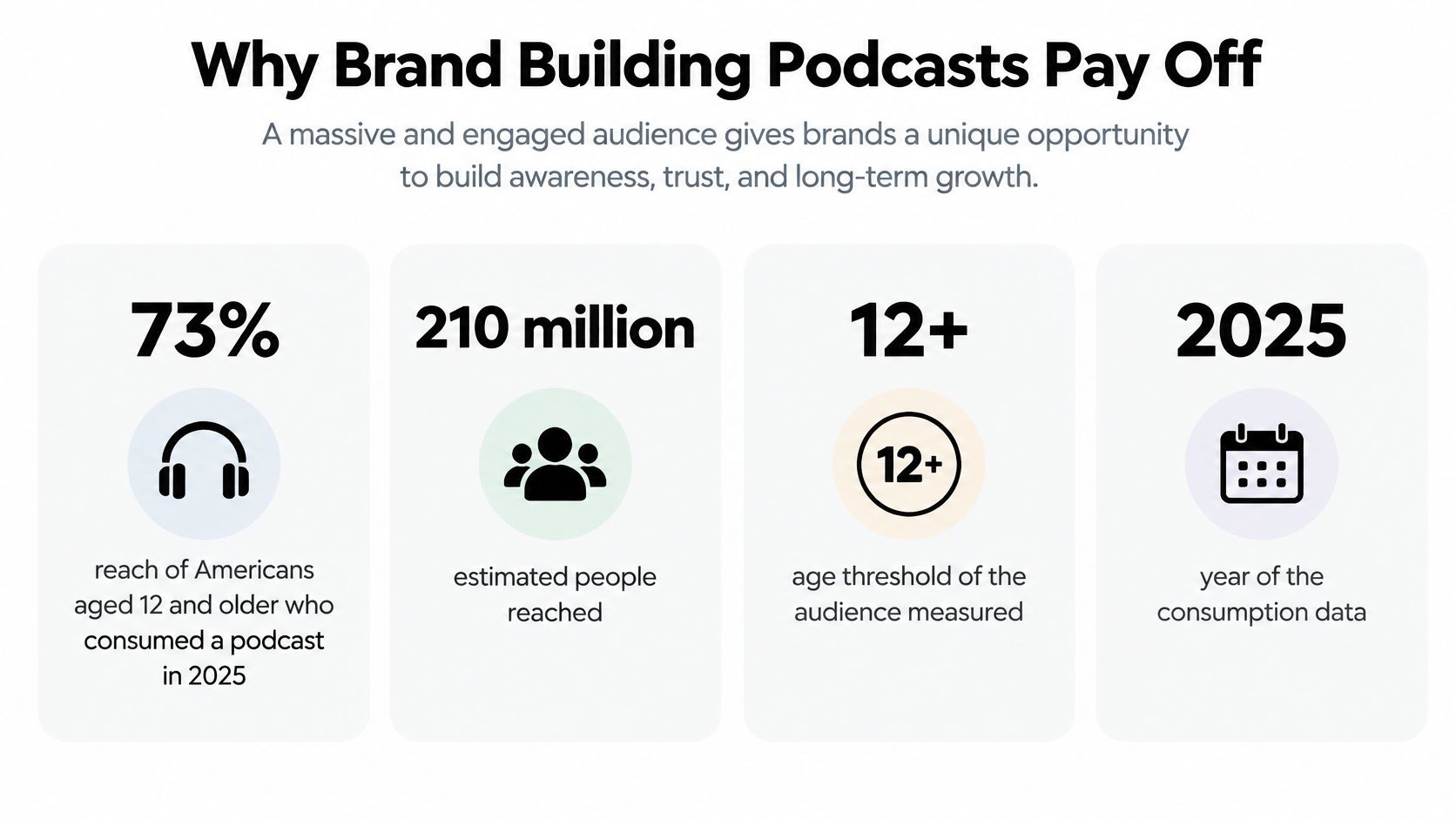
In 2025, 73% of Americans aged 12 and older had consumed a podcast in audio or video form, an estimated 210 million people, according to Edison Research's Infinite Dial report. That scale means podcast audiences aren't limited to a small group of early adopters. It doesn't mean every show suits every business, but it does make podcasting a credible channel to evaluate.
Weekly podcast listening among the U.S. population aged 13 and older reached 773 million hours in 2025, compared with 170 million hours in 2015, according to Edison Research's podcast consumer report. For a brand, the useful point isn't just that people listen. It's that podcasts can create a setting for repeated, sustained attention, which gives listeners more opportunity to connect a person or company with a subject.
A recorded conversation can also become a durable content asset. Publish it on an episode page, link to it from relevant articles, and share useful excerpts in a newsletter or on social channels. A prospect might come across the original episode or one of those follow-up materials later, then arrive at a sales conversation with some familiarity with your name and approach.
The advertising market offers another signal that brands consider the channel useful for more than immediate clicks. The IAB and PwC's podcast revenue study projected that U.S. podcast advertising revenue would exceed $2 billion in 2024 and approach $2.6 billion by 2026. Separately, the IAB and PwC's 2023 revenue report said that brand-building advertising accounted for a majority of industry revenue for the first time in the report's nine-year history. Those findings suggest advertisers are investing in awareness and longer-term brand effects, not only direct-response placements.
Podcasting still has limits. Familiarity builds slowly, and one appearance rarely changes a market's view of a company. A business also won't earn authority just by talking: listeners need specific ideas, useful examples, and a reason to believe the speaker understands the subject.
Before investing, ask a practical question: are your target customers already listening to shows about the problem you solve? If yes, podcasting may give you a relevant place to earn recognition. If not, examine the audience and distribution choices before committing to a format.
Content Pillars That Build Recall
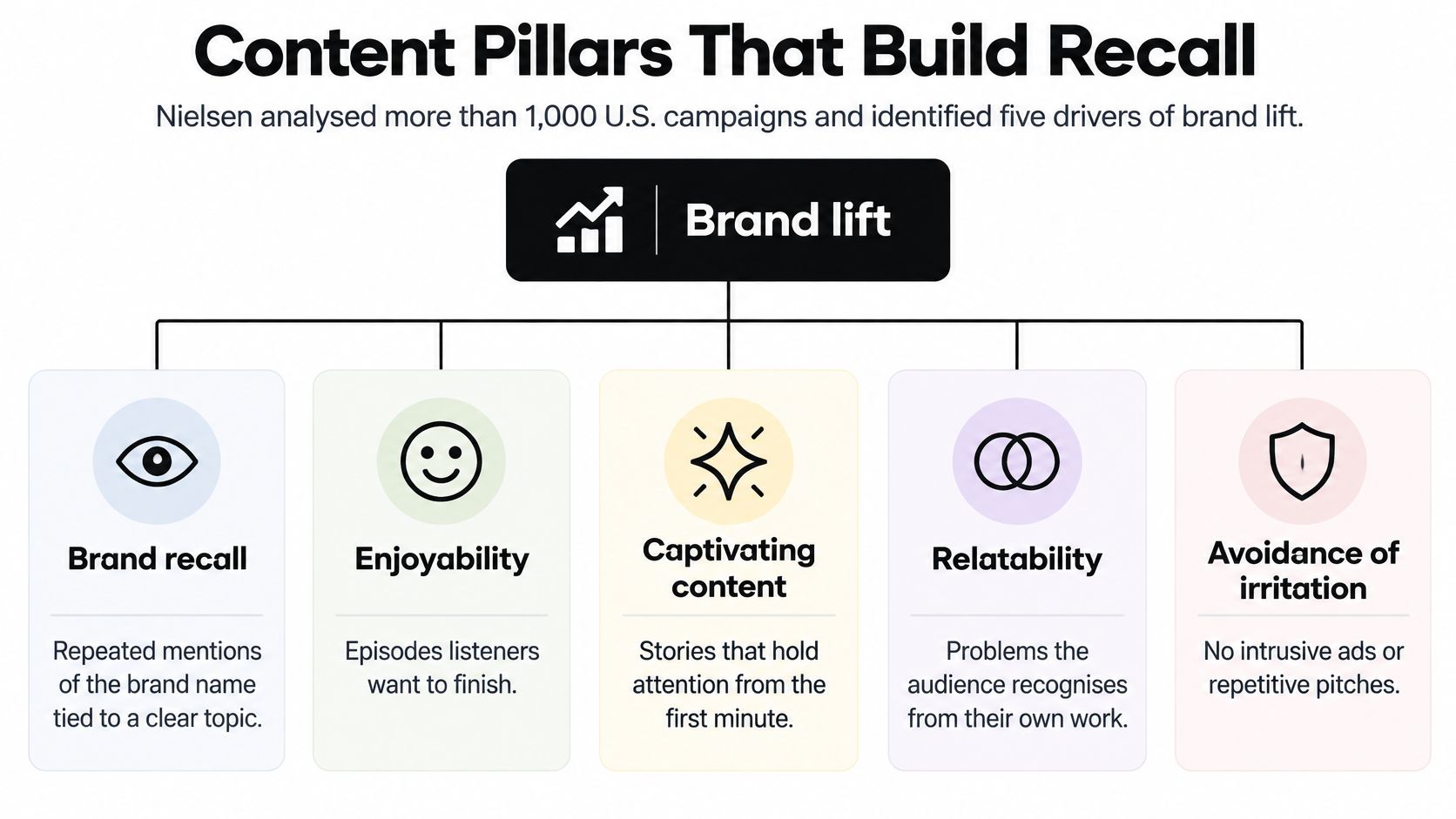
A lively conversation can entertain listeners and still fail as brand building if they can't remember who made the useful point. Nielsen's analysis of more than 1,000 U.S. campaigns identified five drivers of brand lift: brand recall, enjoyability, captivating content, relatability, and avoidance of negative associations. Nielsen describes recall as the strongest driver, so a guest's expertise needs to be distinctive enough to stick.
Build a content mix around the brand association you want listeners to retain. These four pillars give you different ways to reinforce the same area of expertise:
- Expertise lessons: Walk through how to solve a specific problem, from diagnosis to decision. A consultant might explain how a company can spot a reporting bottleneck before it slows a finance team.
- Customer or case stories: Tell a concrete story about a customer challenge and the work behind the outcome. Use details that are appropriate to share and make clear what the story demonstrates.
- Industry viewpoints: Take a defensible position on a debate your audience cares about. Explain what you agree with, where you differ, and why the distinction matters to a listener's work.
- Origin and behind-the-scenes episodes: Show how your company or practice works. This can make an abstract promise easier to understand, as long as the episode offers something useful beyond an internal company update.
A sample schedule might devote half its episodes to expertise lessons, a quarter to customer stories, and the rest to viewpoints and behind-the-scenes conversations. Treat that as a planning tool, not a universal formula: a new brand seeking awareness may need more foundational explanations, while an established brand may benefit from sharper points of view.
Make the brand association unmistakable
Before recording, choose one memorable association you want listeners to connect with your name. Keep it specific. “We help organizations improve” is too broad; “we help regional manufacturers reduce planning confusion between sales and operations” gives the audience a clearer idea to remember.
During the conversation, reinforce that association with a story, example, or practical explanation. A cybersecurity consultant, for instance, might focus on incident post-mortems and show how reviewing a security incident can reveal weaknesses in response planning. The subject gives listeners a reason to connect the consultant's name with a particular capability.
Near the close, restate the next action you want a listener to take. That might be searching for your company name, finding a particular resource, or visiting an episode page. Make the action fit the conversation rather than interrupting the final thought with an unrelated pitch.
If you're preparing a guest interview, the podcast show-notes template can help you organize the episode information and the next step for listeners. A guest can be funny, insightful, and enjoyable, yet still miss the brand-building goal if nobody remembers their name or expertise afterward.
Distribution Channels That Multiply Each Episode
Treat the recording as the start of distribution, not the finish. A useful conversation can produce several distinct assets, each helping a listener find the brand or return to the full episode.
- Episode page: Publish the recording on your site or show page. Include a clear title, guest details, a trackable link, and one relevant next step.
- Video platforms: If you recorded video, publish the full conversation or a substantial excerpt. Choose a useful title and description that explain the episode's subject.
- Short social clips: Select short segments built around one memorable idea. Include the guest's or company's name in the caption so the context travels with the clip.
- Newsletter: Send a concise summary, a strong quote, and a link to the full conversation. Give readers a reason to click beyond “new episode.”
- Guest channels: Ask the guest to share the episode with their audience. Make it easy by providing a ready-to-use link and a short description they can adapt.
Give the recording a transcript, too. Text makes useful passages easier to search, quote, edit, and reuse in articles or sales materials. A transcript also gives search engines and AI assistants readable context, rather than asking them to infer the episode's substance from its title alone.
Use the same tracked destination across the episode page and promotional assets so you can compare activity without mixing up unrelated links. Then plan how to promote a podcast as part of production, not as a task to remember after publishing.
A show distributed only through audio directories may still serve its subscribers, but it leaves useful opportunities on the table. People who encounter a quote, a search result, or a sales follow-up need a clear route to the full conversation and the brand behind it.
First-week publishing checklist:
- Publish: Add the episode, transcript, and a trackable next step to its home page.
- Clip: Share a short segment built around one clear insight.
- Email: Send a summary and a link to the people who would find the topic useful.
- Coordinate: Give the guest a shareable link and a short caption they can personalize.
Brand-Focused Shows and the Trust Rules They Follow
Some podcasts build a recognizable identity through the way they structure conversations. Masters of Scale, hosted by Reid Hoffman, is associated with founders discussing company growth. A useful lesson to borrow is to give every guest a specific business question to answer, then shape the conversation around the choices behind the company's development.
How I Built This, from NPR, centers on founders' origin stories. Its practical lesson is that a narrative arc can help listeners remember not only the guest, but also the company and the decisions that shaped it. The Tim Ferriss Show offers another example of a distinctive host persona carrying long-form conversations across varied subjects. A host can make an interview feel familiar through consistent questions, preparation, and point of view.
Those are structural lessons, not instructions to imitate another show's style. A business should choose a format that suits its expertise and audience, then protect the trust that makes a recurring conversation worth hearing.
A 2025 academic review of podcast advertising reported that audiences often perceive host-read ads as more interesting and effective than pre-recorded spots, associating a host's personal endorsement with greater trust and reliability. But a familiar voice doesn't make every promotion credible. An endorsement can feel out of place when the product has little connection to the show, commercial ties aren't disclosed, or promotional messages appear so often that they crowd out the content.
Set boundaries before the pitch
Hosts and brands can use a few practical safeguards to protect credibility:
- Write a disclosure line: Make paid relationships clear in the episode or ad copy. Don't rely on listeners to infer a commercial connection.
- Set guest-fit criteria: Invite guests who can help the audience understand a relevant subject, not just guests seeking publicity.
- Limit promotional episodes: Decide how much sales-led content fits the show's editorial promise, and keep most conversations useful on their own.
- Listen to audience feedback: Pay attention to comments that show whether the topic, guest, or ad feels relevant or repetitive.
- Separate trust from reach: Track audience growth separately from indicators of brand fit and listener confidence.
Declining a lucrative sponsor or an attention-getting guest may protect the show's point of view. A short-term placement isn't worth much if listeners start doubting the host's judgment. The same tension appears in format choices: audio can create an intimate listening experience, while video can make a conversation easier to discover and share. Choose based on the audience and the job the content must do, rather than assuming one format automatically delivers both trust and reach.
Measure Brand Impact and Run a 90-Day Test
Downloads tell you that an episode was requested or played; they don't tell you whether listeners remember the brand, think it fits their needs, or take a useful next step. A stronger measurement plan tracks recognition and audience response alongside listening activity.
Nielsen's August 2025 podcasting report found that podcast ad exposure generated an average 10-point lift in brand awareness, and 66% of exposed listeners said the advertised brand was a good fit. Those are study findings, not a promise of results for every campaign. Your outcome will depend on the audience, message, host, and how you measure exposure.
| Window | Metric | How to Collect It | Signal to Look For |
|---|---|---|---|
| 30 days | Branded search volume | Search Console or analytics, compared with a pre-launch baseline | Branded queries rise in the weeks after episodes air |
| 30 days | Completion rate | Hosting platform dashboard | Completion remains steady or improves, not just raw downloads |
| 90 days | Aided awareness | Short pre- and post-campaign survey with exposed and unexposed groups | Awareness gains over the unexposed group; Nielsen reports an average 10-point lift from podcast ad exposure |
| 90 days | Brand-fit perception | Survey question asking whether the brand fits listeners' needs | Share of exposed listeners rating the brand a good fit; Nielsen reports 66% |
| 90 days | Trackable URL visits | Unique link in show notes and guest profile | Visits from listeners who didn't arrive through other channels |
| 180 days | Qualified leads citing the podcast | CRM source field and sales notes | Prospects mention the podcast in a relevant sales conversation |
| 180 days | Conversion lift | Compare exposed prospects with a matched control group | Exposed prospects convert at a higher rate |
At the start, save a baseline for branded searches and ask a few simple survey questions about awareness and brand fit. Repeat those questions on a consistent schedule. You don't need an elaborate research project to begin; you do need the same questions asked in a way that lets you compare answers over time.
Run the test in five steps
- Choose a format: Use control, budget, and time available to decide between an owned show, guest appearances, sponsorship, or a co-produced series.
- Name the association: Write down one clear expertise you want listeners to remember and choose a primary metric, such as aided awareness or qualified inquiries.
- Record the baseline: Capture existing branded search activity and survey responses before the first episode or placement.
- Publish or pitch consistently: Set a realistic schedule for an owned show, or pitch a carefully matched group of established programs. Consistency matters more than a one-off appearance.
- Review at the planned windows: Check early listening and search signals first, then awareness and brand fit, and later qualified leads and sales conversations. Keep, adjust, or stop based on what the indicators show.
Expect attribution to be imperfect. A prospect may hear an interview and search for your company later, or mention the podcast in a conversation without using its trackable link. A search increase might also reflect other marketing activity, which is why a baseline and an unexposed comparison group help you interpret the signal. And if nobody records podcast influence in the CRM, sales conversations may never show up in your review.
The decision rule is simple: if you can't describe the brand association in one sentence, clarify it before recording. A podcast can give a clear idea room to build recognition over time, but it can't make a vague position memorable.
Let's Make A Podcast connects podcast guests with relevant shows and provides tools for profiles, pitches, and booking coordination. If you're ready to build authority through well-matched conversations, visit Let's Make A Podcast to explore the directory and guest tools.