7 Best Healthy Diet Podcasts for Credible Nutrition
Which nutrition shows are worth your ears, and which are worth a carefully researched guest pitch? A healthy diet podcast search can leave listeners sorting through wellness hype, unfamiliar credentials, and feeds whose publishing status needs checking. Dietitians and authors face another problem: a relevant topic doesn't necessarily mean a show accepts outside guests.
The distinction matters. Credible nutrition education depends on more than an impressive host biography. In a scoping review of health-podcast research, satisfaction and trust were highest when episodes combined personal anecdotes with reliable medical information. For prospective guests, that supports a useful approach: bring sound evidence and a practical story, not just a book announcement.
The following picks span clinical authority, research depth, and everyday practicality. Each offers a different listening experience and requires a different outreach strategy.
Booking rule: Treat a show's expert interviews as a reason to investigate, not proof that its producers accept unsolicited pitches. Check the current feed, guest roster, and published contact route before sending anything.
Table of Contents
- 1. Mayo Clinic On Nutrition
- 2. Cleveland Clinic's Nutrition Essentials
- 3. Nutrition Facts with Dr. Greger
- 4. ZOE Science & Nutrition
- 5. Sigma Nutrition Radio
- 6. Nutrition Diva
- 7. Dishing Up Nutrition
- Comparison of 7 Healthy Diet Podcasts
- Turn This List Into Your Next Booking
1. Mayo Clinic On Nutrition
Best for balanced, clinically grounded explanations of everyday nutrition. Hosted by registered dietitian Tara Schmidt, Mayo Clinic On Nutrition addresses nutrition trends, modern diets, weight management, and common food myths. Its medical-center setting makes it a sensible starting point for listeners who want measured explanations rather than dramatic dietary promises.
The show's strength is accessibility. Clinicians and subject-matter experts discuss questions that general audiences can recognize, without requiring listeners to arrive with a research background. The trade-off is breadth: an introductory discussion won't necessarily resolve a complicated personal nutrition problem.
The Booking Signal and Pitch Angle
Look for an episode featuring a specialist whose expertise complements the host's. Then check whether that guest belongs to the institution or comes from outside it. Internal expert appearances alone aren't evidence of an open external booking process.
A dietitian's strongest proposed angle would connect a familiar food question to a specific implementation problem. For example, propose a discussion about adapting meal planning when someone's working hours make conventional preparation advice unrealistic.
- What to offer: Relevant credentials, a clearly bounded topic, and practical examples that don't turn into individualized treatment.
- What to avoid: A sweeping claim that a popular diet is either universally harmful or universally effective.
- What to verify: Current publishing activity, the stated inquiry route, and whether comparable outside experts have appeared.
Use a health and fitness podcast directory to compare potential targets, then evaluate this show on its own editorial terms. Clinical relevance beats a broad wellness biography. An author should explain the reader problem their book helps clarify, not assume publication alone makes an interview useful.
2. Cleveland Clinic's Nutrition Essentials
A listener with a focused health question may prefer Cleveland Clinic's Nutrition Essentials to a broad lifestyle interview. The official Nutrition Essentials podcast page organizes conversations around subjects including DASH, gut health, pregnancy, nutrition myths, and eating-related conditions.
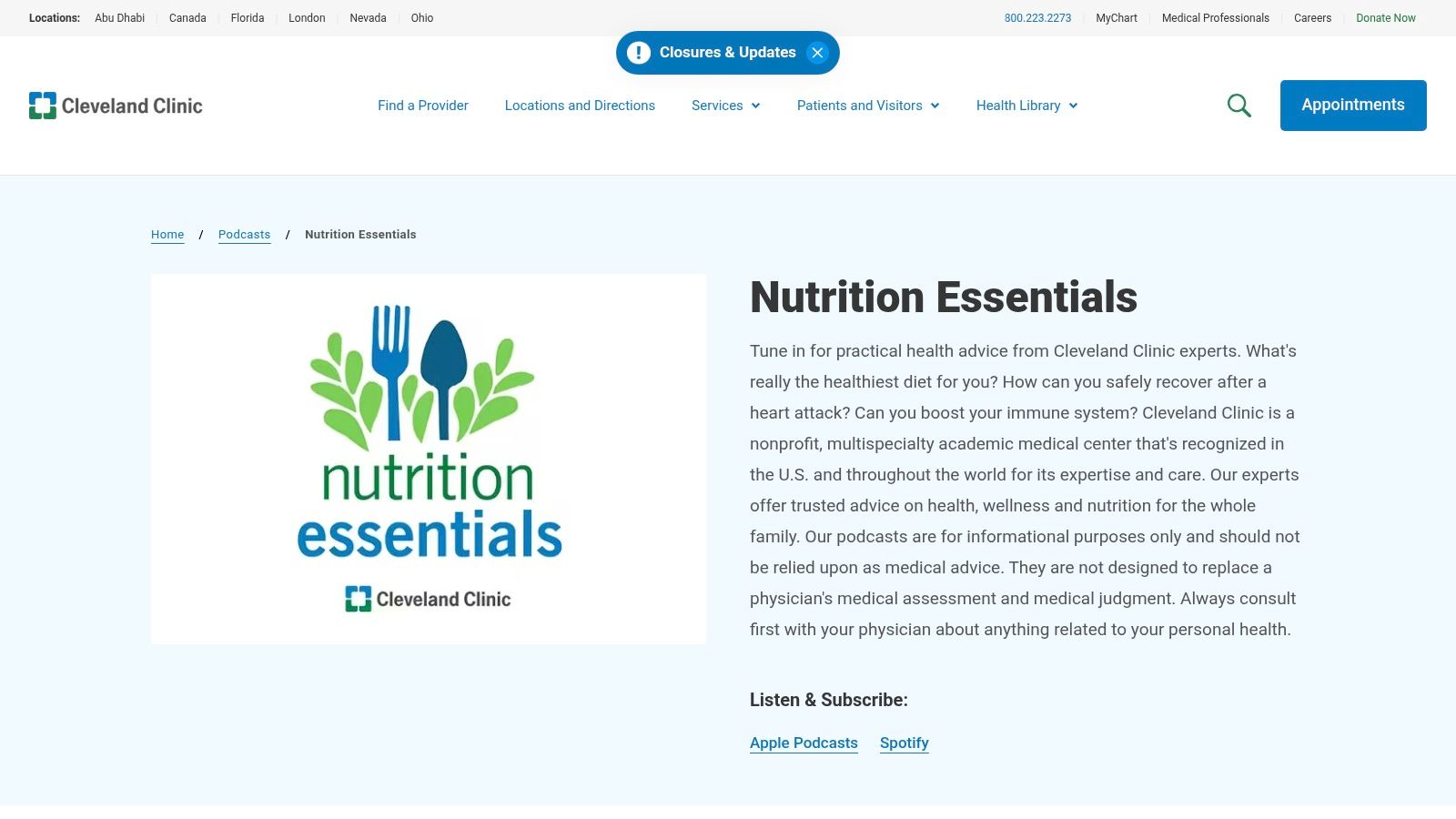
Dietitians, physicians, and other specialists contribute a clinical perspective. That's useful when you want an informed introduction to a defined issue, although listeners seeking recipes or informal conversation may prefer a different format. Episode descriptions and available transcripts also make it easier to assess whether a conversation addresses your question.
Pitch a Clinical Question, Not a Wellness Theme
The booking signal to investigate is which kinds of specialists appear and how their expertise relates to each episode's question. Pay particular attention to institutional affiliations. A roster of Cleveland Clinic experts should prompt caution about assuming external access.
A suitable proposed angle for a qualified dietitian might be translating DASH guidance into culturally familiar meals. The pitch should explain the practical difficulty listeners face and distinguish general education from advice requiring assessment by their own clinician.
A medical podcast pitch should make the producer comfortable with your boundaries, not just impressed by your credentials.
Include your scope of practice, relevant experience, and any commercial relationships. If you're an author without clinical credentials, state that clearly and offer an appropriate contribution, such as food reporting, cooking expertise, or lived experience.
The trade-off for guests is institutional fit. Even excellent expertise may not match the production's sourcing approach. If no external guest route is published, don't repeatedly contact unrelated clinicians or treat patient-contact channels as publicity inboxes.
3. Nutrition Facts with Dr. Greger
Nutrition Facts with Dr. Greger is useful for concise, research-oriented listening, but it requires a different booking calculation. The NutritionFacts.org audio archive adapts material from the publisher's videos into audio episodes covering food, health, and disease prevention.
Its substantial archive makes topic exploration straightforward, and related written and video material provides additional context. The editorial perspective is explicitly whole-food, plant-based, so listeners shouldn't mistake it for an evenly weighted survey of every dietary approach. Supporting material is useful, but personal health decisions still warrant checking the underlying evidence and its applicability.
Check the Format Before Writing a Pitch
The decisive signal is whether the current feed contains outside guest conversations. An audio adaptation format doesn't create the same opportunity as a hosted interview series. If the relevant episodes remain narrated adaptations, a conventional guest pitch may be the wrong offer.
That doesn't make the show a poor listening choice. It makes it a potentially inefficient target for someone whose objective is an interview.
- Listener advantage: Brief, topic-led episodes are easy to sample before exploring supporting material.
- Listener limitation: The strong dietary perspective calls for attention to framing and source selection.
- Booking implication: Look for an explicitly published contribution route before proposing an appearance.
If an appropriate editorial route exists, a dietitian could propose evidence-informed material on making plant-based meals workable with limited shopping options. An author could contribute relevant food-access reporting rather than a generic book interview.
Don't manufacture an interview opportunity because the audience looks attractive. If the format doesn't support your offer, use the archive to understand common audience questions and direct your guest outreach toward shows that demonstrably interview outside specialists.
4. ZOE Science & Nutrition
ZOE Science & Nutrition suits listeners who enjoy researchers explaining food and health in conversational terms. Hosted by ZOE co-founder Jonathan Wolf, the ZOE podcast covers nutrition, gut health, dietary patterns, food processing, and related research through longer conversations and shorter episodes.
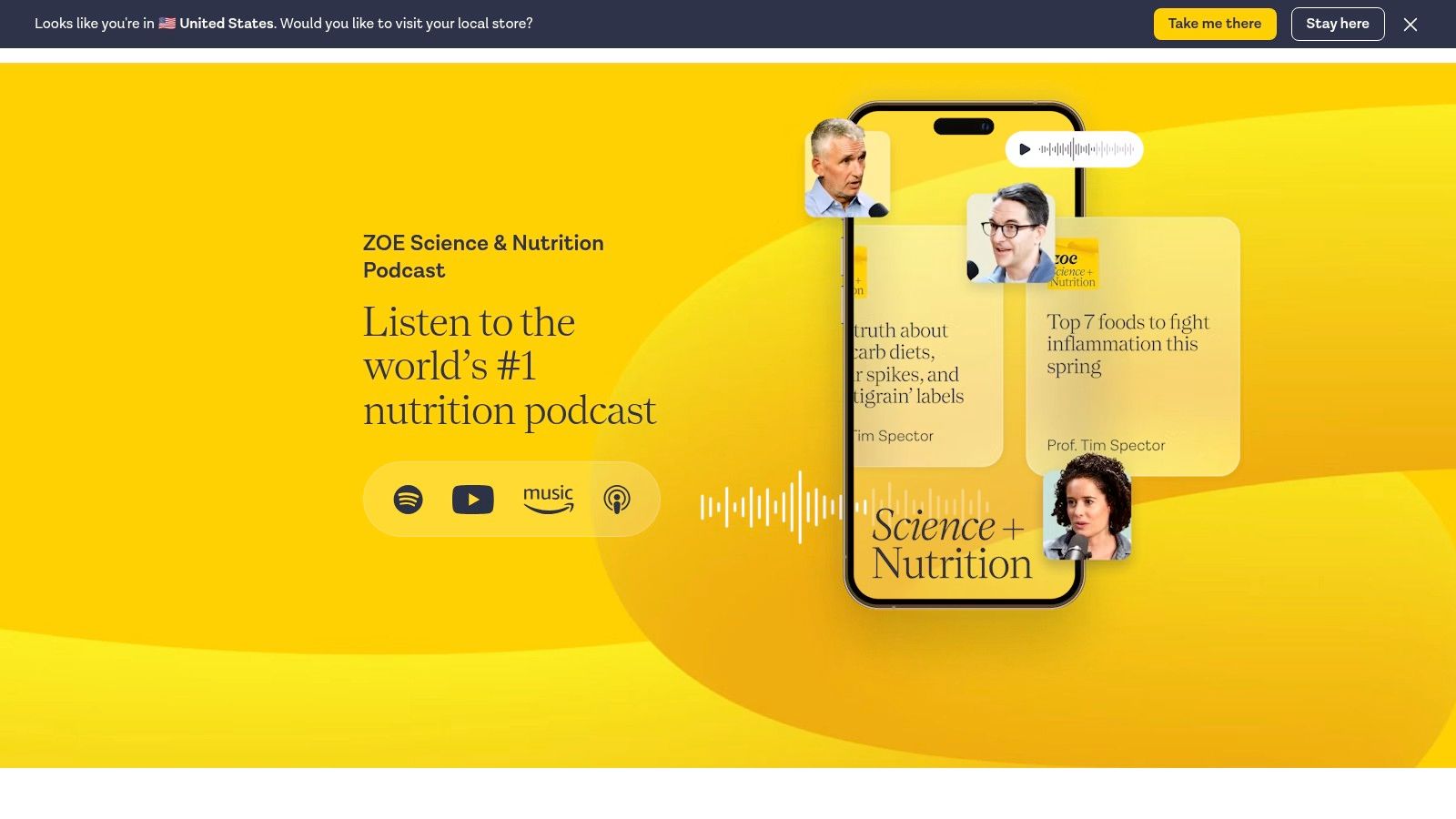
The accessible presentation is a strength, especially for listeners who want more context than a quick food tip. Commercial context matters, however: the producer also sells nutrition-related products and memberships. Evaluate any product discussion separately from the broader scientific conversation, and distinguish emerging findings from established guidance.
Offer a Question That Needs an Expert
For booking, examine recent external expert appearances, their research specialties, and the questions the host asks them. A recognizable subject area isn't enough. Your contribution should add something more specific than another general conversation about gut health.
A strong proposed angle is how listeners can judge personalized-nutrition claims without assuming every test result requires a dietary change. A suitably qualified guest could discuss evidence thresholds, clinical indications, uncertainty, privacy, and the difference between useful personalization and unnecessary complexity.
Explain what you can substantiate and where the evidence remains unsettled. If you sell testing, supplements, or a competing service, disclose that relationship in the initial pitch.
For broader positioning, compare how health and fitness podcasts frame specialist topics before choosing your angle. Don't pitch against the show's commercial model as a provocation. Offer an independent, evidence-aware conversation that helps listeners ask better questions. An author's promotional objective should remain secondary to that editorial value.
5. Sigma Nutrition Radio
Choose Sigma Nutrition Radio when you want to understand the reasoning behind a recommendation, not just the recommendation itself. Hosted by Danny Lennon, Sigma Nutrition Radio emphasizes nutrition science, research interpretation, and long-form expert discussion.
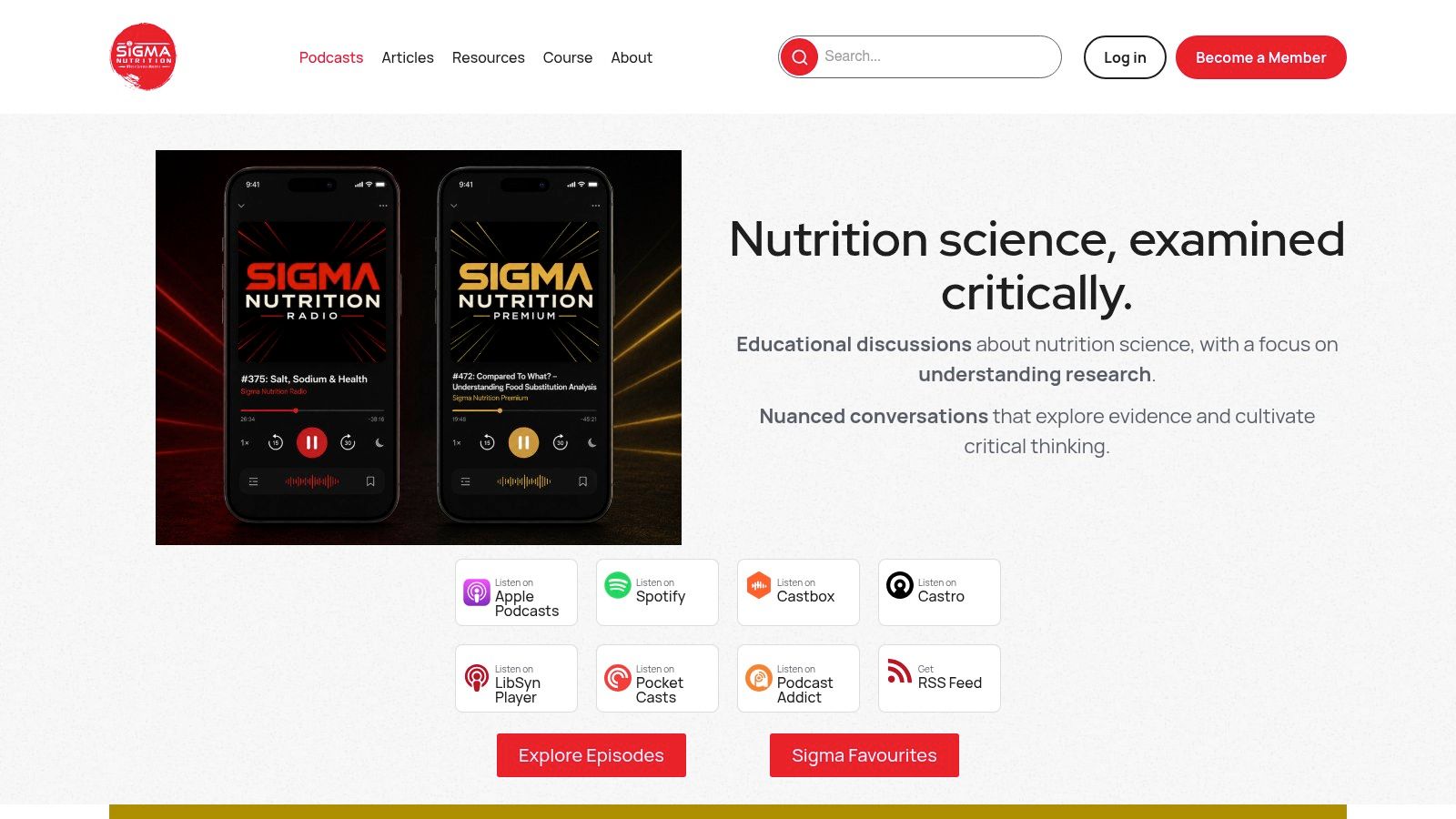
Its topic range includes dietary patterns, fiber, gut health, protein, and public health. Public episodes are free, with additional content available through membership. The main trade-off is attention: technical discussion rewards deliberate listening but isn't the obvious choice for quick meal ideas.
Bring an Evidence Question You Can Defend
The booking signal is a close match between a guest's expertise and the episode's analytical question. Review whether recent guests discuss original research, clinical interpretation, methodology, or public-health implications. Position yourself within the category you can credibly support.
A dietitian might propose examining how affordability changes the application of dietary guidance. A researcher might offer a discussion of what a particular study design can establish, what it can't, and how practitioners should communicate the uncertainty.
Bring a question you can examine critically, including evidence that complicates your preferred answer.
A useful pitch attachment would identify the relevant literature and briefly explain why apparently conflicting findings might differ. Don't substitute a stack of citations for a coherent argument.
For an author, the research problem is the pitch; the book is supporting context. Explain what you investigated, how you evaluated evidence, and what listeners could understand more clearly afterward. Avoid presenting controversy itself as value. The stronger contribution is a careful distinction that changes how someone interprets a nutrition claim.
6. Nutrition Diva
Not everyone wants a long scientific interview during an ordinary day. Nutrition Diva, hosted by registered dietitian Monica Reinagel, offers concise explanations of food questions and nutrition claims through its podcast and written resources.
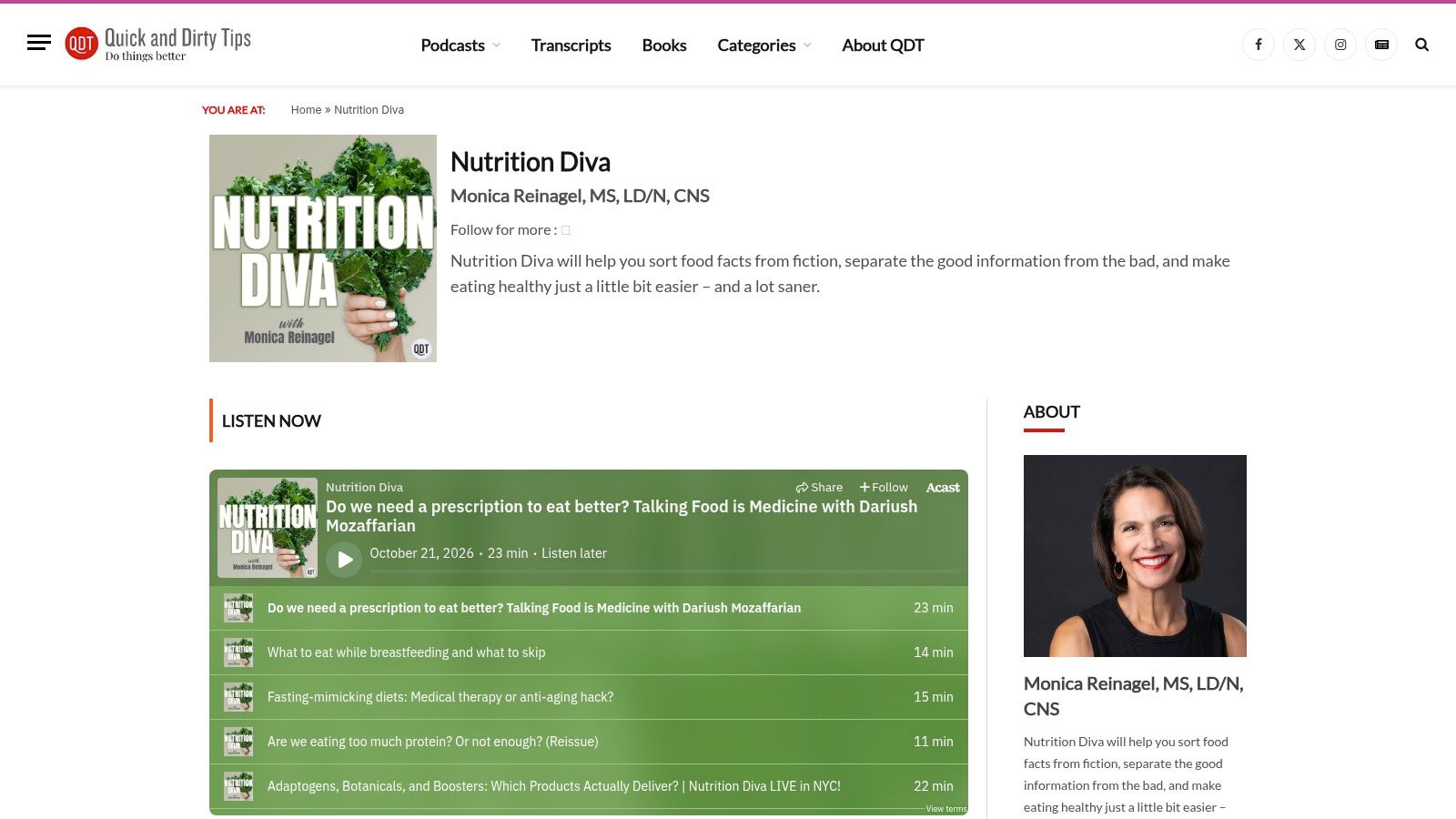
The appeal is focus: listeners can investigate an individual question without committing to an extended interview. Written explanations provide another way to revisit the subject. The limitation follows from that strength, since a short episode can't explore every methodological caveat or provide extensive meal-planning support.
Match the Editorial Unit
Before pitching, check whether recent episodes include outside guests or primarily use host-led explanations. A solo educational format may be better suited to a suggested question or an expert contribution than a conventional interview request. Use only the contribution route the publisher provides.
The most suitable proposed angle is narrow and immediately understandable. A dietitian could suggest how to compare conflicting claims on food packaging, while an author might offer a carefully researched answer to a recurring reader question.
- Strong fit: A bounded question with a useful answer and clearly stated qualifications.
- Weak fit: A broad tour of your professional philosophy or your entire book.
- Essential check: Whether the proposed contribution fits the current episode format.
When researching weight-related topics, compare the framing in these weight-loss podcast recommendations and make your own language precise. Avoid promising a universal result.
Respecting the format matters more than asking for maximum airtime. If your topic requires an extended discussion to avoid misleading listeners, pitch a longer-form show instead of compressing away the nuance.
7. Dishing Up Nutrition
Dishing Up Nutrition emphasizes practical food conversations with nutrition professionals. Produced by Nutritional Weight & Wellness, the Dishing Up Nutrition podcast covers healthy habits, digestion, women's health, food choices, and related concerns.
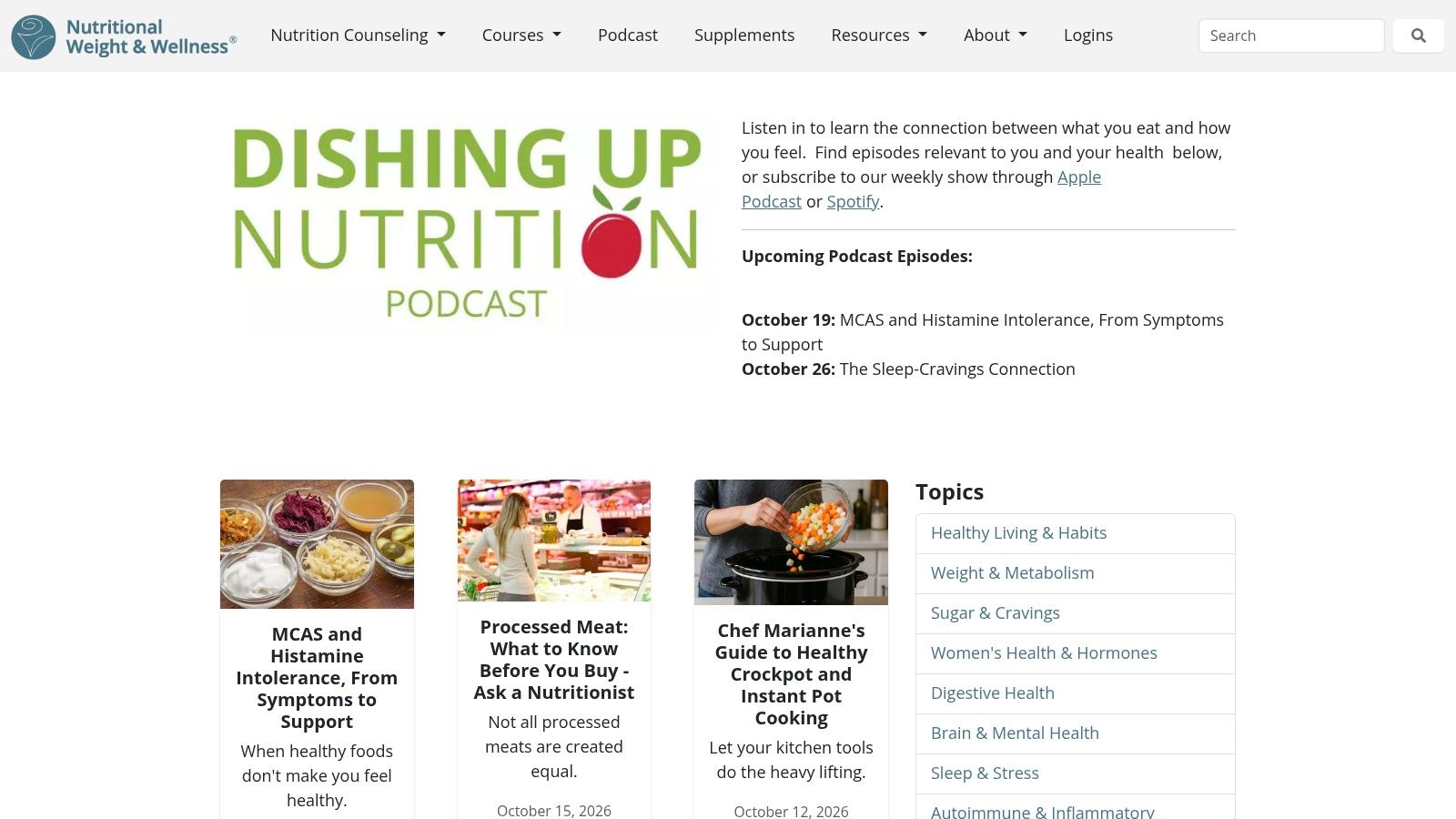
Its real-food orientation and conversational approach suit listeners who want nutrition discussed through daily routines. Someone seeking tightly edited research analysis may prefer Sigma Nutrition Radio. The publisher also offers nutrition services and related resources, so listeners and prospective guests should keep that commercial setting in view.
Propose a Practical Problem With Real Constraints
For booking, inspect who appears alongside the regular nutrition professionals and whether outside contributors have a clear role. A substantial archive isn't proof of guest availability. Confirm the current route and look for contributions comparable to the one you're proposing.
An appropriate proposed angle is meal planning when someone can't freely substitute ingredients, shop repeatedly, or devote substantial time to preparation. A qualified dietitian could explain the decision process, while a cookbook author could contribute preparation methods grounded in the audience's actual constraints.
The useful distinction is affordability versus optimization. A discussion about buying premium ingredients more efficiently won't answer the same questions as a discussion about restricted food access.
- Bring practical detail: Shopping limitations, preparation options, culturally familiar foods, and ways to adapt advice.
- State your boundaries: Separate general food education from treatment claims.
- Check editorial fit: Understand the publisher's dietary perspective without pretending you agree with every position.
Don't pitch budget eating as a motivation lesson. Offer a respectful conversation about workable choices, trade-offs, and the limits of advice when someone lacks money, time, or access.
Comparison of 7 Healthy Diet Podcasts
| Podcast | Format & Effort 🔄⚡ | Nutrition Approach | Key Advantages ⭐ | Considerations | Ideal Use & Expected Outcome 📊💡 |
|---|---|---|---|---|---|
| Mayo Clinic On Nutrition | Free; biweekly, manageable-length episodes | Evidence-focused, medically grounded explanations | Academic medical-center expertise; clear, practical coverage | Newer show with a smaller archive; not individualized advice | General listeners seeking balanced explanations of nutrition trends and food myths |
| Cleveland Clinic's Nutrition Essentials | Free; focused episodes, with some transcripts | Clinician-led topics spanning health conditions and life stages | Organized by topic; useful for specific questions; active feed | Some episodes are condition-specific; clinical tone may feel less conversational | Listeners seeking a clinically informed overview of a particular nutrition concern |
| Nutrition Facts with Dr. Greger | Free; frequent, short episodes; extensive archive | Research-oriented, with a strong whole-food, plant-based perspective | Easy to sample; supporting articles and videos available | Plant-based emphasis shapes coverage; check sources for personal health decisions | Listeners exploring research and plant-based perspectives across many nutrition topics |
| ZOE Science & Nutrition | Free; mix of short episodes and longer interviews | Accessible discussions of nutrition science, gut health, and food | Broad topic range; expert guests; selected transcripts and show notes | Producer sells related products; emerging research may evolve | General audiences wanting approachable conversations about nutrition research |
| Sigma Nutrition Radio | Free public episodes; long-form discussions; optional paid feed | Detailed nutrition science and critical research interpretation | Extensive topic range; depth and evidence-focused interviews | Episodes can be technical and lengthy; premium content costs extra | Listeners seeking in-depth understanding of research and nutrition recommendations |
| Nutrition Diva | Free; concise episodes with a long-running archive and written resources | Practical explanations of food facts and everyday nutrition questions | Convenient, approachable, and paired with articles | Short format limits depth; publishing may be less frequent | Busy listeners seeking quick explanations of one food or nutrition topic at a time |
| Dishing Up Nutrition | Free; weekly episodes and a large archive | Practical, real-food discussions led by nutrition professionals | Consistent publishing; broad everyday-eating topics; easy topic browsing | Some may find delivery repetitive; publisher services and products are relevant context | Listeners seeking regular practical discussions about eating habits and nutrition concerns |
Turn This List Into Your Next Booking
Choose a healthy diet podcast according to the contribution you can make, not just the audience you'd like to reach. Mayo Clinic and Cleveland Clinic are the clearest clinical-authority choices. Sigma Nutrition and ZOE suit research-led topics, while Nutrition Diva, Dishing Up Nutrition, and Nutrition Facts offer different routes into everyday food questions, with important differences in perspective and interview format.
Relevance deserves more attention than a clever subject line. In a survey of podcast users reported in a scoping review, content relevance and presenter expertise were the leading selection criteria. That supports an editorial approach: show why this audience needs your specific expertise.
Build the Pitch Around a Real Episode
Choose a recent episode and listen to it. Identify a question it leaves unresolved, a practical application that deserves more attention, or a related issue the host hasn't addressed in that conversation. Don't invent a gap from the episode title alone.
Draft a two-paragraph pitch. In the opening paragraph, name the episode and explain the proposed extension accurately. In the second, establish your relevant credentials, describe the listener benefit, and disclose any commercial connection that could affect the conversation.
Prepare a one-sheet that makes verification easy:
- Relevant expertise: Credentials, scope of practice, and experience directly connected to the proposed topic.
- Interview readiness: A concise biography, suitable discussion angles, and past appearances if you have them.
- Clear boundaries: What you can discuss responsibly and what requires another specialist.
Track the show, episode reference, published pitch route, outreach status, and any reply instructions. A pitch pipeline tool such as Let's Make A Podcast can keep those details alongside your one-sheet and scheduling activity instead of scattering them across spreadsheets.
Send the strongest match first. If a show doesn't demonstrate external guest participation, investigate before investing in a pitch. A relevant appearance begins with editorial fit, not persistence.
Let's Make A Podcast offers a podcast directory, guest one-sheet tools, pitching tools, and booking workflow features to help experts connect with hosts. Visit Let's Make A Podcast to find nutrition-focused shows, prepare a relevant guest profile, and organize your outreach around a topic you're qualified to explain.