Guest Invitation Letter Sample for Podcasts

You've got the guest picked. You've listened to two interviews, you know the question that would open them up, and then you open a blank draft and the cursor sits there. The last invitation you sent went unanswered, and the one before that came back six weeks later with a polite no.
Most invitation emails fail on the same two things. They ask a stranger for an hour of their attention without earning it, and they leave that stranger guessing what the episode would cover. The fix is structural, not rhetorical.
The letter below is copy-ready. Fill its brackets from a fifteen-minute research pass before you send it, and it stops looking like the other nine invitations in that guest's inbox this week.
Table of Contents
- Podcast Guest Invitation Letter Sample
- Filling the Brackets With a 15-Minute Research Pass
- Five Reasons Guests Ignore the Letter and the Fix for Each
- Adapting the Letter and Scaling It With a Generator
Podcast Guest Invitation Letter Sample
Here's the full email, ready to paste. Swap every bracket, keep the body under 180 words, and don't redesign the structure until you've sent twenty and know from replies which lines land.
Subject: [Guest Name] + [Show Name]: Exploring [Specific Topic]
Hi [Guest Name],
I heard your [Recent Episode or Article] on [Topic] and your point about [Specific Idea] stuck with me. [Show Name] is a weekly show for [Audience Description], and the question listeners keep sending in is [Listener Problem].
Three angles I'd love to dig into with you:
- [Angle One]: "[Draft Question One]"
- [Angle Two]: "[Draft Question Two]"
- [Angle Three]: "[Draft Question Three]"
Logistics in one line: remote recording, 45 to 60 minutes, during [Recording Window], with the episode promoted to our email list and social channels across release week.
Two slots that work on my end are [Date One, Time Zone] and [Date Two, Time Zone], or reply with a time that suits you.
Thanks, [Your Name], [Show Name]
Why the parts work. The subject line names both people and the topic, so it can't be mistaken for a list blast. The first sentence is a receipt: the guest can tell within four seconds that you listened, which is rare enough to keep them reading. The audience sentence answers the question every experienced guest asks, which is who they'd be talking to.
The numbered angles do the heavy lifting. "Come on the show" is a request for free labor with an undefined scope. Three titled angles with real questions is a proposal, and the guest can decide in seconds whether any of them is worth an afternoon.
Practical rule: if you can't write three distinct angles with questions, you don't know the guest's work well enough to send the email yet.
Logistics in one line matters more than it looks. Remote recording, the length, the recording window, and what promotion they get. Guests who've been burned by vague bookings scan for all four, and a single line covering them reads as competence rather than a wall of terms.
The Warm Version for Guests Who Already Know You
The version for someone you've met or corresponded with drops the introduction entirely and gets shorter, because context already exists.
Hi [Guest Name],
We talked at [Event or Thread] about [Shared Topic], and your point about [Specific Idea] has stayed with me since. I'd like to pick that up on [Show Name] with one angle: "[Draft Question]". Would [Date, Time Zone] work, or name a time that does?
Three sentences, no re-introduction, no explanation of who you are. It also asks for less, one angle and one slot, which is the right posture when the relationship already carries the ask.
Send Times and the Stop Rule
Send Tuesday to Thursday morning in the guest's time zone. Monday inboxes are triage. Friday afternoon is where messages go to be forgotten until the following week, and by then your email sits under a pile.
One follow-up after five business days. Same thread, two lines, no guilt language. Something like "Bumping this in case it slipped past. The [Date One] slot is still open." After that, stop. A third email converts almost nobody and costs you the ability to approach that person again next quarter with a clean slate.
If a guest says no, ask which of the three angles came closest and whether a later window suits. Decline reasons are the cheapest audience research you'll ever get.
Filling the Brackets With a 15-Minute Research Pass
The template is only as good as the detail you swap into it. A bracket that stays a bracket produces an email that reads like it was sent to two hundred people, because it was. Fifteen minutes of focused reading fixes that, and it doesn't need to be spread across three tools or a spreadsheet.
Run the pass in one sitting, before you write a single line of the email. Here's the sequence.
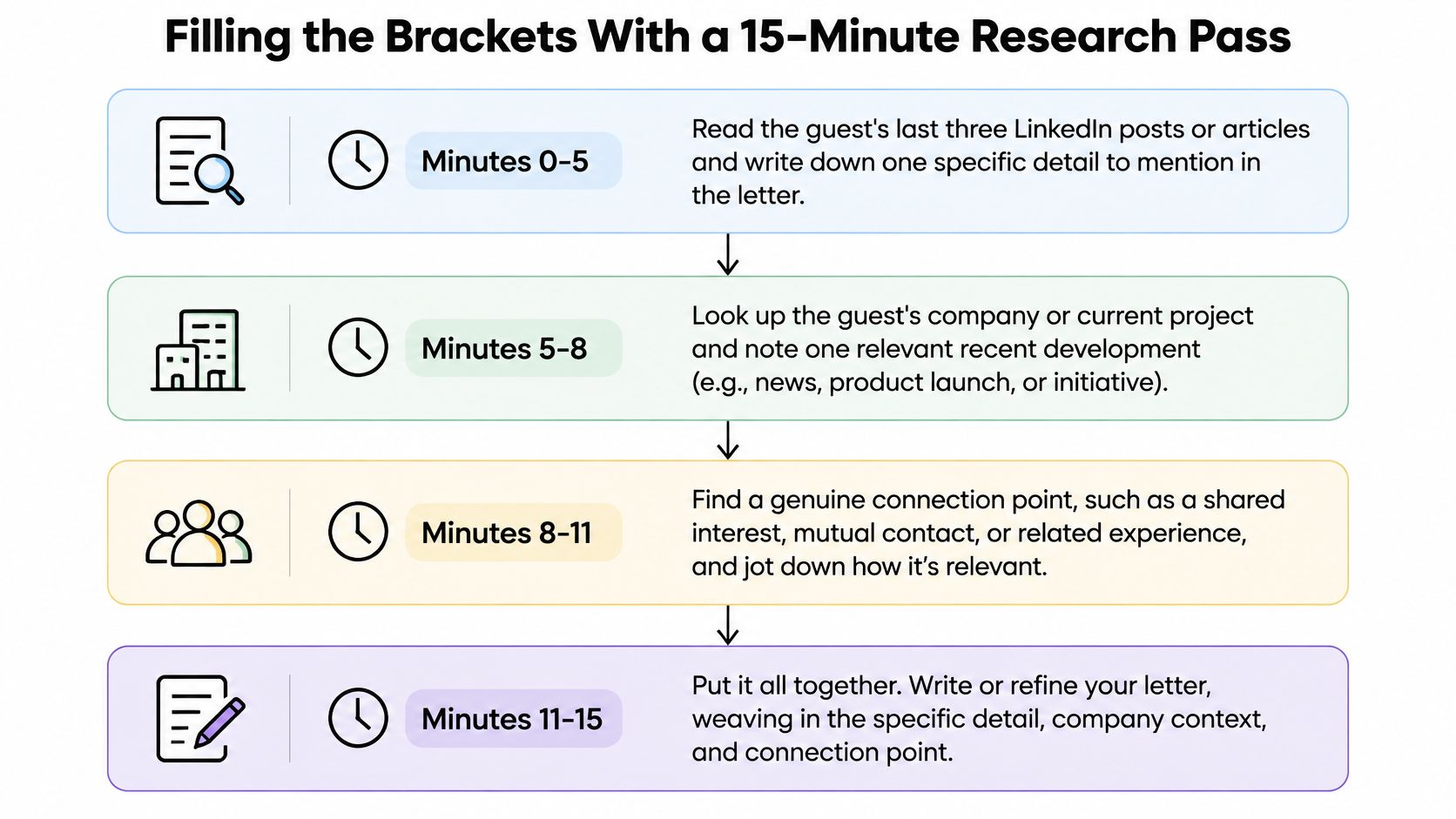
The Four Timed Steps
- Minutes 0 to 5, read their last three posts or articles. Not to gather a bio, but to find one recurring theme. Write it down in a single sentence. Three pieces pointing at the same idea is a pattern. One piece is an anecdote, and you want a pattern.
- Minutes 5 to 10, listen to their most recent podcast appearance at 1.5x. You're listening for the question the other host didn't ask. The unexplored angle is your best material, because the guest already knows the story is good and hasn't had to tell it a third time.
- Minutes 10 to 13, name the listener problem and the episode it echoes. One sentence: the theme from step one solves this specific problem for your audience, and your episode on [related topic] already tried to answer it. That link is what makes the guest feel like a solution rather than a favor.
- Minutes 13 to 15, write the opener and clear every remaining bracket. The opener gets written last, once you know what you're asking for.
If you're still deciding who to approach rather than how to write to them, our guide to finding guests for your podcast belongs in that first five-minute block instead of copy polishing.
The Opener Test
Here's the difference the pass makes, side by side. The weak version could be sent to anyone, which is why it usually gets ignored by everyone.
Weak: I love your work and would be honoured to have you on the show.
Strong: Your thread on pricing experiments challenged my assumption that discounts lift trial signups, and our listeners keep asking about that exact trade-off.
The strong opener does three things at once: it names a specific piece of work, it admits a position the guest changed, and it points at an audience question that connects the two. None of that is flattering, and that's why it works. Flattery asks the guest to trust you. Specificity shows them why you're worth an hour.
If you want to see how this reads in practice, this walkthrough covers the same sequencing from a host's side of the desk.
The Send-Ready Check
Before you hit send, confirm that four fields carry dated, checkable detail: [Guest's Recent Work], [Specific Idea], [Audience Pain Point] and [Recording Window]. Each should name something a stranger could verify with a search, a specific claim, a real listener question or an actual calendar window.
Anything older than 18 months comes out of the draft. A reference to work from three years ago tells the guest your research was a quick skim of their pinned post, and it's the fastest way to lose a reply you nearly earned.
One more pass on tone: read the body aloud. If any sentence could belong to a different host writing a different email, rewrite it until it couldn't.
Five Reasons Guests Ignore the Letter and the Fix for Each
A guest who was ready to say yes still goes quiet when the email leaves nothing specific to answer, or when answering looks like extra work. Five failure modes account for most of that silence. Each one needs a structural fix, not a softer tone.
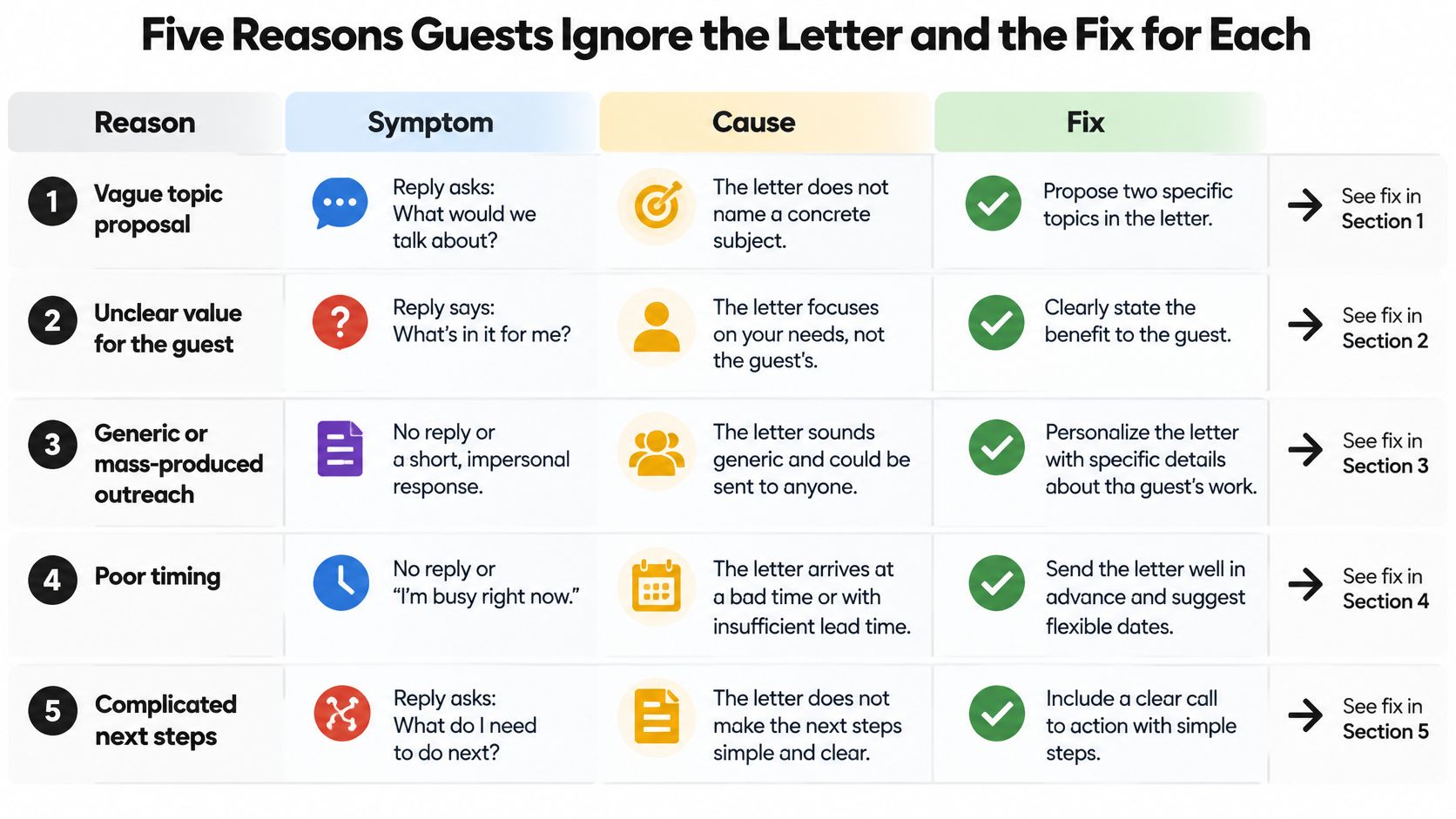
Vague topic proposal. The symptom is a one-line reply: what would we talk about? The letter named a theme instead of an episode, usually something like "your work on growth," which could mean anything. Number the angles and put a draft question under each one, concrete enough that the guest can picture the recording before they agree.
No audience context. Guests weigh reach and relevance before they weigh convenience. A letter that describes the show by genre gives them nothing to weigh. One sentence that names who listens, and the listener problem that keeps coming up, fixes it. That sentence costs about twelve words, and it is the line a guest can forward to a publicist.
Letter too long. The symptom is a reply a month later that opens with an apology for missing the email. The ask sat in the third paragraph under a host bio and a back catalogue, so the guest saved it for a quiet hour that never arrived. Cut the body to under 180 words. Move format, length, and the recording window onto one line.
No clear next step. "Sounds interesting, let's find a time" is where threads die. An open ask pushes scheduling onto the guest, who already has a full calendar. Two dated slots, plus a line that lets them name another time, turn a decision into a reply. The guide to booking podcast guests covers the scheduling that follows a yes.
Privacy red flags. Ordinary samples borrow from visa and event letter formats, which is how a first email ends up asking for a passport number, a date of birth, employer details, or a home address. None of those fields are needed to book a podcast guest. The embassy's warning about visa-related scams covers schemes that use supposed invitation services to solicit personal details. Leave that paperwork out of the podcast template.
The mix-up is easy to clear. The U.S. Department of State's visitor visa guidance states that B-1 and B-2 applicants don't need an invitation letter, and that a letter, if submitted, isn't among the factors used to approve or deny the visa. A podcast invitation is a booking email. Dressing it up as visa paperwork does not help the guest, and a careful reader will stop.
What to ask for instead: a name, a time zone and a recording preference. If you need a bio for the show notes, request it after they've said yes, not before they've decided.
The Five-Question Pre-Send Check
Run the draft through these before it goes out.
- Is the guest named in the subject line, along with the show and the topic?
- Do the first two sentences contain proof of research a stranger could verify?
- Would the ask be clear to a reader who stopped after ten seconds?
- Are the only fields requested name, time zone and recording preference?
- Is there one low-friction call to action, meaning two dated slots or a single reply?
Any no is a rewrite, not a small edit. Most of these fixes shrink the email rather than expand it.
Adapting the Letter and Scaling It With a Generator
Two versions do most of the work, and they're not interchangeable. The cold version earns attention with research and asks for a small decision. The warm version skips the earning step because the relationship already did that work, which is why it can be half the length and still convert.
Here's the comparison that keeps me honest when I'm tempted to send a long warm email to someone I've met once.
| Element | Cold outreach | Warm follow-up |
|---|---|---|
| Body length | 150 to 180 words | 60 to 90 words |
| Opener | Research hook from recent work | Reference to the earlier conversation |
| Topic proposal | 2 to 3 angles with draft questions | 1 angle |
| Ask | Two dated recording slots plus calendar option | One slot |
| Follow-up | One email after five business days | None |
| Privacy fields requested | Name, time zone, recording preference | Same |
The rule underneath all of it: the warmer the relationship, the shorter the letter and the smaller the ask. Sending a long, research-heavy pitch to someone you sat next to at a conference reads as if you don't remember the conversation.
Three Guest Types and What Changes
An author on a book tour. Lead with the chapter angle, not the book. "The chapter on pricing experiments" gives the listener a reason to care and gives the guest a fresh frame for material they've been repeating for three weeks. Offer a slot in release week and mention the episode will publish while the book is still new.
A practitioner with no media experience. Add one line describing what recording involves and how long it takes, something like "we record remotely, you'll need headphones and a quiet room, and it takes about 45 to 60 minutes with no prep required." Uncertainty about the format, not lack of interest, is what makes first-timers go quiet.
A repeat guest. Open with the last episode number and the follow-up question listeners sent afterward. That question is your angle, and it's the strongest possible pitch because the audience asked for it out loud.
For the messages that follow a yes, from confirming the date to sending the pre-interview note, the podcast guest confirmation email picks up where the invitation stops.
Producing Twenty Letters Without Losing the Research
Volume is where personalization usually collapses. The honest trade-off is that you can send twenty specific invitations in a week, but not if you start each one from a blank page.
Our free guest invitation generator turns your show details and one real reason you want that guest into a full invitation draft, subject line through sign-off, and it requires no sign-up and stores nothing. Run one live target through it, compare its hook against the manual version you'd have written, and keep whichever reads more specific. On the Free plan a host can send 10 invites in any 30 days and track up to 25 prospects in a private pipeline, which is roughly two weeks of careful outreach.
The generator doesn't do the reading for you. It removes the blank-page friction, and the fifteen-minute pass still supplies the one detail that makes the email worth opening.
The difference between a guest saying yes and a guest never replying usually comes down to how much of their own work you can reflect back in the first sentence. Let's Make A Podcast builds that into the workflow, with a free invitation generator that drafts the email from your show details and one genuine reason you want the guest, plus a guest directory and pipeline tools that keep research, invitations and scheduling in one thread. Draft your next invitation at Let's Make A Podcast and send it while the episode that made you think of them is still fresh.