Readiness Review for Podcasts: A Practical Scoring System
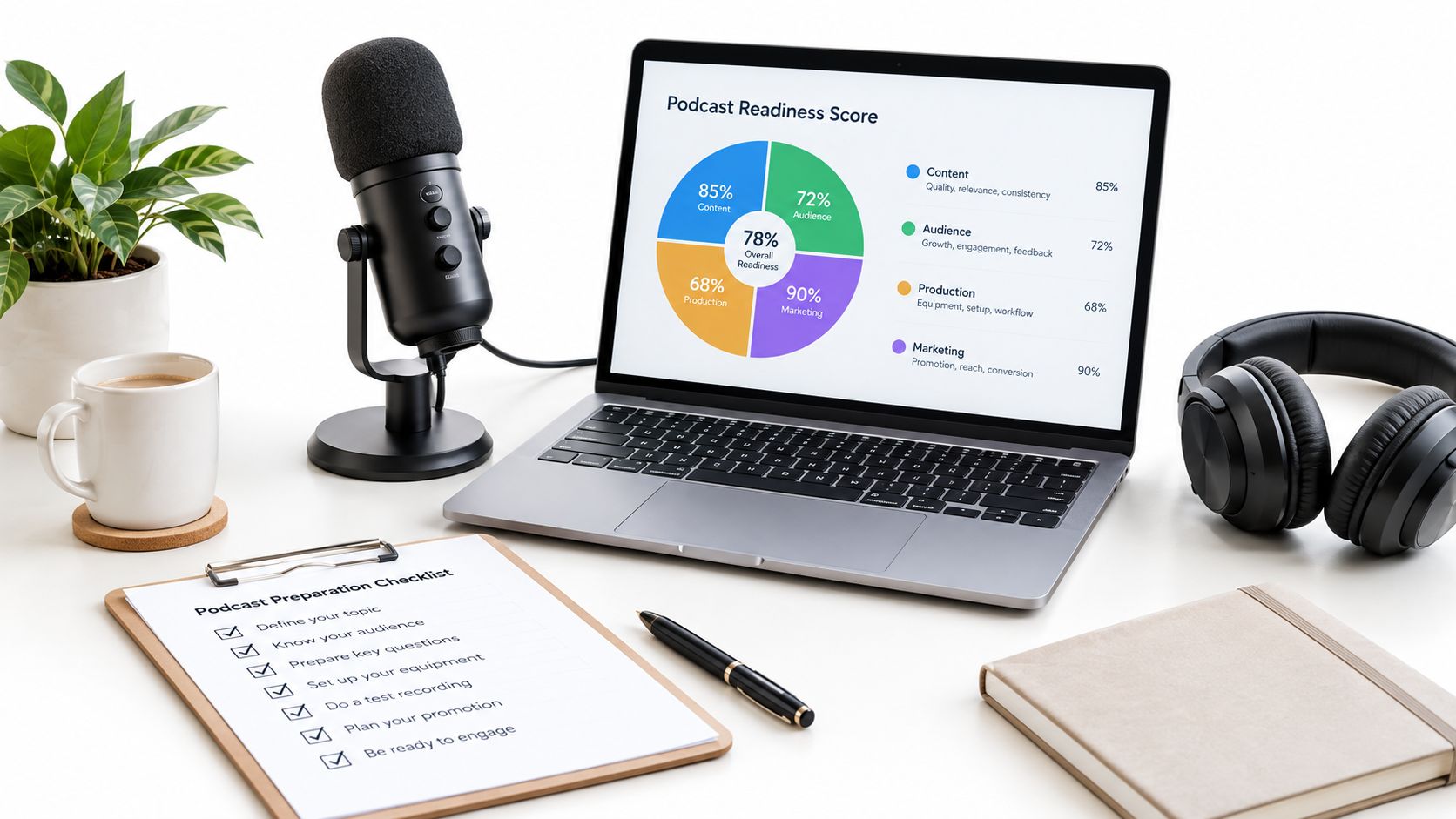
You've just booked a guest, the calendar invite is out, the mic is working, and the room still feels a little shaky. Maybe the questions are solid, maybe the guest sounds like a perfect fit, but something in the process isn't settled yet. That feeling usually means you don't need more enthusiasm, you need a readiness review.
For podcast hosts, that means checking whether the show is prepared for this recording, and for the next one after it. The point isn't to nitpick gear. It's to replace guesswork with a score you can act on before you promise a slot, hit record, or send a pitch.
A good review keeps the host honest about four things: audio, video, guest pipeline, and publishing cadence. If one of those is weak, the booking can still go wrong even when the conversation itself is excellent.
By the end, you should be able to run a self-audit, score each domain, and decide whether to book now, book with conditions, or hold until one fix is in place. That changes the conversation from “Do I feel ready?” to “What exactly needs to be true before I book this person?”
Table of Contents
- Why Hosts Feel Uncertain Before a Guest Recording
- What a Readiness Review Actually Is
- The Four Domains a Readiness Review Scores
- Audio and Technical Setup Checks Hosts Should Verify
- Video, Consent, and Accessibility Beyond Audio-Only
- Guest Pipeline and Publishing Cadence as Readiness
- Using a Readiness Tool to Score and Track Reviews
- Turning Scores into Better Booking Outcomes
Why Hosts Feel Uncertain Before a Guest Recording
A host can feel fully prepared and still hesitate the moment a guest says yes. The invite is confirmed, the recording window is open, and the notes are on the desk, yet there's a nagging sense that one missing piece could unravel the session. That uncertainty usually comes from the fact that most hosts have never been asked to define readiness in a disciplined way.
A readiness review helps. It turns that vague feeling into a structured self-audit before the booking becomes a commitment.
The moment before the call
A new host often thinks the problem is confidence, but the true issue is uncertainty about the system. Can the interview be recorded cleanly, can the guest appear on video if needed, do you have enough episodes queued, and can you publish on time after this one?
A self-audit answers those questions before you promise the slot. It gives you a booking decision based on evidence, not nerves.
Practical rule: if you can't explain what would make the booking a clear pass, conditional pass, or fail, you don't have a readiness review yet.
The rest of the article uses that approach as a working method. You'll score the show, see where the weak spots are, and connect each score to a real booking choice this week. That's more useful than a generic checklist because it tells you where to fix the process first, not just what to worry about.
What a Readiness Review Actually Is
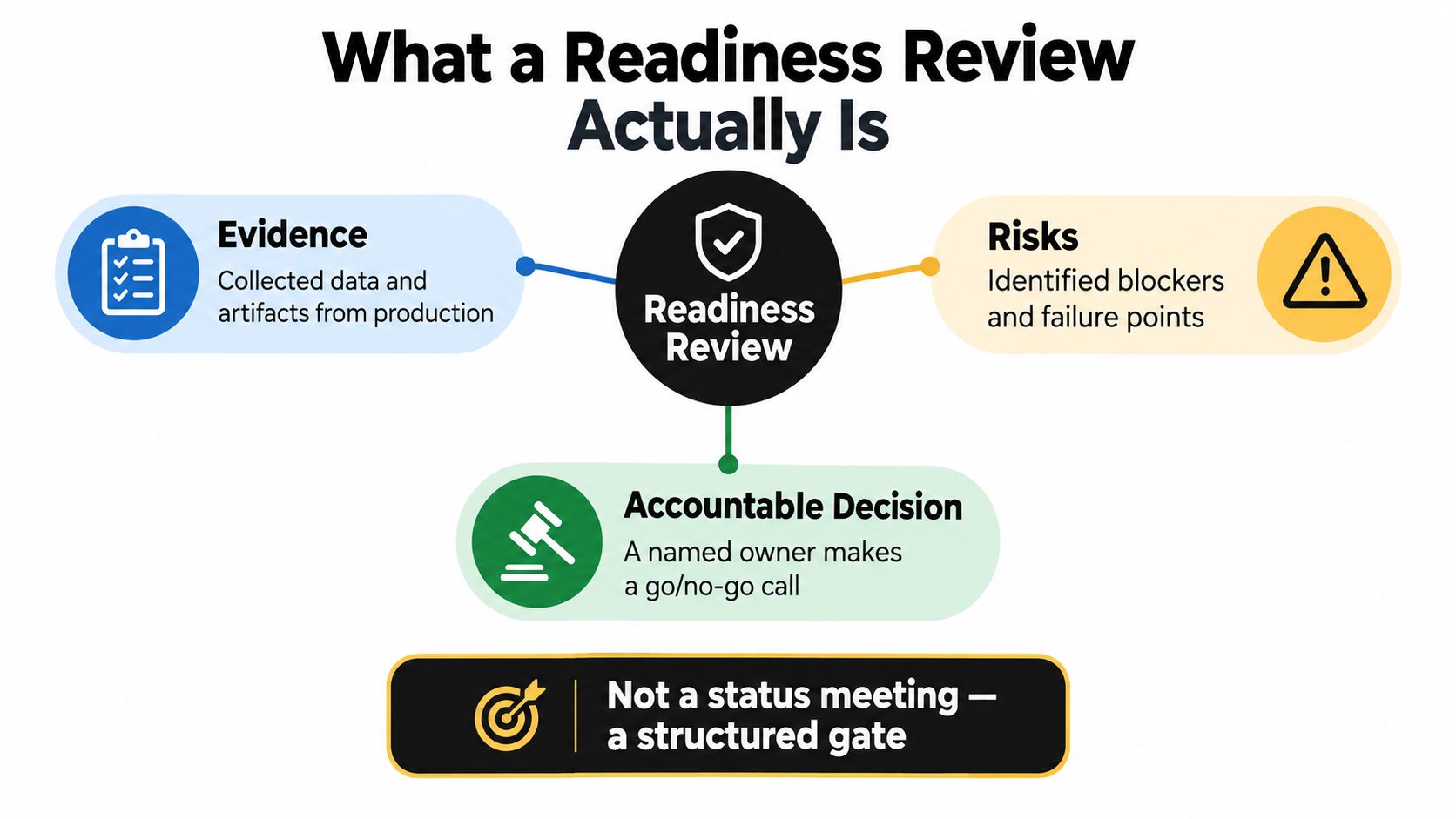
In engineering and mission control, a readiness review is a go or no-go gate. NASA's Apollo and Shuttle processes treated readiness as a formal decision point, not a casual status update, and NASA's later Shuttle process used multiple review layers before launch authorization NASA Apollo 14 history. The important part is the shape of the process, not the setting, evidence is gathered, risks are identified, and a named authority makes the call.
That shape maps neatly to podcasting. A podcast readiness review asks whether the show is prepared for a specific guest session and for ongoing production afterward. It's not just “Do I have a mic?” It's “Do I have evidence that this episode can happen cleanly, be distributed well, and fit into a repeatable workflow?”
Evidence before opinions
The best way to keep a review honest is to define the criteria before the test. That logic is central to GAO's readiness methodology, which requires the purpose, maturity definitions, evidence, and assessment boundaries to be set in advance GAO technology-readiness methodology. In plain English, you don't decide what “ready” means after you've already seen the result.
That matters for hosts because a weekly show creates repeated decisions. If the criteria shift every time, you'll keep telling yourself the show is fine while hidden problems pile up.
A generic checklist asks whether a task got done. A readiness review asks whether the evidence is strong enough to support a launch decision. That's a meaningful difference, especially when the consequences include a cancelled guest, a weak episode, or a show that can't keep publishing.
For hosts who want a starting point for guest intake, the structure behind a podcast guest questionnaire is useful, but the broader review still needs to cover the full production chain.
A readiness review works best when someone can point to the evidence and say, “This is why we booked,” or “This is why we waited.”
The Four Domains a Readiness Review Scores
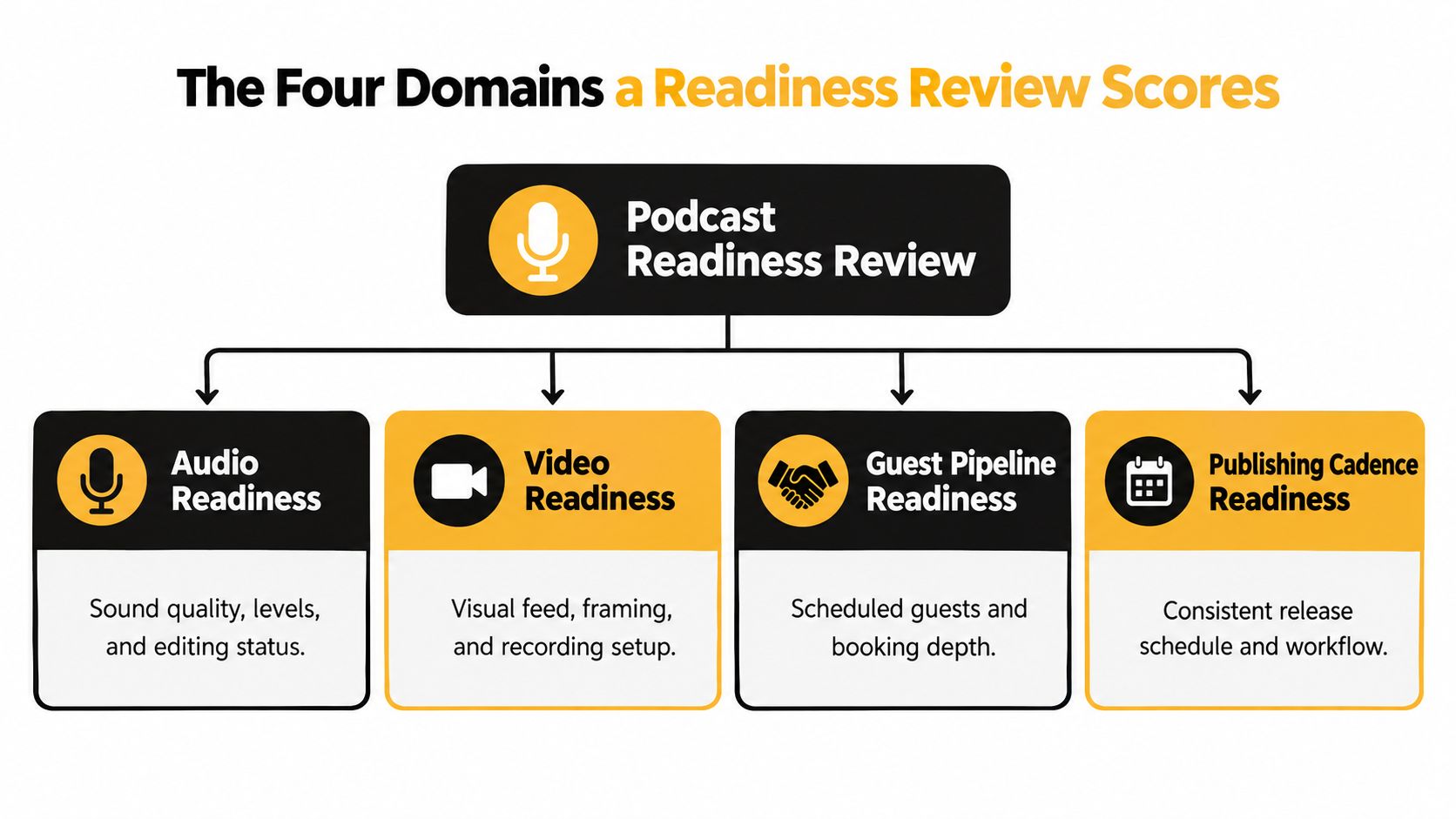
A useful podcast readiness review gets sharper when you split it into four separate scores. Audio readiness tells you whether the recording can happen cleanly. Video readiness tells you whether the episode can be distributed as video without quality or consent problems. Guest pipeline readiness tells you whether the show can keep attracting and preparing guests. Publishing cadence readiness tells you whether the show can keep shipping after the recording is done.
Why one score isn't enough
A show can sound great and still fail on video. It can have a great guest lineup and still miss release deadlines. It can publish consistently and still lose guests because the pitch flow is unclear. One score hides those differences, which is why hosts get misled by a broad feeling of “we're ready.”
The point of four domains is actionability. If audio is the weakest area, fix audio. If guest pipeline readiness is low, stop chasing new guests and build the intake process. If cadence is the problem, tighten the release workflow before you book more interviews.
Here's the simplest way to look at it:
| Domain | What it checks | Booking decision |
|---|---|---|
| Audio readiness | Can the recording be captured and backed up cleanly? | Proceed, conditionally proceed, or hold |
| Video readiness | Can the episode be distributed with acceptable visuals and consent? | Proceed, conditionally proceed, or hold |
| Guest pipeline readiness | Are there enough qualified guests and clear booking routes? | Proceed, conditionally proceed, or hold |
| Publishing cadence readiness | Can the show keep releasing on a stable rhythm? | Proceed, conditionally proceed, or hold |
A review like this keeps you from guessing where to invest. Instead of trying to fix everything at once, you can work the weakest domain first and use that to decide whether the next booking is wise.
Audio and Technical Setup Checks Hosts Should Verify
Audio readiness is the first gate because it affects whether the episode can even be captured. A strong voice, a thoughtful guest, and a great outline won't matter if the recording drops, clips, or gets buried under room noise. This is the domain where hosts usually overestimate their setup because everything sounds fine in a quick test and then falls apart under real pressure.
What pass and fail look like
Pass means the show has a repeatable setup, a backup plan, and a verified recording workflow. Fail means the host is relying on one device, one connection, and one memory of how the app works.
Use this as a self-score:
| Check | Pass looks like | Fail looks like |
|---|---|---|
| Microphone | Main mic is tested and produces clean voice capture | The host is using whatever mic happens to be available |
| Backup mic | A second option exists if the main mic fails | One broken cable ends the session |
| Recording software | The app is tested before the guest arrives | The host opens the app for the first time on recording day |
| Internet failover | There's a backup connection or fallback plan | A network issue means the interview stops |
| Room noise | The room is controlled enough for clear speech | HVAC, street noise, or echo is obvious in the test |
| Monitoring | Headphones are used to hear problems live | No one notices issues until after the file is saved |
| Backup workflow | Files are saved in two places | There's only one copy of the recording |
A host doesn't need to be an audio engineer to pass this domain. The standard is simple, can the show capture usable audio without improvising under stress?
The reason this matters every week
The most important part is repeatability. GAO's readiness logic only works when the evidence is defined in advance, and the same idea applies here. If you test the workflow the same way each week, you can compare outcomes instead of rebuilding confidence from scratch.
Host mindset: if the setup requires luck, it isn't ready yet.
For a practical prep routine, the guidance behind how to prepare for a podcast interview works well as an input, but audio readiness should still get its own score. A clean recording is the foundation for everything that follows, and it's the easiest place to catch problems before a guest ever joins the room.
Video, Consent, and Accessibility Beyond Audio-Only
Audio alone is no longer enough to define distribution readiness. Video podcast consumption overtook audio-only consumption in late 2025, and 82% of weekly podcast consumers reported actively watching video compared with 78% listening to audio only SSRS podcast consumer report. That shift changes the review, because a session can be perfectly recordable and still be wrong for video release.
Video readiness is its own gate
Video readiness isn't just whether the camera turns on. It includes framing, lighting on the guest's face, visible speaker presentation, screen-sharing permissions, thumbnail potential, and whether the recording can be repurposed into clips. A guest who sounds strong on audio can still look awkward on camera if the framing is bad or the background is distracting.
Consent matters here too. If the guest hasn't agreed to video distribution, the episode isn't video-ready even if the recording technically works. The same applies to accessibility, captions and transcripts aren't optional extras once the show is being distributed visually.
A simple way to score the domain is to treat these as separate checks:
- Camera framing: the guest is centered and visible without distracting crop issues.
- Lighting: the face is clear enough that viewers don't strain to see expressions.
- Consent: the guest has approved video use before recording.
- Accessibility: captions or transcripts are planned, not bolted on later.
- Packaging: thumbnails and clip-friendly moments are available for sharing.
Why the same interview can pass one score and fail another
A host can record a beautiful conversation and still not be ready to publish it as video. That's because video adds visual composition, consent management, and post-production work that audio-only shows don't carry in the same way.
The clean rule is simple. Publish video only when audio readiness, video readiness, accessibility readiness, and post-production capacity all pass on their own merits. If one of those is weak, the episode may still be worth publishing, but not necessarily in the format you wanted.
That distinction is what keeps hosts from confusing “technically recordable” with “distribution-ready.”
Guest Pipeline and Publishing Cadence as Readiness
A show can have perfect gear and still collapse at the operational level. Most hosts get surprised here, because the session itself went well but the episode doesn't ship, the guest never receives a clear follow-up, or the next booking never gets filled. One industry benchmark suggests that the average podcast becomes inactive after roughly 21 episodes, though that figure should be treated cautiously rather than as a universal rule RSS.com podcasting overview.
The operational scorecard
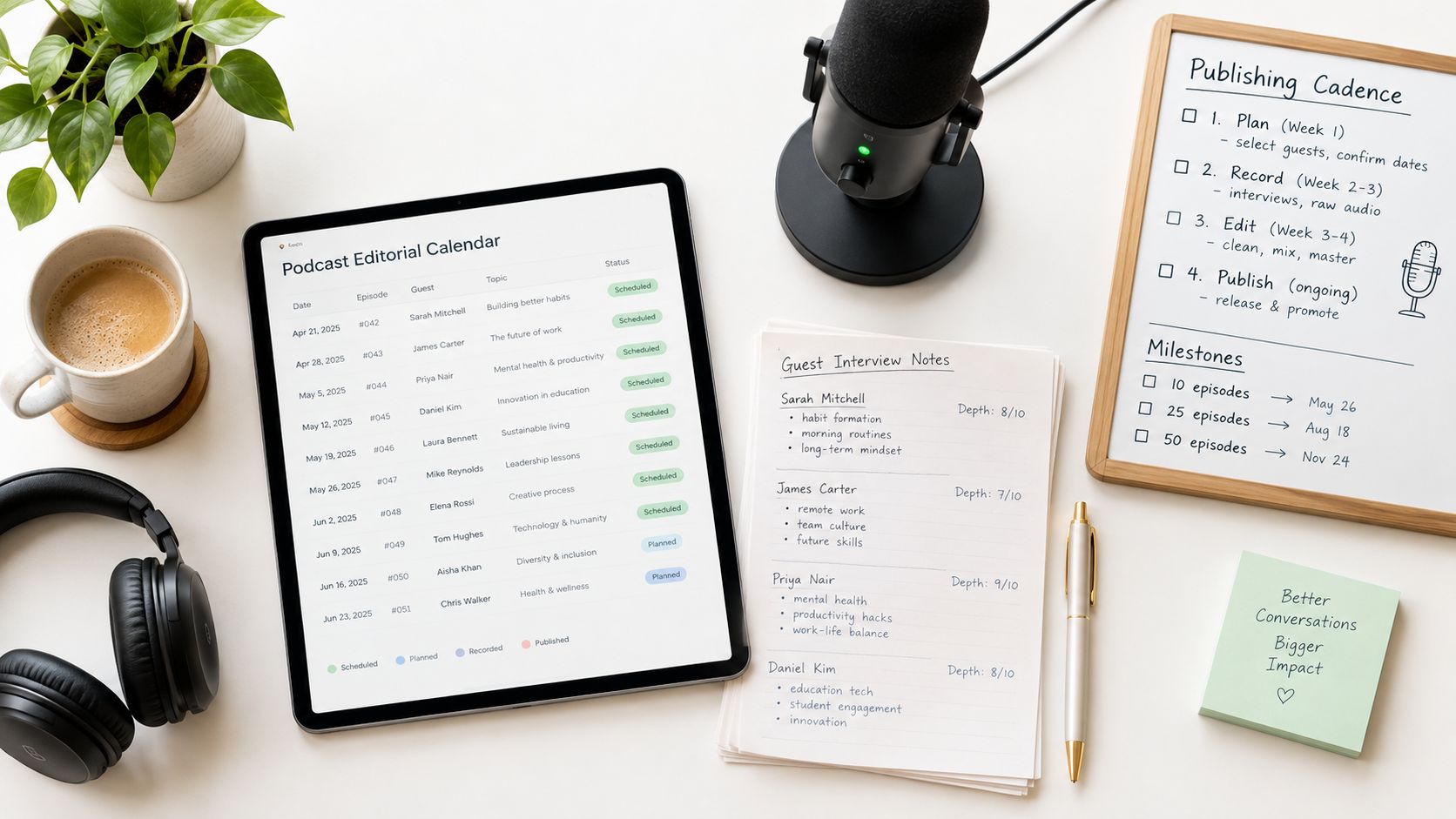
This domain measures whether the show can keep going after the first booking. The host should look at guest preparation, written approval for names and claims, release permissions, backup files, editing ownership, publishing cadence, and promotion.
- Guest depth: there are several qualified guests already identified, not just one person in mind.
- Written remarks: the guest has approved the important claims and details before publication.
- Editing ownership: one person is clearly responsible for finishing the episode.
- Publishing schedule: the release pattern is realistic for the team's actual capacity.
- Fallback option: there's a backup episode or alternate plan if a guest cancels.
Each item points to a decision. If guest depth is weak, queue more qualified guests before booking another recording. If editing ownership is unclear, assign the person before the next interview. If the release rhythm is aspirational rather than real, reduce the cadence until the workflow is stable.
A short view of sustainability
This is the domain hosts skip because it's invisible on recording day. Nobody notices the missing process when the guest is already on camera. They notice it three weeks later when the show stalls.
If a booking depends on hope instead of a publishing system, the problem isn't the guest list, it's the operating model.
A sustainable show needs a repeatable handoff from recording to editing to publishing to promotion. That's what turns one good interview into a functioning series.
Using a Readiness Tool to Score and Track Reviews
A manual checklist helps, but a readiness tool makes the review repeatable. Run the podcast guest readiness check before a new booking and identify the weakest domain from the score. Let's Make A Podcast's guest readiness check lets a host paste an RSS feed and receive a readiness score based on guest evidence, publishing recency, publishing cadence, and whether the show gives guests a way to make contact. The review is no longer just self-reported, it is tied to signals the show already exposes publicly.
From checklist to tracked decision
A good tool turns the review into a working decision. The host scores the domains, sees the weakest one immediately, and decides whether to proceed, proceed with conditions, or hold. That helps before adding a guest to the pipeline, and it helps guests too, because they can see whether a show looks ready before they spend time pitching.
A simple operating rhythm keeps the score useful:
| Timing | What to do |
|---|---|
| Before a new booking | Run the review and identify the weakest domain |
| Weekly for active shows | Recheck readiness so drift does not go unnoticed |
| After a format change | Re-score the show because the workflow has changed |
That rhythm fits how a living show drifts over time. A weekly podcast that changes hosts, formats, or distribution habits can shift fast, so a one-time review will not hold for long.
What the score should change
The score should change behavior, not just sit in a dashboard. If publishing cadence is the weak point, the answer is not to chase more guests. If video readiness is weak, the host should delay video distribution until the consent and visual workflow are fixed.
A score works best when it leads to a clear next step. Book now, book later, or rework the process before the next pitch lands.
Turning Scores into Better Booking Outcomes
A readiness review pays off when it changes the outcome of a booking decision. Audio readiness supports recording completion because the session is less likely to break. Video readiness supports distribution reach because the episode can be published in the format the audience consumes. Guest pipeline readiness supports reply rate because the show has a clear, credible booking process. Publishing cadence readiness supports retention because the show keeps shipping long enough to build trust.
The practical habit is small but powerful:
- Confirm the public feed is active.
- Score all four domains.
- Identify the weakest one.
- Take one corrective action.
- Rerun the review next week.
That turns readiness from a vague feeling into a weekly operating decision. The host stops asking whether a guest is a fit in the abstract and starts asking whether the show is ready to honor the booking.
If you want a clearer way to run this kind of self-audit, Let's Make A Podcast gives hosts tools for guest readiness, outreach, and scheduling in one place. Use it to check whether your show is ready before you invite the next guest, then keep the scorecard in view as your workflow changes.