How to Be a Podcast Guest Who Gets Booked
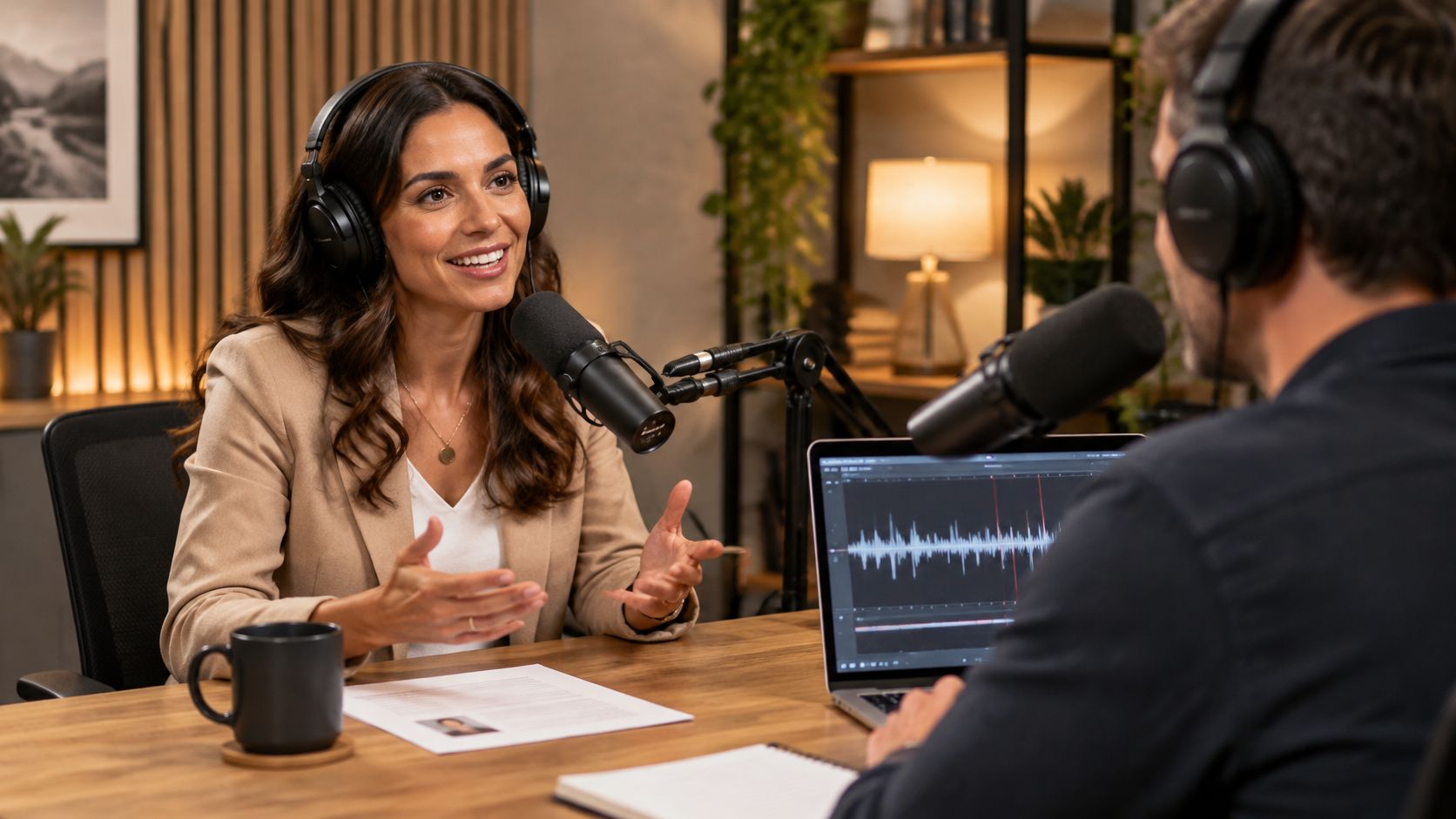
Good experts get ignored every week while average experts with a tighter topic get booked. The difference isn't fame. It's whether a host can see, in under a minute, why you belong in front of their listeners, on their format, right now. Learning how to be a podcast guest means proving that fit before you ask for the slot.
Table of Contents
- Why Being a Podcast Guest Starts With Fit
- How to Choose a High-Fit Podcast
- Build a Guest One-Sheet Hosts Can Book
- Pitch One Relevant Show at a Time
- Prepare for the Recording Itself
- How to Choose Tools for Guest Booking
- Turn the Interview Into a Next Opportunity
Why Being a Podcast Guest Starts With Fit
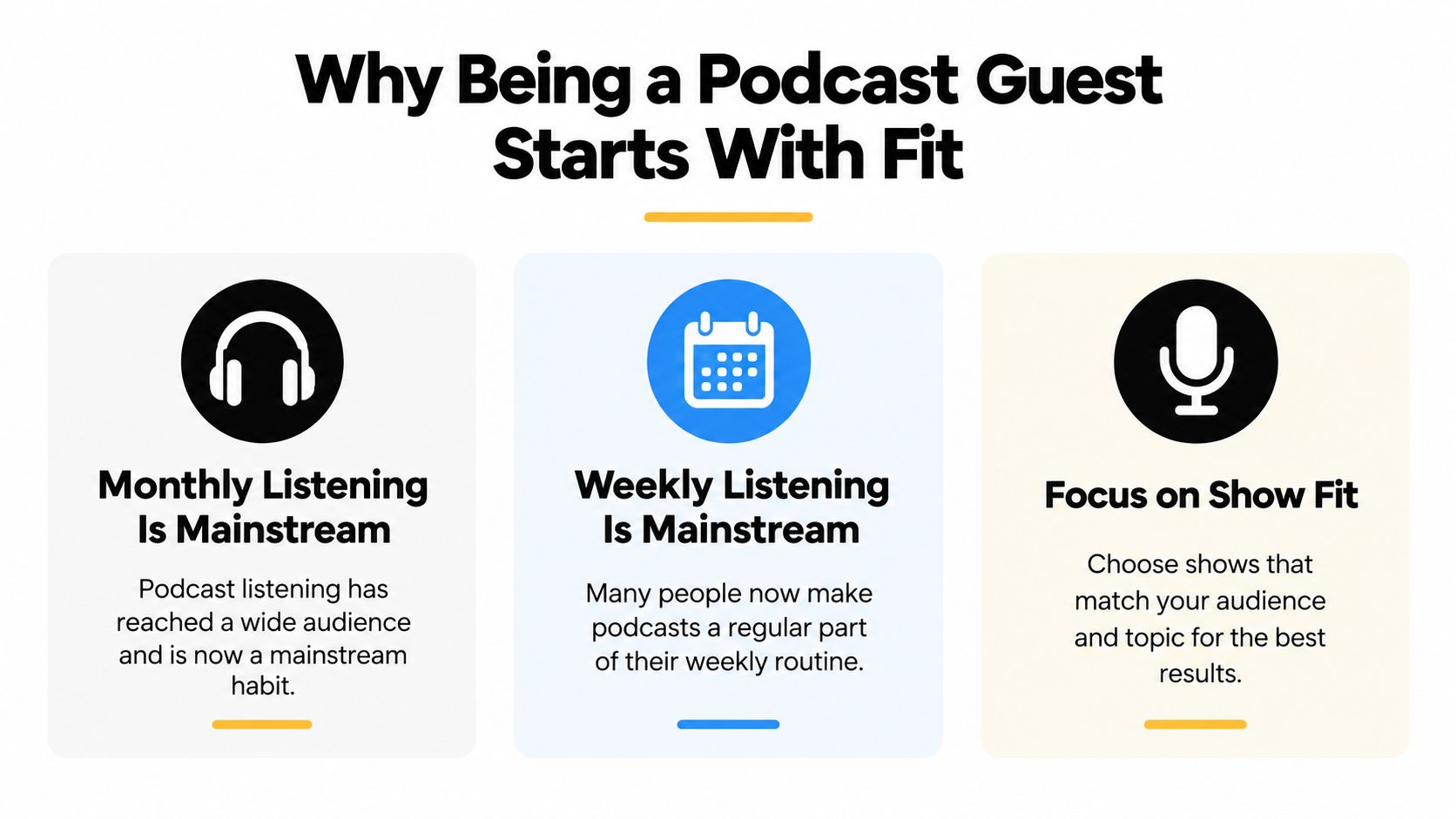
Podcasting isn't a niche channel anymore. 55% of Americans aged 12 and older, about 158 million people, listened in the previous month and 40%, about 115 million, listened in the previous week, according to Edison Research's 2025 Podcast Consumer report. That same source puts ever listened at 73%.
The growth is the point, not just the size. Monthly listening rose from 46 million Americans in 2015 to 158 million in 2025, weekly listening rose from 27 million to 115 million, and weekly listening time grew from 170 million hours to 773 million hours, a 355% increase, all from that Edison Research data set. You're not chasing early adopters. You're asking to borrow a recurring habit.
Scale Does Not Rescue a Generic Pitch
A large audience makes a mismatch worse, not better. The host has more listeners to disappoint, more pitches to sort, and less reason to gamble on a guest who can't name a specific problem their audience has. A biography that works for every show works for none of them.
Hosts book a focused topic, concrete takeaways, and credible evidence that you can deliver them. Your job title, follower count, and book cover are supporting material. They aren't the episode. If you can't finish the sentence "your listeners will be able to do X after this conversation," you aren't ready to pitch.
Fit beats fame because the host is spending listener trust, not ad inventory, when they introduce you.
Who This Approach Suits
This path suits specialists, authors, founders, researchers, and PR teams whose value is depth. If your expertise solves a defined problem for a defined group, a smaller room full of the right people will outperform a big room that's politely indifferent.
The sequence is simple and unforgiving. Choose shows by fit, package your expertise so a host can book it without extra work, pitch one show at a time, record cleanly, then measure what the appearance produced. Skip a step and you'll blame the medium for a selection error.
How to Choose a High-Fit Podcast
A smaller, focused show can lead to more useful conversations than a larger show with a broad audience. Choose by listener fit and likely next action, not download count. A booking is earned host trust: listeners are more likely to consider your advice when the host knows the topic and asks informed questions. Measure that trust after the episode by tracking relevant inquiries, referrals, and invitations, not just reach.
Score the Show Before You Pitch It
Review the show's recent episodes and booking style before you reach out. Confirm it is publishing, welcomes outside guests, and gives guests room to explain an idea with useful detail. For a practical guide on how many episodes to review before you pitch, check enough of the feed to spot both the show's current interests and topics it has already covered.
Score each factor against your own goal:
- Recent topics: Does your subject fit naturally with the show's recent conversations? Can you offer a fresh angle rather than repeat an episode?
- Host credibility: Does the host ask informed follow-up questions on your subject? A strong interviewer helps listeners trust the discussion.
- Listener intent: Are the listeners practitioners, buyers, or peers who can act on your advice, or a general audience seeking inspiration?
- Geography and signals: Does the audience's location match where you work? Do comments, reviews, or other available signs suggest listeners pay attention to full episodes?
| Decision factor | Large low-fit show | Smaller high-fit show |
|---|---|---|
| Topic overlap | Your subject is a detour | Your subject is why people listen |
| Listener intent | Broad interest, unclear next step | Practitioners or buyers with the problem now |
| Format depth | Short segment, little room for detail | Time for evidence, nuance, and questions |
| Host trust on topic | Limited connection to your expertise | Host knows the niche and can frame your advice |
| Likely outcome | Reach with little connection to your goal | Relevant conversations, referrals, or repeat invitations |
Consider a specialist founder who helps clinics reduce no-shows. A broad business show may offer greater reach, but its listeners may not run clinics, and the host may steer the conversation toward generic growth advice. A smaller show for practice managers has listeners who deal with that problem directly. Rank the specialist show higher if its audience is more likely to use the founder's advice. Pass on either booking if the host wants a topic you would not teach clients, leaves no room for specifics, or cannot describe who listens and what they come for.
Keep a ranked shortlist of active, on-topic shows. Put first the shows where your expertise fits the audience, the format supports a useful conversation, and listeners have a clear next step. Track what each appearance produces after publication so you can refine the ranking based on real responses, not audience size alone.
Build a Guest One-Sheet Hosts Can Book
Hosts don't reject good guests only on expertise. They reject guests who make them work. If a producer has to hunt for your photo, guess at your topics, and rewrite your bio from LinkedIn, you've already lost to someone easier.
Build the package before outreach. Guidance on what podcast guests should prepare for hosts is consistent with what producers need, a usable file that answers booking questions without a follow up email.
What Belongs on One Page
Keep it to one page or one clean link. More pages don't signal more authority. They signal that you couldn't prioritize.
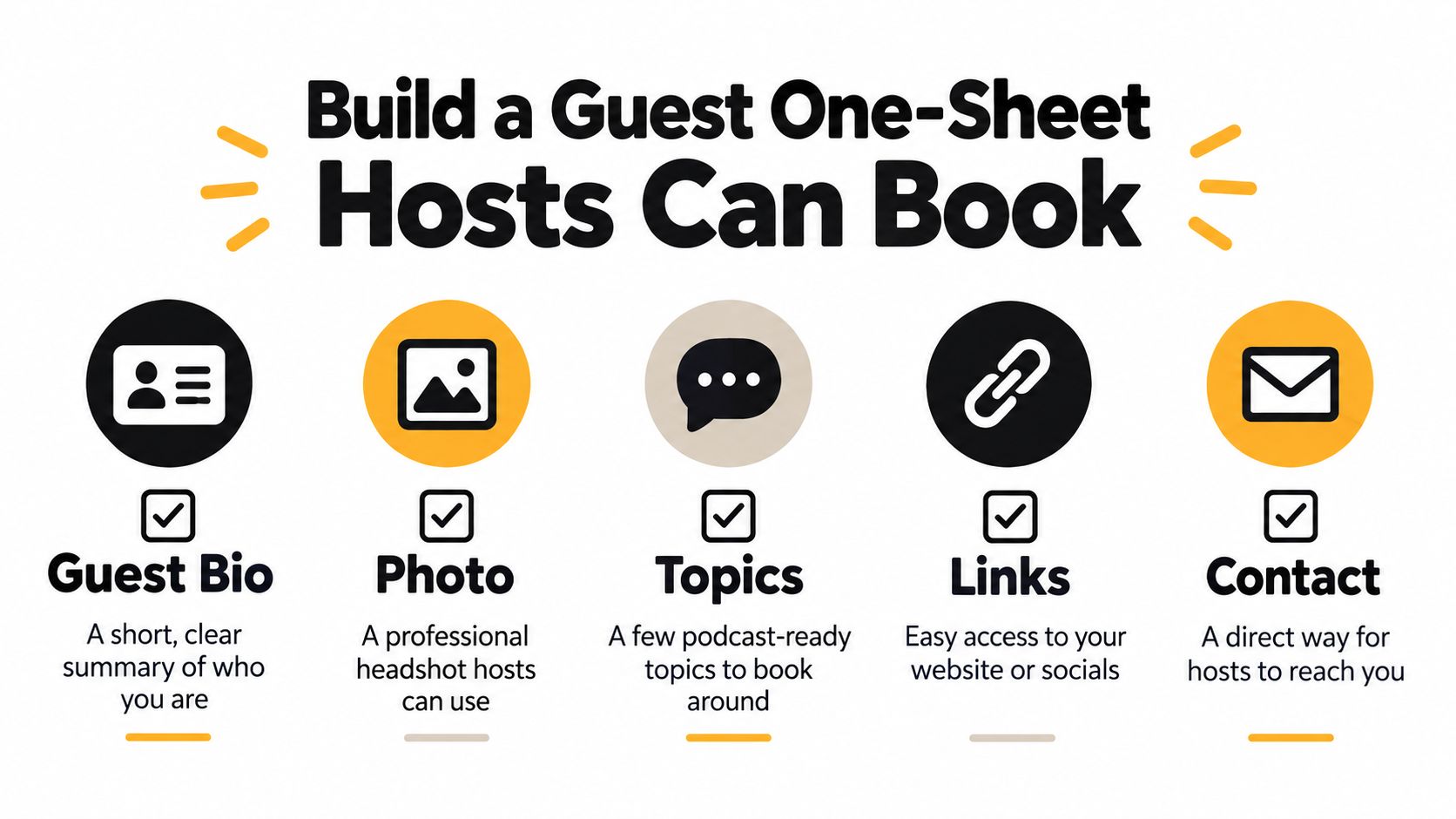
- Identity basics: Concise third person bio, high resolution headshot, name pronunciation, location and time zone, and preferred contact details.
- Authority in one line: A single topic statement that names the audience and outcome, not your life story.
- Bookable angles: Three to five interview ready topics with the audience outcome for each.
- Proof: Relevant credentials, prior appearances, and links to supporting work a host can verify quickly.
Turn each topic into a question shaped premise. "Employee onboarding" is a category. "How can a small team reduce onboarding time without hiring an operations manager?" is an episode. Under it, attach the thing you'll bring, a framework, a dataset, an experiment you ran, or a case result you can walk through step by step.
Watch how that question framing works in practice before you finalize your angles.
Compare that with the usual failure modes. A generic biography tells the host what you've done, not what you'll teach. Overpromised expertise collapses the moment a good host asks a second question. Calling yourself a great guest is a claim with no evidence attached, and producers read it that way.
A shareable link plus an exportable PDF is enough for early outreach. Tools that don't save your data until you publish a one sheet let you draft privately, test the format, and share only when it's ready. Build one reusable sheet and point every pitch to it instead of writing a new biography for every inbox.
Pitch One Relevant Show at a Time
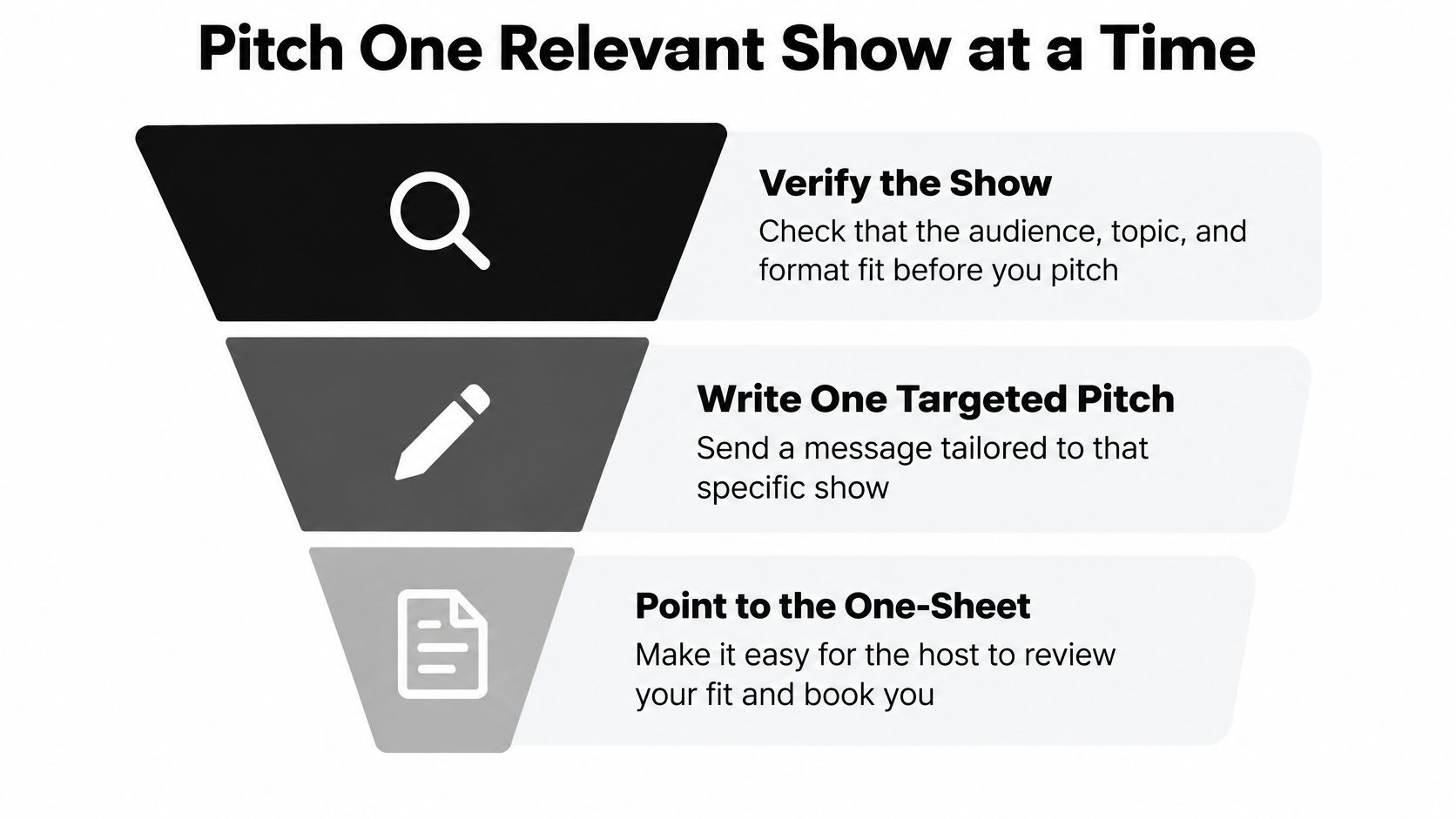
Treat pitching as a narrow funnel, not a blast. If you send the same email to forty shows, you haven't scaled outreach. You've scaled irrelevance, and hosts can smell it in the first two lines.
Set expectations before you start. In a large analysis, only 8.5% of 12 million outreach emails received a response, broader cold email benchmarks commonly place average reply rates near 3.4%, and reported results show advanced personalization near 17 to 18% versus roughly 7 to 9% for basic or generic messages, according to EmailChaser's cold email statistics roundup. Personalization isn't inserting a first name. It's proving you chose this show on purpose.
Verify, Then Write
Don't write a word until you've confirmed the show is active, accepts external guests, and has a stated booking route. Listen to at least one recent episode in full. You're looking for the host's level, the audience's assumed knowledge, and a gap your topic fills without repeating a recent guest. Studying strong podcast pitch examples helps, but copying their wording defeats the point.
Then keep the pitch short and in this order. Reference the specific episode you heard. Lead with the audience benefit, state your point of view or case in one sentence, offer two or three concrete discussion angles, link your one sheet, and end with a low friction ask the host can answer with a yes, a no, or a redirect.
One Follow Up That Adds Something
Send one thoughtful pitch, then one brief follow-up that earns its place. Add a sharper angle, a clearer listener takeaway, or a relevant resource. Don't resend the original copy with "just checking in" on top and call it persistence.
Producer rule: If your follow up contains no new information, you're not following up. You're reminding the host that you were ignorable the first time.
Track sends, replies, qualified conversations, bookings, and appearances as separate stages. That split tells you whether your problem is targeting, pitch quality, or topic fit. Opens tell you almost nothing on their own, so don't report them as progress.
Ban these outright. No identical pitches to multiple shows, no long autobiographical openers, no attachments that risk filtering, and no pitching inactive feeds because the show once looked prestigious. Each one tells a producer you didn't do the basic work.
Prepare for the Recording Itself
A yes isn't the finish line. It's the start of logistics, and guests who improvise logistics usually improvise answers too.
Ask the host, in one message, for the recording format and platform, duration, audience profile, publication date, promotional expectations, and whether the conversation is structured or open. Good hosts share format, approximate length, planned topics, and questions in advance. If they don't volunteer it, ask. Checking a guide on how to prepare for a podcast interview the week before beats discovering the format live.
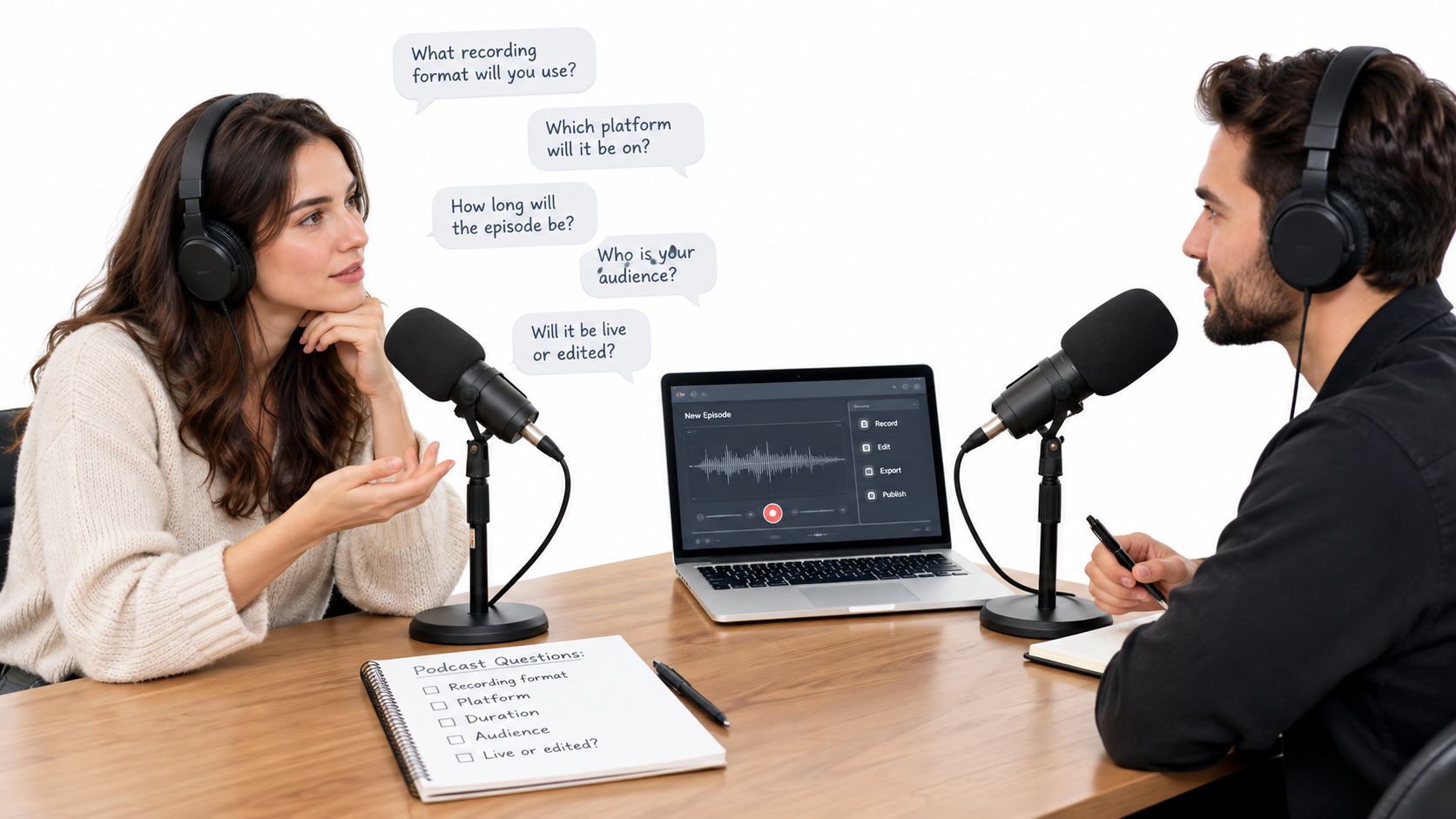
The Day Before Rehearsal
Run a technical rehearsal in the room you'll use. Use wired headphones and a dedicated microphone, close the door, and pick the quietest, softest room you have rather than a glass office that looks good on video.
- Power and connection: Stable power, stable internet, bandwidth heavy apps closed, notifications off.
- Backup: A local backup recording running when the platform allows it.
- Test take: Record thirty seconds and listen for clipping, echo, plosives, and latency before anyone else hears them.
- Notes: Three stories and key figures at eye level, not a script you'll read audibly.
Answer in a Structure Listeners Can Follow
Use one pattern until it becomes habit. State the claim, give the evidence, tell a short example, then land one actionable takeaway. It's how a strong answer sounds prepared without sounding rehearsed.
Say you're a founder tempted to turn a question about churn into a product tour. Don't. Answer the host's listener question with your claim about why customers leave, the evidence from your own work, one concrete customer situation, and the step a listener can try this week. Mention the product only if it's part of that step.
Three pitfalls end referrals. Ignoring the requested format, relying on untested wireless audio, and overpromising expertise live on a topic you only know at headline level. Say what you know, name the limits, and you'll sound more credible, not less.
How to Choose Tools for Guest Booking
You can run this entire workflow by hand. The question is how many shows you'll contact before manual research eats the time you should spend preparing better angles.
Three Ways to Run the Workflow
Manual research means searching feeds yourself, checking publish dates, hunting for a booking page, and writing every email from a blank page. It costs nothing and works for three or four dream shows. It breaks down when you pitch monthly and start losing track of who replied, which angle you sent, and which feeds went dormant.
Standalone free tools sit in the middle. No account utilities that generate a pitch draft, grade a pitch, write a follow up, draft a bio, or build a one sheet will speed up single tasks. They won't tell you whether the show is still publishing or how that host wants to be contacted, so you still own verification and tracking.
A directory workflow combines discovery, pitch routes, messaging, and scheduling. Let's Make A Podcast, at letsmakeapodcast.com, is one example of this model as a marketplace and toolkit. It lists real podcasts with publishing status signals taken from public feeds, host pages that state the topics sought and the pitch route, and search by niche and topic with member shows surfaced first for in app pitching.
Its guest tools include a one sheet builder with topics, bio, photo, and past episodes as a shareable link or PDF, draft emails that can reference a recent episode when the feed lists one, in app messaging and calendar invites in a single thread, and pitch tracking for up to 25 shows on the free plan. Planned paid options, Guest Pro and an AI Booking Concierge, are described as planned, so don't budget around them as if they exist today.
Differences That Actually Matter
Judge any tool on four things. Does it remove dead and closed shows from your list, does it weight declared topics heavily enough to surface exact matches, does it connect you directly without a booking fee intermediary, and does it avoid saving your data until you choose to publish a one sheet?
If you'll pitch a handful of shows a year, manual work plus one free tool is fine. If guesting is a monthly channel for your book, practice, or company, a directory that pairs fit signals with drafting and scheduling will save the hours you'd otherwise spend confirming that a show still exists.
Turn the Interview Into a Next Opportunity
You weren't given an ad slot. You were introduced by someone listeners trust, and that introduction is the asset. Spend it carelessly and you won't get a second one.
That trust is measurable in audience research. 84% of listeners said a podcaster had changed their mind about something they previously believed, and in a nine market study hosts ranked alongside journalists in purchase credibility at 33%, ahead of YouTubers, influencers, and celebrities, according to Command Your Brand's comparison of podcast trust with other media. Hosts anchor the parasocial trust and intimacy listeners build with a show, which is why your behavior reflects on them after the episode ends.
Protect the Trust You Borrowed
Heavy self promotion is the fastest way to waste that credibility. Lead with a clear, useful thesis, support every claim you make, and disclose relationships or interests that a listener would want to know about. If a result came from one client in one context, say so. Precision is what makes a host comfortable recommending you to the next host.
Repurpose clips the same way. Share the moment where you taught something, with the host credited and the context intact. Don't cut your best thirty seconds into a standalone commercial that pretends the conversation never happened. Hosts notice, and so do their listeners.
Measure Action, Not Applause
Downloads won't tell you whether the episode worked, especially when listeners act weeks later. Set up the measurement before publication so you're counting outcomes instead of collecting impressions.
- One useful resource: A checklist, template, or short guide that extends your best answer, offered once and helpful without a purchase.
- A dedicated route: A landing page or UTM link for that episode, with simple email capture so interested listeners can identify themselves.
- Qualified conversations: Calls, replies, referrals, and invitations that mention the episode, tracked for weeks rather than launch day only.
Start today with the smallest complete version. Publish one focused one sheet, pick three active high fit shows, and send a single episode specific pitch through each host's stated route. That's how to be a podcast guest who gets booked again, because the next invitation usually comes from how you handled the last one.
Build your one sheet, find active shows by niche and topic, and pitch through each host's stated route without juggling spreadsheets and inboxes. Visit Let's Make A Podcast to set up your guest profile and send your first targeted pitch today.