7 Best Non Fiction Podcast Picks for 2026
You're staring at a queue full of famous titles, you've got a commute, a walk, or an hour of chores ahead, and you don't want another generic ranking. You want the best non fiction podcast for the job in front of you. Sometimes that's a tight question, answered well. Sometimes it's a story that needs a whole season to unfold.
That's the lens for this list. These seven shows earn their place for different reasons, including journalism, history, science, design, true crime, and human-centered storytelling. Pick by format and listening context first, then by subject. If you're also a prospective guest, that same fit tells you which producers value a reported anecdote, which value specialist expertise, and which rarely book outside guests at all.
The audience for this kind of listening is large and habitual, with Edison Research reporting that 55% of Americans aged 12+ consumed a podcast in the previous month and total listening reached 773 million hours per week among people aged 13+ in Edison Research's Podcast Consumer 2025 report. Start with one episode that matches your time and mood. Don't start with the most famous name.
Table of Contents
- 1. This American Life
- 2. Radiolab
- 3. 99% Invisible
- 4. Serial
- 5. Search Engine
- 6. Throughline
- 7. Criminal
- Best Nonfiction Podcasts: 7-Show Comparison
- Turn Your Best-Fit Show Into a Strong Pitch
1. This American Life
Start here if you want variety without committing to a season. This American Life builds each weekly episode around a theme, then tells several reported stories inside it. One act might be funny, the next might be a piece of serious journalism, and the next might follow an ordinary person through a strange decision.
That structure makes sampling easy. Episodes generally stand alone, so you can search the archive by theme rather than starting at episode one. It's also a useful reference point if you're learning how narrative nonfiction works, because the show moves between culture, politics, economics, and everyday life without turning into a panel discussion.
Who It Fits Best
Choose this show for commutes, walks, and any listening window where you want a complete experience in one sitting. You'll like it if you enjoy character-driven stories and you don't need every episode to stay on one subject. Skip it when you want a sustained investigation that builds week after week.
- Standalone episodes: You can drop in anywhere and still follow the story.
- Mixed tone: Serious reporting sits alongside lighter, personal material.
- Large archive: A long track record gives you plenty of themes to browse.
- Free access: Listening, streaming, and downloads are available through its website and major apps.
The tradeoff is predictability. Because the format is varied, not every act will land for every listener. That's acceptable if you treat the show as an anthology. For prospective guests, the lesson is clear. A pitch needs a specific, well told story that fits a theme, not a general expert biography.
2. Radiolab
Radiolab is the pick when a question sounds too abstract for a plain interview. Published by WNYC Studios, it uses reporting, interviews, narration, music, and layered sound to pull you inside subjects across science, society, philosophy, and human experience. You'll hear ideas tested through people and scenes, not just explained from a studio chair.
The production does real work. Sound cues mark shifts in scale, time, and perspective, and that helps complex material stay approachable. If you often listen while speaking, presenting, or preparing to explain hard ideas yourself, compare its approach with lessons from a public speaking podcast guide for clearer delivery. Radiolab rewards attention, so save it for focused listening rather than noisy multitasking.
Practical rule: If a topic needs you to picture a process, a place, or a moment of discovery, Radiolab's sound rich style will usually beat a transcript style interview.
The same style is the main drawback. Some listeners will find the editing busy, especially if they prefer two voices and no scoring. The subject range is also broad, so you can't predict every episode from the show title alone.
Browse by episode description, not by date. Pick a question you're already curious about, listen with headphones, and decide whether the production helps or distracts. For guests, researchers and storytellers with a concrete scene, a surprising finding, or a human dilemma fit better than general commentators.
3. 99% Invisible
You walk past designed decisions all day. 99% Invisible makes you notice them. The show reports on architecture, infrastructure, objects, cities, and visual culture, then shows how those choices shape how people move, gather, wait, and live.
It's narrative rather than panel based, and that gives each episode a clear subject and a satisfying arc. Companion material on the website adds images and context that audio alone can't carry well. That's a practical advantage for design topics, where seeing the object often explains the story faster.
How to Listen Well
Use the large back catalogue as a topic library. Search for a building type, a city system, or an everyday object you already encounter, then branch outward. Episodes work well on walks because you'll start inspecting signs, benches, borders, and buildings as you go.
- Focused identity: You know the territory before you press play.
- Companion material: Website extras support visual subjects.
- Browsable archive: Older episodes stay relevant because the topics aren't tied to the news cycle.
Don't choose it for breaking news or broad daily coverage. It also won't satisfy listeners who have no interest in design or cities, although many episodes win over generalists through the human story. Guests with expertise in planning, product design, history of technology, or urban systems should pitch one overlooked decision and explain who it affects.
4. Serial
Serial is the clear choice when you want reporting to develop across a season. Each season follows one nonfiction story through interviews, documents, and unanswered questions. Subjects have included the case of Adnan Syed, the military, and the criminal justice system, so pick the season by topic, not by habit.
Its historical importance is real, not hype. Serial premiered in October 2014 as a 12-part investigation into a 1999 murder, became the fastest podcast in Apple's iTunes history to reach 5 million downloads or streams within six weeks, and reached an estimated 40 million downloads by December 2014, according to Pew Research Center's 2015 podcasting fact sheet. It also reached number one on iTunes in the U.S., United Kingdom, Canada, Germany, and Australia.
That success matters because the show turned careful reporting into a weekly habit. You don't get closure in one episode. You get a claim, a complication, and a reason to return.
Set Your Expectations
Treat a season like a reported book in audio chapters. Start at episode one and listen in order, with enough attention to track names and timelines. Episode pages provide context and supporting material when details pile up.
The downside follows from the format. These aren't quick standalone listens, and some seasons cover sensitive or complicated material. If you want a complete story on a short drive, choose Criminal instead. For guests, Serial is a reporting project, not a standard interview booking. Only approach it if you have direct knowledge, documents, or access that materially advances an investigation.
5. Search Engine
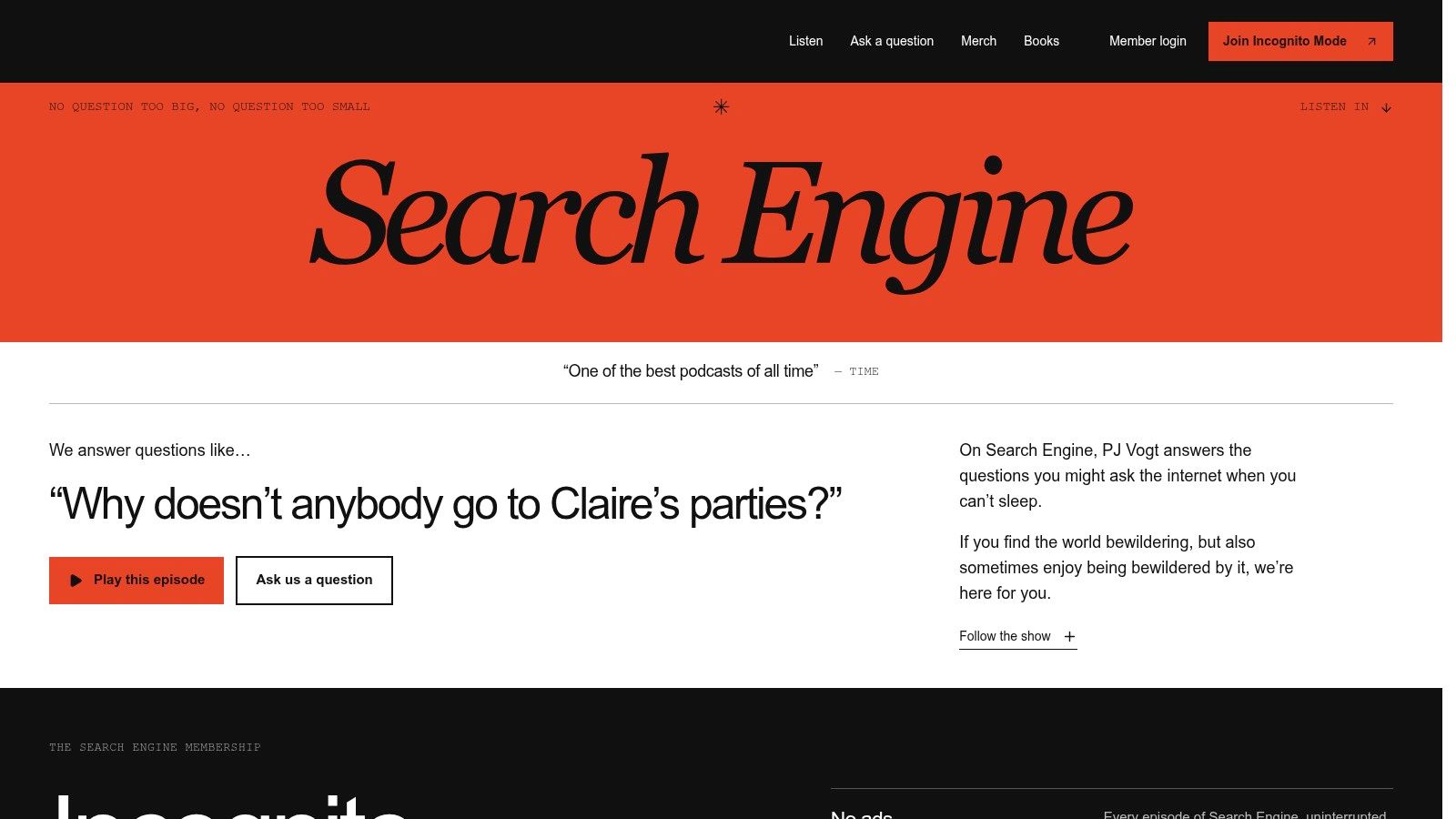
Hosted by PJ Vogt, Search Engine starts where a web search usually stops. Each episode takes a specific question people might type online, then turns it into reporting, interviews, and explanatory storytelling. Topics range across technology, internet culture, and social questions, and listeners can submit questions of their own.
That question first structure is why it works. You know the promise before you press play, and the episode earns its length by going deeper than a quick answer page. Discovery now often works the same way. Edison Research identifies YouTube at 32% as the most used platform among U.S. weekly podcast consumers, ahead of Spotify and Apple Podcasts, in Edison Research's Evolving Ear report. Precise titles and searchable questions therefore aren't cosmetic. They help the right listener find the right episode.
A clear question is a stronger entry point than a clever episode title that hides the subject.
The regular show is free through podcast apps, with ads included. An optional membership adds ad free listening and occasional bonus audio. If you're studying how question led formats attract buyers and audiences, it's worth comparing this model with shows covered in a roundup of the best podcasts on sales.
Subjects vary widely, so browse by question rather than subscribing blindly. Pitch with a question, too. Bring evidence, a person who lived the answer, or a twist that a search result can't explain on its own.
6. Throughline
When a headline feels familiar but unexplained, choose Throughline. This NPR history podcast traces how past events, decisions, and movements created the issues people argue about today. It uses documentary style reporting and interviews to supply context that a news recap usually skips.
Episodes center on one subject, which makes the feed easy to browse by curiosity. Start with a current debate you don't fully understand, then follow the episode backward. You'll get more background than a headline can offer, without needing to commit to a multi season arc.
Best Listening Context
Throughline works best when you can follow a timeline. Put it on during a commute or a focused walk, not while you're skimming other news. The historical framing takes time to develop, and that's the point.
- Historical context: Current events become easier to judge with their background attached.
- Subject led browsing: You can choose episodes by issue or era.
- Free through NPR: Episodes are available on NPR and podcast apps, with NPR+ as an optional paid support option for sponsor free listening.
It won't replace a daily news brief, and listeners who only want what happened today will find the pace indirect. Historians, policy specialists, and other expert voices, including those featured among women leaders podcasts worth studying for expert positioning, should note the fit. Pitch a specific origin story and show the line from that past decision to a present consequence.
7. Criminal
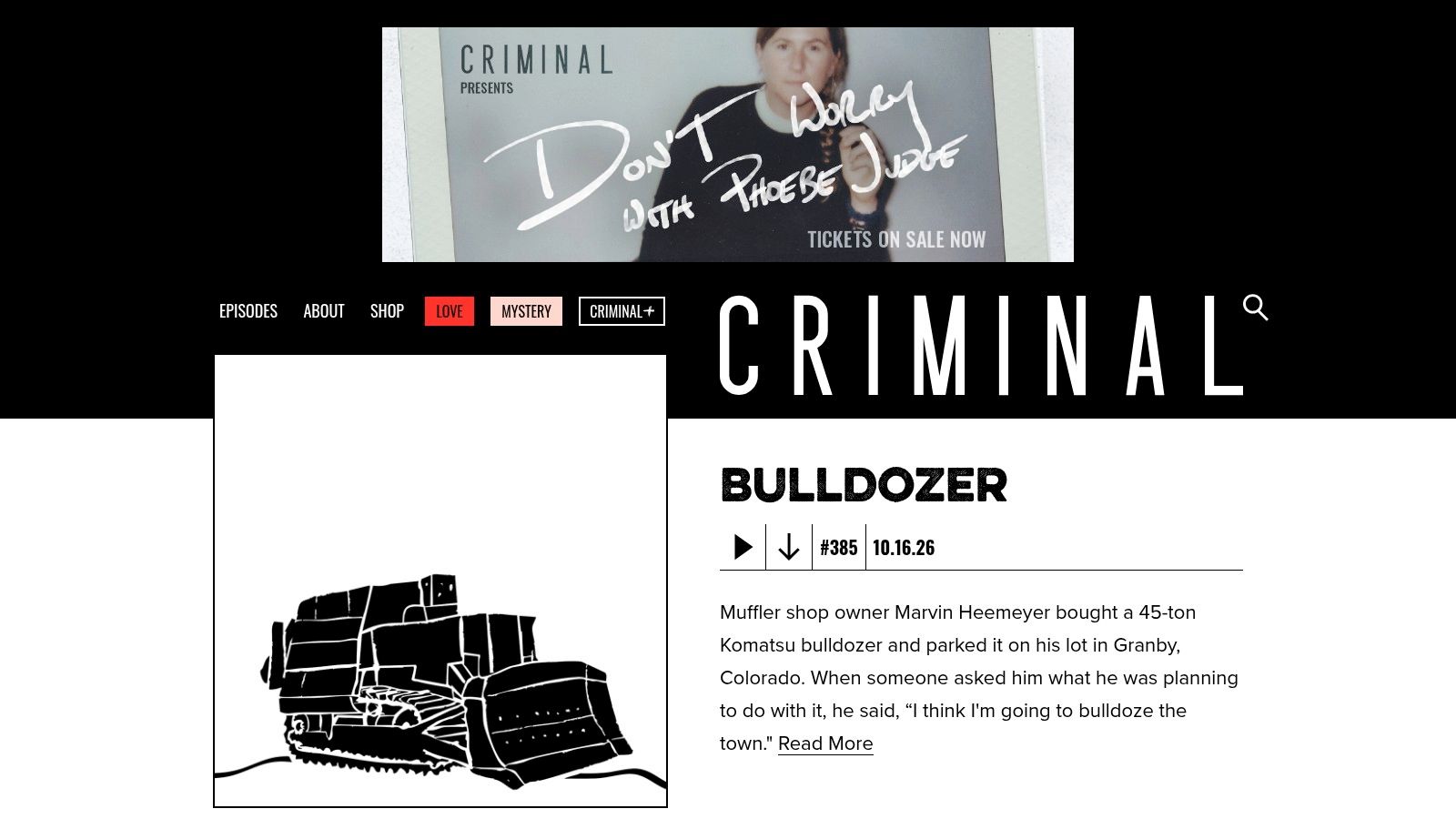
If you're tired of true crime that only means murder cases, pick Criminal. Hosted by Phoebe Judge, it tells a different crime related story in each episode and pays attention to the people and circumstances around the offense. That wider definition gives the archive range that many case of the week shows don't have.
Standalone episodes are easy to sample. You can browse the website archive, choose a premise that suits your mood, and finish the story without tracking a season long timeline. Episodes are free on the website and podcast platforms, and Criminal Plus is available as an optional membership.
That said, lighter doesn't mean light. The show still focuses on crime, so some episodes will be difficult listening. Read the description first if you need to avoid particular subjects, and don't assume every story has the same emotional intensity.
Serial or Criminal
Choose Criminal for a contained story and Serial for an investigation that unfolds over time. Criminal gives you variety and closure. Serial gives you accumulation and uncertainty. Many listeners keep both for exactly that reason.
Recommendation threads often ask for nonfiction beyond the same familiar true crime titles, a pattern visible in a Reddit discussion asking for varied nonfiction podcast recommendations. Criminal answers that request without leaving the genre. For a pitch, bring a contained, human story with a clear crime connection. Don't bring a general take on the justice system and hope producers will find the story for you.
Best Nonfiction Podcasts: 7-Show Comparison
| Podcast | Format & Complexity 🔄 | Resources ⚡ | Expected Outcome 📊 | Ideal Use Case 💡 | Key Advantage ⭐ |
|---|---|---|---|---|---|
| This American Life | Multiple reported stories per themed episode; easy to sample | Free; episodes and archive online | Varied narrative nonfiction across serious and lighter topics | Listeners seeking diverse, standalone stories | Long-running archive and balance of topics |
| Radiolab | Reported storytelling with interviews and sound-rich production | Free; website and podcast apps | Makes scientific and social ideas approachable | Listeners who enjoy immersive audio and broad topics | Strong production paired with clear narratives |
| 99% Invisible | Focused narrative reporting on design and the built world | Free; large archive and companion materials | Reveals how design shapes everyday life | Listeners interested in architecture, objects, and cities | Distinctive focus makes episodes easy to browse |
| Serial | Investigative story unfolds across a season; requires ongoing listening | Free; supporting material on episode pages | Develops questions and reporting over multiple episodes | Listeners seeking long-form investigations | Sustained narrative allows depth over time |
| Search Engine | Question-led reporting and explanatory storytelling; standalone episodes | Free with ads; optional paid membership | Explores everyday questions in greater depth | Listeners curious about technology, internet culture, and social issues | Clear questions provide an accessible starting point |
| Throughline | Documentary-style history reporting; topics take time to develop | Free; optional NPR+ membership | Connects past events and ideas to current issues | Listeners seeking historical context for contemporary topics | Adds background beyond a news recap |
| Criminal | Usually a contained crime-related story per episode | Free; optional Criminal Plus membership | Explores crimes through people and circumstances | Listeners interested in varied crime stories without a season-long commitment | Broadens crime coverage beyond murder cases |
Turn Your Best-Fit Show Into a Strong Pitch
Don't pitch the biggest show on this list. Pitch the show where your story solves an editorial problem. Listen to a recent episode all the way through, write down the exact format it uses, and name the connection between that episode and your experience in your first two sentences.
Frame the proposal around one clear story. Explain why the subject matters now, what evidence or examples you can provide, and what the listener will understand afterward that they didn't understand before. If you're an expert, be specific. A producer can place behavioral economics, urban infrastructure, or criminal procedure. A producer can't do much with a generic claim that you're passionate about business, history, or justice.
Match the format before you send anything. This American Life needs a story with scenes and a turn. Search Engine needs a question worth reporting. Throughline needs a historical line into the present. 99% Invisible needs a designed thing that reveals something larger. If your idea doesn't fit the format, find another show instead of rewriting the same pitch with a new greeting.
For a broader search, Let's Make A Podcast helps prospective guests filter active shows by niche and topic, compare pitch requirements, create a one-sheet, and track outreach without paying intermediary booking fees. Use it to find overlooked active shows that match your subject, cadence, and audience, rather than sending cold emails to dormant feeds. Hosts can use the same specificity in reverse by stating the topics they want and the evidence a strong guest should bring.
Prepare the practical details before outreach. Include a short bio, your relevant credentials, two or three episode angles, past interview links if you have them, and your availability. Keep the pitch concise enough that a producer can forward it internally without editing.
After you send a custom pitch, follow up once with a concise reminder. Add one useful detail if you have it, such as a new publication date or a timely development. Then leave room for the host to respond and move on to the next well matched show. Fit, timing, and a usable story will do more for you than volume.
Find your next best fit show, check that it's actively publishing, and build a pitch around one story its listeners will value. Visit Let's Make A Podcast to search active podcasts by niche and topic, create a shareable one-sheet, and track your outreach in one place without booking fees.
Pitch this show as a guest
One show from this article is in our directory, each with a page on how it books guests and what to send.
More shows that book guests: Science podcasts